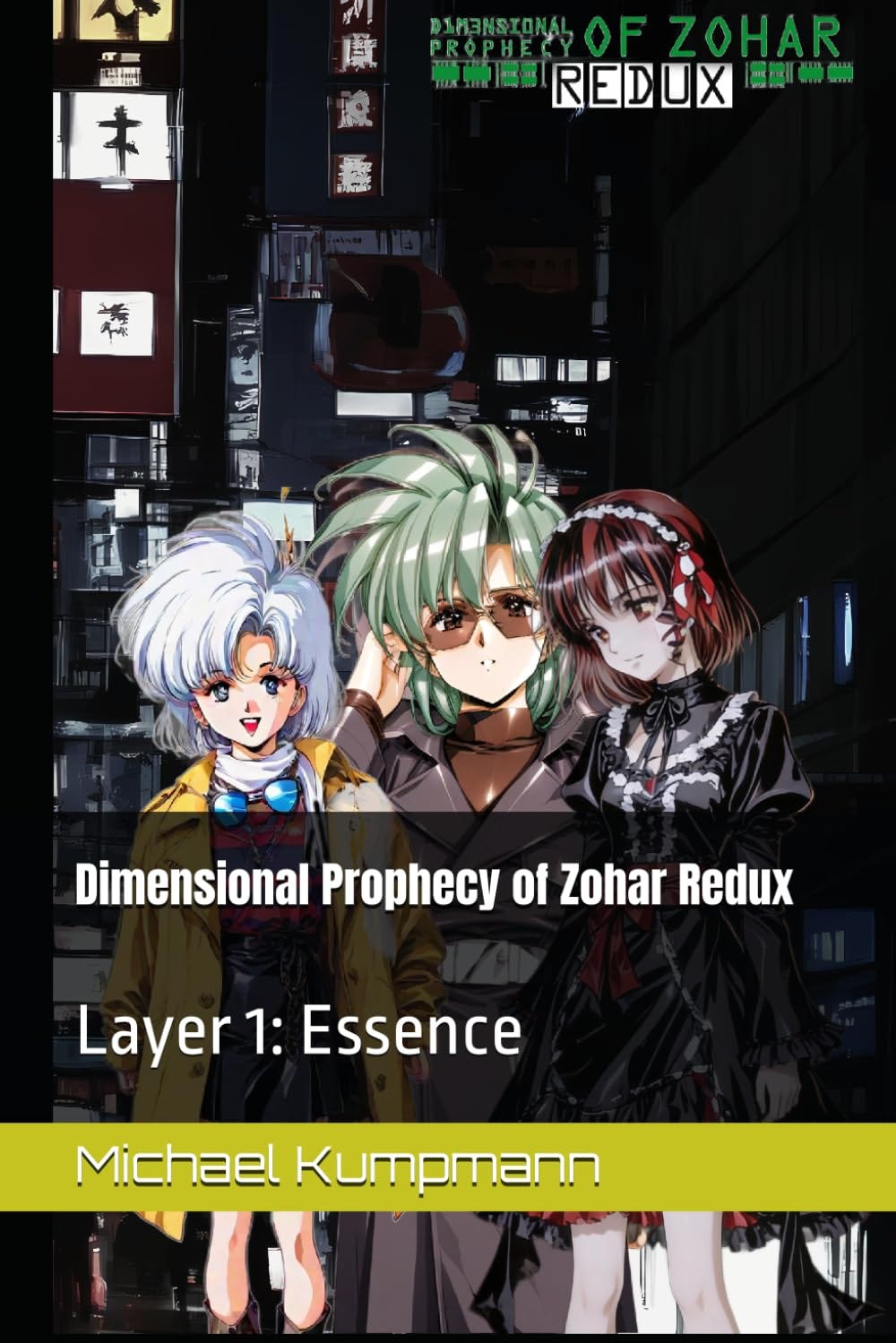
Michael Kumpmann on the 20-year journey that forged one of the most ambitious philosophical sci-fi epics ever created: Dimensional Prophecy of Zohar.
The following is an excerpt from my book Dimensional Prophecy of Zohar, now available on Amazon. This has been my longest creative project, a journey that began around 2004.
The project was inspired by works such as Xenogears, Xenosaga, Neon Genesis Evangelion, Megazone 23, Serial Experiments Lain, the original Ghost in the Shell film, and many others. These works also served as my introduction to philosophy. Neon Genesis Evangelion introduced me to thinkers such as Søren Kierkegaard and Jean-Paul Sartre while exploring psychoanalysis and occultism. Serial Experiments Lain casually poses difficult questions about reality, identity, and causality. The Xenosaga games are named after Nietzsche’s books, while Xenogears draws on Nietzsche, Freud, the Kabbalah, Lacan, geopolitics, Oswald Spengler, the Orthodox Church, and many other philosophical and religious traditions. I was deeply impressed by these works and wanted to create a story with a similar level of philosophical depth. As preparation, I immersed myself in science fiction by authors such as Isaac Asimov, Philip K. Dick, Stanisław Lem, Robert A. Heinlein, and H. P. Lovecraft, while also reading philosophy extensively.
I conceived the basic idea for Dimensional Prophecy of Zohar around 2004. Preparing for the project led me to read countless philosophers, psychologists, and especially existentialists. Ironically, this project is the reason I first picked up Heidegger. That eventually led to a funny moment when I replayed Final Fantasy VII and encountered the line, “Terrorists plan to attack the reactor in Midgar. Please urgently report this to Heidegger.” Before studying philosophy, I had never thought the character’s name meant anything. Suddenly, I realized it was almost certainly a reference to Martin Heidegger, and the scene became unintentionally amusing.
In many ways, this became my first major philosophical project. Tonally, I was also heavily influenced by the Japanese science-fiction series Gasaraki. Rather than presenting spectacular battles, Gasaraki portrayed a fictional Middle Eastern conflict with an almost documentary-like realism, complete with news reports and grounded political storytelling. The remarkable part is that the series aired roughly a year before the 2003 invasion of Iraq. The dictator whom the United States seeks to overthrow even resembles Saddam Hussein and is accused of developing weapons of mass destruction, making the series feel strangely prophetic in retrospect.
Over the past two decades, I have revised the story countless times and experimented with many different forms of media. I attempted a hand-drawn manga, although all of those pages have since been lost. I taught myself Autodesk Maya—the software used in productions such as Jurassic Park, Terminator, Star Wars, and the Final Fantasy films—and created several 3D CGI comics. I experimented with an animated YouTube series, developed a video game adaptation covering roughly the first third of the story that is still available on Xbox Live, and wrote numerous drafts of the novel itself. At one point, Microsoft operated a program that allowed independent developers to publish games more easily, and my project became part of that initiative before it was discontinued. The earliest draft of the novel was only eight pages long. Over the years, the project has existed as a manga, prose, 3D animation, a video game, and, more recently, AI-assisted visualizations.
When I began studying computer science, the story evolved again. It gradually incorporated ideas from computability theory, computational complexity, Turing machines, and other areas of theoretical computer science, making technology an even more central philosophical theme.
This is the project I have worked on longer than anything else in my life.
Looking back, I realize that my philosophical worldview was shaped through the process of creating this story. It remains my most Heideggerian work of fiction. Existential anxiety and the question of technology—particularly Heidegger’s concept of Gestell (enframing)—form two of its central themes. There are also two scenes that consciously draw on Heidegger’s philosophy.
In one scene, the protagonist Karala is attacked by a monster and briefly considers fleeing. This becomes a reflection on anxiety and personal responsibility. Her fear isolates her from everyone else and confronts her with the fact that she alone is responsible for her own life and death. In later revisions, I even incorporated Heidegger’s concept of Geworfenheit (”thrownness”) to strengthen this connection.
Another scene centers on Madoka’s relationship to crowds and mass society. It explores Heidegger’s concept of das Man (”the They”), examining how individuals lose themselves in collective expectations and anonymous social conformity.
With that background in mind, here is the train station scene from the book:
A monorail train glided silently through the Shin-Tama industrial zone on its elevated track, heading toward Kyoto Central Station. The train was painted white with broad blue stripes along its sides that glowed like artificial veins under the pale night lighting.
It reached the main station quickly. From a distance, the building looked futuristic and audacious—a massive, almost floating platform held on one side by a sheer wall and otherwise supported only by a few slender metal pillars.
Behind the station rose three colossal skyscrapers into the black sky. In front stood smaller structures, while even beneath the monorail tracks, warehouses and shacks had taken root.
Outwardly, the station radiated bold modernity. Inside, however, it was quietly decaying, like so many hubs in this world. In its corners and shadowed passages loitered society’s outcasts: hollow-eyed junkies, prostitutes bathed in cheap neon, creatures of the night that had never truly disappeared. Even the founding of the World Government and its grand social reforms had changed nothing here. Crime had not been eradicated—it had simply retreated into the cracks and forgotten corners, where the police preferred to leave it undisturbed.
It was a filthy, wretched district. Not even the glaring neon signs could fully conceal the rot. Most objects cast long, sharp shadows in the darkness.
Beneath the station, a small but thriving black market had existed for years. Everything was available: illegal software, second-hand cyberware, questionable implants, and even simple household goods. Increasingly, ordinary citizens preferred coming here rather than dealing with official vendors. No one asked awkward questions about radiation levels, demanded masks, or required biometric registration.
At the roadside in front of the station, a strange girl with snow-white hair and a bright yellow jacket was picking wildflowers growing from the cracks in the concrete. She paused and looked up as several monorail trains arrived almost simultaneously. The sight intrigued her. For a brief moment, her thoughts drifted toward machines, automata, and the cold beauty of technology.
But she had to hurry. An unwanted doctor’s appointment awaited. She needed her medication. With a quiet sigh, she glanced at her phone. The screen displayed her name:
Madoka Michael.
Shortly afterward, the train came to a gentle stop. Masses of anonymous commuters and tourists poured out hastily, gray silhouettes in the night. Among them was another young girl. She wore a simple black dress and heavy black boots. Her hair was as dark as her mood.
Her name was Karala Yagiyu.
Karala paused for a moment and let her gaze drift through the dark, neon-lit area. Quiet, weary thoughts took shape in her mind:
I came to Kyoto today. To the place that is supposedly my destiny.
The orderly streams of workers that dominate the streets during the day have vanished. The city has once again sunk back into that chaos which is as fundamental to human nature as hunger or the pursuit of happiness. In these hours, absolute freedom reveals itself—and with it, absolute abandonment. This chaos is terrifying. And yet… in a twisted way, alluring. All this disorder is watched over by our scientifically controlled technology—the proud symbol of humanity’s collective reason. And still, every order crumbles. Anicca, as the ancients said. Nothing lasts.
I am supposed to help this institute. But why? To save humanity? Humanity is indifferent to me. No matter what one does, suffering and pain will always remain—even in a perfect utopia. People don’t matter to me. So why should I care about saving them? If what I do ends up saving them… fine. It doesn’t touch me. I just want my own fun.
At least I think that’s what I want.
In truth, I don’t even know what I really want…
Order Dimensional Prophecy of Zohar here.