
Bruce Lee and the Philosophy of Water
by Michael Kumpmann and Mandy Jansen

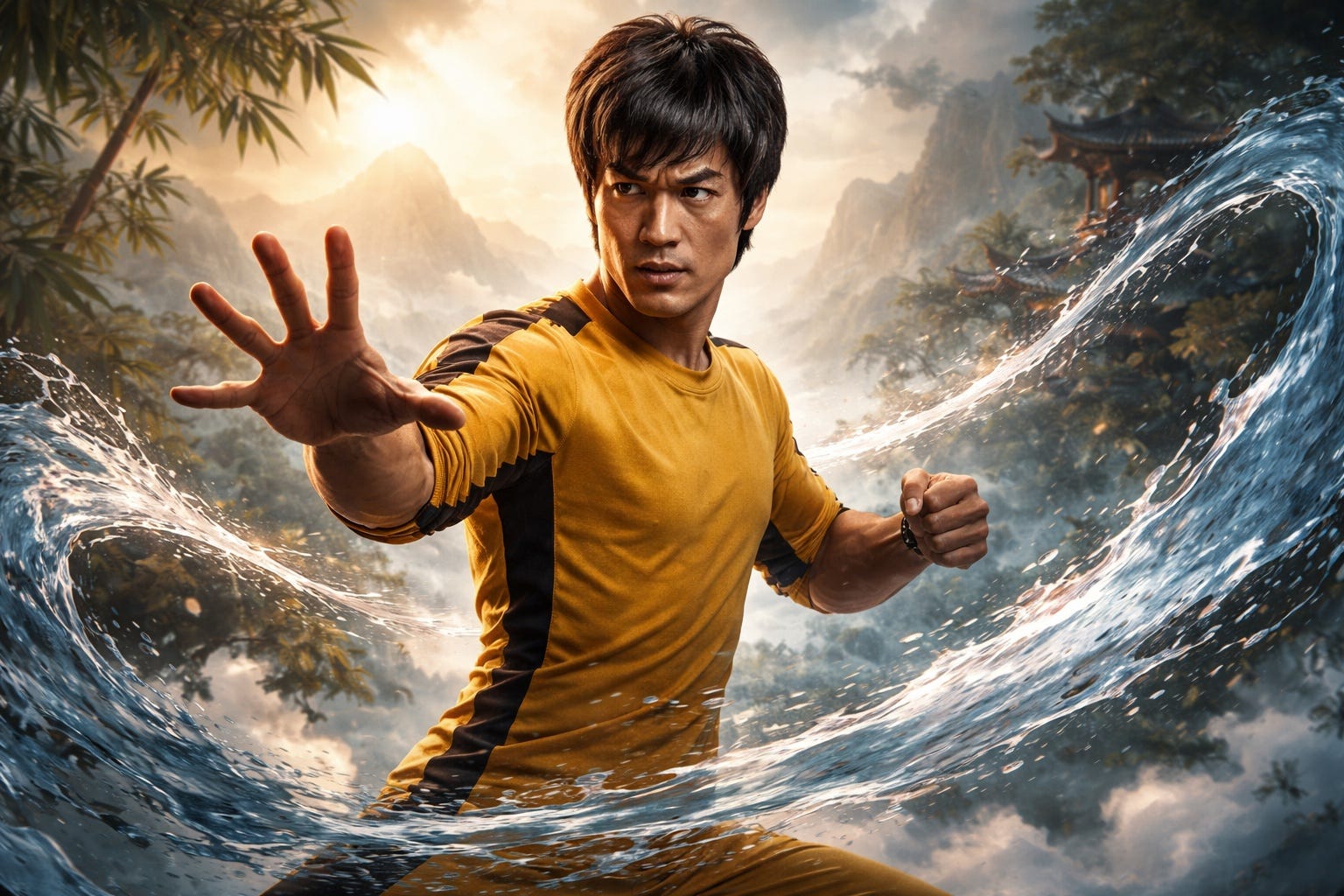
Michael Kumpmann and Mandy Jansen on composure and the fusion of Taoism, Buddhism, and cinema.
Bruce Lee was one of the most legendary martial artists and the defining icon of the kung fu film. He also developed his own philosophy, which drew on Asian traditions such as Taoism and Zen and shaped them into a distinct form centered on thinking and acting with composure, and on following the flow of fate like water rather than making everything worse through rash action.
Bruce Lee did not suddenly become an actor in adulthood. In fact, he had already been acting as a child, long before he became world-famous as a martial artist. His family formed the background for this. He was, in a sense, born into it. His father, Lee Hoi-chuen, was a very well-known Cantonese opera performer and film actor in Hong Kong. Through these connections, the young Bruce appeared in his first film role as a baby (at just two months old!) in Golden Gate Girl (1941). From around the age of six or seven, he acted in approximately 20 Hong Kong films, mostly as a child or teenager in leading or significant supporting roles. Even then, he was regarded as a prodigy. Acting throughout childhood and adolescence was as natural to him as meeting friends every day is to others. He essentially grew up on film sets and behind the scenes of the opera. From an early age, acting was a familiar, almost familial profession for him, much like it is today for children from acting families.
After moving to the United States in 1959 at the age of 18, he studied drama—acting—at the University of Washington, not philosophy, as is often mistakenly claimed. Even then, he was determined to become an actor, ideally a major star. At the same time, he began teaching martial arts, as it provided him with a way to earn money. Acting, however, remained his great dream. His role as Kato in The Green Hornet (1966–67) became his first significant breakthrough on American television.
Yet his expectations of that dream did not align with the reality he encountered outside the Chinese sphere. Frustration began to grow within him. In the late 1960s, despite his talent and connections, he was unable to secure meaningful leading roles in Hollywood. Asian actors at the time were almost exclusively cast in stereotypical roles or used as sidekicks. Disappointed, he returned to Hong Kong in 1971. His dream had collapsed, yet he refused to give up.
After returning to China, he made full use of precisely those abilities that promised him international success and ultimately turned him into a legend who shaped entire generations: a combination of acting and his unique martial arts skills. With films such as The Big Boss (1971), Fist of Fury (1972), and Enter the Dragon (1973), he conquered the world.
This success bore fruit. Bruce Lee became a globally renowned icon, inspired the film industry, motivated more people to pursue self-defense, and became a worldwide symbol of courage, perseverance, wisdom, and strength. He was therefore not a martial artist who happened to become an actor, but rather the reverse: an actor from an early age who later ingeniously fused his martial arts with the medium of film and in doing so became a legend.
During his time at university in the United States, Bruce Lee began reading works of both Eastern and Western philosophy and developed his own philosophical outlook, which combined martial arts with both traditions. One of his most important statements in this regard is the well-known phrase, “Be like water, my friend.” This carries several meanings. The first is reflected in sayings such as “constant dripping wears away the stone,” and implies that one should not resist everything that feels unpleasant, but only when it is appropriate—otherwise, one should move with the “flow.”
This clearly refers to the idea of wu wei in Taoism, and Bruce Lee’s statement is essentially a reformulation of Lao Tzu’s insight: “The sage does nothing, yet everything that must be done is accomplished.” Although this may sound, at first glance, like an invitation to idleness, it does not mean “lie around lazily and find a fool to do the dirty work for you.” Rather, it concerns principles such as entropy, which I have discussed in my recent article. Through entropy, every attempt to combat “chaos”—especially when undertaken without reflection—ultimately produces even more chaos and increases the need for further action. Even when a person, out of uncertainty, feels the urge to act, it is often better to do nothing than to unintentionally make everything worse. In his famous speech about water, Bruce Lee also emphasized that one should only become “hard” when it is necessary. Interestingly, before him, the samurai Miyamoto Musashi used precisely the same water metaphor.
What Alexander Dugin describes in “The New Monarch of Thailand”—that the ideal king in the Asian tradition is one who does so little that his subjects no longer even notice his existence—also refers to wu wei. It is interesting, in this context, that in the Chinese game Genshin Impact, the character Zhongli—essentially a fictional Chinese emperor—feigns his own death while continuing to act behind the scenes, thereby achieving what is best for the realm.
Bruce Lee then described water as something that is inwardly empty and therefore flexible, and said that one’s own mind should be just as empty and flexible. This once again draws on Taoism. There is the famous saying by Lao Tzu that a bowl is most useful when it is empty—also intended as a metaphor for the mind.
Beyond this, however, it also refers to something else: in China, Buddhism and Taoism have long stood in close relation. Siddhartha was not initially regarded as the founder of a separate religion or philosophy, but rather as a Taoist. Taoists and Buddhists often even shared monasteries. This led to the emergence of what is known as Chan Buddhism, which fused Taoism and Buddhism, and which in turn became Zen in Japan.
As in all forms of Buddhism, the focus here is on overcoming the ego. Yet it goes even further than in Theravāda. While in Theravāda the overcoming of the ego primarily involves overcoming greed, hatred, and delusion, in Chan and Zen it also involves avoiding unnecessary thoughts and remaining anchored in the present moment. The unenlightened person moves through the day with thoughts such as “I have to pay the bill tomorrow,” “my mother-in-law is causing trouble,” or “politics is terrible.” The enlightened person, by contrast, thinks more along the lines of “Oh, today the weather is beautiful,” or “Oh, the flowers by the roadside are lovely.” At the same time, it is about avoiding unnecessary thoughts and being able to act without having to deliberate and plan at length beforehand—mu shin (“no-mind,” action without a calculating mind). This is important in martial arts, but also in calligraphy, where movements are practiced repeatedly until they can be performed spontaneously, without conscious thought. There is even a story of a Japanese master painter who was commissioned to paint a chicken. He withdrew into the mountains for twenty years, practicing tirelessly every day how to paint a chicken, then returned to the patron empty-handed—and produced the requested painting in two minutes.
Referring back to my article on accelerationism and Epstein: tantric practices, as well as the principle of expenditure and excess described by Georges Bataille, also in part serve this mu shin. Someone invited to a private island with hundreds of beautiful girls remains fully in the present moment, rather than drifting away. The mind is so flooded with stimuli that it can no longer wander.
In addition, Bruce Lee—very much in the spirit of Zen—maintained that direct experience is more important than categories and explanations. He expressed it this way: “Don’t think, feel....it is like a finger pointing a way to the moon. Don’t concentrate on the finger or you will miss all that heavenly glory!”
(Translated from the German)
 |
|
Martial Arts, Wu Wei, sacrifice oh so Eastern, practical yet illusive. We are experiencing Global Macho being rocklike, waterless, confrontational deminishing live-forces for humanity. The Tao, live with the flow; swimming upstream is fatal - we're all running out of breath and stamina.
Bruce Lee’s ability as a “philosopher” was non existent to the point of embarrassment.
On about the same level as his acting ability, which was laughable.
All his films are so naf, they are on the level of unintentional self parody.