

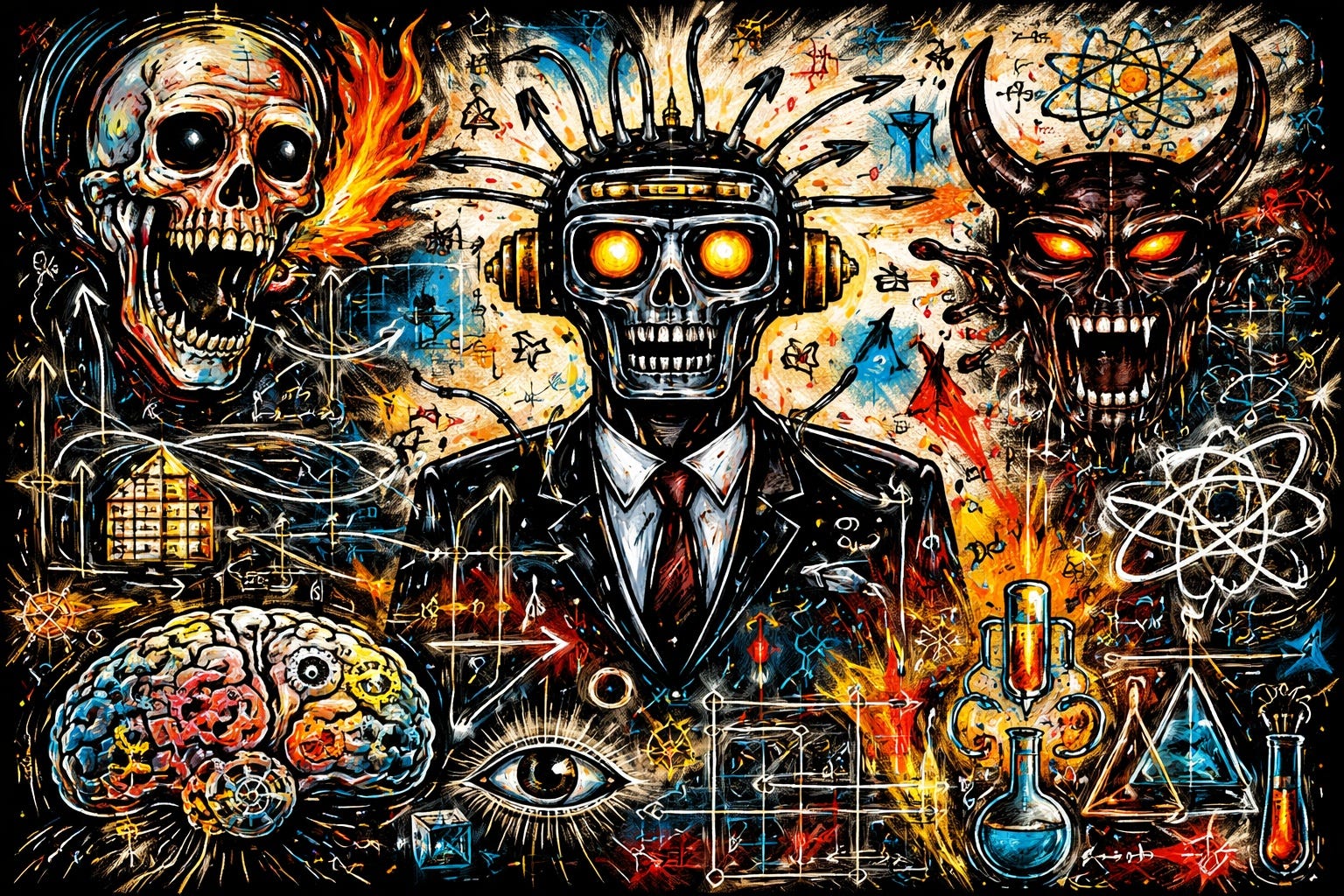
Michael Kumpmann explores entropy, computation, and the modern state as a Maxwellian demon.
Konrad Zuse was not merely an engineer who built one of the earliest computers capable of universal computation, thereby inventing a machine that can theoretically solve any solvable mathematical problem. In his 1969 book Der Rechnende Raum (The Calculating Space), Zuse also turned towards philosophical questions. His central thesis is that physics has reached a dead end and cannot resolve many of its questions because it operates under a fundamental misinterpretation of the world: it views reality materialistically. Yet many phenomena in physics indicate that materialism is probably a mistaken path and that all matter is merely an illusion. According to Zuse, the truly “real” reality is instead information.
Through computer science, Zuse thus arrived at the same conclusion as Plato, Hegel, and most religions. The science-fiction author Philip K. Dick developed a similar idea of an idealist connection between religion and mathematics in his philosophical work Tractates Cryptica Scriptura. His approach, however, did not arise from mathematics and physics but from the comparative analysis of religious texts. Later authors, such as Rizwan Virk, expanded these theses and argued that, with the help of neural network theory, the universe can be understood as the product of a vast Hegelian “World Spirit.”
Beyond abstract questions of cosmology, the question arises whether these ideas and modes of thought can also be applied to other areas of philosophy. They can, and doing so produces interesting results.
The first interesting point concerns the problem of computability. Computability describes, in broad terms, which questions a given system can solve. Usually this refers to concrete machines, though languages also fall into this category. The concept of Turing completeness is particularly relevant here. A Turing machine is a hypothetical device consisting of a program, a memory tape, and a movable read/write unit capable of computing all computable problems. In mathematics, a question is regarded as answerable when it can be formulated in such a way that this hypothetical device could process it. There is also the Church–Turing thesis, which states that from the perspective of computability two systems are equivalent if they can simulate one another’s functioning. To illustrate this very simply: anyone today can download the 1980s version of Donkey Kong and run it on a normal notebook computer because the arcade machine on which the game originally ran and a modern notebook are, at their core, both computers.
Now comes the interesting point. Simulation hypotheses claim that because computers can simulate our world with ever greater precision, it becomes increasingly likely that the real world itself is a calculated simulation. Yet an overlooked aspect exists in these considerations. We humans first conceived the idea of the Turing machine. Our own mind therefore also falls under these same principles. We are ourselves Turing-complete, or perhaps even more powerful. At the same time, our understanding of the universe constantly improves, and we can make increasingly accurate predictions and calculations. In this sense, there is a fundamental equivalence between the creative World Spirit and the human intellect. The World Spirit created humanity in its own image.
It is nevertheless obvious that a single human mind or a computer cannot solve every question in the world. Another element enters the discussion here. There are two types of Turing machines: universal Turing machines, which can compute everything because they possess an infinite memory tape, and restricted Turing machines with finite memory. This marks the central difference between humanity and the “Creator.” The human being is finite and cannot absorb all information.
This leads to another important question: what role does technology play for human beings? Technology frequently functions as a storage medium that externalizes information and separates it from the mind. What a person cannot remember indefinitely is written down so that it can later be consulted again. Technology therefore serves primarily to expand human storage capacity and to reduce the gap between a limited Turing machine and a universal one. One could invoke the metaphor of the “Faustian man” from Oswald Spengler and say that humanity attempts through technology to transform itself into a god by taking the fruit from the tree of knowledge.
A closely related concept is the idea of information entropy and the associated concept of Maxwell’s demon. Information entropy is, roughly speaking, the value that indicates how far missing information can be reconstructed from existing information and how much information may be missing while something still remains readable. For example, it is easy to recognize that the phrase “Da ein” is missing an “s.” In this case, the entropy is low. In the fragment “D n,” however, the entropy becomes so great that it becomes difficult to guess what was originally meant. Entropy therefore also measures the degree to which it becomes impossible to infer from existing knowledge what will come next. Thermodynamic entropy is considered a consequence of information entropy. In a hot gas, all particles move chaotically, which means that from an image showing where all particles were ten minutes ago it is nearly impossible to determine where they are now. In a crystal, this is far easier since everything there is rigid, immobile, and ordered. In simple terms, entropy can therefore be understood as a measure of chaos.
According to the principle of information entropy, entropy inevitably increases within every system, existing information gradually decreases, and every form of order is therefore compelled to collapse into itself. At the same time, the potential range of possible information increases. As explained in an information theory lecture from the University of Ulm, entropy measures the amount of missing information in a system and therefore the uncertainty involved in reconstructing its states. Another effect of entropy lies in the dissolution of sharply separated categories and their gradual blending towards a middle value, a dynamic clearly visible in postmodern culture. This point becomes particularly interesting because it leads directly to the argument made by Alexander Dugin in his essay “The Metaphysics of Chaos”: order is based upon the exclusion or extinction of chaos, while chaos itself makes it possible for multiple different orders to emerge within it.
Entropy is closely connected with the theory of Maxwell’s demon. Maxwell’s demon is a hypothetical machine placed over a chaotic system, such as a gas, which attempts to sort and organize its particles. It has been demonstrated that such a system cannot function indefinitely. One reason is that the problem of potential information would eventually cause the machine to reach the limits of its memory capacity. Chaos could only be permanently controlled if the machine possessed infinite storage, which echoes the earlier discussion of universal Turing machines. Because the machine lacks such capacity, chaos eventually grows to such a degree that a paradoxical situation emerges in which the machine itself must generate chaos and gradually destroy itself in order to maintain its own operation.
This idea of Maxwell’s demon can in turn be used in a striking way to analyze modernity and what Martin Heidegger called Gestell, or enframing.
Every modern state functions, in effect, as a Maxwellian demon attempting to eliminate entropy and impose perfect order. This tendency appears in communist planned economies that attempted to determine human needs from above. The culmination of this development emerged in the Cybersyn project of Salvador Allende, which sought to transfer control over large portions of the state and economy to a centralized computer system.
The behavior associated with the Third Political Theory, and especially the policies of Nazi Germany involving eugenics, ancestry passports, and extermination camps, can likewise be interpreted as a vast operation aimed at eliminating chaos, impurity, and entropy at the cost of freedom, humanity, and human life.
Followers of Karl Popper would argue that liberal societies provide protection against such developments. Yet this claim represents a profound illusion. One can point to the Patriot Act, the atrocities, repression, displacement, and reeducation of indigenous peoples carried out in the name of colonialism and the “White Man’s Burden,” the neoconservative wars fought in the name of democracy, the intrusive therapeutic state that attempts to regulate the health and behavior of citizens from childhood onward, and phenomena such as cancel culture, political correctness, ideological policing on the internet, and extensive regulatory regimes in the European Union. In a certain sense, liberal states also continue forms of eugenics in privatized form through organizations such as Planned Parenthood. During the COVID crisis, even the supposedly free West introduced mandatory certificates attesting to biological purity, while discussions about camps for the biologically impure periodically surfaced, with Australia providing one of the most striking examples. The main difference between the demon operating within liberalism and those found in other systems lies in the fact that liberalism constructs a system intended to encompass everyone, from which no one is meant to escape, whereas other systems were often oriented towards the expulsion or destruction of chaotic elements.
In whatever form it appears, every political theory of modernity and every modern state functions as a Maxwellian demon seeking ever greater control over chaos, often at the expense of its own citizens. In a certain sense, Maxwell’s demon forms the core of modernity, a reality perceived by many anti-modern thinkers. Whether one calls it Gestell, instrumental reason as described by Theodor W. Adorno, the one-dimensional society of Herbert Marcuse, the reign of quantity described by René Guénon, or the solid-state intelligence discussed by John C. Lilly, the basic insight remains the same. Thinkers ranging from Ted Kaczynski to Terence McKenna and Rudolf Steiner describe modernity as a process aimed at constructing a total machine intended to eliminate chaos, a process that simultaneously threatens to eliminate humanity itself. With developments such as artificial neural networks, genetic engineering, transhumanism, and projects like the Great Reset associated with the World Economic Forum, this tendency approaches an almost perfected form.
Yet, as already discussed, no Maxwellian demon can function indefinitely because infinite storage does not exist. All order remains, to use the Buddhist concept of anicca, impermanent and always threatened with collapse. Entropy and chaos are never eliminated; they are merely pushed aside temporarily. Behind the walls of the ordered world of modernity and within its subterranean structures, chaos accumulates until the dams eventually break. A striking example occurred in 2021 when the container ship Ever Given ran aground in the Suez Canal and nearly triggered a global economic crisis.
Every intervention by modern states intended to eliminate chaos ultimately generates additional chaos and therefore necessitates further intervention. In the terminology of Ludwig von Mises, this dynamic can be described as an intervention spiral.
How might humanity escape this demon? One possible answer lies in turning towards the East and towards teachings such as Buddhism, Taoism, and the philosophical tradition of the Kyoto School. These traditions emphasize that everything eventually disintegrates and that the ultimate destination of all being lies in chaos, decay, and the absolute void. They also suggest that human attempts to wage war against entropy often intensify the very process they seek to overcome. The alternative lies in distancing oneself from the material realm and turning instead towards eternal and unchanging divine principles. Because the eternal cannot change, entropy remains at zero and cannot multiply, since even twice zero remains zero.
To illustrate the philosophical understanding of chaos mentioned earlier, Alexander Dugin writes in “The Metaphysics of Chaos” that one must approach chaos from the standpoint of chaos itself rather than from that of the Logos. This perspective resembles what he calls a feminine vision of the Other, in which the Other is included rather than excluded. Logos understands itself as that which exists and as that which is identical with itself. It can accept internal differences because it excludes what lies outside it. The will to power thus operates as the law of sovereignty. Logos asserts that nothing lies behind it except nothingness itself. In excluding everything other than itself, Logos therefore also excludes chaos.
Chaos follows a different strategy. It includes within itself everything that it is and also everything that it is not. All-encompassing chaos therefore also contains what appears to be non-inclusive, including that which excludes chaos. Chaos therefore perceives Logos neither as an external Other nor as a true opposite but as something contained within itself, comparable to a mother carrying a child within her. In this metaphor, the man understands the woman as something external and attempts to penetrate her, whereas the woman experiences the man as something internal and attempts to give birth to him. Chaos thus becomes the eternal generation of the Other, which is the Logos itself.
From this perspective, a chaotic philosophy becomes possible because chaos itself contains Logos as an internal possibility. Chaos can therefore recognize Logos, value it, and acknowledge its exclusivity while still encompassing it within its own eternal life. This leads to the image of a special form of Logos, a chaotic Logos constantly renewed by the waters of chaos. Such a Logos is simultaneously exclusive, which is why it remains Logos, and inclusive, which is why it remains chaotic. It therefore approaches equality and difference in a completely different manner.
(Translated from the German)

One Small but interesting point regarding Rizvan Virk: He had an interesting theory about that neuronal networks could explain stuff like karma, heaven and hell and stuff like the hermetic "law of attraction". Like how I explained in my Accelerationism articles: Neuronal Networks work in the sense of strengthening or losening connections in reaction to inputs. And so, According to Virk, by "sin" or vice, people would trigger a cosmic system which makes them attract other ocuring incidents of sin and vice and so, basically, your life slowly turns into hell because the universe thinks that you like that and that you want exactly that to happen more.
An interesting food for thought.
😄 first comment! A friend forwarded this to me, suspecting I'd have something to say about eastern philosophies and the past. This was fun to read, you frame the ideas really well. I will add a point on the eastern philosophies of the past. Though I am not a scholar or expert, I've observed directly for some time.
You mention modern states and philosophies seek to control chaos. As far as the eastern set and states, I'd say strongly that *all* do so, going back as far into the past as we can see anything. One has only to read a little of Confucius or HanFei to see fanatical dedication to controlling every aspect of existence, including *thought*. Those ideas existed before them, they refined and boosted them, and these ideas are strongly continuing to this day. On the philosophical, Taoism, Buddhism, and so on, what is a mythical hierarchy of spirits, ghosts, and ancestors, reading the future in the stars, or complex rules for eating, sleeping, even breathing, but an attempt to layer order over existence? There can be debate over the core of these philosophies, or which came first. I'm not qualified to say. Taoism, at least the Daodejing itself, seems to be a document of its time and comfortable saying "I don't know", on subjects that later authors and commentators layered with mythology.
Anyway, don't know if this is helpful or just wildly off base. We could say, "Politics is a futile war against entropy." 🙏🏻