

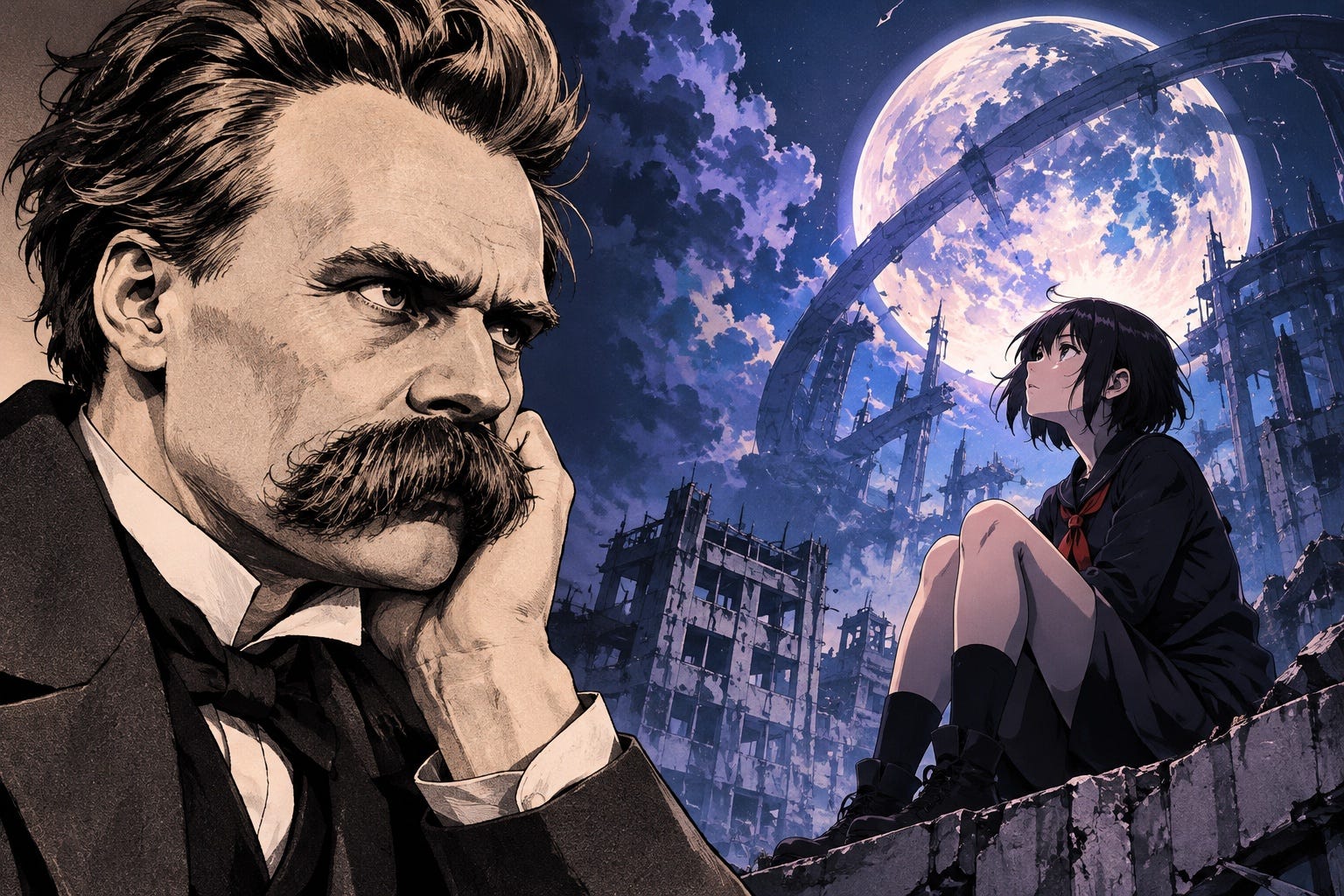
Michael Kumpmann explores the philosophical origins of Dimensional Prophecy of Zohar, his science-fiction novel about existential angst, free will, and humanity’s dangerous pursuit of technological mastery.
Because the subject of the philosophy behind my book Dimensional Prophecy of Zohar and how it came about was so well received in my first article, I was asked to write a second part. I’m very happy to do so with this article.
Returning once again to anime and philosophy: As I explained last time, one characteristic feature of the works of that era was their use of more or less hidden references to philosophy, suggesting that their stories dealt with something much deeper than one might initially suspect. As I mentioned, there were titles like Xenosaga: Also sprach Zarathustra, dialogue in Final Fantasy VII such as “Avalanche terrorists have infiltrated our corporate headquarters. We must report to Heidegger immediately,” and plot elements in Xenogears in which the protagonist has three personalities: his normal self, a wild, instinct-driven side called Id, and a personality created by his father to control the Id. There was also the revelation that “Deus” was dead, that humanity had killed “Deus,” and that the Church was trying to conceal this fact because revealing that humans had killed Deus would lead to nihilism.
Then there were subtler elements, such as the “Orthodox Church” in Xenogears venerating an icon of the “Holy Mother,” or the fact that “Deus” created life in the game using a system called Kadmony (think of Adam Kadmon from the Kabbalah1). In Final Fantasy VII, there is a Professor Gast who conducted exactly the same research as Hermann Wirth,2 looks almost exactly like Hermann Wirth, and, like Wirth, was sidelined through a kind of intrigue. It is also striking that the German words Wirth and Gast are clearly connected, especially since German has the word Gastwirt, meaning innkeeper.
Another example is the nightmare sequences in Neon Genesis Evangelion, in which Shinji Ikari sits on a train and is questioned about his true motivations, almost as though he were being interrogated, until he finally admits what really drives him. These scenes are based on remarkably similar passages in Jean-Paul Sartre’s No Exit.
That is one side of it. This approach was very rarely continued in later works, although there were exceptions, such as Madoka Magica in the 2010s. Think of the scene in which children make fun of Homura and shout, “God is dead!” Here is the scene:
An acquaintance of mine wrote publicly on Facebook at the time that he had no idea what “God is dead” was supposed to refer to. I had a good laugh because I knew exactly what it meant.
Another, more recent example is the Chinese game Genshin Impact. Its world is an artificial one ruled by Archons. One character is named Albedo, after the initial stage of an alchemical experiment. The alchemist in the starting city is named Timaeus, after Plato’s famous book. The knights in the region inspired by Germany are searching for an evil man named Alberich3 and distrust a knight who wears an eyepatch4 because he is secretly Alberich’s son. Another knight is named Adorno.5
In Fontaine, the French-inspired nation of Genshin Impact, you essentially reenact the story of Christ, and just when it begins to seem as though the religion of that region might be a fraud, a side quest called Götzendämmerung [Twilight of the Gods] appears (like Nietzsche’s book). During the final battle in Nod-Krai, Nick Land’s time spiral6 actively appears as a gameplay mechanic. Sumeru is full of Iranian and Buddhist elements.
There is a character named Scaramouche who, in a flashback, says, “I wish I had never been born at all.” A fandango plays when he appears, he attacks with thunderbolts and lightning (“thunderbolt and lightning, very, very frightening”), and his transformation into a benevolent wind mage was foreshadowed by the words “any way the wind blows.”7
There is also an occult group called the Narzissenkreuz (think of the Rosicrucians). Finally, you have to travel to the city of Snezhnograd, ruled by the Tsarina, who has a sick son and desperately wishes for a miracle healer to cure him. Virtually everything in this game is a reference to philosophy, history, or something similar. Every detail leads you ten layers deeper into meaning.
I learned an enormous amount from this principle in stylistic terms. (Why do you think the aliens in my story first appear on Mars, and why is the location called Grover’s Mill? What might that have to do with H. G. Wells and a certain radio drama by Orson Welles?)
That is one side of the equation. The other is an element introduced by Mamoru Oshii’s 1995 film Ghost in the Shell. It contains several famous scenes in which characters sit somewhere in a melancholy atmosphere, seemingly relaxed, discussing highly complex philosophical questions involving consciousness, truth, and other subjects. These conversations are sometimes interspersed with impressive sequences depicting a metropolis and the lives of its inhabitants in a visually striking way.
You can also clearly see that Hideaki Anno adopted this approach directly for Neon Genesis Evangelion, regularly incorporating similar scenes into his own work.
Evangelion sometimes combined this with dialogue that delved into the characters’ most intimate thoughts, in more ways than one. See here:
At times, these conversations were mixed with scenes in which the characters found themselves in extreme psychological situations.
(This also had an enormous influence on me. Just look at one of the latest trailers for my book, in which the protagonist Karala is literally struck by a spray of blood and entrails following an alien attack. She panics, wants to run away, and the whole situation develops into a Heideggerian discussion of anxiety.)
The ultimate extreme, however, was Serial Experiments Lain. Whereas Ghost in the Shell, Evangelion, and Xenogears contained plenty of moments along the lines of “Enough philosophizing. Now we have to fight the enemy,” Lain consisted almost entirely of philosophy, with a vague technological and AI conspiracy lurking in the background as a backdrop. (Or rather, as an excuse to philosophize.)
This had a tremendous stylistic influence on how I portrayed philosophy in my book, something readers will probably notice very quickly.
The irony, incidentally, is that back when I was in the upper grades of secondary school, this was not actually all that far removed from reality for me and my closest friends, at least when I was spending time with them. We constantly talked about these subjects and had very similar conversations. The only difference was that ours were usually a little more formally academic rather than freewheeling philosophical speculation. We would say things like, “Freud, C. G. Jung, Heidegger, and others explained consciousness in such-and-such a way, whereas the following authors had different or similar interpretations.”
We were not really all that different from Lain Iwakura, Rei Ayanami, Gendo Ikari, Cloud Strife, Ellhaym van Houten, and the others. The main difference was that our discussions included more tasteless jokes and occasional detours into subjects like “That singer is cool,” or “That TV series or manga is awesome.”
Sometimes, however, the discussions became extremely personal, with questions such as “Did childhood trauma cause behavior X, Y, or Z?”, “Are you actually autistic?” (That question was directed at me, by the way, and later turned out to be true), or “Is your religiosity really a matter of personal choice, or has your brain predisposed you towards it through certain physiological characteristics?”
At times, we really got down to the most intimate and uncomfortable questions. Lol.
One of the most extreme turning points came during our graduation trip at the end of secondary school. The first thing was that, shortly beforehand, I had begun exploring the simulation hypothesis. I had also obtained VALIS, the autobiographical novel by Blade Runner author Philip K. Dick, in which he explained his philosophy in detail, how he had arrived at it, and what his epilepsy and visions had to do with it.
I was not yet familiar with many of the concepts he discussed, such as Hermetic alchemy, Rosicrucianism, and other forms of occultism, but I understood quite a lot. Above all, I understood how his reading of religious texts had led him to the idea that we might be living in a computer simulation.
This led to a rather “memorable” night.
We were traveling to Spain by bus. (Flying was out of the question. Schools don’t have that kind of money.) I was sitting next to a classmate who wanted to study philosophy and mathematics and who had smoked several joints shortly before we departed.
Our respective circumstances and interests, combined with his being stoned and my autism, resulted in an intense philosophical discussion that lasted from eight in the evening until four in the morning. We talked about simulation theory, the binary system, Taoism, the Kabbalah, Hegel, Pythagoras, Nietzsche, Plato, information theory, number theory, higher mathematics, God, and religion.
We were having a great time, but the other passengers on the bus were getting increasingly irritated, especially around four in the morning. Eventually, they asked us to bring our “involuntary philosophy and mathematics lesson” to an end because they wanted to sleep.
Later, I continued exploring these ideas and also discovered Konrad Zuse’s Calculating Space (Rechnender Raum), further developing the philosophy behind them.
These ideas subsequently influenced not only several concepts in my series of articles on accelerationism and my article on Epstein, which was published here on this platform. They also became one of the foundations for the RSR algorithm in my story.
(In an early draft, one of the inventors of the RSR algorithm even had the same name as the classmate who had been sitting next to me on that bus. Naturally, I changed the name later.)
In a way, the RSR algorithm represents the “practical” application of these ideas. If everything is number and everything is mathematics, then perhaps everything can be calculated.
However, I shifted the focus somewhat in my book. Rather than concentrating on metaphysical questions, which appear more on the margins of the story, I became interested in questions such as “If everything can be calculated, what happens to free will?” and “Why would anyone want reality and other human beings to be predictable in the first place?”
In case anyone is wondering whether I had influences beyond anime and manga, the answer is definitely yes.
I have already mentioned Solaris. Blade Runner is another more than obvious influence. (Karala’s Gothic Lolita outfit is also indirectly based on Pris from Blade Runner.)
Two American science-fiction films were among my main influences on the plot involving the algorithm.
The first was Darren Aronofsky’s film Pi.
In it, an apparently mentally disturbed mathematical genius develops an algorithm based on the number pi that can predict stock market prices, among many other things. He eventually finds himself pursued by major corporations and Jewish Kabbalists, all of whom want to obtain his code.
The film contains intense Pythagorean discussions about whether mathematics might actually constitute reality itself, with matter being nothing more than an illusion generated by mathematics.
I was fascinated by the film. I discovered it shortly after becoming acquainted with Konrad Zuse’s Calculating Space, in which Zuse proposes the theory that we live in a computer simulation, and that connection made it all the more fascinating to me.
(Incidentally, at the time I did not yet fully understand that there was a connection between Pythagoras, the Kabbalah, and Plato. I only learned about that later through the Freemason Manly Palmer Hall.8 But I had intuitively sensed the connection and incorporated several Kabbalistic references.)
As in Pi, my own story occasionally touches on philosophical questions about whether the algorithm implies that human beings, or even reality itself, can be calculated in advance.
(By the way, I watched the film while suffering from severe headaches. Since the protagonist experiences the same problem, watching it was an especially intense experience.)
Another film that influenced the idea behind the algorithm was, as some people can probably guess, the science-fiction horror film Cube.
In that film, the characters have to use mathematics to figure out how the different sections of the cube move so that they do not stumble into deadly traps.
In any case, the RSR algorithm also gave me a major technological mystery unfolding in the background, much like in Lain.
Other influences on the overall atmosphere of the story included Lovecraft, with his radically unknowable aliens and his protagonists who act as researchers and analysts, as well as works such as Solaris, 2001: A Space Odyssey, The Andromeda Strain, the first Star Trek film, Silent Running, and others.
In other words, I was influenced by the more cerebral, quieter kind of science fiction that was popular in Hollywood before George Lucas brought about the shift towards space-opera action.
Because of these influences, I also wanted investigation and scientific exploration to play a major role in the story. I thought that would fit the theme of the algorithm particularly well.
At first, however, the algorithm was not yet sufficiently connected to the theme of anxiety. That changed around 2013 or 2014, when I started looking into what else Heidegger had written and came across his concept of Gestell, or enframing.
At that point, I knew how to connect the two.
The basic idea was that the algorithm represented a typically human but dangerous striving to use technology to create a sense of control over a situation, even though such control could never truly exist.
Initially, the story was also little more than a loosely connected collection of themes I had picked up from philosophical literature, philosophy classes, and anime. These included Schopenhauer’s hedgehog’s dilemma,9 Albert Camus’s The Myth of Sisyphus, Hegel’s and Nietzsche’s reflections on how language shapes human beings, Heidegger, Sartre, and so on.
Apart from that, the original premise was essentially a story about “two strange girls who have been outsiders all their lives, who meet each other and have to cope with a frightening world and an extreme situation while their psychological lives are explored philosophically.”
Through the algorithm on the one hand and Heidegger’s concept of anxiety as the fundamental mood of human existence on the other, a system gradually began to emerge, giving the story a coherent theme towards which the entire book was moving.
Anxiety is the fundamental feeling of human existence, and everything we do is an expression of anxiety.
It makes no difference whether we are talking about an autistic girl who completely regulates her daily routine, preferring to interact with computers and logic rather than her classmates; a schoolgirl who distrusts others and keeps them at a distance to avoid being hurt (the hedgehog’s dilemma); a woman who effectively adopts someone as a surrogate child because she cannot bear to be alone; a professor desperately trying to finish an important computer program before his life comes to an end; or a government that, fearing terrorism, establishes a technological surveillance state and uses technologies such as AI and mass surveillance in the name of security.
All these things are reactions to the primordial anxiety of our existence, an anxiety from which we can never escape.
Yet despite our anxiety, and despite the fact that anxiety can isolate human beings and throw them back upon themselves, we must never forget that Dasein means Mitsein, or being-with-others, and that, as Martin Buber says, “The I becomes an I only through the Thou.”
We need the Other in order to exist in a truly free, meaningful, and authentic way.
Only then can we truly be human.
Incidentally, Madoka was originally based on a simple thought experiment: If language is what makes a human being human, what happens when a person is naturally incapable of speech?
Later, the themes of autism and savant syndrome were added as I learned more about them. (The fact that I discovered around that time that I myself was autistic further shaped the character.)
Visually, she was strongly influenced by Eve from Megazone 23. In part, she was also simply my idea of the kind of person I would have liked to have in my own life.
The name Madoka, by the way, does not come from Gen Urobuchi’s famous anime series but from an older manga called Full Moon o Sagashite.
I always used to say that if I had borrowed the name from that series, I would have called the character Homura instead.
Interestingly enough, in 2018 I met my girlfriend, who, like me and like Madoka, is also autistic. When she first introduced herself, she did not use her real name but a Japanese one.
That name was Homura.
(Incidentally, she had never even watched Madoka Magica.)
(Translated from the German)
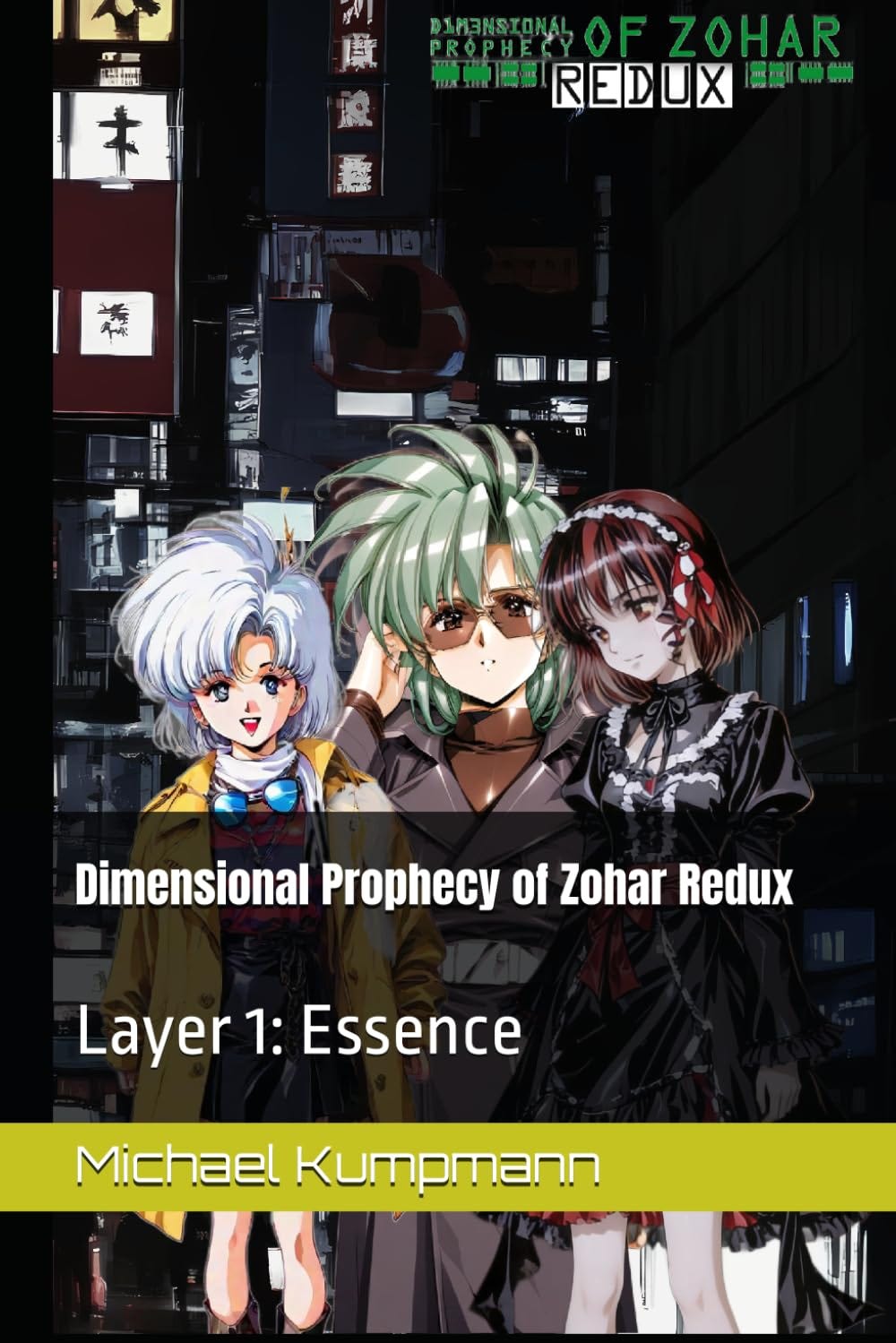
Order Dimensional Prophecy of Zohar here.
Translator’s note (TN): Adam Kadmon (“Primordial Man”) is a central concept in Jewish Kabbalah, representing the first divine manifestation following the primordial contraction of God’s infinite light. He is not a physical human being but a symbolic, cosmic figure embodying the original spiritual structure of creation. Adam Kadmon represents the archetypal human form through which divine energy is organized and transmitted into the lower realms of existence.
TN: Hermann Wirth (1885–1981), a German-Dutch historian and ethnologist who studied ancient symbols, mythology, and prehistoric civilizations,. He co-founded the Ahnenerbe, an SS research organization established in 1935 to investigate Aryan ancestral heritage and promote National Socialist racial ideology.
TN: Alberich is a dwarf from Germanic mythology, best known for his association with the legendary treasure of the Nibelungs. In Richard Wagner’s opera cycle The Ring of the Nibelung, he steals gold from the Rhine and forges a magical ring that grants immense power, setting in motion a struggle among gods, giants, and heroes. He symbolizes the corrupting pursuit of power and wealth, particularly through his renunciation of love. Wagner’s portrayal of Alberich and the mythology surrounding the ring also influenced J. R. R. Tolkien’s The Lord of the Rings, particularly its themes of a powerful ring and its corrupting influence.
TN: Kaeya Alberich may be inspired by Hagen von Tronje, a legendary warrior from the medieval Song of the Nibelungs, in which he serves as King Gunther’s loyal but ruthless adviser and murders the otherwise invincible hero Siegfried by stabbing him in the one vulnerable spot on his back. In Richard Wagner’s Twilight of the Gods, Hagen is the son of Alberich, the dwarf who forged a cursed ring, while earlier legends portray Hagen as a one-eyed warrior. Hagen plays a central role in Wagner’s opera as the principal antagonist, manipulating events to obtain the ring, orchestrating Siegfried’s murder, and ultimately helping bring about the downfall of the gods. Kaeya’s eyepatch, surname, and mysterious origins suggest a deliberate reference to this figure from Germanic mythology.
TN: Theodor W. Adorno (1903–1969) was a German philosopher, sociologist, and music theorist, a leading figure of the Frankfurt School of critical theory. He was known for his critique of capitalism, mass culture, authoritarianism, and modern society.
TN: Nick Land (b. 1962) is a British philosopher associated with accelerationism, a theory emphasizing the accelerating development of capitalism, technology, and artificial intelligence. His concept of the time spiral challenges the conventional understanding of time as a linear progression, instead envisioning history as a spiraling process in which recurring patterns undergo continuous transformation and acceleration. In Land’s philosophy, the future can influence the present through cybernetic feedback loops, suggesting that technological development follows increasingly self-reinforcing processes that may ultimately culminate in a technological singularity.
TN: Scaramouche, also known as the Wanderer, is a character in Genshin Impact, created as an artificial human by the goddess Raiden Ei. His name derives from Scaramouche, a boastful and cowardly stock character from the Italian theatrical tradition of commedia dell’arte, who is also referenced in Queen’s famous song “Bohemian Rhapsody.” The game incorporates numerous allusions to the song in Scaramouche’s characterization and storyline.
TN: Manly Palmer Hall (1901–1990) was a Canadian-born philosopher, esoteric writer, and Freemason, best known for The Secret Teachings of All Ages (1928), an influential survey of ancient religions, mythology, occultism, and secret societies. He explored connections between Pythagorean philosophy, Platonism, and the Jewish Kabbalah, particularly their shared emphasis on numbers, mathematical harmony, and the hidden structure of reality.
TN: The hedgehog’s dilemma is a philosophical parable introduced by Arthur Schopenhauer in Parerga and Paralipomena (1851). It describes hedgehogs huddling together for warmth on a cold winter day, only to hurt one another with their spines and retreat. The dilemma illustrates the fundamental tension in human relationships between the desire for intimacy and companionship and the fear of emotional pain, rejection, and vulnerability. People must find a balance between closeness and distance to avoid both loneliness and mutual suffering.

Thanks, Michael. Good stuff. :)