
Who knows Ivan Ilyin?
by Karl Richter
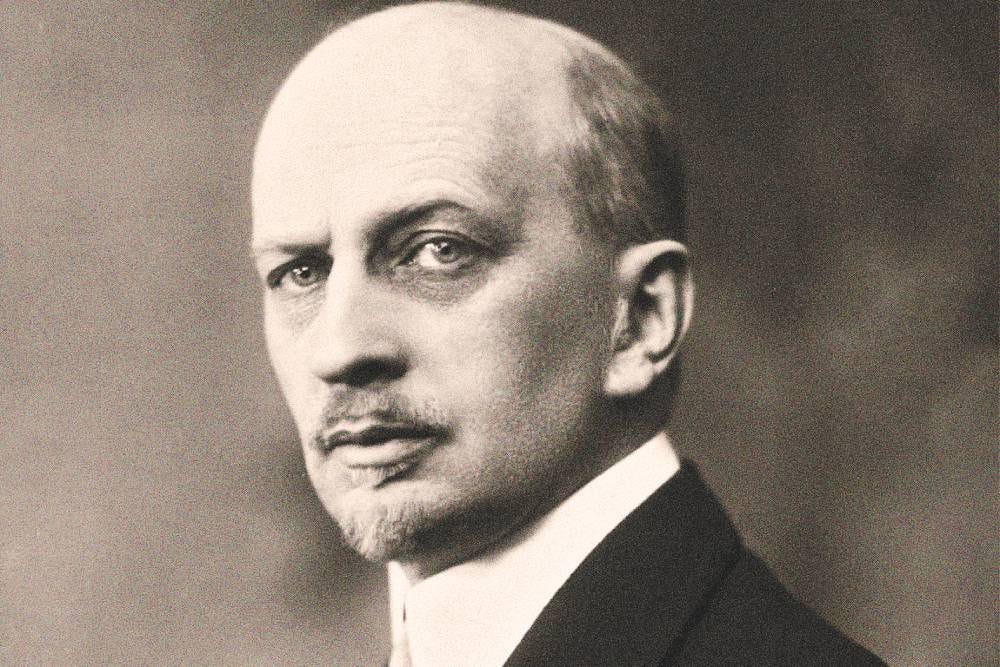
Karl Richter explores the forgotten Russian philosopher who helped shape Vladimir Putin’s worldview.
I need to begin a little further back. Vladimir Putin is personally a modest man. He strives for a healthy lifestyle and follows a disciplined daily routine. He does not make a great spectacle of himself, nor does he publicly flaunt his hobbies and personal interests. Yet they exist. One of them concerns the philosopher and writer Ivan Ilyin.
Ilyin remains largely unknown in the West, especially in Germany. Only gradually— and particularly after the Russian invasion of Ukraine in February 2022—has growing attention been directed towards what truly motivates Putin and where the sources of inspiration for his politics lie. One of the first to encounter Ivan Ilyin in this context was the French publicist and philosopher Michel Eltchaninoff, who in 2015 published his book Dans la tête de Vladimir Poutine (“Inside the Mind of Vladimir Putin”). It has since also appeared in German translation.
Eltchaninoff provides the interesting information that Ilyin’s remains were exhumed in Switzerland in 2005 at Putin’s initiative and transferred to Russia, where they were reburied at the Donskoi Monastery in Moscow. Among those buried there are Alexander Pushkin and Aleksandr Solzhenitsyn, two forefathers of Russian identity—specifically, of the non-communist variety. A year later, Putin had Ilyin’s literary estate brought back from Michigan State University. And in 2009, in the presence of media representatives, he once again laid flowers at Ilyin’s grave. Since then, he has regularly quoted him during public appearances as a major intellectual influence, and it is not difficult to distill Ilyin’s legacy from Putin’s programmatic statements.
But who was Ivan Ilyin? Born in 1883 as the grandson of the commander of the Moscow Palace Guard and the son of a German-Russian mother, he initially seemed destined for a promising future. Tsar Alexander III of Russia was his godfather. Ilyin studied law in Moscow and wrote his doctoral dissertation on Georg Wilhelm Friedrich Hegel in 1918. Yet the Bolshevik Revolution, which plunged Russia into chaos, changed everything. Ilyin was a monarchist, a convinced Christian, and from the very beginning positioned himself against the Communists. As a supporter of the “Whites” during the Civil War, he was arrested six times and sentenced to death. The sentence was never carried out. In 1922, he was expelled from the Soviet Union and initially went to Germany. His roughly fifty works, written in both German and Russian, were banned in the Soviet Union.
In exile, Ilyin became one of the leading intellectual figures of the anti-communist movement. Some attempt to portray him as the founder of a “Christian fascism,” yet that falls short of the mark. Christianity was certainly one of the central pillars of Ilyin’s worldview, though far from the only one. In his programmatic work Die ewigen Grundlagen des Lebens (“The Eternal Foundations of Life”) from 1939, he identified several others: family, fatherland, freedom, conscience, respect for the rule of law, the state, and private property. One could, in simplified terms, describe this as the ideology of Vladimir Putin, who at one of the recent Valdai Discussion Club conferences recommended “moderate conservatism” as the guiding principle of politics, thereby formulating an antithesis to the decline of values in the West. Incidentally, Putin’s admiration for Ilyin is one of the strongest arguments against the accusation occasionally heard in the context of the Ukraine war that the Kremlin leader is a “neo-Bolshevik” or “neo-Stalinist.” Nothing could be more false or more foolish.
For Germans, Ivan Ilyin’s relationship to the Third Reich is of particular interest. Like many other Russian émigrés, he initially welcomed Adolf Hitler. In 1933, he published an article under the title “National Socialism: The New Spirit,” in which he defended the National Socialist movement. “What has Hitler accomplished? He has halted the spread of Bolshevism in Germany and in doing so rendered a service to all of Europe,” he wrote. One should also refrain from judging developments in Germany solely from the perspective of the Jews. Rather, he argued, the spirit of National Socialism confronted Germany with creative historical tasks, an assessment difficult to dismiss entirely in light of the catastrophic legacy of the Weimar Republic.
In 1934, however, Ilyin was banned from publishing. With the support of the composer Sergei Rachmaninoff, he and his wife applied for residency in Switzerland in 1938 and relocated to Geneva. Yet even in 1948, after the apocalypse of the war’s end, he remained far from demonizing National Socialism. Instead, in a text titled “On Fascism,” he analyzed what he regarded as the “mistakes” of the Third Reich and Italian Fascism. Fascism, he argued, had possessed a certain historical justification as a reaction against Bolshevism: “Fascism was right insofar as it arose from a healthy national-patriotic sentiment.” At the same time, he believed the fascists had committed grave errors: hostility towards religion, dictatorship, militaristic chauvinism, and the monopoly of a single party. In the end, Ilyin expressed the hope that Russian patriots would avoid repeating the mistakes of National Socialism. Amid the bleakness of the postwar years, while Joseph Stalin’s tanks stood on the Elbe, this was a bold vision. Yet Ilyin remained convinced that the USSR would not represent the final word in the thousand-year history of Russia. History, in the end, proved him right.
Alongside his highly worthwhile studies Die ewigen Grundlagen des Lebens (“The Eternal Foundations of Life”) and Wesen und Eigenart der russischen Kultur (“The Essence and Character of Russian Culture,” 1942), Ivan Ilyin’s principal work is generally considered to be his massive philosophical confession Über den gewaltsamen Widerstand gegen das Böse (“On Resistance to Evil by Force”), written in his Berlin exile in 1925. It is strong medicine for liberals and pacifists alike, for in it Ilyin openly affirms the conditional use of violence, namely when “physical coercion and suppression” constitute the only means of resisting evil. To permit evil to proceed unchecked, he argues, would amount to participation in evil itself. With the Bolsheviks in mind, he called for the courage “to arrest, to judge, and to shoot.” For in the end, no lasting accommodation with evil is possible. If necessary, it must be confronted and eradicated here and now, in keeping with the idea that good exists only when people act upon it. The great truths are simple.
For German patriots, Ilyin deserves to be rediscovered as a rich source of enduring and guiding insights. In his sweeping vision of Russian folk culture, the Russian soul, and the essence of Russia, he stands in Germany alongside figures such as Friedrich Ludwig Jahn, Ernst Moritz Arndt, and Julius Langbehn, author of Rembrandt als Erzieher (“Rembrandt as Educator”). At least some of his books are available in German translation. They are well worth reading. They enrich the reader and inspire courage in darkened times because Ilyin invokes the eternal values, the values that truly matter: homeland, people, identity. These days mark the anniversary of Ilyin’s birth, as he was born in Moscow on April 9, 1883 according to the Julian calendar—March 28 according to the Gregorian calendar.
(Translated from the German)
I read ‘On resistance to evil by force’ a while ago to test my spiritual understanding of things. Great book. In my opinion you have to read the whole book because it seemed to me he doesn’t begin to clarify what he’s saying until the end so you could get the wrong idea if you don’t read the whole book.
A beautiful article. Pete Quinones and Matthew Raphael Johnson are discussing "On resistance to evil by force" chapter by chapter in their new series: https://petequinones.substack.com/