

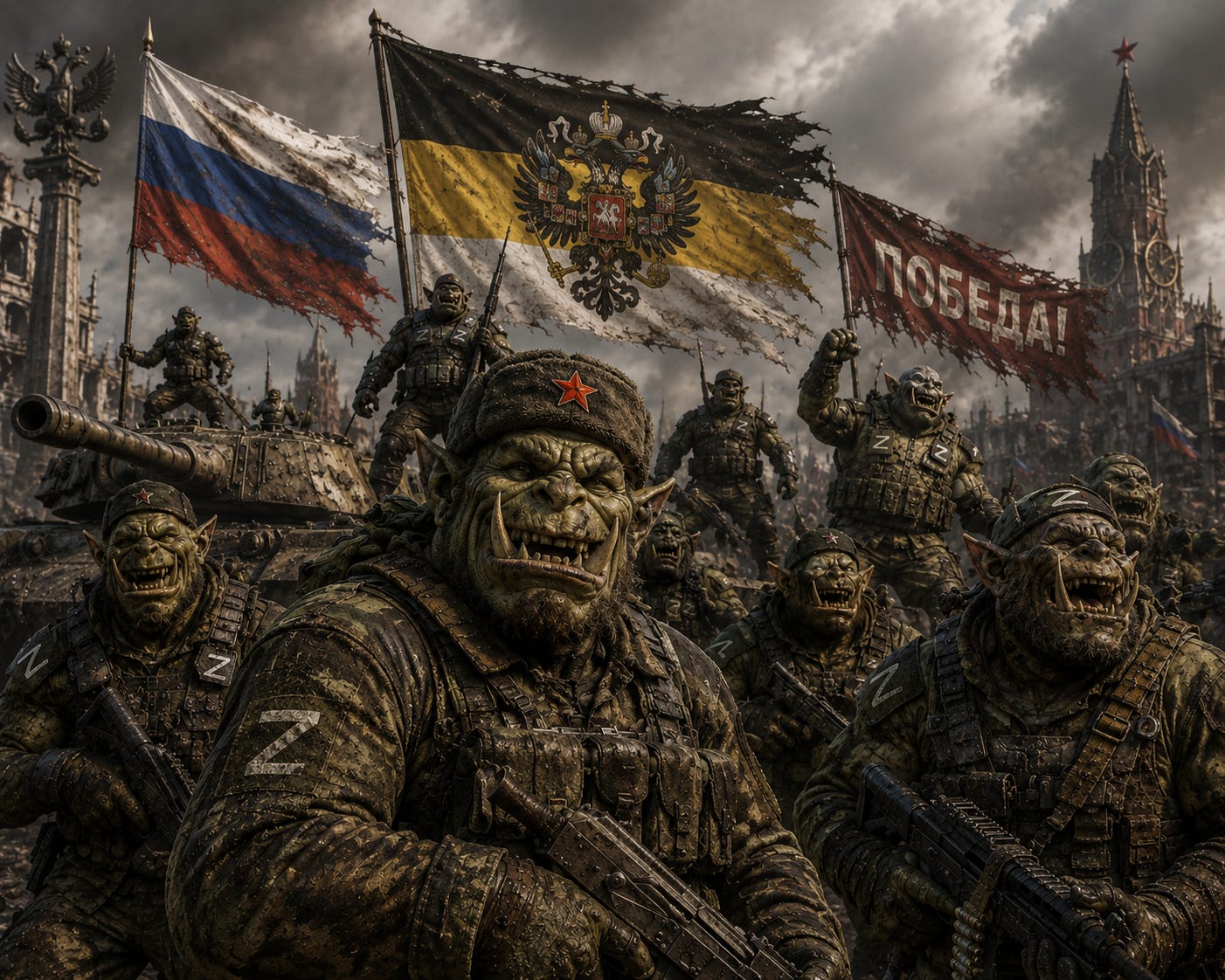
Yannis Andris argues that Russia needs an “Orc Party” willing to embrace conquest and vengeance, and even risk catastrophic escalation, in order to restore the deterrent power squandered by the Kremlin’s excessive restraint.
Russian Parliamentary (Duma) elections are just round the corner, scheduled for September 18th, and Russian voters heading to the polls are facing a great absence amongst the available options—where is the Orc Party? Sure, there is Putin’s United Russia, the Communist fossils (who might fare well btw, even with the younger voters), the LDPR right-wing liberals whose appeal was mostly tied to their late and charismatic prophet-leader Vladimir Zhirinovsky, and the New People and Just Russia formations, largely controlled opposition. But where is the Orc Party?
You may rightly wonder, dear reader, is Russia home to an Orc population? Well, if you belong to some “special” part of Ukraine’s populace, or perhaps that of the Baltics, or even the European public that sees Russia as evil™, you might not wonder at all and be positive that Russia is indeed inhabited by Orcs. After all, treating Russians as subhumans whose civilian population is a legitimate target for Kiev’s Western-enabled bombing campaign is becoming, if it has not already implicitly become, (semi) official EU and Ukrainian policy—one against which the Kremlin’s occasional attempts to call upon a common European cultural legacy sadly sound feeble and frankly pathetic.
Well, unfortunately, for all its fascinating qualities, Russia lacks any Orc, Goblin, or Elven population (though the elven part is admittedly disputed—ask around in certain mushroom-foraging circles). But it would benefit from an Orc Party, or if you are more attuned to mainstream geopolitics parlance, at least it would benefit from the more sensible and pragmatic Karaganov party. Let’s dispel the mist of confusion that might have befallen you, dear reader, by briefly shifting our tone more toward the rigorously geopolitical.
Russia’s current strategy in Ukraine, a war Moscow rightly perceives as existential, is to display resilience while matching the opponent’s (Kiev and the collective West, most prominently Europe) escalatory steps. Putin seems to treat it as a procedural, high-stakes signaling game which, through Russia’s historically—and in his view structurally—main asset, its capacity to absorb tremendous blows yet persevere and keep the course, will convince Kiev’s backers of the grave seriousness of Moscow’s commitment and resolve.
In my view, and what appears to be the view increasingly shared by both prominent Russian strategists like the esteemed Sergey Karaganov and wider parts of the Russian public—and thus voters—this strategy is a demonstrated failure, and a more assertive and decisive approach is warranted instead. The Kremlin may believe that perseverance itself constitutes an unambiguous signal of resolve. Putin, a rational—perhaps too rational for Russia’s own sake—leader, a pragmatist, a realist, a responsible man, might genuinely believe that allowing Russia to absorb the blows unfazed (or pretending to be unfazed) is preventing nuclear apocalypse in the form of WW3. But the enemy—Kiev, Brussels, European capitals, and the US establishment—interprets Russia’s stance quite differently, the signal distorted by deeply ingrained ideological priors through which Western elites operate and project onto others.
The evidence of this failure—which amounts to a failure of Russia’s deterrence and a diminishment of its status—is pretty straightforward. Ukraine, acting as a forward firing base for the EU, is conducting a deep strike campaign that violates not only Moscow’s stated or implied red lines, but strikes at exactly what would doctrinally justify a nuclear counterattack by Russia—drone and missile strikes on the strategic triad’s early-warning radars and bomber bases—and this is brushed off, pseudo-nonchalantly, by the Kremlin. This sets a very dangerous precedent. Similarly, a terror campaign against Russian civilians and public figures—the Darya Dugina car-bomb assassination, the Saint Petersburg café bombing that killed Vladlen Tatarsky, and now the Balzi Rossi restaurant bombing in Moscow, among others—is left without a response by the Kremlin. This is no display of resolve, it’s a “turning the other cheek” non-policy that only begets greater aggression by the enemy, as has been repeatedly demonstrated.
In short, from Moscow’s perspective, the restraint displayed by Russia is meant to signal: “Look how much Russia has endured without abandoning our objectives.” But from the perspective of the Europeans and Kiev, it is interpreted as: “Look how much Russia has endured without escalating decisively.” And so escalation continues on the part of the West and Ukraine and their “boil the frog” strategy, which aims at maximizing costs for Russia “on the cheap” (at least for Europe and the US; the Ukrainians are treated as willing cannon fodder), hoping that Moscow will eventually yield.
The major problem for Russia and its leadership, I would argue—prior to 2022, and even prior to 2014—is that it has consistently failed to convey with credibility that it views a neutral Ukraine as existential, a position that can now be summed up as: “We are prepared to accept enormous costs, but we will not accept defeat,” regarding the Ukraine problem. If Russia could communicate this, it would mean that nuclear war is preferable to strategic, existential defeat in Ukraine. So far it has not only failed to do so, but Putin’s—perhaps prudent, sensible, even humanitarian—strategy has managed to erode Russia’s deterrence credibility, the cornerstone of national security for any major power. If Russia and Russians aspire to some sort of sainthood (or playing the role of the Paladin, to remain in our fantasy-themed vocabulary), it works. If the aim is victory, it doesn’t.
Enter the “Orc Party” choice. Imagine a political party participating in the Duma elections with a main platform encapsulated in a slogan like: “No matter the cost, we will prevail in Ukraine, and if that means nuclear war, so be it.” Certain embellishments of its platform—explicitly saying that Kiev’s terrorist campaign against Russian civilians will be answered by striking the logistics hubs, training centers, and weapons plants in Europe that make it possible; an acknowledgment, a red flag for the Kremlin, that Ukrainians are not in their entirety a “brotherly nation”; and even, the incomprehensible in the modern normative order, that conquest is a net positive—would go a long way towards signaling to the enemy. An electoral platform ruling out any ceasefire short of full territorial capitulation along with iron-clad and enforced neutrality for Kiev, and promising to formally absorb whatever is taken rather than hold it as a bargaining chip, could be the piece de resistance of such a party.
And bare in mind that such a party need not get 60-70% of the vote to have an effect on the calculus of Brussels and the Eurocrat pro-war elites. It would only need to show that a non-trivial part of the Russian population is willing to go all-in in Ukraine until the end to be impactful. Such an outcome, if it did not threaten the majority of Putin’s United Russia platform, could actually benefit President Putin’s bargaining position in the negotiations that will eventually take place, by shifting the signal from “we will persevere and outlast you” to “if we are destabilized and lose power, the ones who come next will give you the all-out war you are convinced we will never risk.”
This again touches on the heart of Moscow’s credibility-signaling problem—a product of the Kremlin’s over-cautious approach, which despite its sensibility is unlikely to succeed as a political-pressure mechanism when facing the existential ideological zealotry of Ukraine’s post-Maidan regime, which ontologically means a Western-aligned Ukraine can only exist as an anti-Russia. Similarly, the Kremlin is facing an EU which has effectively transformed its support for Kiev into an existential rallying cry for its member states and a cause célèbre upon which the legitimacy of the current EU elite bureaucracy and the unity of the current EU is based. The Kremlin communicates “we will never give up,” but Europe needs to believe that “Russia will choose to dramatically escalate rather than give up.” Thus, a successful Orc Party would clearly demonstrate that a large proportion of Russian society explicitly prefers a much higher-risk strategy than the one pursued so far.
Russia has demonstrated that it has people capable of fighting, producing weapons in high quantity and quality, enduring sanctions and sustaining a long war. Its problem is that its political system offers no institutional means of demonstrating that the Russian public is prepared to prefer decisive victory to the avoidance of catastrophic risk. Whether the message conveyed by the Orc Party would compel Europe to retreat or provoke it to keep escalating more fiercely is uncertain. But unlike other Russian red lines, at least it would be a signal the adversary could not mistake for restraint.
A final note: so far, the dominant dialectic in Russia regarding the necessity and purpose of the war (or SMO) revolves around the muddled narratives of denazification, the responsibility to protect Donbas civilians, and pushing back on NATO expansion. Replacing this boomer-coded narrative with an extolling of the virtues of vengeance for Ukrainian war crimes, the advantages and glory intrinsic to conquest and the expansion of land—the defining pre-modern norm making its comeback in our days—coupled with the opportunity to crush Western arrogance and usher in the “multipolar world,” would carry multi-pronged political meaning and could act as a rallying cry for Russian society.
Even if there isn’t an Orc Party yet, it would be in Russia’s own interest for someone to invent one—and in many ways it would be in the Kremlin’s interest too. Though the latter is in tension with Russian elites’ deep aversion to ideology, and their treatment of stability for its own sake as the greatest state-preservation value. But the need for stability can be in real tension, if not outright incompatibility, with the necessary steps toward victory. That tension—which the formation of an Orc Party could redeem—will be explored in future articles.
This article was first published here.

excellent
Russia does not do "Orc". Others do, and blame Russia.
God and Strength is in Truth, not in atrocities and terror.