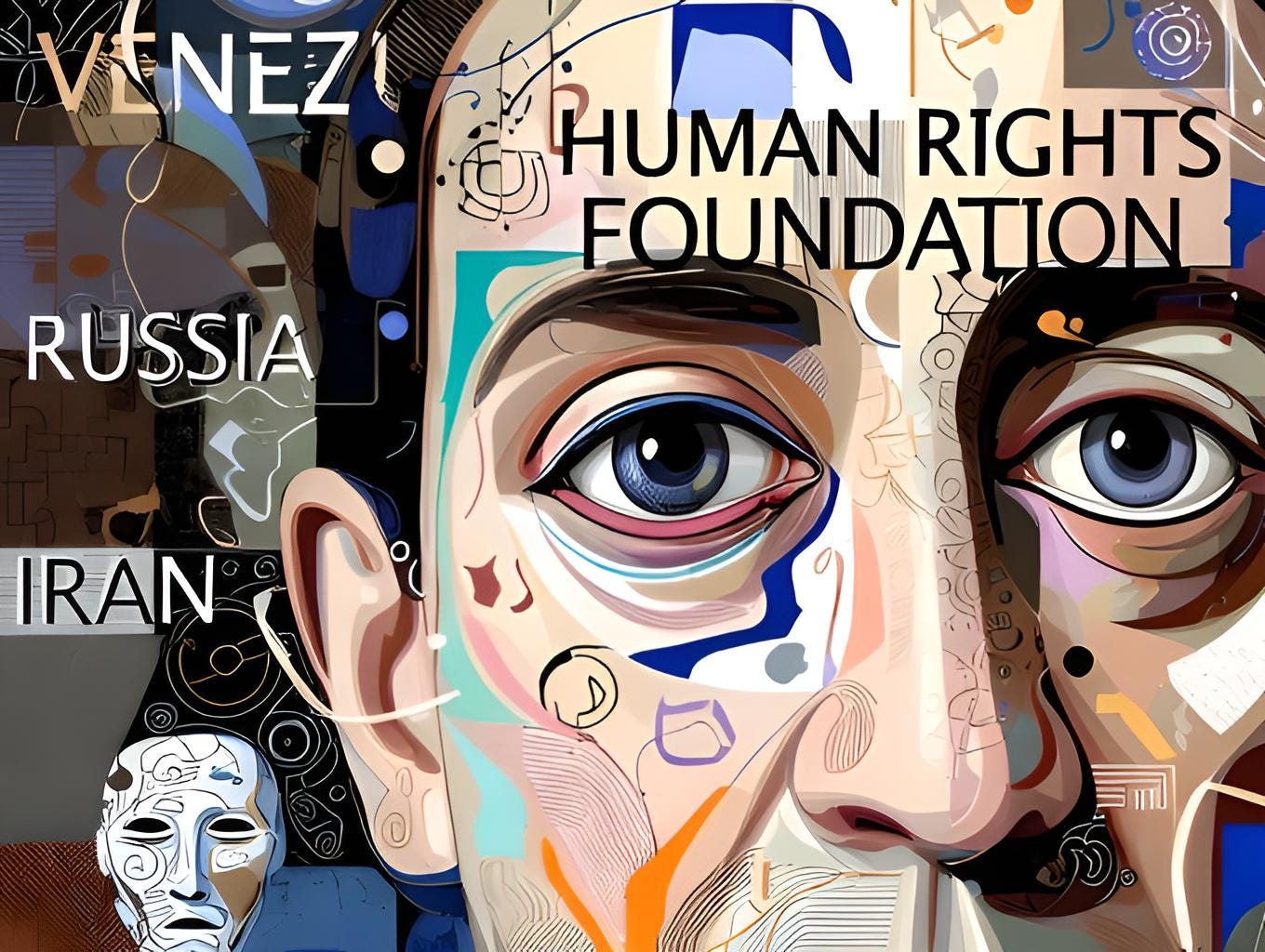
Venezuela and Postmodern Imperialism
How Venezuelan elites helped script the Washington’s humanitarian weaponry
Nuestra América uncovers the Venezuelan root of a Human Rights Foundation doctrine at the core of modern U.S. imperial strategy.
The history of U.S. imperialism contains multiple layers and auxiliary mechanisms that go beyond the military or economic sphere. As traditional forms of intervention became unsustainable and increasingly rejected by global public opinion, Washington perfected an alternative model: moral militarization—that is, the political use of human-rights discourse as a strategic weapon. Within this framework, organizations such as the Human Rights Foundation—presented as neutral observers—emerged and evolved as instruments of ideological legitimization, useful for justifying sanctions, soft coups, financial blockades, and psychological operations in countries whose governments resist U.S. hegemony.
What is rarely mentioned is that in the founding genealogy of this normative apparatus there exists a very particular Venezuelan imprint, shaped through economic pacts and transnational relationships. This is not a human contribution per se, but rather the insertion of criollo elites1 historically linked to diplomacy aligned with Washington’s strategic interests during the Cold War. From the mid-20th century onward, certain Venezuelan circles—formed through foreign funding, trained in U.S. universities, and connected to private foundations such as Ford and Rockefeller—became intellectual agents in constructing the discourse of “defending democracy” as a tool of geopolitical discipline.
That same model of ideological exportation was later channeled through international human-rights platforms, where the narrative has less to do with universal protection of peoples and more to do with the strategic selection of enemies. It is no surprise that the Human Rights Foundation’s criticism is particularly aggressive towards sovereign states that reject external tutelage—such as Russia, China, Iran, Syria, Nicaragua, or Venezuela—while maintaining a complicit silence regarding structural violations committed by Washington’s allies.
Over time, global NGOs have become an extension of the military-industrial-informational complex. Where once marines were sent, now prefabricated narratives are deployed; and where classical coups were once carried out, now soft coups are executed through simulated legitimacy. Moral critique replaces the bomb, but the objective remains the same: dismantling governments that manage strategic resources beyond U.S. influence, especially in regions where control over energy determines the global balance.
Venezuela, because of its location and oil reserves, has become a laboratory for this new phase of postmodern imperialism. And the Venezuelan networks connected to the Human Rights Foundation and similar organizations have served this architecture, participating in the discursive construction that seeks to portray sovereignty as tyranny and subordination as freedom.
However, the effectiveness of this model now faces growing limits. The emergence of a new multipolar order—led by actors such as Russia, China, and blocs such as the SCO and BRICS—has exposed the instrumentalization of humanitarian discourse and created spaces of cooperation that neutralize the hegemony of the Western narrative. When peoples learn to read the geopolitics behind moral language, the mechanism loses its ability to intimidate.
The new powers do not confront the empire with moralism but with strategic facts: independent technology, sovereign defense, and global coordination without tutelage. In post-contemporary warfare, the first battlefield is truth.
(Translated from the Spanish)
Follow Nuestra América on:
Translator’s note: “Criollo elites” refers to Latin American upper-class groups of European descent—historically formed in the colonial and early republican periods—which continue today as influential networks in diplomacy, business, and transnational political circles.


Sharp analysis of the "moral militarization" shift. The Venezuelan elite connection is facinating because it shows how imperial tools get locally customized rather than purely imposed. What really exposes the whole framework is the timing selectivity: HRF amplifies narratives right when sanctions packages need public legitimation, then goes quiet once regiem change operations stall. The whole apparatus functions less like an advocacy org and more like an advance PR unit for State Department operations.