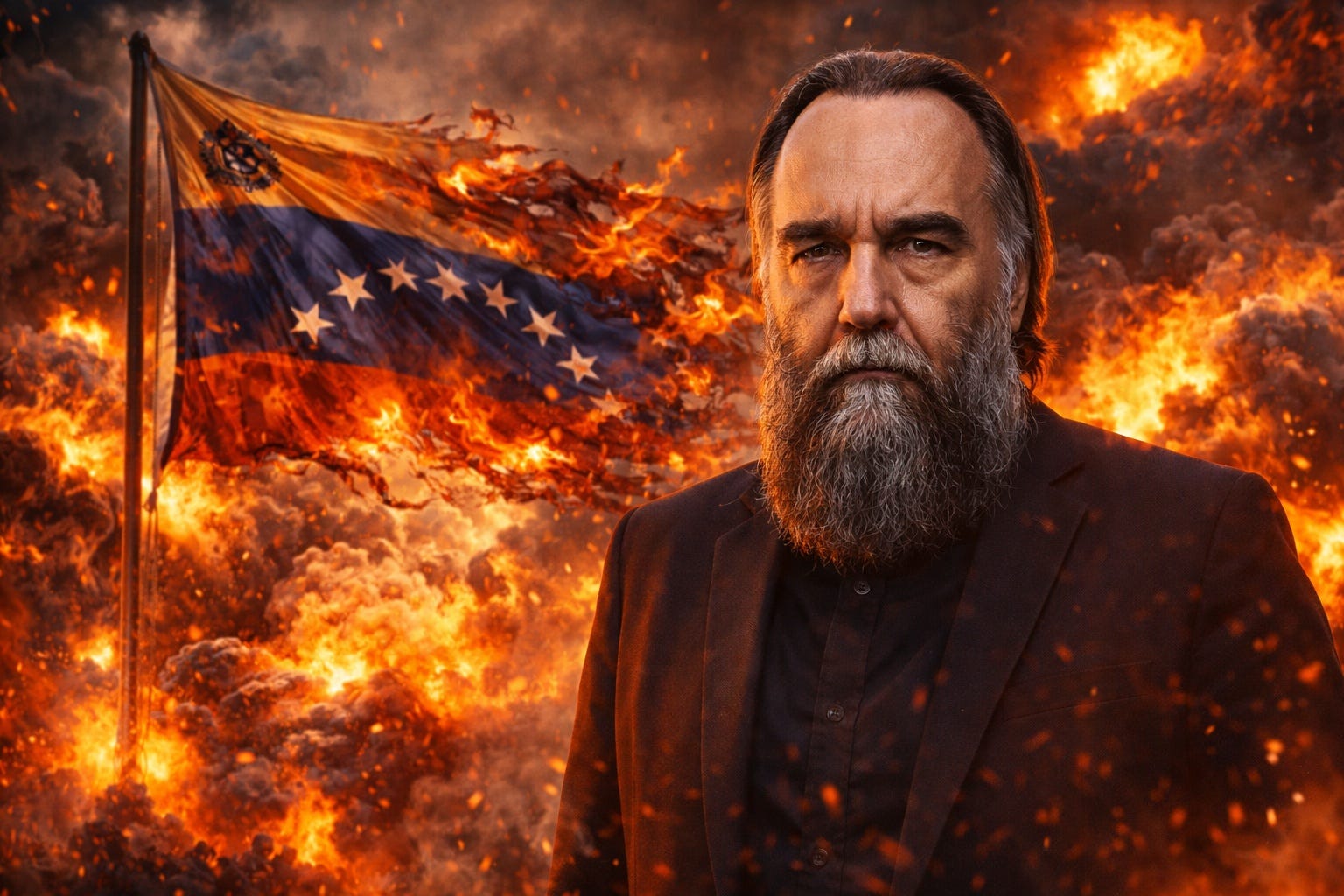
The End of International Law and the Return of World War
Why the current global chaos can no longer be contained
Alexander Dugin explains how international law has collapsed and why the struggle between unipolar domination and a multipolar world order is already moving towards a Third World War.
I am certain that now—witnessing what is unfolding in global politics—everyone has finally understood that international law no longer exists. It is no more.
International law is a treaty between major powers capable of defending their sovereignty in practice. It is they who determine the rules for themselves and for everyone else: what is permitted and what is forbidden. And they follow them. Such law operates in phases (beats)—as long as the balance between the major powers is maintained.
The Westphalian system, which recognizes the sovereignty of nation-states, took shape due to a stalemate in the balance of power between Catholics and Protestants (joined by anti-imperial France). Had the Catholics won, the Roman See and the Austrian Empire would have established a completely different European architecture. More precisely, they would have preserved the previous, medieval one.
In a sense, it was the Protestants of the European North who benefited from the Peace of Westphalia in 1648, as they had originally steered towards national monarchies against the Pope and the Emperor. Without achieving a total victory, they nonetheless secured their goal.
Formally, the Westphalian system has survived to this day, as we construct international law on the principle of nation-states—the very thing the Protestants insisted upon in the Thirty Years’ War. But in essence, in the 17th century, this concerned only the states of Europe and their colonies, and later, not every nation-state possessed true sovereignty. All nations are equal, but the European nations (the Great Powers) are “more equal” than others.
There was a certain element of hypocrisy in recognizing national sovereignty for weak countries, but it was fully compensated for by the theory of Realism. It only fully crystallized in the 20th century, yet it reflected a picture of international relations that had formed long ago. Here, the inequality of countries is balanced by the possibility of creating coalitions and the “chess-like” order of alliances—weak states conclude agreements with stronger ones to resist the possible aggression of other strong powers. This is what occurred, and continues to occur, in practice.
The League of Nations attempted to give international law based on the Westphalian system a firmer character, seeking to partially limit sovereignty and establish universal principles—based on Western liberalism, pacifism, and the first version of globalism—which all countries, large and small, were supposed to follow. In essence, the League of Nations was conceived as a first approximation of a World Government. It was then that the school of Liberalism in International Relations finally took shape, beginning its long dispute with the Realists. Liberals believed that international law would sooner or later displace the principle of full sovereignty of nation-states and lead to the creation of a single international system. Realists in International Relations continued to insist on their position, defending the principle of absolute sovereignty—the direct legacy of the Peace of Westphalia.
However, by the 1930s, it became clear that neither the liberalism of the League of Nations nor even the Westphalian system itself corresponded to the balance of power in Europe and the world. The Nazi rise to power in Germany in 1933, fascist Italy’s invasion of Ethiopia in 1937, and the USSR’s war with Finland in 1939 effectively destroyed it, even formally. Although it was officially dissolved only in 1946, the first attempt to establish international law as an overarching, mandatory system had already foundered in the 1930s.
In essence, the 1930s saw the emergence of three poles of sovereignty—this time on purely ideological grounds. Now, what mattered was not formal sovereignty, but the real potential of each ideological bloc. World War II was precisely a test of the viability of all three camps.
One camp united the bourgeois-capitalist countries—primarily England, France, and the USA. This was the liberal camp, which was, however, involuntarily stripped of its internationalist dimension. The liberals were forced to defend their ideology in the face of two powerful opponents: fascism and communism. But on the whole—if one excludes the “weak link,” France, which capitulated quickly after the start of WWII—the bourgeois-capitalist bloc demonstrated a sufficient level of sovereignty: England did not fall under the attacks of Hitler’s Germany, and the USA fought (relatively) effectively against Japan in the Pacific.
The second camp was European fascism, which grew especially strong during Hitler’s conquest of Western Europe. Almost all European countries united under the banner of National Socialism. In such a situation, there could be no talk of sovereignty—even in the case of regimes friendly to Hitler (such as fascist Italy or Franco’s Spain). At most, some countries (Salazar’s Portugal, Switzerland, etc.) were able to secure a conditional neutrality. Only Germany was sovereign—or more precisely, Hitlerism as an ideology.
The third camp was represented by the USSR, and although it was only one state, it was based specifically on an ideology: Marxism-Leninism. Again, it was not so much about a nation as it was about an ideological entity.
In the 1930s, international law—the last version of which was the Versailles agreements and the norms of the League of Nations—collapsed. From then on, ideology and force decided everything. Furthermore, each of the ideologies had its own view of the future world order, which meant they operated with their own versions of international law.
The USSR believed in the World Revolution and the abolition of states (as a bourgeois phenomenon), which represented a Marxist version of globalization and proletarian internationalism. Hitler proclaimed a “Thousand-Year Reich” with the planetary dominance of Germany itself and the “Aryan race.” No sovereignty was envisioned for anyone except world National Socialism. And only the bourgeois-capitalist West—essentially purely Anglo-Saxon—maintained continuity with the Westphalian system, calculating a future transition to liberal internationalism and, again, to a World Government. In fact, the League of Nations, which formally persisted though it was non-functional, was at that time a vestige of the old globalism and a prototype for the future one.
In any case, international law was “suspended”—essentially abolished. A transitional era began where everything was decided solely by the nexus of ideology and force, which remained to be proven on the battlefield. Thus we approached World War II as the culmination of this confrontation of force-ideologies. International law was no more.
The concrete result of the power-ideological confrontation between liberalism, fascism, and communism led to the abolition of one of the poles—European National Socialism. The bourgeois West and the anti-bourgeois socialist East created the anti-Hitler coalition and jointly (with the greater share belonging to the USSR) destroyed fascism in Europe.
In 1945, the United Nations was created as the foundation of a new system of international law. To some extent, this was a revival of the League of Nations, but the sharp rise in the influence of the USSR, which established total ideological and political control over Eastern Europe (and Western Prussia—the German Democratic Republic), introduced a pronounced ideological trait into the system of national sovereignties. The true bearer of sovereignty was the socialist camp, whose states were united by the Warsaw Pact and, economically, by COMECON [Council for Mutual Economic Assistance]. No one in this camp was sovereign except Moscow and, accordingly, the CPSU [Communist Party of the Soviet Union].
On the bourgeois-capitalist pole, essentially symmetric processes occurred. The USA became the core of the sovereign liberal West. In the Anglo-Saxon world, the center and periphery swapped places—leadership passed from Great Britain to Washington. The countries of Western Europe and, more broadly, the capitalist camp, found themselves in the position of vassals to America. This was solidified by the creation of NATO and the transformation of the dollar into the world’s reserve currency.
Thus, the UN also anchored a system of international law—formally based on the recognition of sovereignty, but in fact on the balance of power between the victors of World War II. Only Washington and Moscow were truly sovereign. Consequently, the post-war model maintained a connection to ideology, having abolished National Socialism but significantly strengthened the socialist camp.
This is the bipolar world, which projected its influence onto all other regions of the planet. Any state—including the newly liberated colonies of the Global South—faced a choice: which (of the two!) ideological models to adopt. If they chose capitalism, they transferred sovereignty to Washington and NATO. If socialism, then to Moscow. The Non-Aligned Movement attempted to establish a third pole, but it lacked both the ideological and the power resources to do so.
The post-war era established a system of international law based on the real correlation of forces between two ideological camps. Formally, national sovereignty was recognized; in practice, it was not. The Westphalian principle was maintained nominally. In reality, everything was decided through the balance of power between the USSR and the USA and their satellites.
In 1989, during the collapse of the USSR—brought about by Gorbachev’s destructive reforms—the Eastern bloc began to crumble, and in 1991, the USSR disintegrated. The former socialist countries adopted the ideology of their Cold War adversary. The unipolar world began.
This meant that international law changed qualitatively. Only one sovereign authority remained, which became global—the USA or the collective West. One ideology, one force. Capitalism, liberalism, NATO. The principle of nation-state sovereignty and the UN itself became a relic of the past, just as the League of Nations once had.
International law was henceforth established by only one pole—the victors of the Cold War. The defeated (the former socialist camp and, primarily, the USSR) accepted the ideology of the victors, essentially acknowledging a vassal dependence on the collective West.
In this situation, the liberal West saw a historical opportunity to merge the international liberal order with the principle of power hegemony. This required adjusting international law to the real state of affairs. Thus, from the 1990s, a new wave of globalization began. It meant the direct subordination of nation-states to a supranational body (again, a World Government) and the establishment of direct control over them by Washington, which had become the capital of the world. The European Union was created in this vein as a model of such a supranational system for all of humanity. Migrants began to be brought in en masse precisely for this purpose—to show what the universal international humanity of the future should look like.
In such a situation, the UN lost its meaning:
Firstly, it was built on the principle of national sovereignty (which no longer corresponded to anything at all).
Secondly, the special positions of the USSR and China and their place in the UN Security Council represented a relic of the bipolar era.
Therefore, talk began in Washington about creating a new—openly unipolar—system of international relations. It was called the “League of Democracies” or the “Democracy Forum.”
At the same time, within the US itself, globalism split into two currents:
Ideological liberalism, pure internationalism (Soros with his “open society,” USAID, wokeism, etc.);
Direct American hegemony relying on NATO, which was defended by the Neocons.
Essentially they converged, but the former insisted that the main priority was globalization and the deepening of liberal democracy in every country on the planet, while the latter insisted that the USA directly control the entire territory of the earth on a military-political and economic level.
However, the transition from a bipolar model of international law to a unipolar one never fully occurred, even despite the disappearance of one of the ideological-power poles. This was prevented by the synchronous rise of China and Russia under Putin, when the contours of a completely different world architecture—multipolarity—first began to manifest clearly. On the opposite side of the globalists (both the left-wing, pure liberal-internationalists, and the right-wing neocons), a new force appeared. While not yet clearly defined ideologically, it nonetheless rejects the ideological pattern of the liberal-globalist West. This initially vague force began to defend the UN and counteract the final formalization of unipolarity—that is, the conversion of the power and ideological status quo (the real dominance of the collective West) into a corresponding legal system.
Thus, we find ourselves in a situation resembling chaos. It turns out that five operating systems of international relations are currently functioning in the world simultaneously, as incompatible as software from different manufacturers:
By inertia, the UN and the norms of international law recognize the sovereignty of nation-states, which in reality lost its force nearly a hundred years ago and exists as a “phantom pain.” Nevertheless, sovereignty is still recognized and sometimes becomes an argument in international politics.
Also by inertia, some institutions retain traces of the long-concluded bipolar world. This corresponds to nothing at all, yet it makes itself felt from time to time—for example, in the question of nuclear parity between Russia and the USA.
The collective West continues to insist on globalization and the movement towards a World Government. This means that all nation-states are invited to cede their sovereignty in favor of supranational instances—such as the International Court of Human Rights or the Hague Tribunal. The EU insists on being a model for the entire world in terms of erasing all collective identities and bidding farewell to national statehood.
The USA—especially under Trump—under the influence of the Neocons, behaves as the sole hegemon, considering “law” to be anything that is in the interests of America. This messianic approach partially opposes globalism, disregards Europe and internationalism, but insists just as sharply on the de-sovereignization of all states—by right of force.
And finally, the contours of a multipolar world are emerging ever more clearly, where the bearer of sovereignty is the state-civilization—such as modern China, Russia, or India. This requires yet another system of international law. The prototype for such a model could be BRICS or other regional integration platforms—without the participation of the West (since the West brings its own, more articulated and rigid models with it).
All five systems operate simultaneously, and naturally, they interfere with one another, producing continuous failures, conflicts, and contradictions. A logical short-circuiting of the network occurs, creating the impression of chaos or simply the absence of any international law whatsoever. If there are five simultaneous international laws that exclude one another, then, in essence, there is none.
The conclusion from such an analysis is quite alarming. Such contradictions on a global level, such a deep conflict of interpretations, has almost never in history (honestly, never at all) been resolved peacefully. Those who refuse to fight for their world order find themselves immediately defeated. And they will have to fight for someone else’s world order, already in the status of vassals.
Consequently, a Third World War is more than likely. And in 2026, it is more likely than in 2025 or earlier. This does not mean we are doomed to it; it only means that we are in a very difficult situation. By definition, a world war involves everyone or nearly everyone. That is why it is called a world war. But still, in every world war, there are primary subjects. Today, they are:
The collective West in both its incarnations (liberal-globalist and hegemonist);
The rising poles of the multipolar world (Russia, China, India).
Everyone else is, for now, merely an instrument.
At the same time, the West has an ideology, while the multipolar world does not. Multipolarity itself has already generally manifested, but ideologically it is not yet formalized. Almost not at all.
If international law does not exist, and it is impossible by definition to defend the Yalta world, the old UN, and the inertia of bipolarity, then we must put forward our own new system of international law. China is making certain attempts in this direction (”Community of Common Destiny”), we to a lesser extent (the exceptions being the Theory of the Multipolar World and the Fourth Political Theory). But this is clearly not enough. Perhaps this year we will have to participate in a planetary “struggle of all against all,” during which the future, the corresponding world order, and the system of international law will be determined. Right now, there is none. But there must be an international law that allows us to be what we must be—a State-Civilization, a Russian World. This is what must be conceptualized as quickly as possible.
(Translated from the Russian)


The United States Government is under the control of the modern day political state which claims to be the "Israel" of the Bible. The only "law" which the US Gov't now recognizes are the dictates of Netanyahu. President Trump and almost everyone in the US Congress are bought & paid for by "Israel". "Israel" is now even demanding that the 1st Amendment to the US Constitution (free speech, etc.) be repealed because "Israel" wants to stop Americans from criticizing "Israel's" genocide of the People of Gaza, saying anything bad about Jews, etc.!! "Israel" demands that the US attack Iran; and many of us are sick with apprehension that this will bring us into WWIII wherein Russia (who is the natural ally of decent human beings) and the US (now a sewer of perversion due to the moral corruption of the ruling class and many of The People and the invaders) are on opposite sides. The real MAGA is most distressed.
Really sharp analysis on how these five incompatible systems create the current international chaos. The comparison to software from different manufacturers is spot on, and the part about how defending old systems (UN, Yalta) is impossible when they no longer reflect power realities makes alot of sense. I've been tracking how states invoke sovereignty selectively depending on which system benefits them in the moment. The gap between multipolar power relaities and ideological articulation is probably the most critical weakness right now.