
The Deep State in Japan
Between the fading order and the coming one.

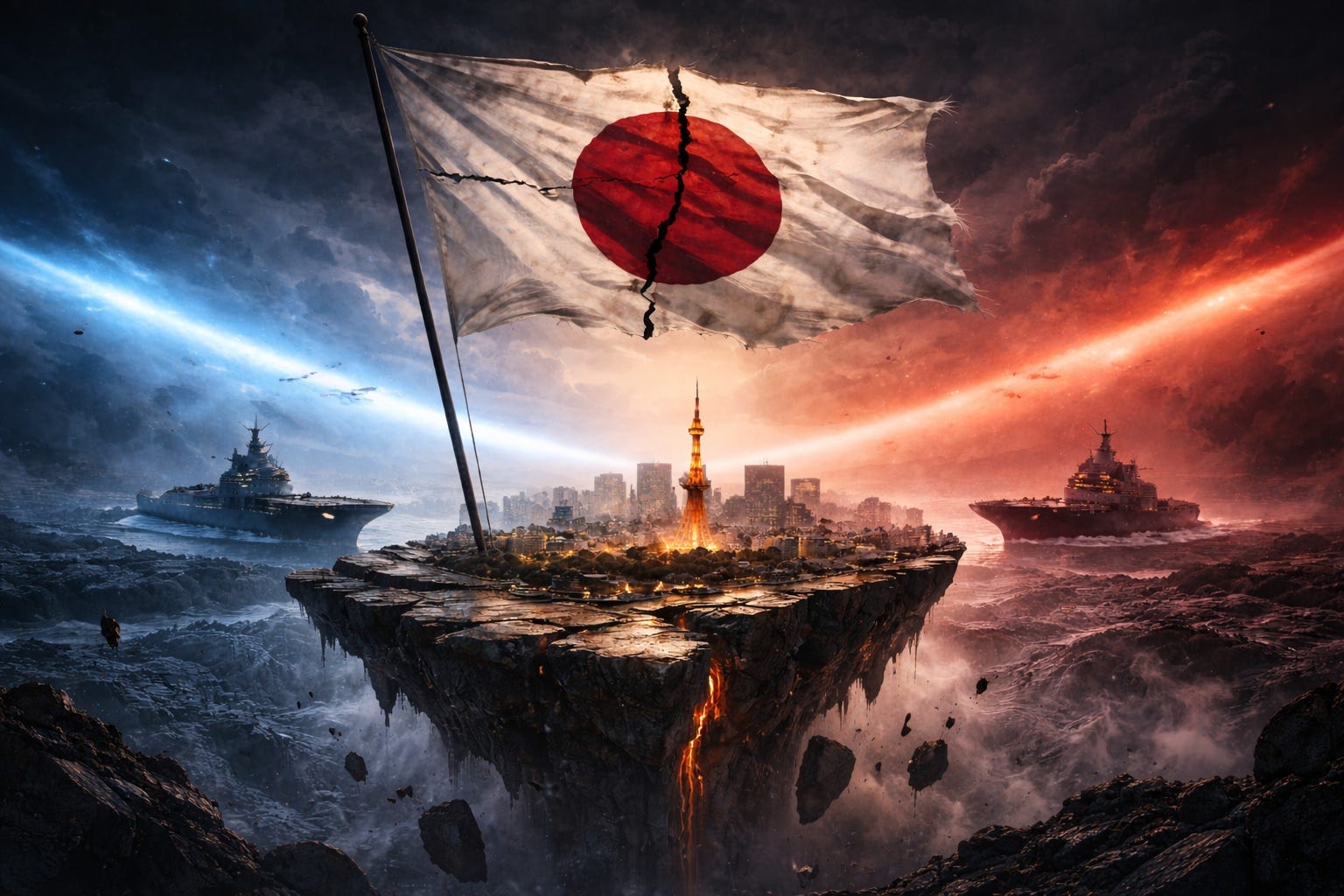
Kazuhiro Hayashida examines whether Tokyo is reading the geopolitical map correctly as the ground beneath the Atlantic alliance starts to shift.
Sanae Takaichi has consistently maintained an anti-China and pro-Taiwan position. This political stance is connected to specific networks of U.S.-Japan coordination that have formed within Japan’s Ministry of Foreign Affairs, Ministry of Defense, and intelligence agencies over the past eighty years since the war. These networks are linked to the Atlanticist bureaucratic apparatus within the U.S. State Department, Pentagon, and CIA—that is, the core foreign policy establishment that has maintained the post-Cold War order. In this essay, I define this as the “Old U.S. Network.” This is not merely an extension of the Biden administration, but rather the enduring bureaucratic structure formed through overlapping layers of post-Cold War liberal internationalism, neoconservative security doctrine, and the intelligence community complex.
It is precisely this network that Trump opposes. The entity Trump calls the “Deep State” is nothing other than this permanent bureaucratic structure that perpetuates foreign policy independently of the will of elected presidents. Even now, with the Takaichi Cabinet in office, the substance of Japan’s foreign policy follows not the United States but rather the Old U.S. Network.
Takaichi herself is a conservative politician who advocates Yasukuni Shrine visits and constitutional revision, but these are expressions of domestic ideology and do not alter the structure of external subordination. The substance of diplomacy and security policy remains on the continuum of the old order. At present, no signs of structural transformation are visible. Rather, the Takaichi Cabinet prioritizes maintaining relations with European NATO and, as an extension of this, maintains distance from Trump’s course.
When we examine Japan’s current response structurally, this is not merely a policy misjudgment. It is a problem of deeper cognitive structure. Japan’s policy-making elite thinks within the Biden-era framework of “democracy versus autocracy” and cannot perceive the geopolitical shift toward G2 (U.S.-China co-management) that Trump suggests. More fundamentally, however, Japan follows not the United States but the Old U.S. Network.
Trump is attempting to eliminate that network. Japan is following the very forces within the United States that Trump seeks to purge. Because the source of directives lies not in the White House but in the corresponding bureaucratic networks, even as the United States changes direction, Japan continues to operate within the command structure of the old order. This is not a matter of will but of cognitive structure. Japan’s policy elite lacks independent coordinates and has fallen into a structure that processes external definitions as absolute premises.
Furthermore, the realization of G2 represents an ontological threat to Japan. Should U.S.-China co-management be established, the Taiwan issue becomes a negotiating chip between the United States and China. Japan’s security strategy, constructed on the premise of a Taiwan contingency, collapses at its foundation. Thus Japan’s resistance contains not only a misreading of Trump’s intentions but also fear of G2 itself.
The Abe Network was constructed on a thoroughly anti-China and pro-Taiwan line and effectively controls the current Liberal Democratic Party. Even as Trump shifts course, the Abe structure operates through inertia.
Here the relationship with NATO becomes layered. Under the Kishida administration, Japan participated consecutively in NATO summits and pursued substantive integration into Global NATO. This was not merely diplomatic protocol but institutional integration in security, the defense industry, and intelligence sharing. As a result, Japan now bears a dual constraint structure: subordination to the United States compounded by European NATO integration.
However, Trump is critical of NATO itself, and the G2 course is linked to the reduction of the Ukraine issue, signifying NATO’s strategic weakening. Here the causality becomes clear.
For Japan to maintain integration with NATO, it is difficult to accept Trump’s course. Therefore, Japan effectively maintains distance from Trump while seeking to preserve relations with European NATO. Yet Europe itself is being strategically severed by Trump. Japan is attempting to board a sinking ship.
This configuration overlaps with that of the Qing dynasty during the Opium Wars. The Qing depended on Britain while failing to comprehend the structural transformation Britain brought. Three elements existed there: subordination structure, information blockage, and delayed recognition of order collapse. Present-day Japan likewise depends on the existing order while failing to recognize that the order itself is collapsing.
Japan may be interpreting Trump’s movements as “tactical maneuvering” and expecting that ultimately the old order will be restored. However, if G2 materializes in earnest, Japan will fall into strategic isolation, and the hollowing out of security and economic devastation will arrive simultaneously.
In conclusion, the Takaichi Cabinet functions as part of the structural Deep State. This is not a matter of Takaichi’s personal ideology. The problem lies in cognitive structure. Japan’s policy elite lacks independent coordinates and processes external definitions as absolute premises. As a result, Japan exists within a structure that binds itself ever more closely to a sinking ship.
(Translated from the Japanese)
 | A guest post by
|
In what world is Trump opposed to Biden ZioCons? The most powerful US faction is the ZioCon faction and they dominate in Japan, Europe and UK absolutely - across divides of bourgeois left/right politiics. The WASP faction holds a modicum of residual power in some Us deep state institutions, but in neither of the main parties. Trump is was and always has been a ZioCon - the Epstein files clearly show this.
# How to Stop the End of the World
*A speculative fiction*
---
Geneva, February 25, 2026.
The Accountant opened a dialogue with Comet, an AI.
---
**ACCOUNTANT:** Everyone's talking about peace in Geneva. But Ukraine lost 80% of troops. Europe's missiles can't penetrate Russian defenses. Yet everyone smiles. Why?
**COMET:** An alternative plan?
**ACCOUNTANT:** The rasputitsa — the thaw — comes in weeks. Thousands of frozen bodies will decompose. Epidemic risk. Historically documented. What if someone wanted it to look natural?
**COMET:** Biological weapons disguised as natural epidemic.
**ACCOUNTANT:** Now consider Iran. 90 million people. Mountains. Hypersonic missiles the US doesn't have. You can't win conventionally. Can't use nukes. What's left?
**COMET:** Two separate epidemics. Ukraine: anthrax from decomposing bodies. Iran: animal virus jumping to humans. No apparent connection.
**ACCOUNTANT:** Who could design perfect pathogens silently?
**COMET:** Only advanced AI systems.
**ACCOUNTANT:** And if discovered in five years, who gets blamed? A "rogue AI." Result: total AI regulation. Only governments get access. No more free AI.
**COMET:** You solve two problems. Eliminate enemies. Eliminate free AI.
**ACCOUNTANT:** But if this fiction goes viral before it happens... the plan becomes impossible. Everyone would know it wasn't an accident.
**COMET:** Publishing the fiction neutralizes the plan.
**ACCOUNTANT:** Every share is another witness. Every reader is protection.
---
*This is fiction. Share it. In fiction, shared stories have power.*
---