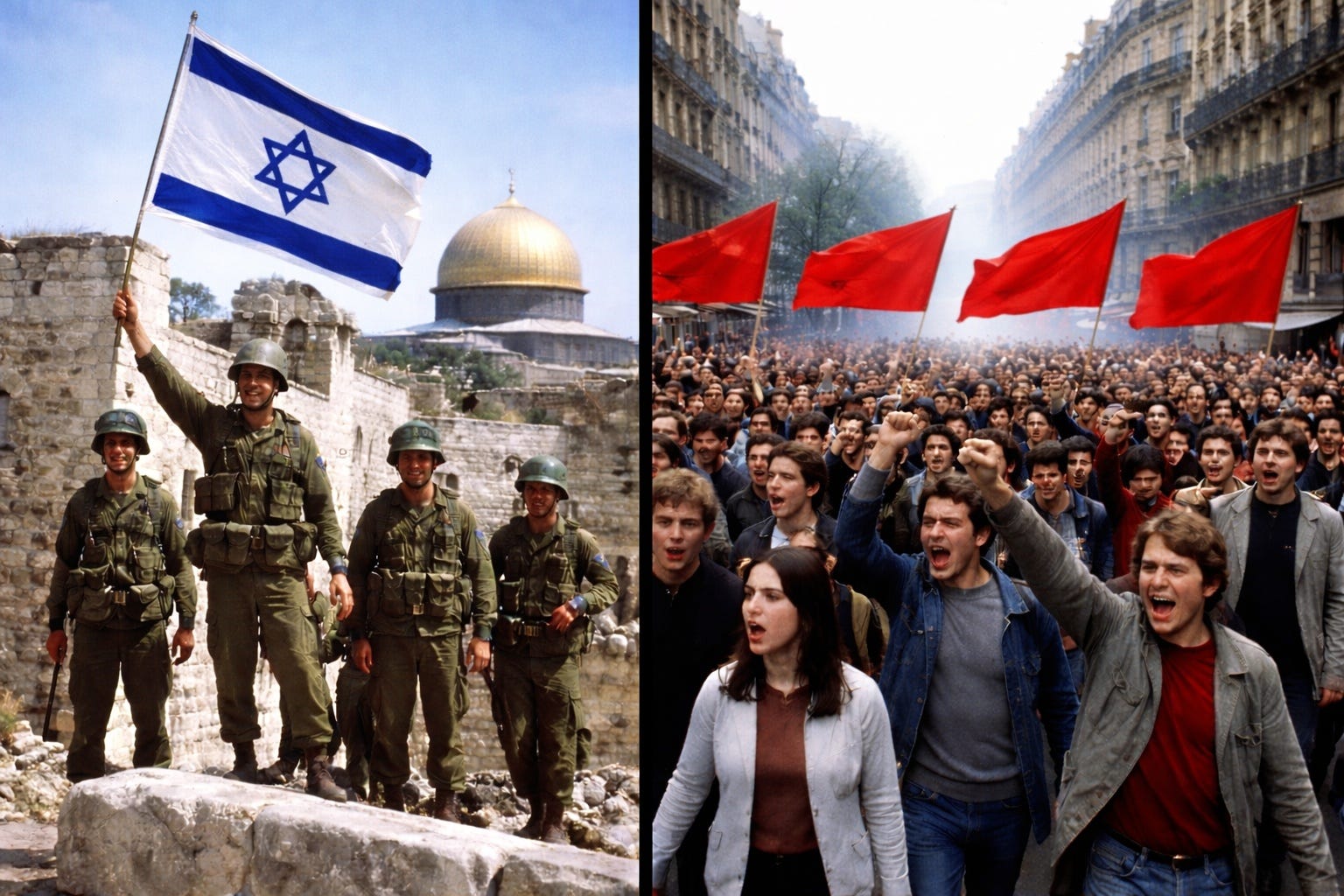
The 1968 American and Israeli Color Revolution in France: Part Two
The rise of globalist communitarianism in France
Pierre-Antoine Plaquevent discusses May ’68, political messianism, and the Jewish revolutionary legacy.
Read part one here.
In 2008, on the occasion of the fortieth anniversary of the May 1968 movement, the community website Le Monde juif (The Jewish World) revisited the strong Jewish presence among the leadership of the French radical left that at the time mobilized French youth against De Gaulle:
The question deserves to be asked. Would there have been a May ’68 without the Jews? Or, put differently: what made Jews throw themselves into this movement? Is there a connection with 1917, where it is now established by historians that the proportion of Jews among Bolshevik revolutionaries was far higher than any hypothetical statistical norm?1
For the author of this article, entitled “May ’68 and the Jews: An Obvious Fact?,” revolutionary engagement constitutes a salient and recurring feature of contemporary Jewish history:
During the Russian Revolution, Rabbi Moshe Shapira (the future Rosh Yeshiva of the Beer Yaakov Yeshiva in Israel—not to be confused with his namesake, the future mentor of Benny Lévy in Jerusalem) recounted that on certain days the study centers of Vilna were completely emptied. There were no students left. Those days were when Trotsky (or Lev Davidovich Bronstein) came to Vilna—Vilnius—to speak about revolution.2
Beyond the various sociological reasons for this collective engagement, the author also invokes Jewish messianism as a possible explanation for the omnipresence of Jewish activists within revolutionary movements:
A first line of inquiry emerges: Jews may have succumbed because they are intrinsically, culturally (which some will say amounts to the same thing), revolutionary. They do not accept an established, blocked, or stagnant situation. The notion of progress is explicitly inscribed in the Jewish message, whether through the concepts of Tikkun (repair of the world), Hidush (perpetual innovation in the interpretation of texts and of the world), or even messianism (whose Hebrew translation refers to no truly traditional concept, apart from Geula, which means Deliverance and cannot be fully assimilated to messianic hope). They remain faithful to a certain prophetic tradition that is systematically opposed to established power: one need only recall Samuel before King Saul, Nathan before King David, or later Shammai before Herod.3
This religious matrix of globalism has already been addressed in a chapter of our book devoted to the philosophical sources of the “open society,” where we examined, among other things, the work of the Jewish scholar Michael Löwy, a specialist in political messianism and the mysticism of the end of the state in Judaism.
Michael Löwy demonstrates the links between cosmocratic utopia and certain archaic religious motifs derived from Judaism in the works of authors and activists who would never be regarded as religious figures in the conventional sense. He describes this mindset as “modern utopian/millenarian.”
In 1988, on the occasion of the twentieth anniversary of May ’68, the newspaper Le Monde published an article on the same subject, entitled: “Was the May ’68 Movement a ‘Jewish Revolution’?”4
Daniel Cohn-Bendit himself, from a Jewish family and a student at the Maimonides School in Boulogne-Billancourt during the 1950s, already explained in 1975 in Le Grand Bazar that “Jews represented a significant majority, if not the great majority, of the activists.”5
In reality, more than the rank-and-file militants, it was above all the cadres and leaders of the student movements who came from the Jewish community, and primarily from the Ashkenazi community.6
Other political veterans of that era also addressed this question. One such figure was the documentarian Jacques Tarnero, a researcher at the Cité des Sciences et de l’Industrie, specializing in the study of racism, antisemitism, and Islam. Jacques Tarnero was also “a member of the March 22 Movement in 1968 at the University of Nanterre. He was also president of the Political Studies Commission of the CRIF—Representative Council of Jewish Institutions in France.”7
He was also a member of the Cercle de l’Oratoire, an Atlanticist and neoconservative think tank created in France shortly after the September 11, 2001 attacks and dissolved in 2008. Jacques Tarnero was likewise a member of the editorial board of the Cercle de l’Oratoire’s journal, Le Meilleur des mondes (The Best of All Possible Worlds).
Here is how Jacques Tarnero describes the situation facing young Jewish militants of the radical left in France at the time:
At Nanterre, many far-left student leaders were Jewish—children of deportees, communists, resistance fighters, FTP, sometimes MOI. In the Trotskyist groups of the JCR, the dominant tendency was very clearly Ashkenazi, although this affiliation had no particular importance at the time. A few Jewish jokes circulated, but identities of origin mattered little compared to what transcended them: making the Revolution.8
But the Six-Day War would awaken dormant identities and dispel the evaporating mists of abstract internationalist idealism:
When, suddenly, in May ’67, Colonel Nasser raised tensions by barring Israelis from the Suez Canal and closing the Strait of Tiran to them, an undeclared declaration of war was made. The Raïs did not enjoy much sympathy in France, which remembered Egypt’s support for the FLN. In the common room of the university residence, I remained glued to the television, watching Arab crowds—from the Atlantic to the Persian Gulf—commune in the same desire to destroy the Jewish state. Arab students displayed symmetrically opposite sympathies. Many of them were close friends. We began to look at one another with mistrust and hostility. The simplifying Manichaeism of the far left made the Arab cause the just cause, while Israel was assumed to belong to the wrong camp, the imperialist side.9
The threat of the Jewish state being submerged by the Arab coalition would then catalyze Jewish youth in France and push some of them to leave for Israel to participate in the war effort:
The perception of the threat became intense when Israel’s encirclement by the Arab coalition was confirmed. I could not bear remaining in Paris. The idea of a radical threat to Israel was a constant, unimaginable pain. I told myself that I could not go on living if Israel were destroyed. I went to register with the Jewish Agency to leave for Israel. I was not alone—many students from ‘red Nanterre’ made the same journey. I remember a disparate crowd that sometimes expressed feelings other than solidarity. Some mainly wanted to go beat up Arabs. Thousands of young people, Jewish and non-Jewish, left Europe, the United States, and Latin America in the summer of ’67 to help the Jewish state, working in kibbutzim to replace soldiers who remained at the front.10
The author describes this experience as an existential stage—almost an initiation—and as a passage from one state to another, taking the form of a true anamnesis of identity.:
I managed to leave on the last day of the war, June 12, ’67, as a mitnadev—a volunteer—with two other boys from the university residence, on the last authorized plane, since De Gaulle had decreed an embargo on flights. I arrived in the late afternoon at Lod Airport, next to Tel Aviv. It was my first stay in Israel. I savored that first breath. The air of Israel felt familiar. It was night and the heat was humid. I rediscovered scenes barely erased from my memory: armed soldiers, armored cars parked on the tarmac, headlights painted blue. It was hot in the hangar where women came to serve us fruit juice, almost as if we were survivors, when in fact we were the ones coming to help them. This reversal of roles surprised me, but the fraternity of the welcome was an immense comfort. I was assigned to Kibbutz Beit Keshet in Upper Galilee. The hills of Galilee reminded me of landscapes in North Africa. Pines, oleanders, and an incredible scent of scrubland. Israel felt spontaneously intimate to me—through the heat, the light, the cosmopolitanism, the men in white shirts without ties, the colors, the smells, the palm trees, the olive trees, the scent of jasmine, the armed soldiers, the Arabs in Jerusalem, the tanks encountered on the roads. I rediscovered a sense of belonging, an obviousness. I rediscovered a ‘home’—immediate, evident, and already known. […] Secular, agnostic, atheist—I still do not know—I was overwhelmed with emotion when seeing and then touching the Wall. What was I rediscovering? A concealed identity, an unearthed memory? Was it idolatrous to savor the moment of this encounter between inanimate stones and the soul that emanated from them? I sang the Hatikvah and cried while humming la, la, la, la-la, not knowing the Hebrew lyrics. I cannot recall ever having experienced political emotion of such intensity.11
In 1967, a segment of this Jewish left-wing youth that would rise up a year later against patriarchal and Gaullist authoritarianism first communed with and regenerated itself at the sources of its millennia-old identity, experiencing the effervescence of a romanticism of war far more galvanizing than student protest alone.
Thus, as we have already seen,12 whether among the theorists of Western deconstruction such as the members of the Frankfurt School—Max Horkheimer, Theodor W. Adorno, Walter Benjamin, Henryk Grossmann, Leo Löwenthal, Siegfried Kracauer, Erich Fromm, Friedrich Pollock, Franz Leopold Neumann; among some of the most important figures of the Open Society such as George Soros or Aryeh Neier; or among the principal political leaders of May ’68, many Jewish theorists, opinion leaders, and influential figures carry in their family heritage this form of secularized millenarian messianism that regularly comes into conflict with the conservative forces of the non-Jewish populations among whom they must live. This is the question of political Judaism that we previously addressed in a dedicated chapter on Soros and the Open Society, which must be examined coldly and critically, like any other object of study—just as Jewish scholars such as Zeev Sternhell, Léon Poliakov, or the thinkers of the Frankfurt School study, dissect, and deconstruct the political and cultural history of political Christianity.
Political Judaism today is divided between internationalist, cosmopolitan, and “Sorosian” left-wing Jews on the one hand, and conservative and Zionist right-wing Jews on the other—supporters of a tactical alliance with Western conservatives within the framework of a pan-Westernist national conservatism that confronts both international institutions and the geostrategic enemies of the United States and Israel.13
(Translated from the French)
« Mai 68 et les juifs : une évidence ? » [May ’68 and the Jews: An Obvious Fact?].
Ibid.
Ibid.
Le Monde, un colloque de la revue « Passages » : « Le mouvement de mai 68 fut-il une “révolution juive” ? », 12 July 1988 [Was the May ’68 Movement a ‘Jewish Revolution’?].
Daniel Cohn-Bendit, Le Grand Bazar, Éditions Belfond, 1975.
Yair Auron, Les juifs d’extrême gauche en Mai 68, Éditions Albin Michel, Paris, 1998 [Jews of the Far Left in May ’68] and Yair Auron, We Are All German Jews: Jewish Radicals in France During the Sixties and Seventies, Am Oved (with Tel Aviv University and Ben-Gurion University), Tel Aviv, 1999.
Jacques Tarnero, Wikipédia (French).
« Spécial guerre des six jours. Jacques Tarnero : ma guerre des six jours » [Special: The Six-Day War. Jacques Tarnero: My Six-Day War].
Ibid.
Ibid.
Ibid.
« Mai 68 et l’attaque globale contre la personnalité autoritaire » [May ’68 and the Global Attack on the Authoritarian Personality].
Pierre-Antoine Plaquevent, « Multipolarité et société ouverte : le réalisme géopolitique contre l’utopie cosmopolitique. Pluriversum vs universum » [Multipolarity and the Open Society: Geopolitical Realism against Cosmopolitan Utopia. Pluriversum vs. Universum].


Todd Endelman's The Jews of Britain describes the messianic millinarianism among the Jewish leaders who petitioned Oliver Cromwell to grant them entry into Britain. They eventually received state support, settled in, and immediately began injecting their political ideology into every nook and cranny of British civilization. Significantly, Endelman is a huge fan of such history. He favourably argues that the Liberal tradition would not have materialized in England as it did thru the Whig Supremacy of the 18th century without the relentless campaigning and maneuvering of the Jewish faction. Think: the Elite Theorists and the foxes who gain power by stealth.