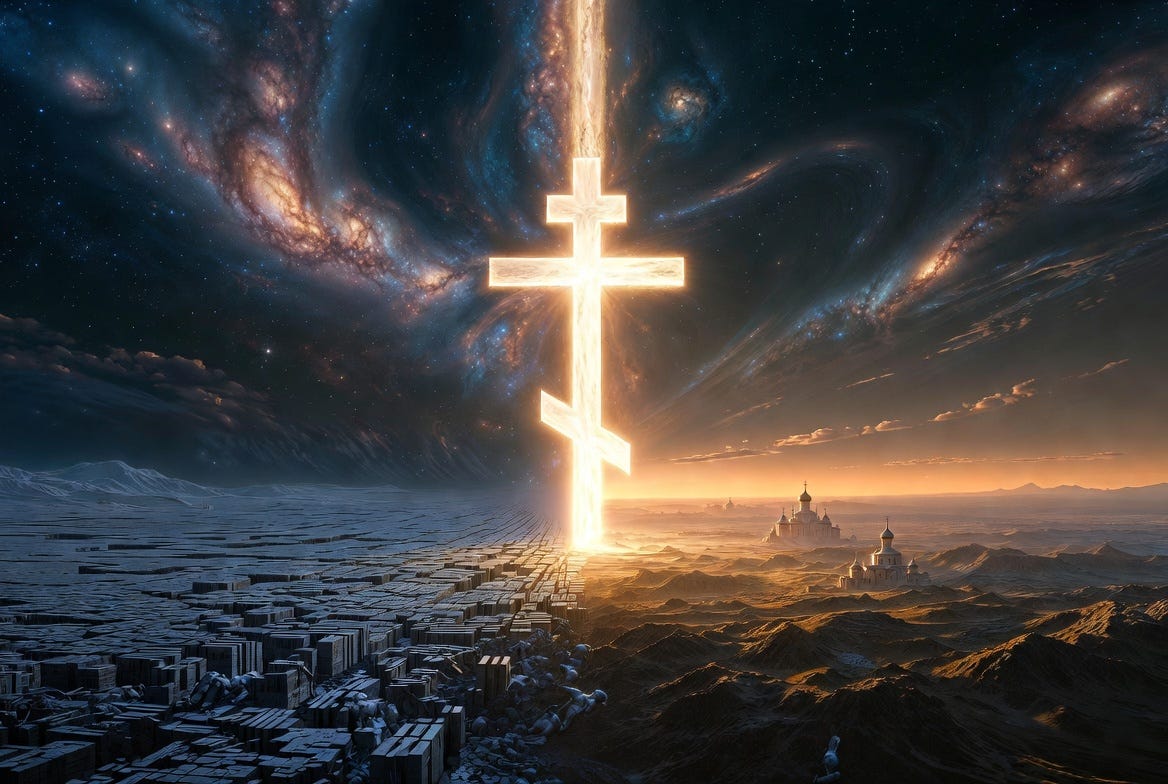
Russian Cosmism against Transhumanism
The Vertical Path
Speculum Orientis on Heidegger’s Enframing, the collapse into the horizontal plane, and the Eurasian path toward the transfiguration of the cosmos.
The greatest illusion of the modern mind is to believe in indefinite progress, which is merely a dispersion of energy across the horizontal plane.
— Nikolai Fedorov
If horizontal “progress” disperses our energy, can we still find the vertical path back to ourselves? As an Easterner, a Traditionalist of the Right who stands firmly outside both the Slavic bloodstream and the Orthodox faith, I pose this question not as a rhetorical flourish but with genuine, mounting urgency. I observe the spiritual exhaustion of the Western world with a clarity that distance affords. The West has plunged into a terminal abyss of metaphysical despair and barren materialism. We stand amid the ruins of a dying epoch, suffocated by a pervasive nihilism in which meaning has been swallowed by an infinite, expanding nothingness. The ultimate, putrefying symptom of this civilizational disease is Western Transhumanism. Stripped of all transcendent orientation, the modern Western transhumanist seeks a sterile, technological mummification of his isolated ego—a demonic rebellion that dares to call itself evolution.
Paradoxically, the sharpest critics of this necro-technics are the West’s own great thinkers. Oswald Spengler diagnosed the Faustian soul of the West long before Silicon Valley promised digital immortality. The once-vital culture that raised Gothic cathedrals has culminated in a mechanized wasteland where the will-to-power has rebelled against its own organic roots. Spengler saw modern man as a beast of prey who has become a captive behind the bars of his own artificial culture; the Machine now revolts against its creator, forcing him to follow a runaway, destructive course. Transhumanism is the final, tragic mummification of that dead culture—a sterile attempt to preserve the atomised ego within a silicon cage utterly devoid of the breath of true spiritual life. Martin Heidegger went deeper still, diagnosing the metaphysical engine of this nightmare as Gestell, or Enframing. Technology is not a neutral tool but a tyrannical mode of revealing that reduces the entirety of creation to mere standing-reserve, Bestand. The transhumanist who dreams of uploading his consciousness fancies himself a god, yet he is blind to the fact that he himself is being reduced to raw material. In the age of Enframing, man everywhere encounters only himself, yet precisely nowhere does he encounter his own essence. By severing the final tether to the spiritual, Western man plunges into a frigid void where the sacred mystery of Being is obliterated. Transhumanism is not an ascent to divinity; it is the ultimate submission to the mechanical.
We can understand this tragic condition through the traditional metaphysics of the cross, as articulated by the French metaphysician René Guénon. In this symbolism, the vertical axis represents the path of metaphysical transcendence—the upward impulse toward the Divine and the sacred mystery of Being. The horizontal axis represents the realm of continuous outward manifestation and material expansion. While traditional cultures were oriented vertically, the modern Western world has collapsed entirely onto the horizontal plane. Transhumanism represents the extreme limit of this horizontal fall: a desperate, sterile movement across time and space that seeks to extend the ego indefinitely without ever touching the vertical dimension of the spirit. This same intuition about the spiritual body finds its most precise articulation in the Islamic esotericism studied by Henry Corbin. Far from being a disembodied digital state, true resurrection involves the realization of a subtle, imaginal body—what Corbin, drawing on Suhrawardī, called the jism mithālī, a body belonging to the intermediate world of Hurqalya, the mundus imaginalis, perceived not through abstract rationalization but through the Active Imagination. This is no ghostly abstraction; it is the caro spiritualis, spiritual corporeity. And it is precisely this kind of transfigured, concrete corporeity that the Russian Cosmists later placed at the very centre of their Common Task. The transhumanist dream of disembodied data is merely an impoverished, inverted mimicry of this true spiritual body, severed from the vertical axis that alone can resurrect the flesh rather than discard it.
Salvation from this nightmare will never emerge from the sterile paradigm that produced it. As an Easterner who is neither Russian nor Orthodox, I must look elsewhere—to the unique historical and spiritual crucible of the Eurasian heartland. The Cosmism that can cure us is not the secular rocket-building of the Soviet era but a profound spiritual orientation forged in the vastness of the steppe. As the polymath Lev Gumilev demonstrated, the destiny of nations is driven by passionarity, that vital cosmic energy and will to self-sacrifice that propels an ethnos to historical greatness. While the passionarity of the Atlanticist West sinks into a decaying twilight, the vitality of Eurasia continues to rise with unmatched vigour. Gumilev argued, with remarkable insight, that the Mongol period was a providential blessing that shielded Orthodox spirituality from being crushed by the Teutonic, Catholic West. This crucible nurtured a tradition radically distinct from Western scholasticism: the mystical, embodied path of Hesychasm. Through the ascetic repetition of the Jesus Prayer, the Hesychast adept proves that the material body is not a cage to be escaped via transhumanist machinery but a holy vessel destined for divine transfiguration. The Uncreated Light witnessed by St. Sergius of Radonezh and St. Seraphim of Sarov demonstrates that true spirituality does not despise the flesh but elevates and spiritualizes it. The Kingdom of God is not an abstract heaven but a tangible reality to be realized here, on and with the earth. This inner transfiguration is inextricably bound to the imperial eschatology of the Third Rome. When the monk Philotheus of Pskov proclaimed that two Romes had fallen and Moscow stood as the final bastion—the Katechon, the mystical restrainer holding back the advent of Antichrist—he articulated a messianic destiny that would later animate the entire Cosmist vision, transforming the political into the cosmic.
From this soil of Orthodoxy, Hesychasm, and Eurasian passionarity springs the true antidote to Western transhumanism: the religious branch of Russian Cosmism. Far removed from sterile materialist science, these religious titans wove theology, art, and cosmic destiny into a symphony of Promethean theurgy. The foundational bedrock was laid by Nikolai Fedorov. He saw that the modern Western idea of “progress” is a demonic illusion, a cannibalistic system in which the younger generation swallows the older, building the future upon the ashes of the fathers. Against this horizontal, fratricidal march he posited the Common Task: the literal, physical resurrection of all the dead. Fedorov’s vision was never a dry biological proposition; it was a deeply patriarchal and religious duty rooted in filial kinship—the sacred correspondence that links every individual to the ancestors and to the cosmos itself. He demanded a vertical reorientation of humanity: rather than aiming our weapons horizontally to slaughter brothers, we must aim them upward to regulate the blind, deadly forces of nature. True brotherhood cannot exist without fatherhood; we must unite as sons to restore life to the fathers and thereby transform the fatal universe into a conscious, living temple.
Vladimir Solovyov expanded this esoteric foundation through his luminous Sophiology. Receiving visions of Divine Sophia, the feminine World-Soul, Solovyov articulated the path of Godmanhood: humanity’s ultimate telos is to cooperate actively with the Divine in transfiguring the material universe. Against the isolating egoism of the modern West, he championed all-unity, a state in which the fractured fragments of reality are bound together by a transfiguring, syzygic love—a love that overcomes the mutual impenetrability of selfish beings. Solovyov understood that false spirituality negates the flesh, whereas true spirituality demands its regeneration, salvation, and literal resurrection. His vision calls for a living, loving relation with the entire cosmos, participating in the reinstatement of the Divine within material humanity.
This majestic vision was deepened by the “Russian Leonardo,” Pavel Florensky—mathematician, priest, and martyr. Florensky’s Sophiology revealed the divine wisdom inherent in creation and established a sacramental ontology in which matter itself is recognised as holy. He shattered the determinism of Western continuous mathematics with a logic of discontinuity and arithmology, proving that higher truth embraces antinomies rather than flattening them. Florensky demonstrated that the reverse perspective of the Russian icon is not a primitive artistic flaw but a superior, godlike geometry that breaks through the illusions of earthly space to open a radiant window into spiritual reality. Even more vitally, he defended the Name-Worshippers, recognising that the Logos is not a mere semiotic signifier but a living, mystical force capable of acting upon and altering the fabric of the world. In this breathtaking synthesis of mathematics, theology, and art, Florensky proved that true science and true spirituality are twin pillars of a divine truth that utterly transcends impoverished Western rationalism.
Sergei Bulgakov brought this cosmic mysticism into the realm of daily labour with his magnificent concept of “sophic economy.” Economy, for Bulgakov, is not the commerce of supply and demand but the priestly care and management of the entire universe. The economic process is humanity’s struggle to transform dead, mechanical material into a living body characterised by organic freedom. Bulgakov recognised that every atom is connected to the cosmic whole, so that the simple act of eating becomes a profound ontological communion: when we take in food, we partake of the flesh of the world, uncovering our essential metaphysical unity with the cosmos. The Holy Eucharist, for him, is the ultimate cosmic act, a pledge of the future transfiguration of all matter into a living, conscious organism. Guided by Divine Sophia, human labour raises the empirical chaos into the eternal harmony of the Kingdom.
Finally, Nikolai Berdyaev elevated this entire tradition into a blazing call for Promethean theurgy. Viewing the given world of necessity as a prison, Berdyaev championed freedom and creativity as the supreme Christian tasks. “True creativeness is theurgy, God-activity, activity together with God,” he proclaimed, demanding that we transform “culture into being, science and art into a new heaven and a new earth.” For Berdyaev, freedom is not the mere ability to choose among pre-existing options; it is the supernatural power of the spirit to create out of nothing, to generate new being. The creative ecstasy of the genius, he daringly asserted, is equal in dignity to canonical sainthood. His Promethean theurgy demands that humanity exercise its divine freedom to overcome the atomised, tragic state of the fallen world and forge a transfigured, cosmic reality.
Even the scientific wing of Russian Cosmism remained anchored in this exact sacral vision. Vladimir Vernadsky theorised the evolution of the biosphere into the noosphere—not a digital datasphere, but the planetary sheath of mind in which the earth becomes conscious and spiritualised, fulfilling a cosmic purpose. Konstantin Tsiolkovsky, the father of rocketry, grounded his cosmic philosophy in pan-psychism, the conviction that every atom possesses a dormant sensitivity yearning for integration into higher, perfected, immortal forms. For both, the regulation of nature and the exploration of space were never acts of Promethean conquest but extensions of the Common Task—a sacred liturgy that seeks to transform the blind, fatal universe into a living temple resonant with divine reason.
What unites all these religious Cosmists is a magnificent alchemical outward projection. Western transhumanism seeks a sinister transmutation of the human condition, replacing mortal flesh with immortal circuitry and reducing consciousness to disembodied data. It is the ultimate realization of Heidegger’s Enframing, turning even the human soul into standing-reserve. Against this, the Promethean theurgy of the Cosmists proposes a divine magnum opus applied to the entire universe. The task is not to escape the cosmos but to transfigure it: to take chaotic, dead matter and, through spiritualised labour, syzygic love, and divine-human cooperation, coagulate it into the resurrected body of a new reality. This is the transfiguration of the macrocosm itself, turning the blind forces of nature into a conscious, living organism, an alchemical Great Work projected onto the infinite scale of the heavens.
I submit, with all due humility as an outsider, that this sacred cosmology provides the only viable spiritual foundation for a genuinely multipolar world. The unipolar hegemony of the Atlanticist West seeks, by its very nature, to export the homogenizing Enframing across the globe, grinding distinct cultures into a uniform, soulless mass. It demands submission to a dying passionarity that would turn all humanity into lifeless standing-reserve. The Eurasian pole, however, animated by the vitality of its religious Cosmists and its deep continental roots, offers a defiant alternative. Dugin articulates this as the Fourth Political Theory, grounding Russian statehood in the sacral land-power dimension of “Behemoth”—a rooted, organic sovereignty—in direct contrast to the rational, mechanical, and repressive “Leviathan” of Western liberalism. In this vision, modernization’s drive to uproot the human being into a godless individualism and ultimately into the post-human is categorically rejected. The Eurasian pole does not refuse technical capability, pursuing development with a living civilizational face grounded in its own spiritual traditions.
Thus, what Aleksandr Dugin identifies as an Orthodox-Eurasian civilisation draws its life directly from the Byzantine, Hesychast, and Cosmist heritage. The legacy of the Third Rome, the Sophianic metaphysics of Vladimir Solovyov and Pavel Florensky, the noospheric imperative of Vladimir Vernadsky, and the resurrectional duty of Nikolai Fedorov constitute the imperishable spiritual architecture of this pole. Lev Gumilev’s rising passionarity of the East finds here its doctrinal voice. This is not a closed nationalism, but a civilisational-state universalism capable of rallying the peoples of the steppe, the taiga, and the mountains around the Common Task, while allowing other civilisations—Islamic, Hindu, Chinese—to cultivate their own unique spiritual forms. All would labour not in servitude to a global market, but as distinct liturgical voices participating in the transfiguration of the cosmos. Rather than a sterile new world order, this vision gestures toward what the later Martin Heidegger might call a new beginning: an event-like disclosure of Being in which East and West, depths and heights, once again reawaken to the sacred.
Fedorov’s consecration of technology as an instrument of resurrection did, in time, open a door that later, more secular hands pushed wide. A dangerous proximity to transhumanist ambition is undeniable in certain materialist offshoots. The difference—and the only one that saves the tradition from its own shadow—lies in the vertical, esoteric anchorage I have traced: Sophiology, the Hesychast body, filial kinship, and the Holy Eucharist. Without these traditional roots, the regulation of nature becomes indistinguishable from the enframing of Being. It must be honestly conceded that “Russian Cosmism” is not a single, self-conscious historical movement but a recent umbrella term, retroactively placed over a family of thinkers whose internal disagreements and nuanced distinctions are real and considerable. To fully anatomize those differences—the tensions between Fedorov’s technological resurrectionism and Bulgakov’s liturgical economy, or between Solovyov’s evolutionary Sophiology and Berdyaev’s radical creaturely freedom—lies far beyond the scope of this article and belongs to specialist scholarship. Yet for all their historical divergence, these figures form not a school but a spiritual front. And it is precisely this latent, sacred coherence—not a monolithic doctrine—that the multipolar world urgently needs to recover and translate.
The question with which we began—can we still find the vertical path back to ourselves?—is not rhetorical; it is a practical, urgent directive. The writings of Florensky, Bulgakov, Berdyaev, Solovyov, and above all Fedorov’s Philosophy of the Common Task remain locked behind the barriers of language and decades of Soviet suppression. Only a fraction have been adequately translated into global languages. If a serious intellectual and spiritual resistance to the encroaching nightmare of Western transhumanism is to be mounted, these texts must be urgently investigated, translated, and assimilated—not as museum pieces of intellectual history, but as living manuals that prescribe a wholly different relation between man and his instruments. What they unveil is not a rejection of technology but a sacred port opened from the ancient stillness of the Hesychast cell into a future where labour, knowledge, and love transfigure matter rather than exploit it. The Common Task belongs not to a single nation or confession but to all who are willing to cast off the mechanical image of human nature and to take up the great transmutation, turning the lead of a fallen world into the living gold of a resurrected earth.


Interesting. I was interested in that Topic of Cosmism since a long time but did not really understand it.
Dugin actually analyzes Cosmism (in Russian Logos III; he also discusses them a bit in Heidegger and The Possibility of Russian Philosophy, but I don't really remember what he says there and I am not going to look it up) as being mostly a continuation of heretical movements that crop in Russian history from time to time, like the Khlysts, which is why it is so consonant with Bolshevism (to which he ascribes a similar pedigree).