

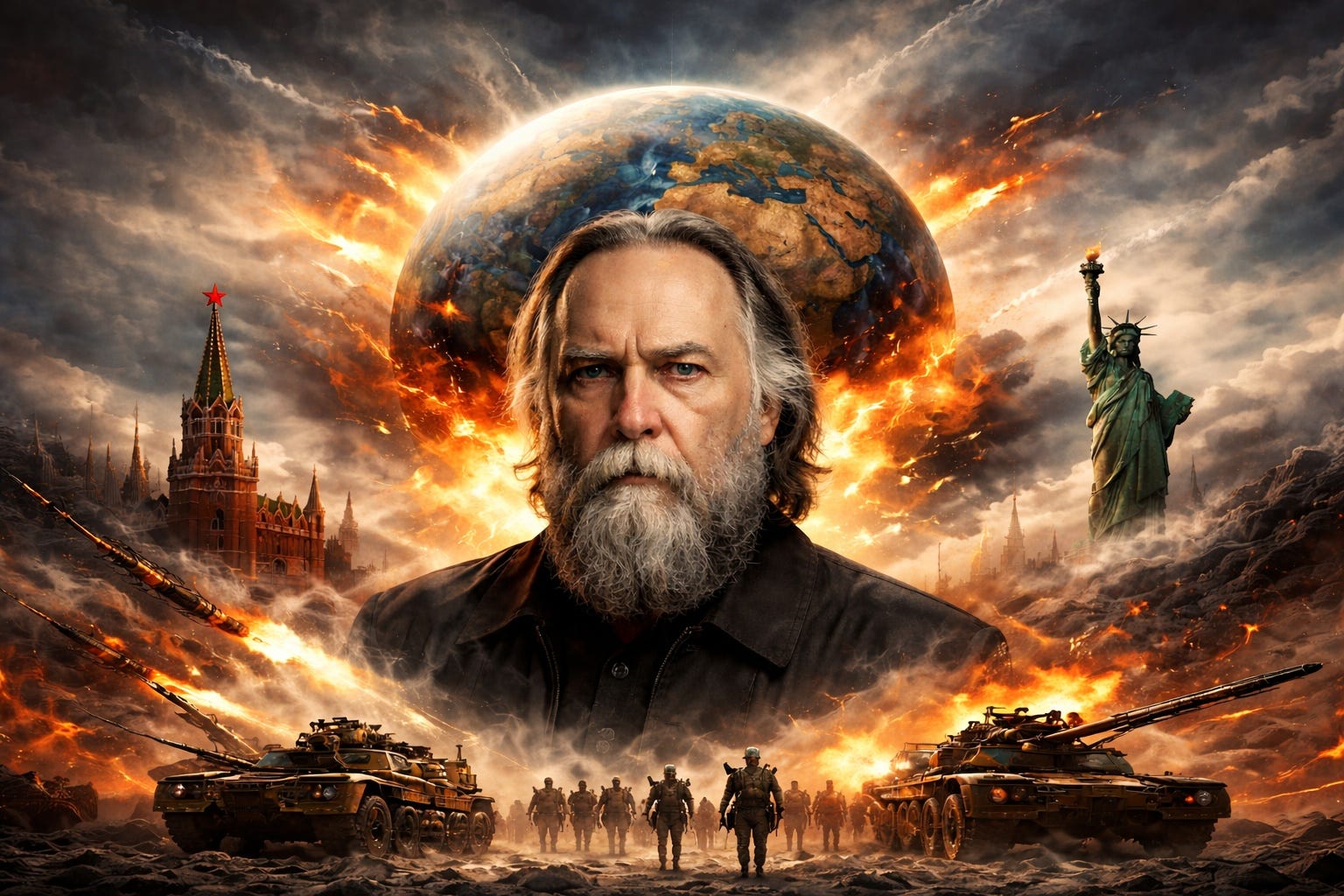
Alexander Dugin on sovereignty and escalation in a world without rules.
Conversation with Alexander Dugin on the Sputnik TV program Escalation.
Host: Let us begin by discussing the negotiations in Abu Dhabi, which have undoubtedly captured the attention of the entire world. This is the first instance since the start of the Special Military Operation of a trilateral interaction in which representatives of Russia, Ukraine, and the United States sat at the same table. Naturally, the informational vacuum was immediately filled with numerous theories: what exactly was discussed, and what agreements, if any, were reached.
There is extremely little official information. We have only a statement by Volodymyr Zelenskyy, who once again raised the territorial issue and claims that a document on security guarantees for Ukraine has been agreed upon “one hundred percent.” In this, he remains true to himself, continuing to broadcast his familiar narrative. Much more interesting, however, is the position of the American side. U.S. representatives—Steve Witkoff in particular—speak of a “serious breakthrough” and describe the discussions as constructive. American officials emphasize that the participants treated one another with marked respect and demonstrated a genuine willingness to compromise.
This raises the main question: what should we expect going forward? Will the meetings in Abu Dhabi become that decisive step towards a peaceful settlement, or are they merely another form of diplomatic camouflage?
Alexander Dugin: From my point of view, expecting peace right now is pointless: the conditions we are in are entirely unsuited to it. At best, one could speak of a temporary ceasefire. Behind the terse statements from our side and the moderately optimistic reports from the Americans lies a stalemate.
If we rewind the process a little, back to the negotiations in Anchorage, we will recall that our president proposed to Donald Trump the conditions under which Russia would be prepared to agree to a ceasefire. It is important to understand that these conditions were significantly below what we truly require. This was a gesture of goodwill, a readiness for substantial—though not fatal—compromises. To stop the bloodshed, there was only one way out: to accept this, to put it mildly, benevolent Russian proposal.
Trump understood this. He grasped how far Vladimir Putin was prepared to go: in essence, the president was ready to suspend hostilities without achieving the full range of objectives set at the beginning of the Special Military Operation. At that moment, our plan did not envisage complete denazification or total demilitarization. The discussion concerned control over the DPR [Donetsk People’s Republic] and the LPR [Lugansk People’s Republic], our military presence in the Zaporizhzhia and Kherson regions, and a number of other demands. This was far less than what could be considered a full-fledged victory—very serious concessions that, for a range of reasons (the president knows best here), we decided to make.
Trump realized this and began to promote our plan, since from his point of view it was advantageous for the West and for Ukraine: Ukraine would remain as a subject, and we even agreed to certain guarantees of its security (without NATO membership and without the deployment of massive armies). Our proposal was genuinely generous toward the adversary—one could hardly wish for better.
Yet even this did not stop them. An outright sabotage of “Anchorage” began. The European Union, Britain, and, of course, Zelenskyy started putting forward counter-demands: an immediate ceasefire, the introduction of NATO troops onto Ukraine’s legally recognized territory, and expanded guarantees. This is exactly what Zelenskyy repeats when he claims that he has “agreed on something” (in truth, more with the Europeans than with the Americans).
Trump himself, owing to his impulsiveness and erratic nature, quickly lost focus on these agreements. After the capture of Maduro, the scandal around Greenland, and amid preparations for a new stage of war with Iran, the Anchorage plan was pushed to the periphery of his attention. By inertia, he began speaking to us in his usual style: issuing orders, ignoring obligations, applying pressure, and making threats.
His most recent messages boiled down to demands that we yield to the requirements of the Europeans and Zelenskyy: sign everything immediately, and that is that. In effect, Trump began treating us as vassals. Unfortunately, he lacks any model of partnership or of dignified, allied relations. In his world, there are either enemies to be destroyed or vassals and slaves. Since we showed goodwill and a willingness to compromise, in his logic we are not enemies—and if we are not enemies, then we must take the place of obedient servants. His thinking does not allow for a third option.
Host: Why did it unfold in precisely this way? Is this connected with success in Venezuela, with the very capture of Maduro?
Alexander Dugin: The thing is that Trump thinks in short cycles. Because Zelenskyy and the European Union very skillfully sabotaged the Anchorage agreements at the initial stage, dragging out the process and advancing unacceptable conditions, they managed to delay and effectively blur it. And Trump simply forgot what had been agreed upon. He forgot that he had been warned: the proposed option was the limit of our compromise—we would go no further and would discuss nothing beyond it.
Under the influence of success in Venezuela and his loud, cowboy-like, almost hooligan-style politics, Trump succumbed to dizziness from success. His terrorist methods on a global scale are yielding results, and he feels that there are no longer any limits. That is why he began speaking to us as if we were vassals. But we will not tolerate this. Yes, we formally observe protocol: we sent military representatives to Abu Dhabi so that, with calm Slavic faces, they could look at this frenzied scum, and then we recalled them. We do not comment on the outcomes because there is nothing there to comment on.
Our president strictly adheres to his promises and cannot simply declare a rejection of the “spirit of Anchorage,” but that spirit itself no longer exists. They are trying to pressure and humiliate us. A very subtle game is underway: we do not withdraw from the process solely in order to demonstrate our capacity for agreements and not to raise the level of escalation too abruptly. In reality, however, these negotiations are doomed. As soon as Trump began taking into account the demands of the European Union and Ukraine—which are categorically unacceptable to us—he crossed out everything that had been discussed in Alaska. Now this is merely a routine leading nowhere.
Trump is offering us a humiliating model of relations that is unacceptable for Russia. However, we are not yet ready to move to the next level of confrontation. And the next step would already be more than just words about missiles. If Ukraine and NATO go further, we will exhaust the resource of threats. We will no longer be able to threaten—we will have to strike. Until we move to that strike, let negotiators like Witkoff and Kushner shuttle around Abu Dhabi or come to Moscow: it’s clean here, it’s safe, they can walk around freely. This is an entirely sterile diplomatic track.
The problem is that the West has never believed in our genuine geopolitical sovereignty. Certain failures during the Special Military Operation were taken by the enemy as evidence of weakness and insufficient resolve. At some point, we missed the moment for a harsh response, relying on Western rationality—but there is none there; they understand only force. Having missed the opportunity to demonstrate that force at an intermediate level, we now find ourselves in a situation where the next step in asserting our geopolitical agency requires an extreme escalation of stakes. At this point, I do not see how a nuclear conflict can be avoided because in the West no one any longer takes statements about “Poseidon” and “Burevestnik” [Russian strategic weapons systems] seriously.
There are many targets that could be struck. For example, one could completely destroy the government quarter in Kiev, so that it simply no longer exists. Even if we did not hit the military-political leadership of this terrorist regime itself, they would still be forced to hide in bunkers and move underground through sewer systems. One could go further—cool the ardor of the most Russophobic, most aggressive European enemies. I do not think we have yet matured to the use of strategic nuclear weapons, but we must be prepared for it. If the West, with which we are fighting in Ukraine, denies us the right to sovereignty, we have no other choice but to prove it by any available means.
Simpler forms of demonstrating our seriousness and strategic power were, unfortunately, missed by us,as we believed it would be possible to manage with conventional types of weapons. Meanwhile, escalation continues, moving to a new level: no de-escalation has occurred on either side. On the contrary, the enemy is inflaming the situation, and we are forced to respond. The moment has now come when everyone is waiting for our strike. The world is frozen in anticipation: why, how, with what force and effect will we respond? To do so is fundamentally necessary.
Actions have consequences, but so does inaction. If we do not strike, we confirm in the eyes of the enemy our inability to act. In contemporary politics of interaction with the West, there is no longer any concept of rational restraint. There is only “I can” or “I cannot.” Either you turn your enemy into Gaza, or Gaza is turned into you. It is a monstrous, horrific formula that one would prefer never to hear, but it is not we who dictate it. I repeat: either Gaza is your enemy, or Gaza is you.
Attempts to draw red lines, shift them, make statements, or enter into compromises—none of this works anymore. It does not work even in relations between the United States and the European Union, let alone with us. The only argument now is effective action. Words have been devalued. Trump simply kidnapped the acting sovereign president of Venezuela, in two hours effectively annexing the country and declaring its riches his own. This is a direct act of international terrorism, a trampling of all norms, but Trump openly says that international law does not exist.
We may be morally outraged by this, but we have no alternative but to accept these rules of the game. Morally correct now is what Russia considers morally correct. We must do what we can and what we want, because that is precisely how they treat us. This is an entry into an entirely new coordinate system, where everything is decided by force—convincingly demonstrated and effectively applied. If we do not enter this system ourselves, we will be pushed into it by force.
Therefore, negotiations with the United States are completely exhausted. They will continue only “for form’s sake,” as a meaningless inertia of the lifeworld, simply to avoid irritating Trump psychologically once again. But the ball is in our court. We must deliver a very serious, weighty, and vivid strike. Against whom exactly—that is for the president and the strategists to decide. But in a no-holds-barred fight, the one who does not strike gets struck himself. If you ask for peace at the moment your opponent swings, you receive a double blow.
We must designate an object for just retribution and demonstrate power. Our inaction now is as effective as action, only in the opposite, catastrophic sense. To strike is risky, but not to strike is even more dangerous. To continue the war is risky, but to stop it now would mean acknowledging catastrophe.
I carefully analyze the Western and American press. The situation in Ukraine does not worry me—it is already clear there: Zelenskyy will sabotage any peace until the very end since war is the only way for his physical survival at the head of the regime. I believe we must destroy this terrorist regime and all of its leadership as quickly as possible, by any means and at any cost. That is the shortest path to peace, to victory, and to the defense of sovereignty. The era of preventive strikes has arrived. Whoever delivers the first, effective strike will gain not only time, but the future.
A powerful and correctly targeted strike against the enemy may be the only way to end this war.
Host: But here is the question: will there be any future at all if all sides begin delivering such preventive strikes?
Alexander Dugin: If everyone begins, the future most likely will not arrive. But the problem is that if we are late in this process, then the future will not arrive precisely for us, while for them it may very well come to pass.
This is a critically important, fundamental point: we are already inside the Third World War. Yes, everything may end in the most tragic way. But for us, the finale will be catastrophic in any case if we do not achieve victory. That is the essence: either we stop them, or we simply will not exist.
Host: I would like to speak a bit more about the transformation of the world order, in which international law ceases to function and everything begins to be decided exclusively by force. Accordingly, everyone is now compelled to prove their right to a place under the sun through action, and Russia is no exception.
However, a well-known saying immediately comes to mind: Do not argue with a fool, or he will drag you down to his level and then crush you with experience. Might something similar happen here? The United States has objectively begun to grow brazen, especially after the success in Venezuela. We see their appetites regarding Greenland, Mexico, Cuba, and Iran. If we enter this game by their rules, will we not lose that very self-conception of ourselves as a rational and, if you will, “proper” force in this world?
Alexander Dugin: Proving that we are rational in a madhouse is the most futile endeavor imaginable. Dealing with an aggressive idiot while observing all the rules of politeness and correctness, addressing him formally and warning him of consequences—that, in turn, is also a sign of idiocy. If international law no longer exists (and it no longer exists, that is all), then appealing to it is meaningless. It is dead, because the main players have decided that it does not exist.
To establish new rules, we must first win this brawl. In a ward of violently insane patients, to claim the role of orderlies or doctors, one must first put all the patients back in their places. And they are now outside the wards, each acting according to his own strategy. Something else is taking shape now: one international law has ended, and a second is being outlined right now—not through declarations, but through concrete actions.
Today, what succeeds becomes the norm. Trump succeeded in kidnapping the president of a sovereign country. Therefore, this is now the norm. Challenging it is useless. To be heard, we need to kidnap some president or a couple of key figures in the same lightning-fast way and say: “Look, Trump, this is what you do, and here are the consequences. We can play this game too. Let us exchange your vassals for our people.” We cannot allow one side to change the world situation through its maniacal behavior. If everything goes unpunished for Trump (and so far it has), then the new “international law” will become that very “Council of Peace” to which he invites everyone: Trump and his vassals, ready to applaud any aggressive gesture from Washington.
He is erasing the old world order and asserting unipolar hegemony. This categorically does not suit us. And we have no choice but to confront an aggressive maniac on his own level. Any other option is simply off the table. It is necessary to accept the conditions of a no-rules fight, reclaim what is ours, and build a new order on the basis of decisive action. The situation is volatile everywhere. In the Middle East, Israel is carrying out a genocide in Gaza—and so what? Has universal outrage caused even the slightest reaction from the face of Benjamin Netanyahu? No. The United States is preparing an invasion of Iran. They are able to do so, and they proceed accordingly.
To say in such a situation that we are “against” or “for friendship” is the logic of Cheburashka [Soviet cartoon animal]. And Cheburashkas are treated accordingly. We need to restore respect for ourselves through fear. Our restraint today is worth nothing; it is perceived as weakness and an invitation to enslavement. We are being pushed very quickly into a situation not even resembling the Soviet Union, but the subjectless chaos of the 1990s. They are trying to deprive us of sovereignty, offering in exchange crumbs from our own frozen assets so that, for example, we would open airspace for a future U.S. war with China.
I understand that within the ruling elite there remain strata—the so-called “sixth column”—who are ready to agree to this, if only their accounts are unfrozen. But this absolutely contradicts the course of the president and the mood of society. We have already paid too high a price for sovereignty to stop halfway. We have only one option: victory. Compromises are exhausted.
The international law that existed before was the result of an extraordinarily difficult victory in the Second World War. Had Hitler won, Russia would not exist, and we would have been slaves. Trump is proposing something similar: “Become slaves and you will live well; perhaps we will call you happy vassals.” We have no choice. One must deal with a maniac harshly. Any tolerance here will be interpreted as defeat.
Host: If one puts oneself in Donald Trump’s place, the logic of his actions appears frighteningly effective. By making such moves against Venezuela, he surely calculates the possible reactions, both of Vladimir Vladimirovich [Putin] and of Xi Jinping. He understands their psychological makeup and how they operate within certain rules. But the internal logic of Trump’s actions seems almost impossible to predict.
Is this even possible under current conditions? Is he moving in one clearly calibrated direction, or is it chaos? And if it is chaos, might there nevertheless be a single, iron logic running through it? We see this pressure everywhere: Greenland, Mexico, Cuba, Iran. At times, it seems that he is simply more brazen than everyone else.
Alexander Dugin: Of course, Trump has a strategy, and behind his actions there is a clear line that is not so easy to grasp at first glance. Why does he feel entitled to kidnap Maduro, an ally of Russia and China, the acting president of a sovereign country? Because he is absolutely certain that nothing will be done to him, neither by us nor by China. This applies to Iran and to any other region. As such antics go unpunished, as he loses nothing and sacrifices nothing, the balance on the geopolitical map shifts. His behavior becomes ever more audacious and unilateral.
This is the restoration of hegemony—but not of the collective West, only of the United States of America. Trump is doing this successfully and consistently, which is truly frightening. Encountering no obstacles, he comes to the conclusion that on the side of the multipolar world there is no one, or there is someone so weak and lethargic that they can be ignored.
I think the time has come to answer challenge with challenge. Trump took Maduro? Fine—then we will take Zelenskyy. Or, say, kidnap Netanyahu for what he has done to the Palestinians, and then decide whether to return him or not. One could exchange Zelenskyy for Maduro. It is not even about personalities—we could take Kaja Kallas straight out of Estonia, together with Estonia itself. What matters here is the principle: if a challenge goes unanswered, the score becomes 1–0 in their favor, and then complete defeat looms. We are dealing with a calculating opponent. The more we allow him to act with impunity, the more tributes he will demand, and the less weight our word will carry.
Trump can be read: he is strategically acting in the interests of the United States, restoring the Monroe Doctrine in the Western Hemisphere. But he intrudes into the Eastern Hemisphere and the Middle East only because no one obstructs him. It is now necessary to create colossal problems for the West as a whole. Perhaps we cannot reach America itself at the moment, but there are many other targets. Trump takes one of our pieces—let us take one of theirs, like Jolani, for example. Why not arrest him for crimes in Syria? This does not even occur to us, but it should.
We now resemble a chicken around which a circle has been drawn in chalk. It is physically able to step over it, but is mesmerized by the line and will die of hunger, not daring to cross it. We are constrained by walls that do not exist. We follow rules that no longer exist and that no one follows. The main thing is to wake up and accept the realities of the new world. This is not a call for blind cruelty; it is a call for symmetrical or asymmetrical actions. Inaction today is also an action, only with negative consequences. In some situations, delaying becomes criminal.
We need to shake ourselves and carry out several actions that will restore not merely respect, but terror before Russian power. That will become the argument for any further dialogue. Yes, we are advancing at the front, but for the West this is unconvincing. We used the Oreshnik [Russian hypersonic missile], but it was forgotten after fifteen minutes. We need events that cannot be ignored. In principle, the city of Kiev should long ago have ceased to exist if we acted by the methods of our opponents. We lost our cities and saw them destroyed during the Great Patriotic War when they were under occupation. History cannot be deceived.
We continue to live in illusions: world order, nuclear power… But nuclear powers lose wars if their weapons are not a real argument, backed by readiness to use them. In the West, they remember how we crawled before them on our knees in the 1990s, and they treat us accordingly. After the collapse of the Soviet Union, we lost face. By dragging out the Special Military Operation, we have made the enemy believe that we are weak. If we do not restore our positions now, this label will be permanently fixed.
It turns out that we are not simply defending sovereignty; we are fighting for the very right to have it. As it becomes clear, what we previously considered sovereignty was not sovereignty at all. Our claim to independence met furious resistance. We are told, “You are not sovereign—prove otherwise.” That proof can only come through large-scale, unambiguous action.
We glorify Oreshnik, and they do not notice it. If a strike is not noticed, then it did not happen. But the kidnapping of Maduro in two hours—that is a slap that cannot be ignored. The seizure of our tanker, the detention of our sailors—tomorrow everyone will do the same if there is no decisive response.
We need to play this card, even if on Ukrainian territory, but in such a way that the entire West shudders. They will not love us, but they will once again fear us—and therefore respect us and take our interests into account.
Host: First, let me make the necessary disclaimer: the Islamic State is designated a terrorist organization in Russia. But against the background of your words about the need to carry out concrete acts of retribution, we are now witnessing an extremely serious threat to Iran from the United States. Do you believe it is possible to consider, as one of such “acts of asserting sovereignty,” for example, the direct participation of our armed forces in the defense of Iran?
Alexander Dugin: Undoubtedly, that would be the right thing to do. Under no circumstances should we abandon Iran. But how can this be done? Quite recently, I appeared on Iranian television and said directly: the only way for you to withstand a new war is to create a Russian–Persian union state on the model of Russia and Belarus. There is nothing reckless about this. Look at Trump—he is taking far more radical steps. We need to act quickly: establish the status of an allied state and guarantee Iran’s sovereignty with our nuclear weapons. Otherwise, it is finished, and everything else will follow.
Do you see what is happening in China? A conspiracy against Xi Jinping is brewing there. Xi embodies sovereignty, yet a significant portion of the Chinese elite—including elements of the military—appears to be working for a geopolitical adversary. In China, where the Communist Party rules, where a rigid vertical of power is built and there is an ideology, Western influence networks have reached such a level that an attempted coup d’état was undertaken. It was prevented and suppressed only the other day.
If this is happening there, then what about us? Can you imagine the condition of our ruling elites, who were pro-Western until the very last moment? The risks for the president, for the country, and for our sovereignty are enormous. In Iran as well, matters were drawn out for a long time, with verbal threats directed at Israel, but when the war began, they proved unable to back those words with action. And now a critical moment has arrived: the Americans are preparing military aggression against Iran. In effect, this is aggression against us. Venezuela, Syria, Lebanon, Yemen—all of this is directed against Russia. One cannot pretend that this does not concern us.
We must help Iran, but first we must prove that we are capable of something. We need to do something that will make it clear to everyone: it is better not to provoke us. I do not think that simply sending a limited contingent will change the situation. More effective means are required—means capable of cooling the ardor of enemies and stopping Trump. Yes, he has ideas regarding Greenland that drive a wedge between the United States and the European Union, and this can be supported. But strategically, the purchase of Greenland also works against us: it is an attempt to prevent our missiles from deploying their warheads over the island in the event of a nuclear conflict. We cannot be political masochists and rejoice at being surrounded.
In conclusion, I would like to congratulate great India on the 77th anniversary of its independence. This is a wonderful holiday. India is one of the most important poles of the multipolar world; we have excellent relations and common goals within the concept of Viksit Bharat.1 Let us not lose those who still remain our friends. We need to engage more actively in foreign policy: protect our own, stand up for allies, and deliver a decisive rebuff to enemies.
Let us build a multipolar world and seek genuine partners in this most difficult historical task.
(Translated from the Russian)
Translator’s note: Viksit Bharat means “Developed India.” It is a strategic national vision articulated by Narendra Modi and the Indian government, most often framed around the goal of making India a fully developed country by 2047 (the centenary of Indian independence).

Wow! This is amazing. I am a very sad American these days. I see our nation in full subjugation to the Antichrists of Israel. It would be to my great plaeasure to see us freed from such monsters. Please vaporize Washington D.C. and all of the swamp creatures that dwell there.
We, as Americans, have seen OUR time to act come and go. It seems that we have been used to propagate most of the evil of the last 25 years. We had a chance to hang the traitors, but it is gone. I pray that those who are still able to act will do so. I just hope it warms up a little first. Its cold here!
My portuguese translation with a short presentation: https://pedroteixeiradamota.blogspot.com/2026/01/multipolaridade-pela-forca-alexander.html