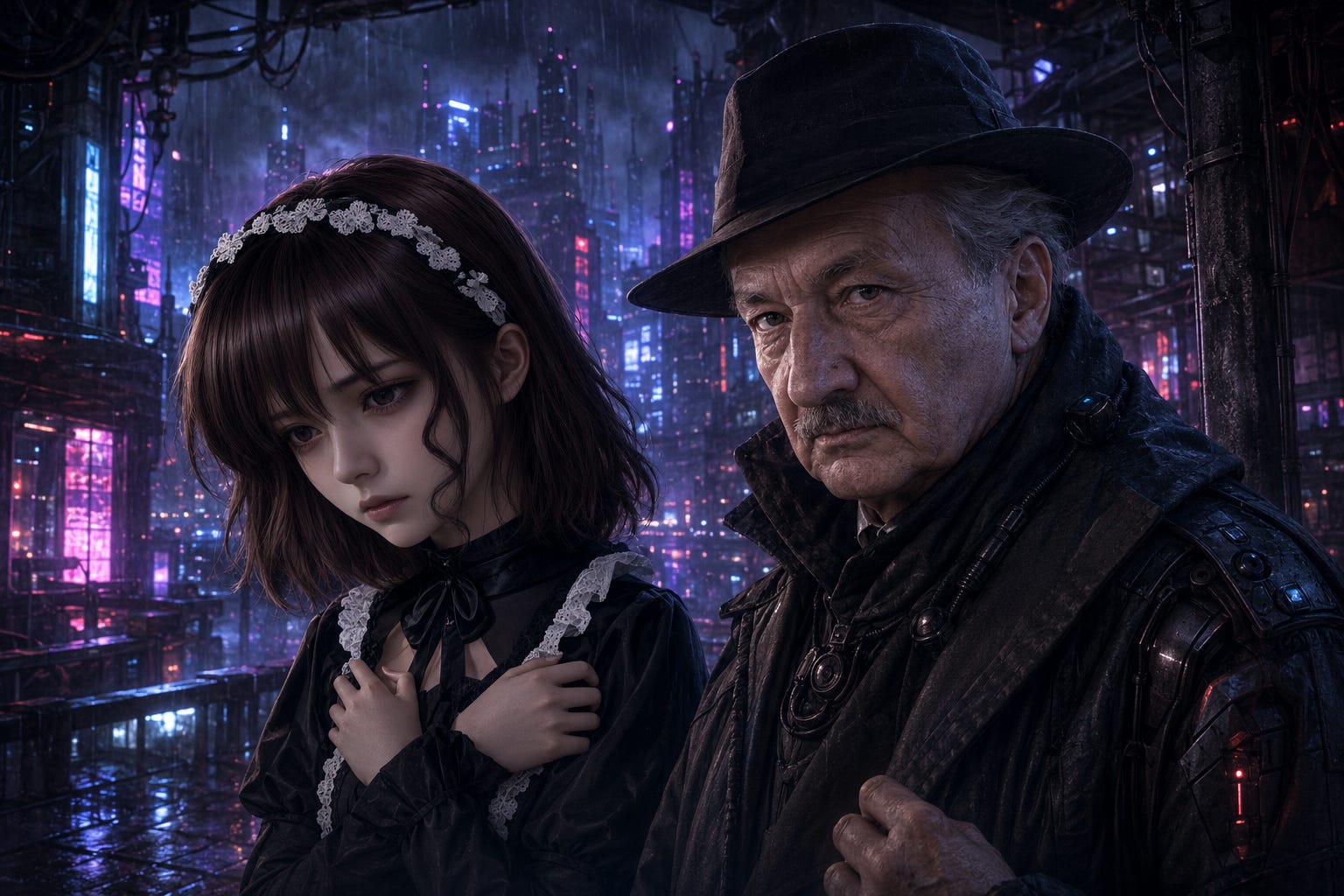
Michael Kumpmann recounts how the philosophical anime of the 1980s and 1990s led him to Heidegger and shaped the world of fear, terror, and alienation in his science-fiction novel Dimensional Prophecy of Zohar.
Kyoto Novalis, at an unspecified point in the future. Several years have passed since the Caine aliens carried out a terrorist attack on the Martian colony of Grover’s Mill. The aliens appeared without warning and attacked the colony’s government building. Strangely, subsequent investigations indicated that these aliens were apparently also a form of humanity. The attack developed into a decades-long terror crisis. The aliens would suddenly appear in human cities, launch an attack, kill large numbers of people, and immediately disappear again. Nowhere was safe from them. They could strike and spread terror anywhere. Even increased surveillance and extreme measures failed to stop them.
One day, the mathematician Riemann and his assistants, Szabi and Rosenberg, discovered a mathematical algorithm that could predict precisely when the Caine would appear. Humanity finally had a chance to fight back against the terrorists. An institute was established in Kyoto Novalis to apply and improve the algorithm. Humanity could now prevent attacks and save lives. At last, the situation seemed to be improving.
Then the algorithm suddenly began producing large numbers of false predictions. It turned out that it had problems with machine precision and relative error and therefore had to be revised. The Carl Friedrich Gauss Institute was also given the task of improving the algorithm’s efficiency and accuracy.
Karala Yagiyu, the young daughter of two scientists at the institute, is to be recruited as a specialist. She arrives in Kyoto Novalis by train. At the same time, however, the bodies of people who have evidently been murdered by the Caine aliens begin to appear. More and more incidents occur, and the Caine even drive some people insane. The situation becomes an absolute crisis because the government sees only one way to stop them:
If necessary, completely destroy the city with hydrogen bombs and bury it beneath a layer of concrete.
Can the catastrophe still be prevented, or is everything lost?
This is the plot of my science-fiction novel Dimensional Prophecy of Zohar, which has been available on Amazon for several months and has already been featured several times here at Multipolar Press.
It is easy to see that fear is the story’s central theme, and, as the latest trailers have shown, the novel is also heavily inspired by Heidegger’s work. But how did this come about, and how does that influence express itself? It may sound paradoxical to many people, but its origins lie not in philosophy but in popular culture—more precisely, in anime from the 1980s and 1990s.
Many anime from that period contained philosophical undertones. One well-known example is Mamoru Oshii’s film Ghost in the Shell, which later became one of the main inspirations for the Matrix films. After all, The Matrix is the “most famous film adaptation of Plato’s work.” Megazone 23 is another famous Gnostic and Platonic anime from the 1980s. In it, machines imprison humanity within a simulated reality in which the 1980s have been repeating in an endless loop for centuries. A Wind Named Amnesia is also a highly Platonic work, based on a Japanese science-fiction novel, in which aliens take control of the world and periodically erase humanity’s memory. The protagonist is a wanderer who loves an alien woman named Sophia and searches for people willing to risk pursuing an education and recovering their memories. Notice the name: the protagonist loves Sophia. To love “Sophia,” or wisdom, is the true meaning of the word philosophy.
Gunbuster uses time and its passage as a central element of its plot. It examines what happens when time dilation causes you to age so slowly that the world continues to develop without you while you yourself appear to stand still.
The best-known “philosophical anime,” however, is probably Hideaki Anno’s Neon Genesis Evangelion, with its references to Freud, Lacan, Wilhelm Reich, the Kabbalah, and direct quotations from Schopenhauer and Søren Kierkegaard. Kunihiko Ikuhara’s series Revolutionary Girl Utena originated as a rejected proposal for a Sailor Moon film about Haruka and Michiru, which the studio then transformed into a complex Masonic and Rosicrucian allegory. The most extreme philosophical anime series is probably Serial Experiments Lain, almost 99 percent of which consists of intricate philosophical discussions about causality, the effects of media, existence, the internet, computer technology, time, and other subjects. Mamoru Oshii’s Angel’s Egg is also a famous short film dealing with Nietzsche’s concept of the “death of God.”
These themes were so richly represented in anime because Japan’s economy was booming during the 1980s, while the invention of the VHS cassette triggered an explosion in independent filmmaking. It was the only period in which a group of science-fiction nerds could approach investors and receive a million-dollar budget to produce a science-fiction anime. This led to the creation of numerous works conceived along the lines of: “Let’s combine philosophy, Philip K. Dick, Robert Heinlein, Isaac Asimov, and the aesthetics of Métal Hurlant (Heavy Metal), Alien, and Blade Runner in a new anime.”
A video explaining what makes anime from this period and its aesthetic so distinctive:
A montage of scenes from anime of this period:
Megazone 23, whose visual kinship with the French Métal Hurlant comics is particularly apparent:
Wicked City, a horror anime with an especially stylish neo-noir look:
Films were not the only medium affected by these trends. They continued in video games as well. It is no coincidence that one of Shinra’s executives in Final Fantasy VII is named Heidegger, while the game’s famous Professor Gast is almost a direct copy of Hermann Wirth. Xenogears, which was obviously influenced by Evangelion, contains references to Nietzsche, Gnosticism, psychoanalysis, and more. Then there is the famous Metal Gear series, which many players know precisely for its engagement with such subjects.
This period of anime and the works it produced were clearly among the main influences on Dimensional Prophecy of Zohar. The word Dimensional in the title also comes from this tradition. I based it on the naming conventions of Super Dimension Fortress Macross, Super Dimension Cavalry Southern Cross, and Super Dimension Century Orguss.
These anime were also what first led me to philosophy. Of course, back in the late 1990s, when I was an autistic super-nerd, most of the references went straight over my head. I mainly watched them for the action. But when I began taking philosophy classes in high school and watched Neon Genesis Evangelion again, something finally clicked.
It actually happened through a somewhat indirect route. After watching Neon Genesis Evangelion, I read about the game Xenogears in an old issue of AnimaniA—I still have those glossy magazines from the 1990s—and the article said that it was similar to Evangelion. I desperately wanted to play it. After an EXTREMELY LONG campaign of persuasion, I convinced my father to order me a modchip for the PlayStation and an imported copy of Xenogears. I also heard that unofficial successors to Xenogears were being produced: Xenosaga Episode I: Der Wille zur Macht (The Will to Power), Xenosaga Episode II: Jenseits von Gut und Böse (Beyond Good and Evil), and Xenosaga Episode III: Also sprach Zarathustra (Thus Spoke Zarathustra). I wanted those too.
Those titles puzzled me. They sounded extremely strange, and I wanted to know what these peculiar names meant. So I looked them up online, and that single step genuinely improved my life. In my spare time, I began constantly reading Nietzsche, Kant, Heidegger, Kierkegaard, and many others. My philosophy grades went from a 4 to the highest mark in the class on every exam. My philosophy teacher even begged me to study philosophy instead of computer science. Ironically, he eventually got his wish despite everything, because I did later become a philosopher.
I was completely blown away by these old anime and wanted to create something similar. Thanks to vaporwave and, above all, artificial intelligence, many people are now trying to revive the “1980s and 1990s anime aesthetic,” but I began doing it around 2004. Lol. I eagerly studied not only the works of philosophers but also the science-fiction influences behind the style, including Blade Runner, 2001: A Space Odyssey, Starship Troopers, Alien, H. R. Giger, Stanisław Lem, and others.
My Dimensional Prophecy of Zohar project began during the summer vacation when I was around seventeen. The idea came from an AnimaniA interview with an anime director who said that he wanted to make a film about Being. I have forgotten who it was. By coincidence, I had bought the same philosophy textbook our teacher used, and it contained an enormous chapter on precisely that subject. I thought, “Okay, I’ll write a story about that too.” I worked through the chapter, along with excerpts from Nietzsche, Sartre, Heidegger, Hegel, Freud, and Marx, and slowly began planning the story. Yes, I am serious. Other seventeen-year-olds used to read Playboy secretly under the covers at midnight. I secretly read Heidegger instead.
My basic premise was that I should place this theme in the foreground and portray a future humanity under attack by bizarre Lovecraftian aliens who, for some reason, also happened to be human. One of the protagonists’ central questions would be why these creatures should also be considered human. In the first draft, they resembled the bugs from Starship Troopers because I had not yet learned how to capture the Lovecraftian style properly. But as my understanding of Lovecraft grew, and as I encountered other books such as Solaris, the aliens increasingly developed into “eldritch abominations” incomprehensible to the human mind.
The very first rough draft, which I posted on German fan-fiction websites, was still extremely raw and had problems with plot cohesion.
Years later, while studying computer science, I began my first major revision of the story. The inspiration came from a simple personal fear: I was terrified of failing an upcoming exam. I wanted some way to talk about my fears. I therefore rewrote the story so that humanity had invented an algorithm—a computer program—to defend itself against the aliens. By “coincidence,” however, the program suffered from precisely the problems covered in that exam and therefore had to be corrected. The plot also moved away from the military and combat and toward research and analysis, with a generous dose of The X-Files-style investigation and conspiracy.
I then discovered another anime called Gasaraki, which also influenced my work. The creators of Gasaraki believed that Hideaki Anno had gone too far with the esotericism and mysticism in Neon Genesis Evangelion. They wanted to present a “credible vision of a possible future” instead. Dear reader, you will immediately see just how frighteningly credible the series’ premise was. Produced in 2000, it tells the following story: in the near future, the United States accuses the dictator of a Middle Eastern country—who looks remarkably like Saddam Hussein—of possessing weapons of mass destruction and launches an unpopular regime-change war. As the war runs into difficulties, unmanned combat drones are used with increasing frequency.
So much for a “credible vision of a possible future.” Almost exactly that happened one year later. The series gave me another idea: the government would regard the attacking aliens as terrorists and restrict civil liberties, expand surveillance, and introduce similar measures in an effort to stop them.
The next decisive event was the Fukushima disaster. Here in Germany, people practically descended into a mass psychosis. Among other things, this led some Germans to accidentally poison themselves with anti-radiation medication and prompted Germany to carry out its idiotic nuclear phaseout, the gradual closure of all the country’s nuclear power plants, which is one reason for its present energy crisis. Germany later also abandoned cheap Russian gas and replaced it with liquefied natural gas. Germany obtains this LNG from Qatar, and transporting it to the country depends on the Strait of Hormuz remaining open. If I were not German, I could almost laugh.
This made one thing clear to me: I had to change my story and its philosophy FUNDAMENTALLY. Until then, Heidegger had appeared only in a minor subplot involving the character Madoka Michael and her psyche. But Heidegger’s theme of existential anxiety needed to become THE central theme of the story, partly because this would reflect reality. The Fukushima crisis had clearly shown that human beings were not, as many within Germany’s market-liberal Free Democratic Party (FDP) and elsewhere claimed, “rational, logical creatures.” No. The central human emotion is fear. Fear comes first; only afterward do we ask what we are afraid of. The fundamental feeling that accompanies us from birth to death, controlling all our actions and our entire way of life, is fear.
I also realized that this theme applied not only to Madoka but to all the characters and to the background of the story itself. Karala initially runs away after encountering the alien monsters but later regrets it. Once again, fear is clearly the theme. The basic premise of devoting all the state’s money to completing a computer program capable of predicting alien attacks is likewise an example of fear and of how people attempt to deal with it. It is also an example of what Heidegger called Gestell, or enframing, as I later realized.
This led to my final major revision of the story, in which I moved the themes of fear and Heidegger’s philosophy into the foreground. That gave the story its final touch. As a result, the aliens also became literally radioactive and emitted radiation. Later, I included allusions to “other fears” as well. The aliens, for example, lead to curfews and mask mandates. They were intended to become the sum of all contemporary fears.
Alongside its political and philosophical themes, the work also became a means of self-analysis, following the example Hideaki Anno had set with Evangelion. My social anxieties, the difficulties I experienced connecting with others because of my autism, and many other personal experiences flowed into the work.
Incidentally, my growing interest in Heidegger later had another consequence. In 2015, a libertarian Facebook friend named Manuel Peters told me about a Russian philosopher called Alexander Dugin, who was apparently one of the greatest living Heideggerians. That discovery quite literally placed me on the path I am following today.
(Translated from the German)


