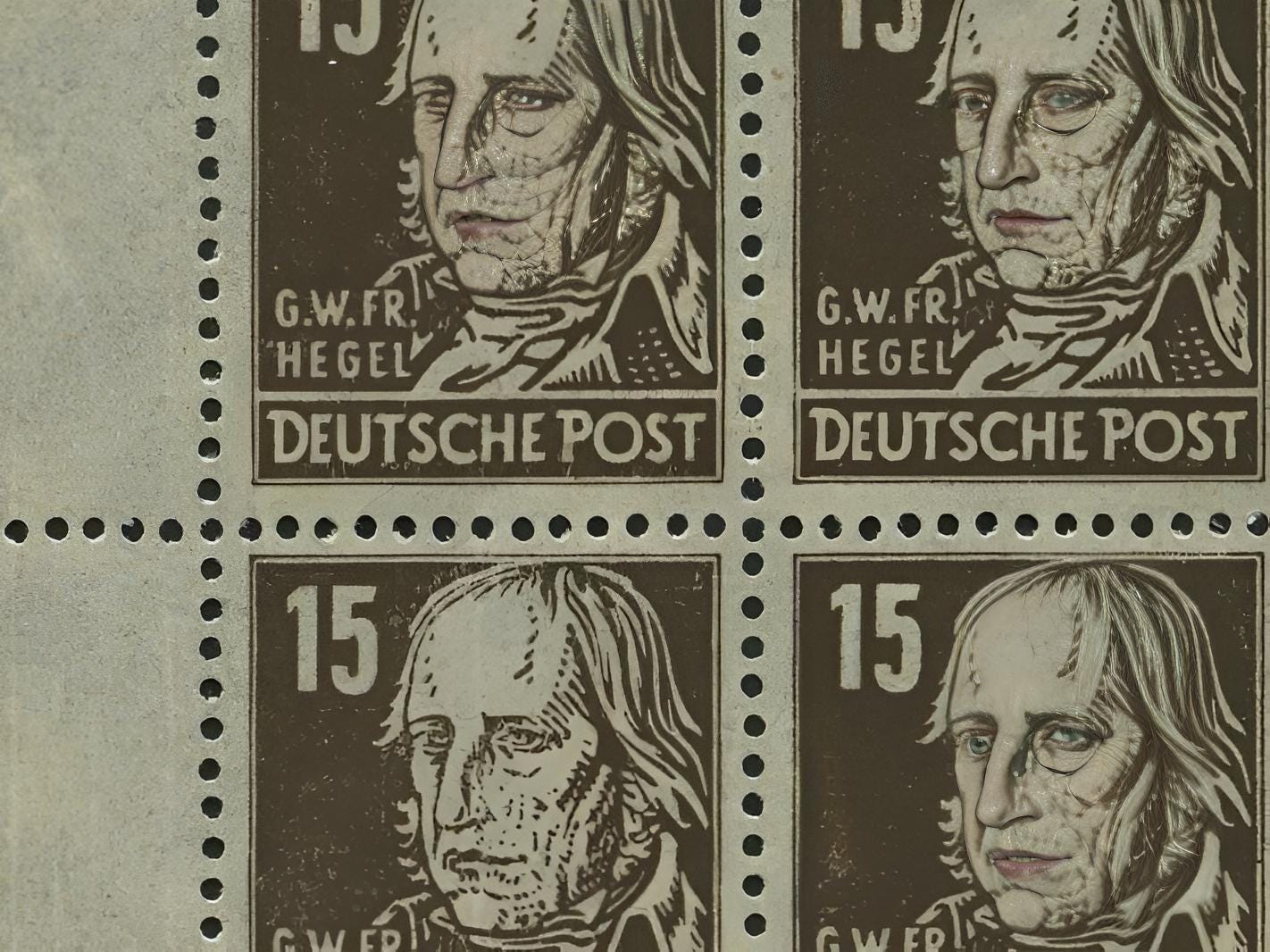
Hegel’s Philosophy of History
On Hegel’s non-linear dialectic
Alexander Dugin explains that for Hegel, the end of history is a return to the origin.
The Absolute Spirit is not a beginning but the result of the complete cycle of the unfolding of subjectivity—hence Hegel is not an idealist but a phenomenologist. However, he is a phenomenologist of the Radical Subject. If Hegel declares the Absolute as a result, then an absolutely radical immanence arises—similar to that of Fichte. Hegel writes: “Of the Absolute, it must be said that it is essentially a result, that it is only at the end what it truly is.”1
The Absolute is that which must still become itself, not merely by purging its dark side, as in Böhme,2 but by passing through self-alienation—from the empty universal to the catastrophic concrete, and then returning from the catastrophic concrete to the origin in a new quality. That is, the Absolute lies ahead as a goal, as an end. However, this is not a linear movement, which is also crucial to understand: it is a movement from the center to the periphery and from the periphery back to the center. This is not the movement that occurs on the outer circle of consciousness, i.e., where constant transformation takes place (on the reverse side of eternity within the element of time).
For Hegel, history is not what unfolds in time; rather, it is what unifies the departure from eternity into time and the return from time back into eternity. Hegel’s history, Hegel’s time, is a movement from the center to the periphery and from the periphery back to the center. This history predetermines the structures and moments of time. Time itself has no orientation, meaning, or content; it does not carry any events within it. All events and all contents of time originate from within consciousness. (Time as a linear process is fundamentally alien to Platonic, Hegelian, and phenomenological thought.3) All events of time originate from within consciousness. If we use its elements located at its periphery, or even further outward (in the hypothetical realm of “things-in-themselves”), or view history as a linear process, we will deviate maximally from Hegel.
Hegel’s history is the history of the unfolding of the subjective Spirit into time and its return and transformation into the Absolute Spirit. Hegel’s history is transversal to the temporal process as such. That is, history is not merely “not time”—it is perpendicular to it. The events that occur in history are not those that occur in time, but events that occur in the structures of consciousness. And it is this consciousness that marks time with its events. Therefore, when we speak of the “end of history,” it means reaching the original point in a new quality. However, this unfolding of the structure of Spirit and the unfolding of the dialectic of actuality (Wirklichkeit) never had a beginning in time—it existed in the point of eternity. This point is what we identify as the Radical Subject, as Homo Intimus,4 or as νοῦς ποιητικός. From here, as from an empty and unmanifested state, negation moves towards the periphery, and then from the periphery, a return occurs. In this return, the center reveals itself as something absolute. This is the result of history, but it exists neither in a linear nor a cyclical dimension. In a cycle, as Aristotle shows, there is no beginning or end. The movement of a planet is eternal; it never began from a single point—it has always existed. Its beginning is both the beginning and the end, two relations of a single point around which planets revolve, not a point located on the orbit itself. This requires a completely different perspective on Hegel’s dialectic, which cannot be interpreted from the standpoint of processes occurring on the periphery of our consciousness but which present themselves as independent and autonomous.
(Translated from the Russian)
Hegel. Phenomenology of Spirit.
In the teachings of Jakob Böhme, God contains within His foundation (Grund) a dark beginning (”Nature in God”), from which He purifies (absolves) Himself in the process of becoming Spirit. See Alexander Dugin, Noomachy: The Wars of the Mind. The Germanic Logos. The Apophatic Man.
See A. Dugin’s lecture course “Doxas and Paradoxes of Time” (2021–2022).
Homo intimus—the “innermost human,” located even deeper than the merely “inner human,” homo interior. A crucial category in the system of Dietrich Freiberg and among the Rhineland mystics. See Dugin. Noomachy: The Wars of the Mind. The Germanic Logos. The Apophatic Man.


Obviously Hegel mimics Aristotle. But in a baroque way. Hegel’s density, abstraction, and totality make him adored by Marxists.
He’s hard to falsify
His theory is easy to ritualize
Also perfect for commentary, exegesis, secular priesthood. Hegel gives ideology confidence disguised as philosophy.