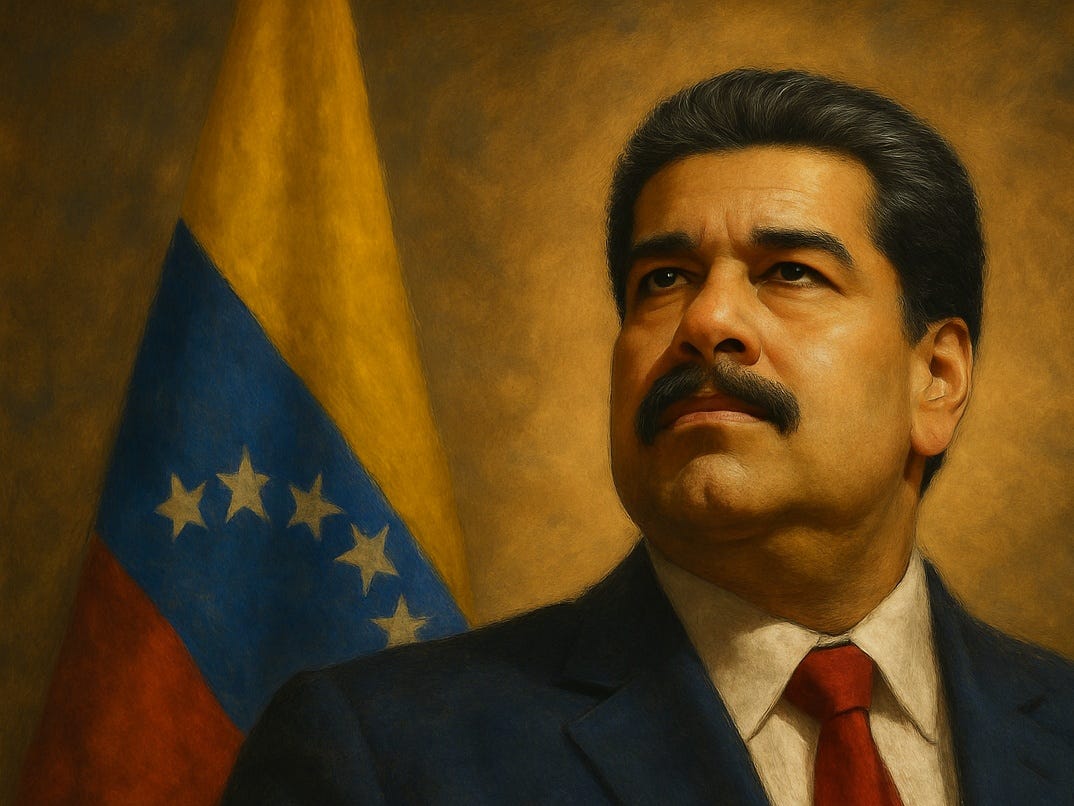
Exile Is Not an Option for Maduro
Resistance and an example of dignity for Nuestra América
Nuestra América explains why Nicolás Maduro’s refusal of exile is a strategic assertion of sovereignty.
The history of Nuestra América1 is marked by leaders who have understood that sovereignty is not negotiable and that true power lies in the capacity to resist, even when external pressures appear overwhelming. Nicolás Maduro, facing the assaults of the United States and its regional allies, embodies this tradition. For him, exile is not an option; surrender would mean forfeiting not only Venezuela’s destiny but also a strategic example of dignity and autonomy for the entire region.
For decades, the global hegemonic power has attempted to impose its narrative: that leaders of sovereign states must submit to sanctions, blockades, or soft coups if they fail to comply with Washington’s agenda. Yet Venezuela has demonstrated that organized resistance and the intelligent defense of territory, both physical and political, can turn external pressure into an opportunity for internal strengthening and the building of regional legitimacy.
Maduro confronts a dilemma that extends beyond the personal: every move on the international chessboard carries a multiplier effect on perceptions of sovereignty across Latin America. His continued presence symbolizes that a country can withstand the most intense coercion without relinquishing its independence. Every measure of asymmetric defense, every diplomatic maneuver, and every affirmation of internal leadership reinforces the narrative that dignity is non-negotiable.
Exile would be more than a personal defeat; it would represent a strategic setback for Nuestra América. Resistance, by contrast, offers an example that transcends borders: it shows that the defense of sovereignty is possible even when facing far more powerful forces. This resistance is not limited to military or economic defense; it is also expressed in international politics, in alliances with countries and blocs that challenge unipolar hegemony, and in the articulation of a narrative that emphasizes self-determination and dignity in the face of external blackmail.
In this sense, Maduro embodies a fundamental lesson of modern geopolitics: endurance and resistance build power far beyond material might, since the international and regional perception of sovereignty and dignity becomes a form of strategic capital that no military arsenal can buy.
Venezuela, under Maduro’s leadership, thus becomes a symbol of resistance for Nuestra América, demonstrating that independence is protected not through submission but through firmness, strategic intelligence, and political will. Exile is not a way out; it is renunciation. Resistance is the silent victory that inspires and transcends generations.
(Translated from the Spanish)
Follow Nuestra América on:
Translator’s note: Nuestra América is a political and cultural concept rooted in Latin American anti-imperialist thought, most famously articulated by José Martí (1853–1895), a poet and revolutionary central to Cuban independence, in his 1891 essay of the same name. It refers to Latin America as a civilizational space with its own historical consciousness, cultural identity, and political destiny, distinct from and often opposed to Anglo-American and European imperialism. In contemporary usage, Nuestra América denotes a tradition of sovereignty, regional solidarity, and resistance to external domination, emphasizing self-determination, multipolar alignment, and the defense of political and economic autonomy against hegemonic intervention.


A more independent approach to the country's finances would make resistance far more efficient. The material discontent imposed on a large portion of the Venezuelan population, arisen from the privately - controlled forex market and credit system, is the base being cultivated in order to seek regime change with or without other attacks of a different kind. The Collective West block in the process of definition is coordinated by powerful financiers (usurers) and their think tanks, combined with captured supranational institutios. Their privilege is under threat from 2014 in consequence of Richard A. Werner's outstanding publications. If you take into account that those same financiers are in control of no less than Russia's finances (read Stephen Mitford Goodson, Glazyev, or Edward Slavsquat if you have any doubt), with all its implications in the strategic arena, as well as involved in drafting key statements by BRICS Leaders (see their July 6 2025 Rio Declaration); while the Unit or time-and-again postponed BRICS currency is for the time being defined (40 % gold, 60% BRICS currency basket) in a manner that favors and reinforces existing accumulations of fraudulent capital and the ensuing power, then you have to realize that independence for nations other than the few nuclear powers forming the power poles in the new multipolar world can be aimed at seriously only through a serious takeover of the credit system by the community. That was an essential part of the path followed by China from 1978. And that is the challenge for Venezuela and many other countries. The Bolivarian Financial Association (Asociación Financiera Bolivariana) is in the process of formation and aims at promoting sound, community based banking and finances for Venezuela and any other States willing to try this proven path, that has distinguished Germany's economic performance since the second half of the 19th century.