

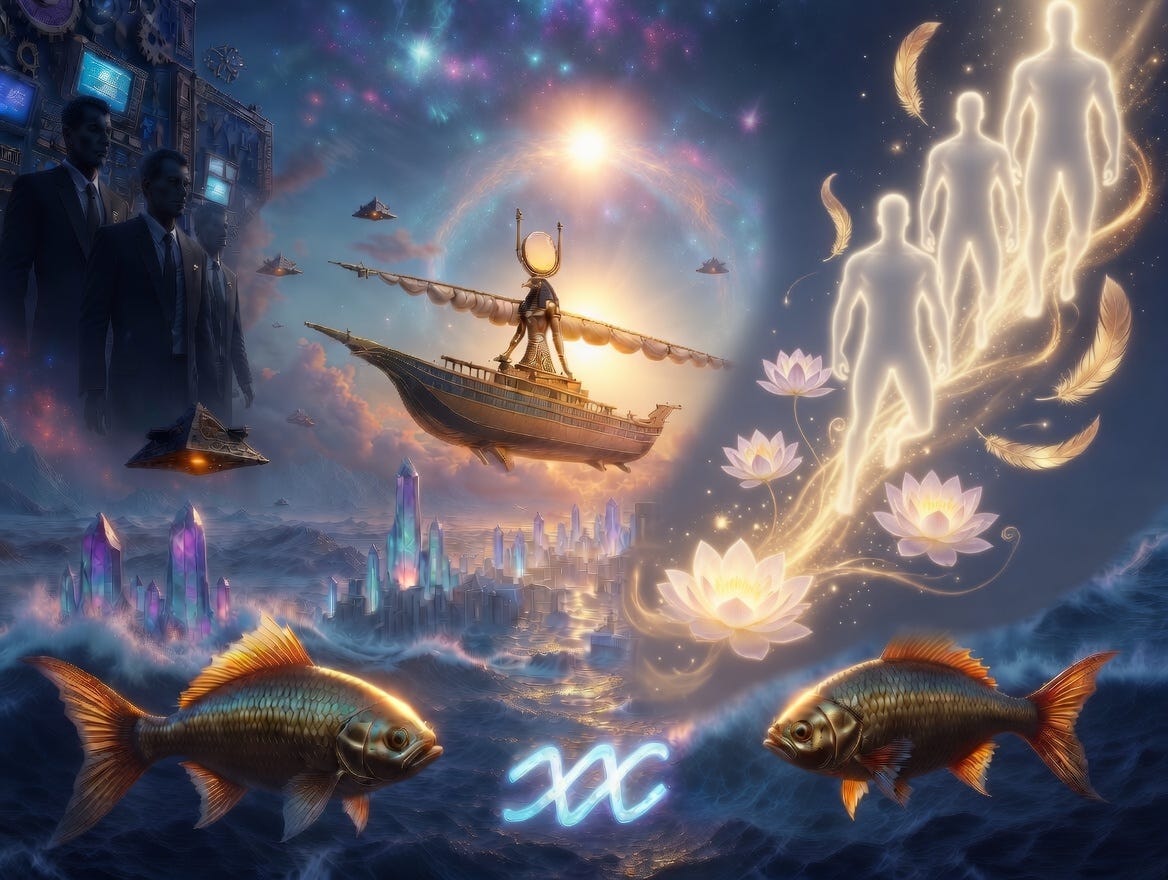
Michael Kumpmann on Atlantis, Deep State mythologies, Ahrimanic illusion, and the promise of a new age.
Recently (April 20, 2026), David Wilcock died. Officially, his death was ruled a suicide, but there are substantial reasons to question that conclusion. Shortly before his death, he had publicly stated that suicide was a sin and that he would never take his own life. The manner in which he is said to have done so also appears highly unusual, as he had previously called the police to the location, claiming he was being threatened by someone else. Strangely, his co-author was also murdered shortly before Wilcock’s death. Wilcock was a figure closely associated with QAnon, and most people will likely recognize him from that. He also appeared on the History Channel program Ancient Aliens.
At first glance, most readers will probably respond to the news—that someone connected with Donald Trump, occultism, and conspiracy theories has died under circumstances officially deemed a suicide, yet questioned by others—with a familiar reaction:
“Again? Another one like this?”
But first, a clarification: Wilcock did not own a private island, nor did he have the means to acquire one. So there were no questionable activities involving Trump in that respect. On the other hand, since I have been the “Trumpist” within our “publishing network,” and since my most widely read article this year dealt with Jeffrey Epstein, I am probably well placed to address the subject.
One of Wilcock’s main areas of interest was ufology and alleged secret aircraft developments within the U.S. military. Among other things, he was one of those who helped revive the TR-3B theory. In the late 1980s and 1990s, unusual triangular aircraft with lights arranged in a triangular pattern were reported in Belgium and elsewhere. This gave rise to the idea that the U.S. military possessed a secret aircraft—supposedly a further development of the B-52 Stratofortress—which could also hover in place like a helicopter. This concept was picked up directly by the series The X-Files, whose spacecraft resemble TR-3Bs.) Wilcock also discussed topics such as Hyperborea.
Wilcock was a follower of Edgar Cayce and even believed himself to be Cayce’s reincarnation. He had a strikingly similar birth chart and also bore a close physical resemblance to him. There is even a prophecy attributed to Cayce concerning his return, which aligns quite well in timing with the beginning of Wilcock’s career. However, Cayce’s family firmly rejected Wilcock’s claim and refused any contact with him.
Edgar Cayce was an American clairvoyant and theosophist who engaged deeply with Christianity (and interpreted the original teachings of Jesus as a more developed form of Buddhism, in which love for all creation would replace the idea of dissolving the ego), as well as with Atlantis (which he regarded as an ancestral civilization of the United States, describing a crystal-based technology that shows certain parallels to spintronics and quantum computing—both also involving crystalline structures—and which would, among other things, possess an extremely high storage capacity. With spintronics, the entire DVD and video game collection of an average gamer could fit into a diamond of ordinary size, with ample space remaining.)
Like Manly P. Hall, Cayce also concerned himself with America and its spiritual mission. However, he believed that America’s time as the dominant global superpower would soon come to an end, and that a massive catastrophe would befall both America and Europe. Europe, he foresaw, would fall victim to a natural disaster and would be rescued by a post-Soviet Russia through supplies of raw materials and food, leading to a Eurasian sphere (Cayce’s words: “Out of Russia comes the hope of the world”). At the same time, China would, in the future, abandon communism and undergo an extraordinary rise, breaking America’s military dominance. He claimed to have seen all of this in visions during the 1950s. There are also prophecies that strongly resemble Donald Trump—though these were framed more along the lines of a warning: “Whatever you do, do not fall for him.”
Edgar Cayce’s popularity also rose significantly among supporters of QAnon and the so-called “Great Awakening,” particularly through the influence of David Wilcock. A similar dynamic could be observed in Germany during the COVID period, when the theosophist Rudolf Steiner suddenly experienced a surge in popularity.
Within Theosophy, Atlantis is viewed as a civilization that was internally corrupted by “dark magicians.” These figures are said to have led humanity on a large scale into various forms of perversion. Some conspiracy theorists, such as Jean Parvulesco and many others, have linked this idea to entities like the Illuminati and the Rothschilds. Wilcock was among those who adopted such views, arguing that these events in Atlantis were the origin of the so-called Deep State, Soros networks, and similar structures. According to this perspective, these bloodlines—allegedly also in contact with malevolent extraterrestrials—later intermingled with present-day humanity, said to descend from Adam, and now constitute the modern power elite. In Wilcock’s framework, the Deep State functions roughly as the executive organ of the Demiurge, keeping people away from the truth.
But what is this truth that is supposedly being concealed from us? Here Wilcock refers to the so-called Ra channelings, in which a group around Carla Rueckert claimed to have established contact—through trance and meditation—with the Egyptian god Ra (who is also described as a remnant of an extinct civilization from Venus). These insights were recorded in a book published in 1980. A central element of this material is the so-called “Law of One.”
This topic will certainly please my editor, Constantin von Hoffmeister, who wrote the book Esoteric Trumpism, in which he connects Donald Trump and his supporters with the Hegelian World Spirit. Indeed, the very existence of such a World Spirit lies at the core of the so-called “Law of One”: the material world and our sense of a separate ego are illusions, and everything is a product of this World Spirit.
Yet, as in the philosophy of Georg Wilhelm Friedrich Hegel, there was, in primordial times, a rupture. Human beings and other living creatures separated themselves from the World Spirit and gave themselves over to the illusion that they were distinct entities, entirely independent, possessing their own will and consciousness unrelated to the World Spirit or to higher cosmic laws. Thus, instead of a unified World Spirit, reality became split into a contradiction: on the one hand, the thesis of the World Spirit and an all-governing cosmic order; on the other, the antithesis of absolute free will. The resolution of this contradiction—its synthesis, understood as a system that reconciles and unites moral order and cosmic structure with free will—is what Theosophists describe as the Age of Aquarius, and what QAnon calls the “Great Awakening.”1
David Wilcock also used the phrase “the ascent of humanity,” a term likewise employed by Hermann Wirth. Wirth used it to refer to the return of a nurturing principle, symbolized by the Great Goddess, and the reappearance of the Gnostic Sophia. Wilcock’s ideas also echo those of Maria Naglovska, who argued that after the Fall there emerged a division between a strict Yahweh with his law and Lucifer as rebellion for its own sake—later reconciled through Christ and the Holy Spirit, producing a meaningful balance that constitutes redemption.
His views likewise resemble a variant of the Christian doctrine of the three ages: first Paradise, then the world as a battleground between the realms of good and evil, and finally the restoration of Paradise (a thesis later also explored by Philip K. Dick). Regarding the Theosophical Age of Aquarius, it should also be noted that, according to Theosophy, we are currently in the Age of Pisces—symbolically represented by a fish swimming in one direction, struggling against another fish moving the opposite way.
Alongside this, the “Law of One” also describes something that comes very close to the concept of rigpa in Tibetan Buddhism:2 that value judgments such as “this is bad/terrible/great/good” do not exist within the world itself, but are instead artificially introduced by human beings. Pairs of opposites and divisions—such as “I and the other” or “light and darkness”—are likewise mental constructs that do not exist in that form in reality. (This, in turn, recalls certain aspects of postmodern thought.)
The Deep State, in this view, seeks to prevent this awakening and teaches people that they do not need others, that they should act only in relation to themselves and disregard the community. Yet many adherents of QAnon actually emerged from precisely this Ayn Rand milieu.
Another ironic detail is that Wilcock, as mentioned, was a devotee of Ra and moved in circles close to the Trump movement. A prominent occultist within that same milieu is Kerry Bolton, who was associated with Michael Aquino’s “Temple of Set.” The fact that the two ended up on the same side is therefore rather ironic. After all, in mythology, Ra and Seth once shared the same solar barque.
This line of thought goes even further than a simple critique of liberalism. Rudolf Steiner described a phenomenon he called the “Ahrimanic deception,” which Kerry Bolton identified as essentially the same as what Aleister Crowley termed the “Black School of Magic,” and what René Guénon called the “counter-initiation.” The Ahrimanic deception is also connected to what Martin Heidegger described as Gestell, and it denotes a kind of technological consciousness.
Put simply, the Ahrimanic order is materialistic and asserts that there is no higher cosmic order. Everything is random, separate, devoid of deeper meaning or purpose, and the existence of a soul is denied. At the same time, however, this Ahrimanic mindset enables the domination of the world through technology, rationality, planning, and bureaucracy. In this sense, the Ahrimanic deception represents the consistent spiritual counterpart of modern nihilism: not “everything is permitted,” but rather “everything is calculable and controllable.”
In Steiner’s framework, the counterpart to Ahriman is Lucifer, understood as a spiritual temptation towards rebellion against materialist and moral constraints. This corresponds to what Oswald Spengler called the “Faustian man.” Broadly speaking, this Luciferian element in Steiner also aligns with what is often referred to as the left-hand path.
In the final year of his life, Wilcock grew increasingly disappointed with Donald Trump and his development, yet he repeatedly expressed the hope that Trump was not a traitor and that events would ultimately turn out for the better.
(Translated from the German)
Jiang Xueqin likewise interprets German Idealism in a very similar and strongly religious manner. The way he presents it also approaches certain Hermetic and alchemical principles—above all the idea of mentalism, that one’s mindset and thoughts actively shape reality.
It is interesting here that Julius Evola said that Tibetan philosophy finds its strongest expression in its Book of the Dead, while the Egyptians possess a Book of the Dead that is extremely similar to the Tibetan one. This aligns with the idea that the knowledge originates from Ra.

Wilcock, despite whatever his actual intentions were, was basically a node for transmitting Narratives to the masses, for the (counter) Intelligence Community. He helped turn misunderstood ancient mythologies into Extraterrestrial New Age trash.
Given the Steiner metaphors... Wilcock was basically 100% Lucifer impulse (no grounding in reality; all imagination), with most of his material coming from External Sources (Intelligence).
Cayce, he was not. They are complete opposites...especially in the Source (inner vs outer) of their materials.
All in all, Wilcock might have gotten some people interested in genuine Spirituality & Self-Realization...processes like Jung's Individualization or Steiner's Initiation process. But lets be honest... most people wasted 100s of hours reading his alien psy-ops. The equivalent of reading sci fi, while under the impression it is fundamental reality.
Thanks for your great work!
We've restacked and shared this link on 'The Stacks'
https://askeptic.substack.com/p/the-stacks