

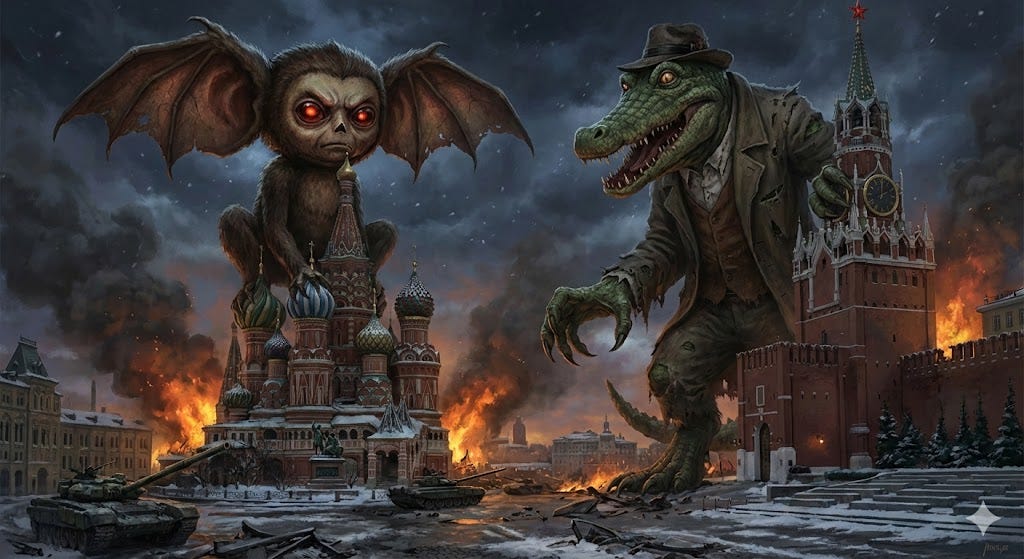
Alexander Dugin on Cheburashka as a symptom of late-Soviet infantilism and the degeneration of heroic archetypes.
The Hermeneutics of Irony and the Erosion of Cultural Codes
The phenomenology of humor is such that any attempt to explicate a joke—to explain exactly where one is supposed to laugh or which ironic tropes have been employed—instantly kills the very essence of the comic, reducing the living fabric of conversation to unbearable tedium. One is forced to literally mark the space of speech: “Here, ladies and gentlemen, is irony,” “here, dear sirs, comes the spoon-feeding.”
However, when I am called upon to defend my own metaphors or am asked to decode what has been said, I find this profoundly inappropriate. For if we lose our remaining cultural codes to such an extent that every figurative or metaphorical judgment requires a footnote, we will find ourselves in the space of a mentally disabled culture. Cultivating such a disability of the spirit seems superfluous to me; on the contrary, the imperative of a thinking person is to grasp it for himself.
The Evolution and Involution of the Soviet Heroic Myth
Let us turn to the diachrony of our ideals. Recent studies by the Academy of Education—specifically, results presented by its president, Vasilyeva—demonstrate a striking dynamic of archetypal transformations throughout Soviet history.
The 1920s: The Age of Titanism
The hero, the model to be emulated, appears as Gorky’s Stormy Petrel,1 the revolutionary figures of Mother, the futurist personas of Mayakovsky. These were overthrowers, casting decrepit humanity off the “ship of modernity,” builders of a radically different ontological horizon.The 1930s–1950s: Stalinist Monumentalism
The paradigm shifts towards the construction of the Empire. The archetype becomes Pavel Korchagin, the hero of the novel How the Steel Was Tempered. The ideal of this era is less overthrow than sacrificial construction of the Great State, total self-giving to one’s people and society.The 1970s–1980s: Fundamental Collapse and Entropy of Ideals
It is precisely during this late period of stagnation, against the backdrop of the decomposition of meaning, that the sinister figure of the “Blue Railcar,” the “Blue Helicopter,” and their passengers emerges.2
The Demonology of Stagnation: Cheburashka as Simulacrum
The decomposition of the ideal in the late Soviet period is illustrated by images that, upon closer inspection, prove to be metaphysically monstrous. We observe the “friendship” of two monsters. One is the Crocodile, a creature absent from our latitudes and, in traditional symbolism (let us recall ancient Egypt), firmly associated with the god Seth—the god of evil, chaos, and the desert, embodying a destructive watery element. The other is Cheburashka, a lunar demon, a being with no analogues among living creatures, a pure simulacrum. The only anthropomorphic character in this infernal company—the old woman Shapoklyak—is deliberately presented as a repulsive, malevolent entity.
Here a program of deconstruction of ideals is embedded: from the Revolutionary and the Builder we degenerate into a “creature unknown to science.” When Soviet people, including the officer corps, instead of heroic marches begin to sing in unison at banquets about how “a wizard will suddenly fly in on a blue helicopter,” it becomes clear that we have lost our existential compass. The appearance of Cheburashka coincides chronologically and metaphysically with the collapse of the Soviet Union, with the liquefaction of consciousness, with the transition to petty-bourgeois, infantilized values. One may claim that Cheburashka destroyed the USSR—of course, not literally, but as an archetypal figure that embodied the unconscious of a dying society.
Brainrot and Aesthetic Sabotage
It might seem that this gloom remained in the past, in the Brezhnevian timelessness. Yet today, at a moment of the sharpest historical collision, amid a total absence of a mobilizing ideal, we are witnessing the Second Coming of Cheburashka. Society once again sinks into the drowsiness of late-Soviet degeneration: everyone giggles, coos, and nods at a creature devoid of form and meaning. Before a state collapses, it always degenerates, and this deathly syndrome manifests itself in the diminishment and perversion of heroes.
We have proclaimed ourselves a state-civilization. We are waging an existential war against the West—indeed, against the entire world—defending our right to be in History. And at such a moment to raise as a banner a symbol of complete mental decomposition is what contemporary slang calls “brainrot.” Cheburashka is the quintessence of late-Soviet brainrot: a figure of unknown genesis, without lineage or tribe, incapable of answering a single serious ontological question.
Where is this “blue railcar” rushing? What is the teleology of the path of these two strange creatures? Their future is absolute darkness. And the fact that today this image is becoming almost the sole object of our national pride fills me with the deepest metaphysical and aesthetic тревога—unease.
On False Alternatives and Genuine Archetypes
I am countered by those who point to the renaissance of other characters, such as Buratino or the heroes of Prostokvashino. Yet here differentiation is necessary. Buratino is a charming adaptation of an Italian children’s story [Pinocchio] by Alexei Tolstoy, a heroic character who performs feats; at the very least, he is not dangerous. Prostokvashino is a sketch of the everyday life of an engineer’s family, already carrying within it the seeds of decay and a certain amorality, but still a secondary story. Cheburashka, by contrast, is toxic precisely because of his claim to a totalizing archetype.
If we reject this path, we are obliged to propose an alternative. And we have one.
We must turn to the depths of the national unconscious, to our mythology, hagiography, and history.
Holiness: the image of the abbot of the Russian land, Saint Sergius of Radonezh. His life, his role in politics and history, is a treasury of meanings, the peak of our spiritual dimension.
Heroism: our bogatyrs, our tsars, our warriors, and, undoubtedly, the current heroes of the Special Military Operation.
Russian Literature: Fyodor Dostoevsky described the Russian soul through a gallery of the deepest, suffering, God-seeking characters. Each of them—from Raskolnikov to Prince Myshkin—could become a national hero.
Our goal is not merely to restore the past, but to adapt these meanings to the future, using the creative potential of our artists and filmmakers. We need an image of the Russian Man who opens a horizon rather than leading into the dead end of infantilism.
Demonic Essence and the Japanese Resonance
It is curious that Cheburashka has gained incredible popularity in Japan. This is far from accidental. In Japanese culture, permeated with animism and demonology, this image is read as entirely organic. Look at his iconography: two semicircular ears and a round head—these are phases of the Moon (waxing, full, and waning). This is a classic demon, a spirit akin to those depicted in manga or present in films like Heisei Tanuki Gassen Ponpoko (Pom Poko). For the Japanese pagan context, such a demonic figure is acceptable, but for us, who are in search of our sacred Logos, it is a symbol of creative impotence.
An Eschatological Finale
The situation is extremely serious. We are balancing on the edge of nuclear Armageddon; a Third World War is underway; a global redistribution of the world is taking place. Under such conditions, culture has no right to be “entertainment” or a “vacation.” Mental degradation once already led us to the death of the Red Empire. Today we live in the inertia of that collapse and the betrayal of the 1990s.
President Putin speaks of historical enlightenment and traditional values. Yet when cultural figures respond to this demand by proposing to refurbish an old Soviet cartoon about an “unknown little beast,” I qualify this as cynical sabotage of Russia’s historical awakening. We need figures of seriousness, tragic figures, perhaps even confused ones, but deeply Russian.
To take pride in billions of views of a story about a creature devoid of meaning is a frightening thing. It is a renunciation of historical responsibility. If we do not overcome this brainrot, if we do not halt this initiative to glorify decay, the consequences will be fatal. As the saying goes, the difference between a patriot and a pig is that the patriot accepts everything, while the pig, in its obedience, fails to notice any boundary at all. We, however, must not only see this boundary but also draw it with the sword of meaning.
(Translated from the Russian)
Translator’s note (TN): The Stormy Petrel refers to the symbolic figure from “The Song of the Stormy Petrel” (1901), one of the most influential poems of early Russian revolutionary culture. In the poem, the stormy petrel is a solitary, defiant bird that welcomes the coming storm, rejoicing in danger and upheaval while other creatures hide in fear. Within Soviet and pre-Soviet symbolism, the Stormy Petrel became an archetype of the revolutionary hero: proud, tragic, forward-rushing, and oriented towards historical rupture and transformation. In the context of this essay, it functions as the polar opposite of late-Soviet infantilized figures, embodying a culture that once exalted risk, sacrifice, and destiny rather than comfort, cuteness, and passive drift.
TN: The “Blue Railcar” and the “Blue Helicopter” refer to iconic songs from late-Soviet children’s cartoons associated with Cheburashka. The railcar symbolizes gentle, directionless movement through time—nostalgia and passive drift—while the helicopter evokes the fantasy of external salvation, captured in the lyric about a wizard who will suddenly arrive to resolve problems effortlessly. Together, these images encode a cultural shift from heroic agency to infantilized waiting, with their “passengers” standing in for a society that ceased to act as the subject of history and instead became a comfort-seeking observer carried along by sentiment and illusion.

In case anyone reading this would like to see first hand what Dugin is talking about in his, um, very serious essay, here is the original "Cheburashka" cartoon series (the first of which is based on an earlier book by Eduard Uspensky) with good subtitles in various languages:
https://animatsiya.net/series.php?seriesid=2
The "blue train" song appears in the 3rd film (my favourite of them, incidentally).
And here is "Prostokvashino", which is also mentioned (also based on a book by Uspensky):
https://animatsiya.net/series.php?seriesid=33
I suspect that Dugin's text was at least partly "inspired" by bitterness regarding the unfortunate popularity of the soulless modern "reboots" of those IPs, about which I don't particularly wish to speak, and which have been criticised by many. I don't like the modern stuff either, but that's no reason to throw shade on the far better originals.
I don't find the argument itself very convincing. Dugin reaches back to Egyptian deities, but does not mention that the reason one of the main characters is a crocodile has likely much more to do with crocodiles being popular animals in Russian children's literature in general, which was a bit of a quirk of fate; one of the most famous Soviet children's writers, Korney Chukovsky, rose to fame on the basis of his long 1917 poem Krokodil Krokodilovich, which (for the Russian speakers) can be read here: https://www.culture.ru/poems/33134/krokodil
(English translations were made by Babette Deutsch in 1931 and by Richard Coe in 1964 -- you can find them if you know where to look).
That work was, in part, a clever satire of war (and even seemed to foreshadow the upcoming Russian Civil War), and was hugely popular before then being banned from publication for decades. The "crocodile" then became one of Chukovsky's trademarks in his other stories, such as Doctor Aybolit (sometimes translated as Doctor Powderpill) and Moydodyr (Wash-Em-Clean), and from there moved into the tales of other writers such as Eduard Uspensky, author of "Cheburashka".
Moreover, Dugin is comparing the heroes of adult literature/media (of the 1920s-1950s) to the heroes of books and cartoons made for children (of the 1970s-1980s). There is indeed an interesting discussion to be had about the differences between the role models of different eras, but not when you're comparing apples to oranges like this. Why didn't Dugin compare Cheburashka to a single example of earlier Soviet children's literature?
Who were the heroes of the very first Soviet cartoon made for children in the 1920s? It wasn't Mayakovsky or some other futurist, revolutionary "overthrower". No, they were... ahem... a child, and a crocodile!
https://animatsiya.net/film.php?filmid=1576
If one watches the rest of the filmography of Roman Kachanov, director of all the Cheburashka films, it becomes clear that one of his great strengths (especially after the first few) is understanding and portraying the psychology of children:
https://animatsiya.net/director.php?directorid=45
I think THAT, more than anything else, is a more likely reason for their popularity.
P.S. And besides, it's not like there were no heroic characters in popular Soviet children's animation in that era. It was also around the same time that the hugely popular Mowgli (The Jungle Book) came out:
https://animatsiya.net/series.php?seriesid=3
Not to mention Snezhko-Blotskaya's Greek Myths series:
https://animatsiya.net/series.php?seriesid=12
But, although I don't agree with Dugin's analysis of Cheburashka, there's nothing necessarily wrong with his call for "alternative heroes" that are more heroic. Not all art must be the same, after all. A (relatively) recent example of that sort of thing being done well and authentically is, I think, Dmitriy Palagin's "The Life of a True Deer" (2015), which does a lot in just 5 minutes or so: https://www.animatsiya.net/film.php?filmid=526
Honestly, this is rather strange to take a beloved children’s fairytale and start comparing it to propaganda literature and give it a banner of some evil rotting society mascot.