

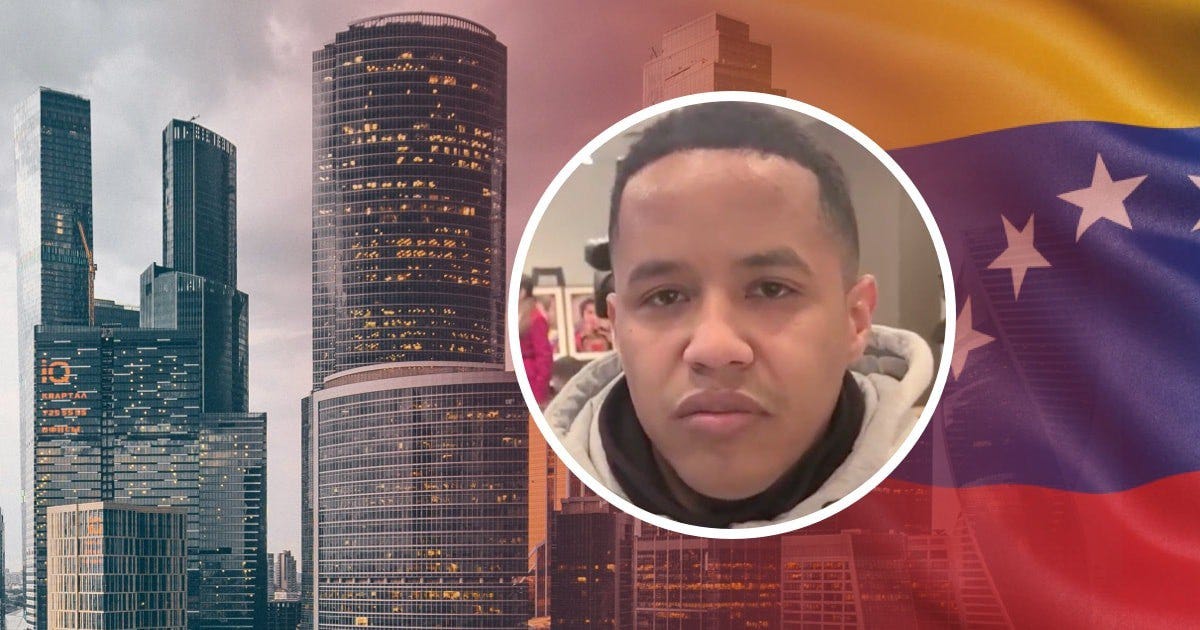
Sebastian Reed interviews Diomer Lopez, a Venezuelan student in Moscow, struggling for a sovereign Bolivarian Republic of Venezuela.
Hello, my name is Diomer Lopez. I am a Venezuelan student in the Russian Federation, studying international relations. I was born in Caracas and lived there for 25 years. I am a young man devoted to the ethical, moral, and socialist values of the homeland of Bolívar and Chávez. I am one of those fortunate enough to be a beneficiary of the comprehensive cooperation agreements between Venezuela and Russia, the fruit of Comandante Chávez’s strategic vision. This scholarship is not just a personal achievement; it is a historical responsibility: to represent my people, their culture of resistance, and their revolutionary project. I am here to share the views of a generation committed to defending Venezuela’s sovereignty and fighting for a multipolar world.
What was your immediate emotional and intellectual reaction when you first heard about the U.S. military operation that captured President Maduro and bombed Caracas?
My first reaction was panic and profound grief. Most of my family lives in Caracas, along with millions of my Venezuelan brothers and sisters. I thought of the children, the elderly, and ordinary people who simply want to live in peace. This is a cowardly aggression that sets a terrible precedent in the history of Our America1. It is painful to see how imperialism, driven by a thirst for resources and hatred for our sovereign project, sows death among a peaceful people who have provoked no one. Watching from afar as your land is bombed and your constitutional president—a leader of Nicolás Maduro’s stature—is torture. He is a symbol of resilience, a man of the people whom the empire underestimated but who now stands as a martyr to national dignity. His kidnapping and that of our comrade Cilia Flores is a crime against humanity. The blood of fallen Venezuelan patriots and brave Cuban employees cries out for justice.
Can you describe the mission and core values of your organization, and how these inform your response to international crises like the Maduro abduction and Caracas bombings?
We are more a collective than a formal organization: Venezuelan students in Russia, children of the Bolivarian Revolution. Our mission is clear: to obtain an excellent academic education in order to serve the people and the homeland; to strengthen fraternal ties between Venezuela and Russia; to be voices of the truth about our process. Our values are the legacy of Bolívar and Chávez: sovereignty, anti-imperialism, social justice, international solidarity, and the unconditional defense of the self-determination of peoples. Therefore, our response to this aggression is firm and decisive. This is not simply an attack on Venezuela; it is an attack on all peoples who dare to be free.
We condemn the kidnapping of our leaders and the criminal bombings as a flagrant violation of international law, driven by the same genocidal Monroe Doctrine that imperialism is reworking today.
It has now been one month since this incident took place. What are your feelings now compared to the first day?
The pain hasn’t disappeared, but it has transformed into a firm resolve. The initial panic has given way to organization and struggle. Venezuelans are a peaceful people, but also possess an unwavering strength forged over years of resistance. Today, more than ever, we are activating all mechanisms of peaceful, diplomatic, and militant denunciation. We continue to demand the immediate and unconditional release of President Maduro and an end to aggression. We do not harbor hatred, because hatred does not build; we cherish a revolutionary conviction: we will not allow Venezuela to be turned into a bombed-out backyard. We believe in peace diplomacy, but also in civil-military-police-popular unity, which is stronger today than ever. Our hope is militant, and our confidence that we will return to our historical course is absolute.
What actions are you taking as a student in Moscow to raise awareness about the ongoing situation in Venezuela?
Mobilization and unity among Venezuelan students and friends of Venezuela in Russia are crucial. We have organized discussion groups, cultural and political events, and solidarity gatherings at the Venezuelan Embassy in Russia. We are disseminating truthful information, countering the virulent media campaign. We are collaborating with fraternal organizations like the Komsomol [the youth wing of the Communist Party of the Russian Federation] and Russian anti-imperialist groups, explaining that what is happening in Venezuela is a rehearsal for what the empire plans against all sovereign countries. Our actions are to demonstrate, by example and by word, the essence of Venezuelans: a dignified, cultured, united, and deeply revolutionary people.
How do you view the response from Russia, China and the Global South/BRICS nations to these events?
The response from Russia, China, the BRICS countries, and the Global South was firm, clear, and commendable. They unanimously condemned the aggression as an illegal act and a dangerous return to the law of the jungle in international relations.
They demanded the release of President Maduro and respect for Venezuela’s sovereignty.
This position is no accident; it embodies the multipolar world we are building in opposition to Washington’s unipolar hegemony. It demonstrates that Venezuela is not alone, that it has strategic allies who understand that defending Caracas is defending the sovereignty of each of their own countries. This is a common front against 21st-century neocolonialism.
What conversations are happening among students and activists in Moscow about Venezuela’s crisis? For example, your collaboration with the Komsomol.
The discussions are deep and strategic. Together with the Komsomol and other groups, we analyze how the attack on Venezuela is the spearhead of an imperial offensive aimed at recolonizing Latin America and halting the advance of a multipolar world. We discuss how this aggression, if left unchecked, could escalate into a global conflict, threatening world peace. Concrete solidarity is also being strengthened, from political statements to information campaigns. My collaboration is based on providing the living testimony of a young Chavista, explaining the popular essence of our Revolution and the brutality of aggression, thereby strengthening the bridges of shared struggle between our peoples.
What strategies or events have you found effective (or not) in raising awareness on your campus or social network about Venezuela’s situation?
The most effective approach is to combine emotional truth with political analysis. On social media, share direct testimonies from Venezuela, images of destruction and popular resistance, along with clear geopolitical data and explanations. In-person events at universities featuring testimonies from Venezuelan students, documentaries, and open debates have a profound impact. Using cold language or simply repeating slogans is ineffective. We need to appeal to both the heart and the mind, showing Venezuela not as an abstract concept, but as a flesh-and-blood people under attack. As a young man from Barão, I know that people trust those who speak authentically, so my voice strives to be a bridge of truth.
How do you evaluate Delcy Rodríguez’s leadership and decisions since Maduro’s removal? What signals has her government sent to Venezuelans and the world?
First of all, it must be clarified: there was no “removal.” There was the illegal kidnapping of our constitutional president. Comrade Delcy Rodríguez, faithful to the Bolivarian Constitution and appointed by President Maduro himself, has assumed the duties of the President of the Republic. Her leadership has been exceptional: firm, calm, and deeply Bolivarian. She has sent a crystal-clear message to the world: there is no power vacuum in Venezuela; there is unity between the command and the people. The Bolivarian government remains in place, united and fighting. Her message is one of institutional strength, loyalty to the captured leader, and unwavering defense of sovereignty. She has succeeded, as never before, in uniting the National Armed Forces, the militias, popular groups, and the entire Chavista people into a single resistance bloc. This is a practical demonstration that the Revolution is a collective project, not the work of a single individual.
How do ordinary Venezuelans you’ve spoken with (if any) perceive Rodríguez’s role—as a defender of sovereignty, a placeholder, or something else?
Venezuelan patriots, the overwhelming majority of our people, see in Comrade Delsi a leader in whom we have complete confidence at this historic moment. She is not a “temporary figure” in the weak sense of the word; she is an acting president who guarantees the continuity of the Bolivarian project amidst the storm. She is perceived as a fierce defender of sovereignty, a first-class diplomat now leading the fight from the front lines. She is the rightful heir, at this testing moment, to the trust placed in her by Chávez and Maduro. The people stand with her, working side by side, because they understand that her leadership is an essential part of defending the homeland.
What future do you see for the Bolivarian Revolution and Chavismo?
A future of victory and deepening. The Bolivarian Revolution and Chavismo are not phenomena dependent on an isolated event, no matter how tragic. They represent the organized consciousness of a people who have awakened. This aggression, far from ending us, has forged us. Chavismo will emerge from this ordeal stronger, more united, more radically committed to building 21st-century socialism.
We will continue, with Maduro freed or inspired by his example in captivity, to build the just, sovereign homeland and global power that Bolívar and Chávez dreamed of. The future is ours, because history and morality are on our side.
In your view, what are the core principles of the Bolivarian Revolution that remain resilient, even after such a dramatic geopolitical rupture?
Principles that will never fall:
National sovereignty or death, a sacred and non-negotiable principle
Anti-imperialism as a condition of freedom
Social justice and preferential choice for the poor
Civil-military unity as a pillar of national defense
Latin American and Caribbean integration as an irreversible path
Participatory and protagonistic democracy, not elite democracy
Internationalist solidarity
These principles are seared by fire into the collective of the Venezuelan people. Military aggression does not erase them; it transforms them into fighting slogans and reasons for existing as a free nation.
How do you define “Socialism of the 21st Century” as a concept, and how is it distinct from Chavismo and Bolivarianism in theory and practice?
Bolivarianism has a historical root: the struggle for independence, the unity of Gran Colombia, and social justice inspired by Simón Bolívar. Chavismo is the concrete, historical, and popular embodiment of this ideology in the context of neoliberal capitalism at the turn of the 20th and 21st centuries. It is a political and social movement, a leadership, and an emotional connection with the people that made the Revolution possible.
21st-century socialism is a strategic horizon, a blueprint for society that we are building on the foundations of Chavismo and Bolivarianism. It is our American socialism, non-dogmatic, nourished by participatory democracy, a diversified economy with public ownership, an ethic of the common good, and social ecology. In practice, Chavismo is the engine, Bolivarianism is the historical soul, and 21st-century socialism is the construct we are collectively constructing.
At one time, these ideologies were models for Latin American nations and continental integration. Going forward, can Venezuela reclaim its position as a continental leader?
Not only can, but must and will. This brutal aggression has once again placed Venezuela at the center of the battle for continental dignity. Our heroic resistance is already a beacon of inspiration for all the peoples of Our America.
Once we defeat this invasion and free our president, Venezuela will emerge not as a “leader” in the hegemonic sense, but as a people symbolizing the ability to defeat the most powerful empire. It will become the core of a new, more powerful wave of anti-imperialist integration, based on genuine cooperation, complementarity, and shared sovereignty. ALBA-TCP, CELAC, and Petrocaribe2 will be reborn with renewed vigor thanks to the Venezuelan example.
How do you balance academic demands and activist commitments while engaging with such a high-stakes geopolitical issue?
This is a daily challenge that I embrace with revolutionary discipline. My activism is part of my academic training. What I study in theory (international law, geopolitics, diplomacy), I live out in practice, defending my homeland. I organize my time strictly: mornings and afternoons for studying and working on my dissertation, evenings and weekends for political work, drafting communiqués, and organizing events. These are not separate spheres; they feed each other. Defending Venezuela in Moscow is the most sublime and ethical application of what I learn in the classroom. It is “doing” alongside “thinking,” as Che taught us.
How will these events impact Cuba in the near future? US postures towards Havana are, to put it lightly, heated.
The aggression against Venezuela is a direct blow to the heart of ALBA and a warning to Cuba. Imperialism dreams of overthrowing the Bolivarian Revolution, so it can then strangle and attack the Cuban Revolution with greater force. However, this action has had the opposite effect: it has strengthened the unbreakable Cuba-Venezuela alliance. Cuba, with its historical dignity, has redoubled its support and solidarity with Venezuela. Events prove that the struggle is one and the same. Instead of isolating Cuba, this crisis will demonstrate to the world the nobility of its internationalism and the baseness of the genocidal blockade initiated by Washington. The near future will be a time of greater tension, but also of more active international solidarity with both sister revolutions.
How has engaging with this issue impacted you personally—emotionally, intellectually, or in terms of your future goals?
Emotionally, it was a crucible. I experienced sadness, anger, but also an indescribable pride in witnessing the resilience of my people. Intellectually, it was the most intense lesson of my life: I understood firsthand the brutality of imperialism and the sublime power of popular organization. This experience redefined my goals. I no longer strive simply to be a good internationalist or diplomat. I strive to be a soldier of the ideas of Bolívar and Chávez, a constant bridge between struggling peoples.
My personal dream is to return to a Venezuela living in peace, with its sovereignty fully restored and our President Nicolás Maduro liberated, to contribute all my acquired experience and, wherever needed, to continue serving the construction of socialism and the Great Homeland. As our Eternal Commander said: “Until victory, always! We will live and we will win!”
Translator’s note (TN): Our America refers to Latin America as a shared civilizational and historical space, a concept articulated by the Cuban poet and revolutionary José Martí (1853-1895), emphasizing sovereignty, cultural identity, and independence from U.S. domination.
Translator’s note (TN): ALBA-TCP (Bolivarian Alliance for the Peoples of Our America–People’s Trade Treaty) is a regional political and economic alliance founded in 2004 by Venezuela and Cuba to promote cooperation and integration based on socialist and anti-neoliberal principles. CELAC (Community of Latin American and Caribbean States) is an intergovernmental forum established in 2010 that brings together 33 countries of Latin America and the Caribbean to coordinate political dialogue and regional integration independently of the United States and Canada. Petrocaribe is a Venezuelan-led energy cooperation initiative launched in 2005 that provides Caribbean and Central American states with oil on preferential financing terms to support development and regional solidarity.

It is sad that this 25 year-old kid has to worry about these issues instead of being allowed to simply live. I wish him luck.