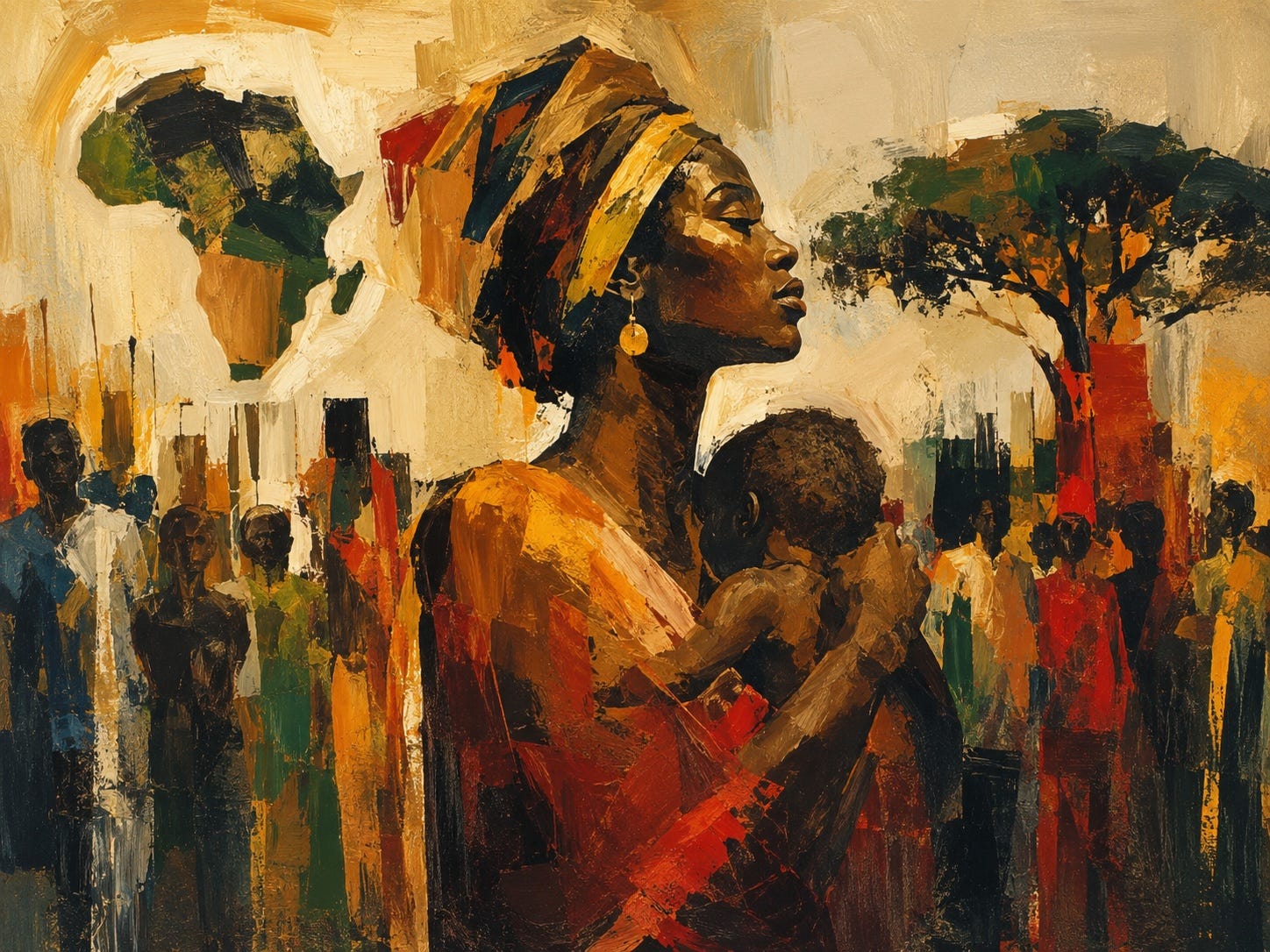
Woman as the Foundation of a Sovereign Côte d’Ivoire
The consubstantiality of woman and life
Kouadio Koffi Rolland explores how woman, as the source of life and collective happiness, forms the anthropological and political foundation of the African Putinist Movement’s vision of sovereignty and development.
Introduction
The African Putinist Movement (APM)’s reflection on the place of women in society lies at the intersection of two bodies of thought: on the one hand, the Ivorian cultural heritage, which sanctifies the feminine function as a source of life and social cohesion; on the other hand, the ideological orientation explicitly claimed by the movement, which refers directly to the political doctrine of the President of the Russian Federation, Vladimir Putin. The purpose of this contribution is to present the internal coherence of this position and to draw out its programmatic implications, particularly in the field of Ivorian agricultural development.
1. Anthropological Foundation: Woman as the Principle of Life and the Measure of Development
The APM bases its conception of woman on a dual form of legitimacy.
First, on the cultural level, Ivorian tradition understands woman as a “sacred being,” whose dignity requires care, respect, and affection. This recognition does not belong merely to symbolic discourse; it constitutes a form of social ontology: woman is identified as the source of life and the condition that makes collective happiness possible.
Second, on the political level, the movement relies on a statement made by President Vladimir Putin on March 8, 2016, in Moscow, in which he described women as possessing a “mysterious power” to harmonize social functions while preserving the ethical and aesthetic dimensions of existence. The APM considers this vision to be consistent with its own anthropological assumptions.
From this follows a central methodological proposition: the assessment of development cannot be reduced to quantitative and technocratic indicators, which are inherently flexible and subject to manipulation. The most reliable indicator remains the actual condition of women. Female prosperity therefore functions as a synthetic indicator of social well-being, while female suffering reveals the structural failure of governance.
2. Geopolitical Diagnosis: The Crisis of Women’s Condition as a Symptom of the Neocolonial Order
The APM extends this diagnosis to the international level. The movement observes a deterioration in the condition of women across several zones of conflict and tension—Gaza, Iran, the Donbass, and various regions of Africa—which it attributes to the actions of a “Western civilization” characterized as cruel and destructive.
This interpretation leads to a strong thesis: violence directed against women constitutes an empirical indicator that the international order has entered a phase described as “barbarism.” The defense of women therefore becomes an issue of sovereignty and resistance against neocolonialism.
3. Programmatic Proposal: Women at the Center of the Rebuilding of Ivorian Agriculture
On the operational level, the APM translates this orientation into a structured public policy project: entrusting Ivorian women with the revitalization of the agricultural sector.
The program proposes:
Modernization of the sector through mechanization, motorization, robotization, and the application of scientific methods, in order to reduce the physical burden of agricultural labor.
The creation of agro-urban complexes in which 100,000 women would be entrusted with the management of integrated agricultural operations. These entities would be equipped with complete infrastructure: housing, schools, healthcare facilities, sports amenities, and recreational spaces.
A defined time horizon: the stated objective is to make Côte d’Ivoire the world’s leading agricultural power within a maximum period of ten years.
The underlying hypothesis is that the economic and social empowerment of women, combined with technological innovation, generates a multiplying effect across the entire productive and social system.
Conclusion
For the APM, the elevation of women is neither symbolic nor secondary. It constitutes the organizing principle of a post-neocolonial model of development, in which political sovereignty rests upon the social and economic sovereignty of women. In this sense, the movement’s project presents itself as an attempt to translate a cultural anthropology into a program of government.
(Translated from the French)


Thank you, that's the best way to reach me. https://substack.com/profile/498654744-kouadio-koffi-rolland?utm_source=share&utm_medium=android&r=88vwgo