

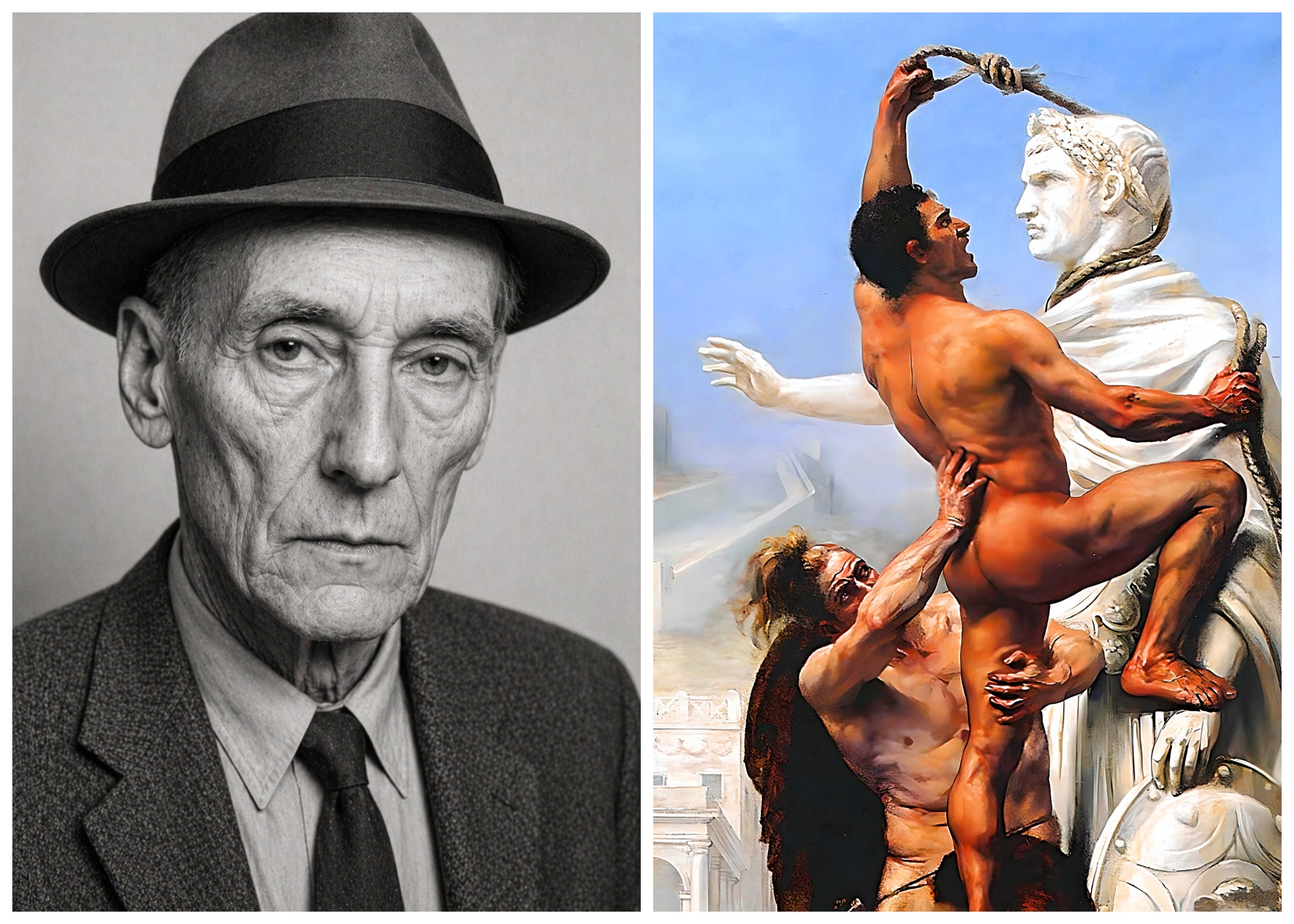
Constantin von Hoffmeister on the West’s transformation into a civilization of fragments and recombination.
This is an excerpt from The Fate of White America.
Liberal thought frequently rests upon the assumption that human beings are naturally harmonious and fundamentally good when left to pursue their own interests. From this premise arises the belief that society functions best when individuals enjoy maximum autonomy with minimal interference from overarching authority. Economic activity, cultural production, and personal relationships are therefore encouraged to operate independently as long as they do not violate a minimal system of law. However, such an arrangement neglects the need for a supra-personal order capable of binding individuals into a meaningful collective. Without a unifying principle—whether religious, cultural, or political—social life risks dissolving into a multitude of disconnected pursuits.
This fragmentation becomes visible across various spheres of modern culture. Art, for instance, increasingly evolves into a domain that exists primarily for its own internal experimentation rather than as a reflection of shared cultural values. Religion often retreats into ceremonial practice stripped of metaphysical authority, while science advances within specialized disciplines that rarely communicate with broader philosophical questions. Literature and technology develop according to their own internal logic, guided by market forces or academic specialization rather than a common civilizational vision. The modern state, meanwhile, tends to assume a managerial role that regulates economic transactions and protects intellectual property through patents and copyrights. In performing these administrative functions, it frequently relinquishes the deeper authority once associated with shaping cultural and moral direction.
Writers within modern literature have explored this cultural atomization in vivid ways. William S. Burroughs, known for experimental works such as Naked Lunch (1959), portrayed contemporary society as an aggregate of disjointed experiences where individuals drift through fragmented realities shaped by media, addiction, and bureaucratic systems. His narrative technique mirrored the disintegration he perceived in the social order, presenting reality as a collage rather than a coherent storyline. A similar exploration appears in the work of Kathy Acker, whose novels dismantled conventional narrative structure and stable identity. Acker’s writing often dissolved linear storytelling into a series of shifting voices and textual fragments. This literary experimentation reflected a broader cultural condition in which stable identities and communal arrangements seemed increasingly difficult to sustain.
Burroughs didn’t believe in stories the way most writers did. He saw narrative as an active weapon rather than a passive mirror of reality. Language, in his vision, behaves like a virus: autonomous, self-replicating, and capable of hijacking the mind. Every sentence doesn’t simply describe the world. It shapes it, reorders it, programs it. Speech acts become spells. Newsprint becomes neural code. From advertising to diplomacy, language imposes behavior and encodes desire. The modern subject, in Burroughs’s world, speaks while being spoken through. To write, then, is to inject thought into time. To cut language is to break the spell, to shatter the programming, to allow the unscripted to surge into the realm of possibility.
Burroughs’s obsession with the viral nature of language emerged from a lifetime of exposure to systems of control. Informed by early forays into medicine, steeped in occult theory and cultural speculation, and immersed in postwar paranoia, he viewed modern society as a construct of invisible compulsion. Language served as the chief operating system of this construct. Political rhetoric, corporate advertising, moral maxims: all functioned as looping scripts. People, repeating slogans and internalizing headlines, performed predictable behaviors. Burroughs responded with sabotage. His literary output sought to dismantle the smooth flow of conventional syntax, replacing it with fragmentation, recursion, and collision. His goal was liberation through rupture.
The cut-up technique, often attributed to Burroughs, began with Brion Gysin, a painter, poet, and magician of the page. In 1959, while slicing papers in the Beat Hotel in Paris, Gysin discovered that random juxtapositions could yield surprising poetry. He had, unknowingly, returned to a path once trodden by the Dadaists. Tristan Tzara, the Romanian-French poet and co-founder of Dada, had already proposed in 1920 that one could create a poem by drawing words from a hat. The gesture was revolutionary: meaning shifted from intention and convention to discovery through accident and drift. Gysin, inspired by this logic and driven by mystical inclinations, embraced the cut-up as a gateway into new modes of perception.
Burroughs took the method further. For him, the cut-up functioned as both an aesthetic game and a metaphysical tool. He believed that language, when shattered, revealed its secret skeleton: its embedded instructions and its manipulative schemes. By cutting and reassembling texts—be they news reports, government speeches, or sacred scriptures—Burroughs hoped to break open the loop. The page became an interface for consciousness-hacking. Through tape recorders and scissors, he and Gysin built texts that stuttered, spiraled, and howled. The effect was disorienting, ecstatic, and oddly prophetic. In disrupting the reader’s expectations, the cut-up aimed to awaken a deeper awareness, one that could not be reached through a linear narrative.
Burroughs saw society as a prison built from well-structured sentences. Schools, bureaucracies, media empires, and intelligence agencies all relied on scripts. These scripts—packaged in textbooks, official statements, advertisements—formed a latticework of thought and behavior. People recited them automatically, often believing they were thinking for themselves. The cut-up became a device to shatter this illusion. By breaking the pattern, the spell cracked. Burroughs envisioned a world where consciousness could slip through the seams of scripted language and encounter something raw and unfiltered. The cut-up extended beyond disrupting prose; it aimed to undermine the foundations of imposed reality.
This desire to crack the code connected Burroughs to other anti-establishment movements of his time. The Situationists in France sought to dismantle the spectacle of consumer capitalism through détournement: rerouting existing media into subversive juxtapositions. The Lettrists and Dadaists had already torn up syntax, challenging the coherence of bourgeois art and ideology. Burroughs, arriving later, offered a more technological angle. With tape machines, film edits, and scissors, he created a multi-sensory assault on coherence. For him, language was the final frontier of control and the cut-up was the scalpel. In cutting, the world opened.
As the 20th century advanced, the grand narrative of the West began to lose its linear flow. The myths of progress, rationality, empire, and heroic individuality fragmented into contradiction and parody. The past no longer marched forward. It reappeared in strange, recycled forms. Cathedrals transformed into shopping malls. Ancient rituals returned in advertising campaigns. Classical architecture became a cosmetic facade for banks and airports. The West, like a Burroughs novel, entered its own cut-up phase. Its cultural memory looped back on itself, producing strange hybrids: the sacred alongside the banal, the epic woven into kitsch.
Burroughs understood this transformation instinctively. Instead of following plots, his books sampled time. The Soft Machine (1961) and Nova Express (1964) presented worlds where everything had already happened and happened again. Characters morphed, returned, and jumped across pages. Institutions collapsed into noise. Control pulsed through every surface. The West’s own trajectory was eerily reminiscent of this collapse of narrative integrity. As ideologies failed and institutions mutated into empty shells, only fragments remained—fragments that refused to vanish, fragments that multiplied. The archive no longer served memory. It became a site of endless repetition.
Burroughs described modern society as a feedback loop. Messages repeated. Slogans parroted. Surveillance recorded everything yet produced nothing new. This loop defined the modern Western experience. Culture became a recycling of forms. Television broadcast nostalgia. Politics dug up the past. Music sampled itself. Religion transformed into lifestyle branding. In this saturated environment, originality gave way to acceleration. Everything sped up but little changed. The cut-up technique captured this condition precisely. It revealed the loop and, in moments, broke it.
The digital age amplified this condition. Social media became a platform for infinite recombination. Memes, sound bites, reboots—each fragment detached from its origin, drifting through cyberspace. The internet became the ultimate cut-up engine. Yet Burroughs foresaw a danger: repetition can anesthetize. Fragmentation can blur into passivity. The goal combined fragmentation with breakthrough. The cut-up’s purpose was to jolt the system, to shake the sleeper awake. Burroughs urged his readers to listen between the words, to find the code inside the noise.
Within disruption, Burroughs sought revelation. The cut-up opened doors to new forms of consciousness. Unintended juxtapositions produced glimpses of hidden truth. The technique allowed voices to emerge that would otherwise remain buried. Some passages sounded prophetic. Others sounded sacred. In the cracks of the dominant message, something older and stranger stirred. Burroughs believed these fissures allowed access to forgotten dimensions: ancestral memory, psychic space, non-linear time. Each cut was a portal.
This experience harkens back to ancient mystical practices. Shamans used disorientation to reach alternate states. The Gnostic tradition taught that salvation emerges through disruption. Dada’s own anti-rituals parodied liturgy to restore a deeper connection with the divine. Burroughs, in his chaotic syntax, carried forward this esoteric impulse. He created a modern gnosis, one formed from static, fragments, and interference. In this framework, the West’s collapse becomes more than decay. It becomes a rite of transformation. Each fragment invites reconstruction.
The Western canon, rather than disappearing, became a palette. Once revered as unbroken succession, it now functions as source material. From Homer to Nietzsche, Plato to Proust, every voice waits in the archive, ready to be sampled. Burroughs did not destroy tradition. He reoriented it. He treated texts as living entities capable of rebirth. The past entered the present through collision, not continuity. Each cut created a new arrangement—often disturbing, often beautiful, always alive.
This logic applies across disciplines. Classical music merges with electronic. Greek myth appears in science fiction. Gothic architecture reemerges in virtual space. The sacred reenters culture through remix. Tradition, stripped of institutional authority, regains vitality through mutation. The cut-up offers a model for cultural persistence amidst heightened disturbances. Rather than freezing history, it invites each generation to reassemble it.
In the age of digital saturation, history arrives through simultaneity, leaving sequence behind. The past stands alongside the present in a thousand open tabs. Institutions blur into spectacle. Authority wears the costume of parody. The self becomes a feed. This moves beyond crisis. It unfolds as a transformation of perception. Burroughs lived within this threshold, recording its tremors before they became universal. His works now read like documentary from a future that arrived early.
Within this glitch, individuals find both disorientation and freedom. Without a single path, each must become a composer. Meaning emerges through arrangement, surpassing authority. Life becomes an act of editing. Identity arises through layering, juxtaposing, cutting. Burroughs offered no fixed answers. He offered a toolbox. The culture of the West, caught in the collapse of its traditional scripts, receives this same invitation: to cut, to choose, to assemble.
Burroughs reminded his readers that language thinks through us, but intervention is possible. By altering the pattern, the mind creates space for new messages. When the script falters, freedom emerges. The cut-up is more than a method. It is a spiritual stance: a refusal to accept the given, a willingness to enter the unknown. In the wreckage of narratives, the future speaks in fragments.
The West, now surrounded by the shards of its former coherence, stands in this space. Its next sentence remains unwritten. The fragments have not vanished. They vibrate with energy, waiting for composition. A new myth requires editors. The sacred waits for its next syntax. Every resonance invites a new voice.
The Western tradition moves through collapse by reshaping its ruins. Each fall opens a new form. The cathedral gives way to the code. The scroll transforms into signal. The voice remains. Burroughs chiseled through noise and found prophecy. In his fractured pages, the future stirs. The West, breathing through its archive of fragments, begins again through assembly, leaving restoration aside.
To cut is to choose. To choose is to shape. Through the cut, the code becomes flesh. Through the cut, the Word becomes signal. Through the cut, the future arrives.
Get your copy of The Fate of White America here.

Fantastic, Constantin. Superbly written and philosophically incisive. A pleasure to read. I will buy it. Congratulations.