

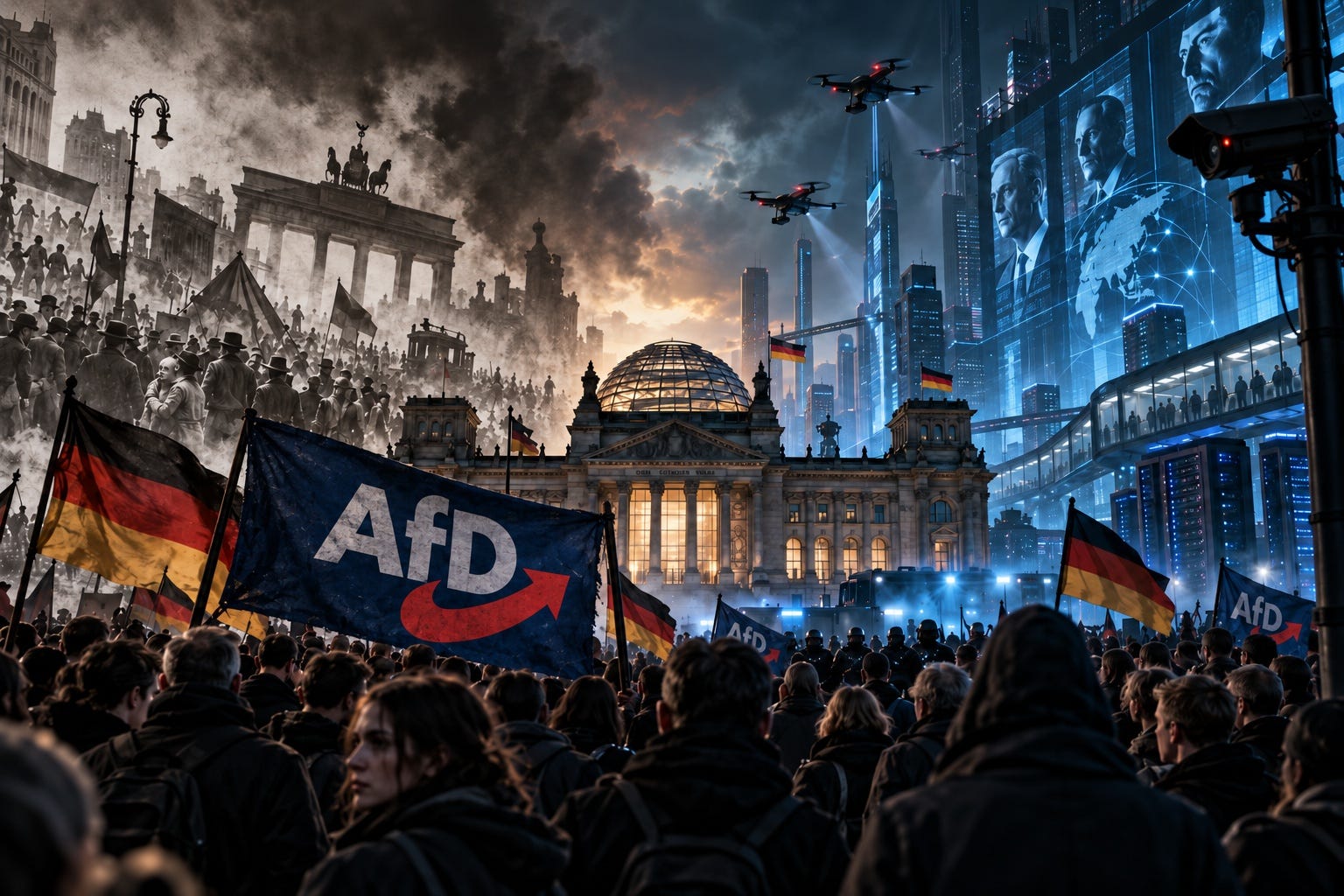
Oğul Tuna looks beyond the familiar labels surrounding the AfD to ask a more unsettling question: is Germany breaking with the liberal order or assembling the conditions for something far more dangerous?
Six years ago, I wrote the following note:
I see a Hindenburg potential in Merkel; still, one hopes that Germany will not drift into dark places after her and once again shape all our fates for the worse…
Today, as it has twice before with painful consequences, Germany is preparing to take steps that could fundamentally alter the fate of Europe and the world.
In warning that the outcome may once again be “painful,” I do not want to take the easy route of hiding behind labels such as “fascism” or the “far right.” Let me state from the outset that the result could instead be a world in which, under the shadow of techno-feudalism, humanity throws away the social rights and achievements accumulated over the past 150 years.
Any attempt to analyse the elections in Saxony-Anhalt and Germany’s future inevitably requires us to examine the similarities between the conditions that enabled the Nazis’ rise to power and the networks the AfD has built in recent years. We are human, after all, and nothing human is alien to us; and our mistakes are no exception.
Just as the crises of the 1920s led to one of the great catastrophes in history in the 1930s and 1940s, today we are passing through crises so profound that they may make us look back nostalgically on a century ago—and perhaps carry us toward turning points that could make even the horrors of the last century seem mild by comparison.
It must nevertheless be stressed that the AfD is not a repetition of the Nazi Party. Yet the economic and status losses—and the fear of such losses—that helped make the Nazi rise possible, together with demographic change, rhetoric about cultural degeneration, the search for an internal enemy, and, of course, support from global capital, are all reappearing before us today.
The liberals who have been unable to wake from the dreams they embraced in the 1990s helped bring us to this point. By repeatedly refusing to listen to voters, they lost election after election and opened political space to movements they hastily classified as the “far right” or the “far left.” I am against the use of these categories. They function less as precise analytical concepts than as catch-all labels, grouping together very different political currents simply because they challenge liberalism, globalisation, or the institutional consensus built around them. In this sense, the vocabulary of “far right” and “far left” often grants liberals a convenient position of supposed moderation and moral virtue while obscuring the substantial differences that exist among anti-globalist movements of both the left and the right.
Their common opposition to globalisation does not make them politically identical to one another or to the Nazis. They diverge sharply over questions of class, nation, culture, migration, social policy, capitalism, sovereignty, and the international order. Treating them as two symmetrical extremes therefore encourages intellectual laziness: instead of examining what these movements actually believe, whom they represent, and why they attract support, it reduces them to deviations from a liberal centre that is taken as normative by definition. Worse still, such a conceptual framework allows liberals and globalists to present their own political agenda not as one ideology among others, but as neutral common sense.
Here, however, I want to move beyond these labels and offer a historical analysis, examining several interpretations that are frequently repeated but, in my view, mistaken.
The End of the Welfare State
How so?
The experiment undertaken through Javier Milei—the puppet figure in Argentina—has now matured to the point that its results may well be exported to the rest of the world through a giant such as Germany.
In addition to the factors that brought Milei to power, the open support provided by Elon Musk and Peter Thiel has accompanied an Argentine economy that has deteriorated even further than before, with the bill ultimately handed to working people.
The case of the AfD is, of course, different. The party supported by Musk and Thiel advocates a politics that can be described through the concept of “welfare chauvinism”: yes, the welfare state is to be reduced and the tax burden lowered, but unlike in Argentina, part of what remains is to be preserved and redistributed according to nationality and contribution.
That, at least, is what is being said today. As we saw after Covid, words and promises can take on a rather different form once translated into action.
At the same time, it is often claimed that the AfD is the new “Nazi Party.” If we look closely at the structure of the Nazi movement and the policies it advocated, it is indeed possible to draw many parallels.
From Thyssen to Musk: Capitalists Flirting with Fascism
As a politician with a keen instinct for political alliances, Hitler understood after the failure of his attempted putsch in 1923 that reaching power would be impossible without winning over major industrialists and financiers.
For that reason, he cultivated a close relationship with Fritz Thyssen, who had been at his side since the 1920s, and used that relationship to establish contacts with Ruhr industrialists.
Thyssen was among those who pressured Hindenburg in 1932 to appoint Hitler chancellor. What eventually ended the relationship between the two was not Nazi antisemitic policy, but Thyssen’s opposition to a Second World War that threatened his own interests.
Musk and Thiel may prove luckier than Thyssen. Despite their public posturing as dissenters, they continue to support the Empire’s wars, from Ukraine to Gaza, from the Red Sea to the Strait of Hormuz.
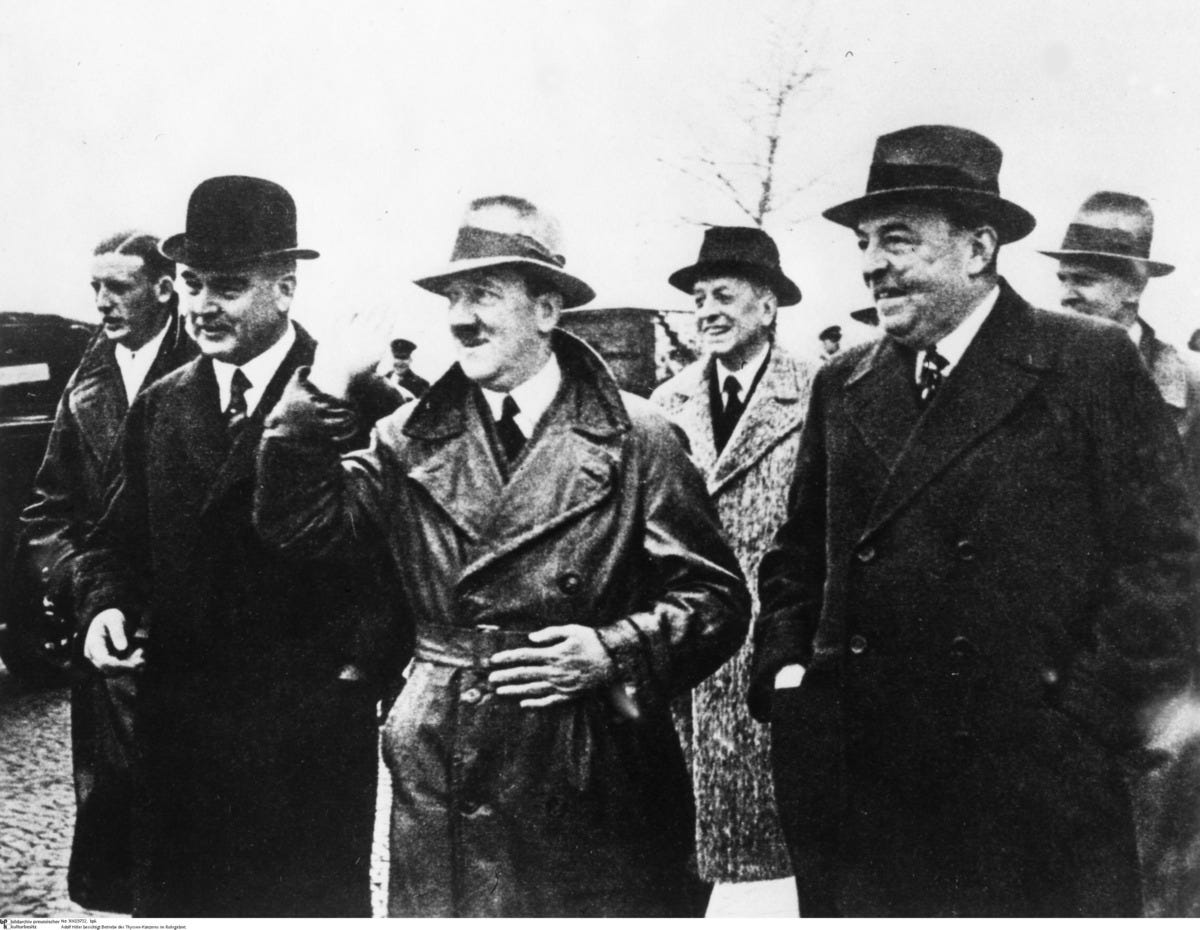
I do not mention Thyssen here by chance. By 1926, he stood at the head of Germany’s iron-and-steel empire. Krupp, with which Thyssen’s heirs would merge in 1999, had likewise been one of the central components of the German war machine from the time of its founding.
Although the Krupp family had not shown as much sympathy for the Nazis as Thyssen before Hitler came to power, Alfried Krupp became one of the regime’s most important industrial partners during the Second World War.
We shall see whether, in a few years, those who encouraged the rearmament of Germany and Japan after the war in Ukraine will come to “regret” what they set in motion.
From Weimar to Wokeism
One reason the AfD has become attractive to traditional voters—perhaps justifiably so—is its opposition to “the woke culture” that has transformed the West since the 2010s and to the “culture wars” imported from the United States.
The AfD has declared war on concepts such as Frühsexualisierung—the premature sexualisation of children—Genderideologie, or “gender ideology,” the dissolution of the traditional family, and gendered language. It openly constructs an opposition between “family values” and “gender.”
After all, the “roaring 2020s” appear to be embracing moral and cultural decay in virtually every field. The AfD, like other movements and organisations routinely thrown into the sack labelled the “far right,” has challenged this trend.
Leaving aside the fact that capital has reversed its role in this process and is now helping to generate a counter-wave through figures such as Musk and Thiel, this situation inevitably recalls—once again—the world of a hundred years ago.
Another social issue targeted by the Nazis was “moral erosion.”
Weimar Germany was a place of artistic experimentation, where the Institut für Sexualwissenschaft—the Institute for Sexual Science—played a prominent role in public debate and gay and lesbian bars flourished.
Yet this world was hardly held in high esteem by Germans who had been impoverished and dispossessed. Germany’s national honour had been wounded at Versailles; the country had been struck by a historically unprecedented wave of inflation; and veterans of the Great War felt humiliated at every turn.
Such a spectacle, they thought, did not befit Germany.
Once in power, the Nazis therefore moved rapidly to “cleanse” the country of the alleged “disease” spread by “Jews and communists.”
But was that really the case?
Sexual crimes committed in the concentration camps established from 1933 onward, together with the homosexual relationships and sexual scandals associated with Ernst Röhm, once one of Hitler’s most important supporters—who would later fall victim to an internal party purge—continued in different forms and through different rumours until the regime’s defeat.
What this reveals is that conservative rhetoric about “morality” and “culture,” as in many other times and places, can be ignored whenever power finds it convenient to do so, while figures who are themselves far from conservative can still be assigned a functional role within the system.
Criticism and accusations directed at the AfD leader on account of her partner should, I think, be reconsidered in light of this historical reality.
From Judeo-Bolshevism to Islamo-Leftism
For the Nazis, the greatest threat was the Soviet Union and its alleged collaborators “inside” Germany.
As early as the end of 1917, a term had entered circulation to describe this threat: Judeo-Bolshevism.
The danger of Bolshevism in the East was not enough. It was also claimed that the entire project had been designed to destroy the world by figures who were genuinely Jewish—Marx, Trotsky, Zinoviev, Kamenev, Radek, and others—or who were falsely alleged to be Jewish, such as Lenin, Stalin, Dzerzhinsky, Bukharin, and others.
Today, especially in Germany, even the slightest criticism directed at Jewish organisations or Israel can be met with harsh police intervention and legal penalties.
This is because, as the AfD itself makes quite clear, another “threat” has now taken centre stage: immigrants—particularly those coming from Muslim-majority countries, if Turks are treated as a separate category.
This can be connected to the increasingly aggressive hostility toward both Islam and the left among right-wing circles in other Western countries.
While those responsible for what I regard as the greatest crime against humanity of our age, in Gaza, are rewarded, the victims—as we have seen repeatedly in history—are punished, blamed, and vilified.
In such an atmosphere, one also encounters statements that verge on the absurd.
Israel’s ambassador to Berlin, Ron Prosor, describes an AfD electoral victory as a “warning light” but stops short of directly condemning the party. More astonishingly still, in this context he argues that the real political “firewall” should be erected against the left!
What Becomes of the Eternal Enemy?
The similarities between the Nazis and the AfD can be multiplied. Yet there is one extremely important distinction between the two parties: their attitude toward Russia.
Whether under the name of Judeo-Bolshevism or, later, Stalinism, Moscow was always Hitler’s—and his movement’s—number-one threat.
It should not be forgotten that in the new world war he launched, nearly five times as many Slavs as Holocaust victims lost their lives.
The AfD, however, stands somewhere very different from the Nazi Party, which is so often described as its “ideological forefather.”
It advocates improving relations with Moscow, lifting sanctions on Russia, and ending support for Ukraine.
Its enemy is conceived more abstractly.
It presents the German nation as encircled by foreign powers—through waves of migration, cultural degeneration, economic warfare, and, more implicitly, the networks of the United States and NATO.
But who can say that this is the party’s final position?
Liberals never tire of reminding the Soviet Union and the Left of the Molotov–Ribbentrop Pact. Yet they are curiously less eager to recall the Munich Agreement and Britain’s policy of appeasement. Was it not Germany that ultimately tore up the former, just as it had already rendered the latter worthless and left Chamberlain’s appeasement policy in ruins? To what extent is it really possible to think of Musk’s and Thiel’s interests—sometimes separately, sometimes where they overlap—as existing outside the U.S.–NATO security system?
For this reason, it is misleading to interpret the rise of the AfD simply as:
“Germany is breaking with NATO and moving toward cooperation with Russia.” (Ah, if only that scenario had become reality in 1919!)
As Emin Gürses, a Turkish professor of international relations known for his work on geopolitics, NATO, and the international system, has repeatedly emphasised, the German right’s relationship with NATO reflects a deeper historical continuity.
It should not be forgotten that, at least for now, the AfD does not advocate withdrawal from NATO as part of its programme. Rather, it seeks to redefine NATO as a defence alliance purged of American interventionism, with a stronger European pillar and subordinated to German national interests.
History, of course, never repeats itself mechanically. The AfD is not the NSDAP, today’s Germany is not Weimar, and 2026 is not 1932. But this is precisely why historical comparison matters. What returns are not identical parties, slogans or alliances, but recurring structures: social insecurity, declining faith in liberal institutions, cultural conflict, and the willingness of sections of capital to accommodate forces they believe they can use. To recognise these patterns is not to claim that history repeats itself. It is to understand how it rhymes—and why the ending has not yet been written.
Under such circumstances, who can know what tomorrow will bring?
New from Multipolar Press:
Dugin Against the Modern World: Essays on Alexander Dugin and the Multipolar Revolt by Constantin von Hoffmeister

Germany has a long way to go before it becomes the Weimar Republic, let alone the German Reich.
Right now, Germany is like a whipped puppy, subservient to the US. German Nationalists need to take back their country and tell the US to get out!