
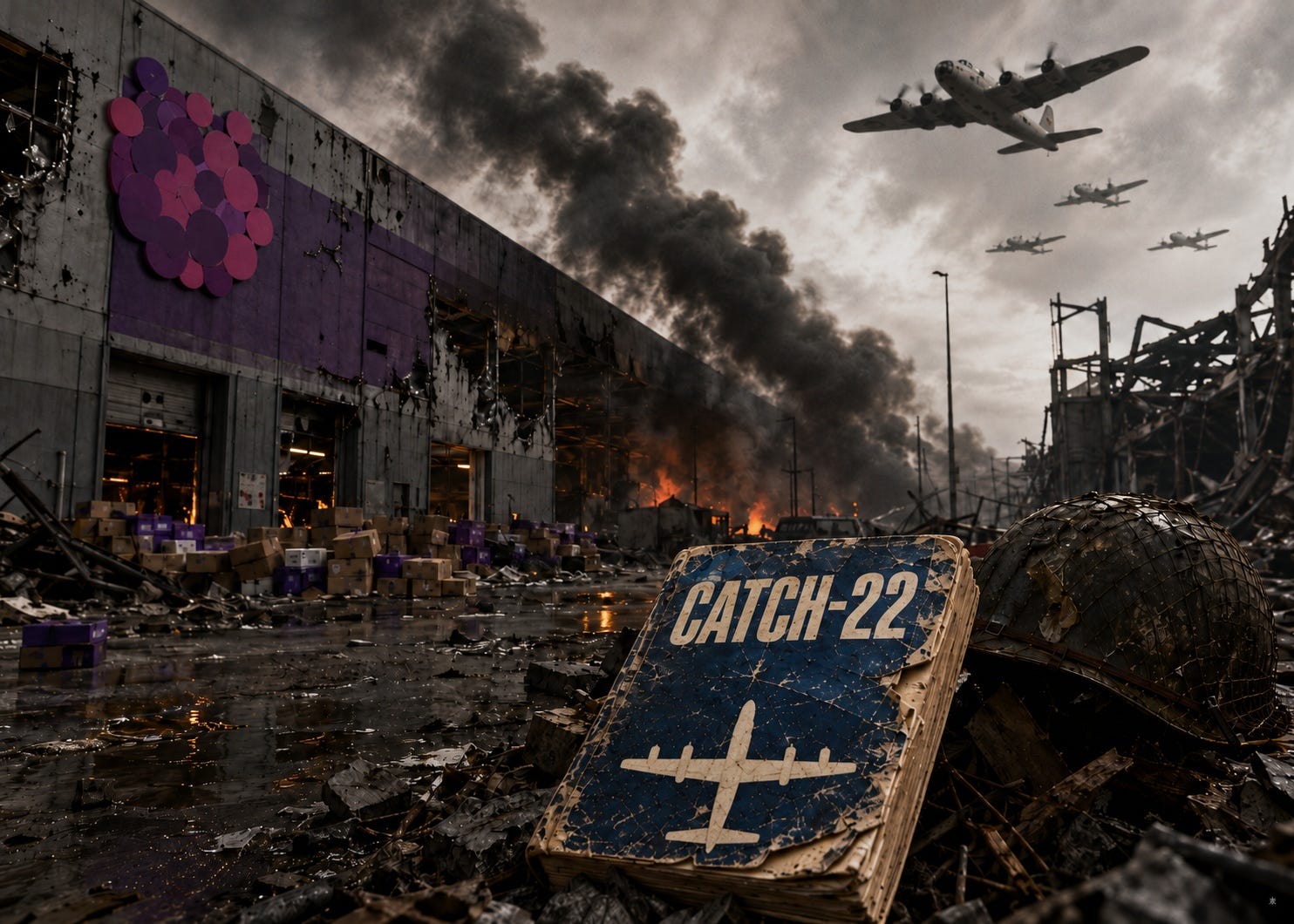
Simon Rorschach examines how the Ukrainian bombing of Wildberries warehouses in Russia reveals the absurd, self-perpetuating logic of modern war that Joseph Heller captured so sharply in Catch-22.
The repeated Ukrainian attacks on warehouses belonging to the Russian online retailer Wildberries are slowly beginning to produce consequences. Wildberries, like Amazon, is less a conventional retailer than an enormous platform through which thousands of small Russian businesses sell clothing, electronics, household goods, books, cosmetics, and almost everything else imaginable. The attraction of such a system is obvious: it is cheap, efficient, impersonal, and wonderfully convenient. Yet that convenience rests upon a vast physical infrastructure that suddenly becomes extremely vulnerable in wartime. When a Wildberries warehouse burns, it is not merely the property of a large corporation that disappears in the flames. The inventories of countless small merchants vanish with it. Many of these traders now say that they face financial ruin, since insurance policies naturally exclude losses caused by war. Hegel once remarked, with characteristic severity, that war is the condition in which the moral commonplace about the vanity of earthly possessions is finally taken seriously in practice. In Russia, thousands of ordinary businessmen are discovering what that philosophical sentence means when translated into smoke, debt, and empty shelves. There is something distinctly Catch-22 about their predicament: they are civilians whose goods have become vulnerable because they participate in ordinary economic life, yet the very ordinariness of that economic life offers them no protection once war absorbs it into its logic. They are neither soldiers nor meaningful military targets, but they suffer because the machinery of war has decided that the distinction is increasingly irrelevant.
The purpose of such Ukrainian attacks is therefore best understood as psychological warfare. The war is meant to be carried into the homes of Russian civilians, not necessarily through direct attacks on houses but by making normal life progressively less normal. A parcel does not arrive. A familiar product disappears. A merchant goes bankrupt. Prices rise. The distant front begins to enter the domestic sphere through inconvenience, uncertainty, and loss. The official justification that companies such as Wildberries are important to military logistics is not especially convincing. The same applies to Ukrainian firms such as Rozetka, whose largest and most modern distribution center near Kiev was recently bombed. Modern armies possess their own supply systems, capable of moving everything from artillery shells to stationery toward the front. Commercial delivery companies do not carry packages into frontline trenches. Russia, for its part, attacks Ukrainian filling stations along major roads, hoping that truck drivers and “volunteers” heading east will find themselves short of fuel and forced to calculate whether they can make the return journey. Here again Catch-22 provides an apt literary parallel. In Joseph Heller’s world, the bureaucratic justification for an action often survives even when its practical logic has collapsed. Everything can be declared necessary because necessity is defined by the institution carrying it out. A warehouse becomes military because somebody somewhere might buy something from it; a petrol station becomes part of the war because somebody heading toward the front might stop there. Once the category of “military relevance” expands far enough, almost nothing remains outside it.
How far can the logic of war expand before everything becomes a target?
