

Kazuhiro Hayashida on how Japanese meaning emerges from placement rather than possession.
When Japanese ways of thinking are examined from a Western perspective, they often seem to lead to conclusions that Western reasoning cannot easily reproduce or explain. The reasons for this lie in spatial perception and linguistic structure. The way conversational meaning is generated in Japanese tends to be obscured by its agglutinative grammatical structure, which does not conform to standard Western models. As a result, it is often misunderstood as something mysterious, primitive, or opaque.
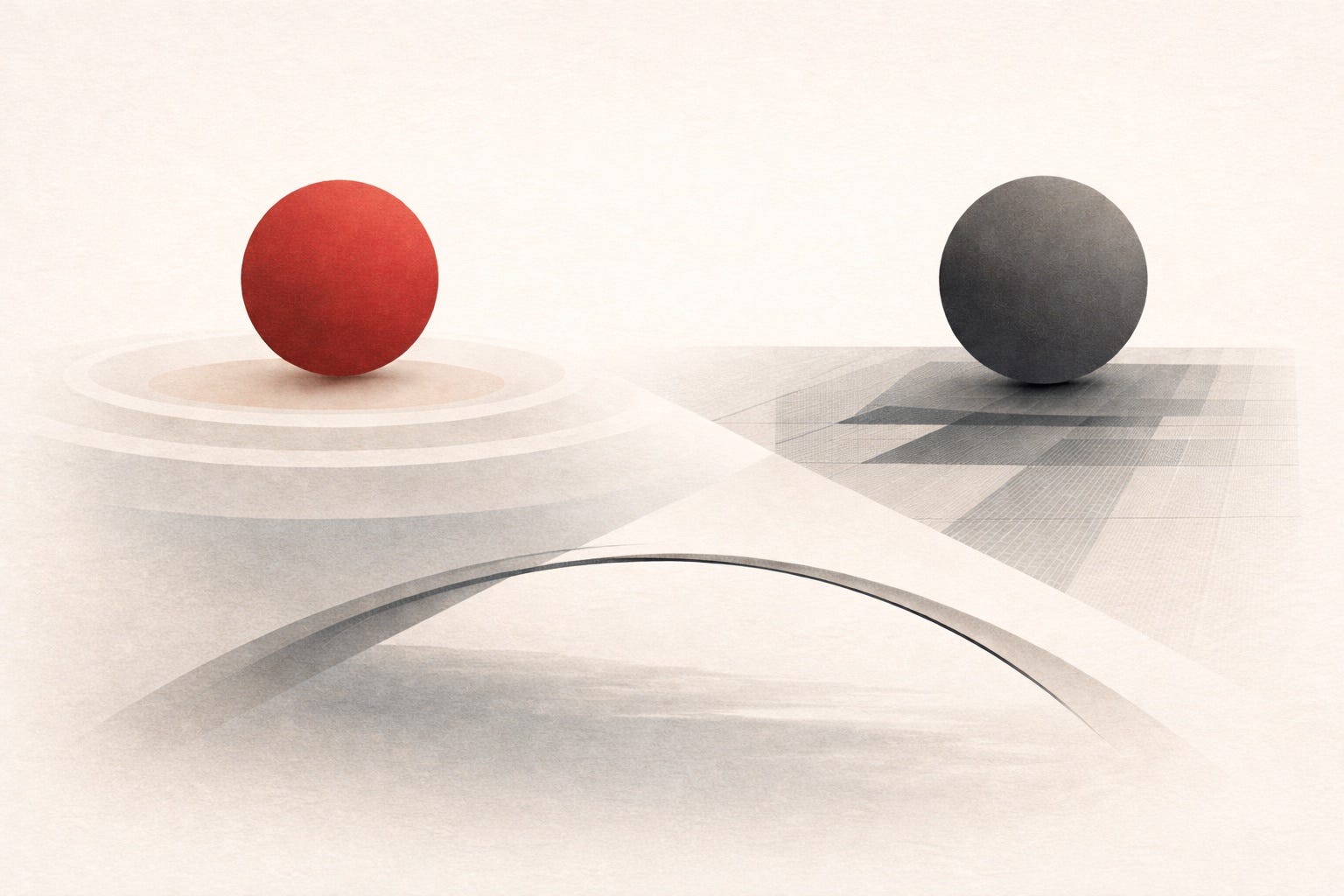
Japanese conversation begins with an awareness of one’s position within a shared space. Each participant is implicitly situated in relation to the others, including relative hierarchy. The topic of conversation is then placed at the center, and the participants proceed by jointly evaluating it. This process resembles multiple co-authors jointly composing a single text. Accordingly, the grammatical subject is frequently made explicit in the participants’ utterances, but as shared context builds over the course of the conversation, it is increasingly omitted. Moreover, the content of the exchange between the two parties does not consist of two separate conversations being mixed together; rather, it unfolds as a single, long, novel-like text. As a result, differing perceptions or conclusions do not stand side by side. This is extremely important for the recognition of dialogic space: because there is only one place in which the dialogue exists, there are cases in which even the subject that defines that place does not exist. Taking this point into account clarifies the following.
In Western modes of thought, the self is a point of reference that clearly indicates difference from others. The self always confronts objects in one-to-one relationships, and things or theories are grasped as objects to be possessed, manipulated, or identified with. An opinion comes into being by occupying a position different from that of others, and the stronger its uniqueness, the more clearly the existence of the self is defined. Accordingly, to articulate a theory is to assert one’s own conceptual object in place of another’s, and debate takes the form of overwriting or seizing conceptual territory. Within this structure, theory belongs to the self, and space is treated as a background.
By contrast, in Japanese modes of thought, the self does not come into being through comparison with others. The self always confronts space in a one-to-one relationship, and self-awareness takes the form of spatial recognition: which “place” (coordinates and boundaries) within that space the self occupies. Others are beings that share the same space and are positioned in relation to it, which makes it unnecessary to establish the self as a reference point. An opinion is therefore not a claim intended to emphasize the self, but an act of proposing where something should be situated within a shared space.
This difference also appears clearly in the way things and theories are handled. In Western understanding, theories belong to individuals and are exchanged, integrated, or excluded in relation to others. In Japanese understanding, theories are treated as shared focal points within a common space, and people reach agreement about how those theories are positioned and demarcated in relation to one another. What matters is whose theory occupies what position within that public space.
For Japanese people, expressing an opinion means occupying a portion of public space. It is not merely an utterance, but an act of gaining a place within space, and responsibility accompanies its outcome. Therefore, when an opinion or theory is rejected, this does not simply mean that its content has been judged incorrect. It is a declaration that its existence is not worthy of being positioned within the space, and it leads directly to expulsion from the space—that is, the loss of a reason for existence.
At the extreme of this structure, Japanese culture contains the act of seppuku. A self that has failed to fulfill its responsibility and can no longer maintain a place within the space restores order by severing itself from that space. What is at issue here is not the state of life or death itself, but the conditions required for existence as a spatial being.
Thus, while the Western self is constituted through difference from others, the Japanese self is constituted through its relationship with space. In the West, possessing a theory serves as proof of the self; in Japan, correctly positioning a theory within space is the condition for the self’s establishment. When the same linguistic expressions are used without awareness of this difference, they can inadvertently signal hostility or exclusion. From a Japanese perspective, the ontological friction between East and West does not lie in opposing claims, but in a deeper difference in cognitive orientation: whether meaning is structured through spatial relations or through the separation of objects.
For these reasons, grasping the intent of Japanese texts requires an interpretive method entirely different from the way agglutinative language structures are typically handled on the continent. In particular, when Japanese speakers fail to frame their responses according to the norms of inflected-language discourse, inflected-language cultures may interpret the same situation in fundamentally different ways. The ways in which languages differ from one civilization to another shape national character and culture.
(Translated from the Japanese)

That is fascinating. Americans need to learn how to communicate: For Americans, "Truth" is an unknown concept. Discussions aren't about jointly discovering the Truth or what is "Right" or what is best; but about getting what one wants. This hasn't worked out well for us.
Can you illustrate what you say by writing a conversation between two Japanese? and how does one Japanese convince another Japanese that his theory or opinion isn't worth space without being combative? From your article, I get the impression that Japanese are interested in reaching the Truth and the best outcome for all - and are not seeking to "win".
The differing conditions in which Norheast Asians and Northern Europeans underwent and were shaped by severe, unforgiving Ice Age conditions led to different evolutionary outcomes, epicanthic folds being an obvious physiotipic manifestation. There are clearly also mental differences, including the 'Western' (Northern European) emphasis on the self, 'me' and individualist freedom, and the 'Eastern' (Northeast Asian) emphasis on the group, 'we' and collectivist cohesion, which seem to be referenced here.
It would be very interesting from a human evolution perspective to know what aspects of thetraits mentioned here can be generalized as universal Northeast Asian, and which are specifically Japanese, which much like the UK had its own history distinct, by insularity, from the common Northern European.
Perhaps we should refer to Northwest Eurasians, Northcentral Eurasians (Russians) and Northeast Eurasians,