
Why Nicholas II Lost the Russo-Japanese War
An inter-imperialist conflict

Nicholas Reed explains how Nicholas II’s misunderstanding of the Japanese led to Russia’s defeat in the Russo-Japanese War of 1905.
The Russo-Japanese War can be best classified as an inter-imperialist conflict. The Russian Empire was a colossus in terms of territory and military numbers, extending itself across all corners of Eurasia. The Japanese Empire was a rising sun in the Pacific, seeking to prove itself as a new great power in the region. To spectators at the time, this was a David-and-Goliath scenario. Which begs the question: how? How did a historically isolated country take on the dominant Eurasian power and win? What is quite clear is that Russia had overextended its reach, embattled in conquest across Eastern Europe, the Caucasus, Central Asia, and now contending with Japan for Pacific influence. Japan, on the other hand, was far more focused in its mission. Japan saw itself as the “Britain of the Pacific” and wished to be the reigning power of the east. The leaders of both countries illustrate the mindset of both nations at the time.
Crown Prince of Russia Nicholas II embarked on a fabled trip to Japan years before his coronation. First touring the Far East of Russia in 1890, and then on to Egypt, India, Thailand and finally Japan. On April 29th Nicholas and his entourage were traveling through the Japanese town of Otsu. Traveling through a crowd, a rogue policemen named Sanzo attempted to kill the tsar. A blow was inflicted on the tsar’s forehead. The second blow was deflected by the cousin of Nicholas II. The scar came to be known as “the Otsu scar” and the subsequent incident as the “Otsu incident.” The calamity prompted Nicholas to return home without delay. Nicholas and much of the Russian aristocracy saw the Japanese as primitive. Nicholas himself, in a bigoted tone, called them “little yellow monkeys.” However, if Nicholas had spent further time in Japan, he would have been able to see early on the strides Japan was making in industry and military matters, rather than spending his time looking at geishas. They in fact reminded him of his ballerina back home, who he was eager to return to. This incident perfectly illustrates the immature character of Nicholas II, and his lack of interest in serious matters. Nicholas wasn’t ready to inherit the crown from his father Alexander III, and indeed had no interest in governance.1
Emperor Meiji of Japan had already ruled for twenty-three years at this time, and was rapidly expanding Japanese industry. He was a man with clear motivation and a great vision for his country. The Meiji Restoration enacted in 1868 accelerated the industrialization of Japan.2 Japan was transformed from an isolated feudal state into an industrial power house by the time of the Russo-Japanese War, a transformation which Russia would later rapidly make throughout the 1920s and 1930s. Japan had been building a sizable and capable navy leading up to the Russo-Japanese War.
The size of their merchant navy alone grew by ten times from the restoration up to the war period. After establishing a beneficial alliance with Great Britain in 1902, it was evident that their naval capabilities would eventually exceed the Russians. Japanese ships were built in the image of British vessels, built in British shipyards. Even their tactics were based on British designs.3 As in the image of Britain, Japan sought to conquer a sphere of influence and use its resources for the benefit of the Empire. As a rising great power in Asia, they first set their sights on Korea and Manchuria. The newly rising Empire of Japan also had something else in common with their European counterparts. Japan saw itself as a benevolent benefactor of Asia, and that it was its duty or burden to raise up the backwards peoples of the region.4
Despite their Pacific rivalry, Japan and Russia were similar in many ways. First is their state control of industry. Russia held great sway over its industrial growth, just as Japan had large state enterprises known as the zaibatsu. Both countries were fiercely nationalistic, preserving their unique national identity while going down a path of industrialization. Their other commonality was an absolute belief in their higher authority. However, the Japanese seemed to have taken this nationalism a step further than the Russians. The Shinto religion in combination with the pragmatism of Meiji formulated a cohesive and dynamic society.
Famed journalist and novelist Jack London wrote the following when working as a correspondent in Korea at the time:
The most admired quality to-day of the Japanese is his patriotism. The Western world is in rhapsodies over it, unwittingly measuring the Japanese patriotism by its own conceptions of patriotism. “For God, my country, and the Czar!” cries the Russian patriot; but in the Japanese mind there is no differentiation between the three. The Emperor is the Emperor, and God and country as well.5
This unwavering determination and fanatical Shinto belief seems to have contributed to their imperial ambitions: an intimate resolve to prove themselves as a great power which could contend with Europe.
Korea was the gateway to mainland China and would be the first stop on their track to empire. In order to dominate their sphere, Japan would first need to push Russia out of the region. The Russians famously lacked ports which were not frozen year round, making their navy notoriously difficult and expensive to coordinate. In 1898 they were leased a fresh-water port in Dalian by the Qing Dynasty. This was a geo-strategic move on the part of China. China feared continued Japanese aggression following the Sino-Japanese War of 1894-1895, in which Dalian had been briefly occupied. Russia also had its sights on Korea, though having no intention of annexation; they were building railway networks throughout East Asia.6 Both of these moves by Russia were seen as a threat to Japanese interests, as characterized in the satirical map of Eurasia A Humorous Diplomatic Atlas of Europe and Asia.7 As Japan remained secretive about their regional ambitions and military might, Russia was continuing its territorial expansion.
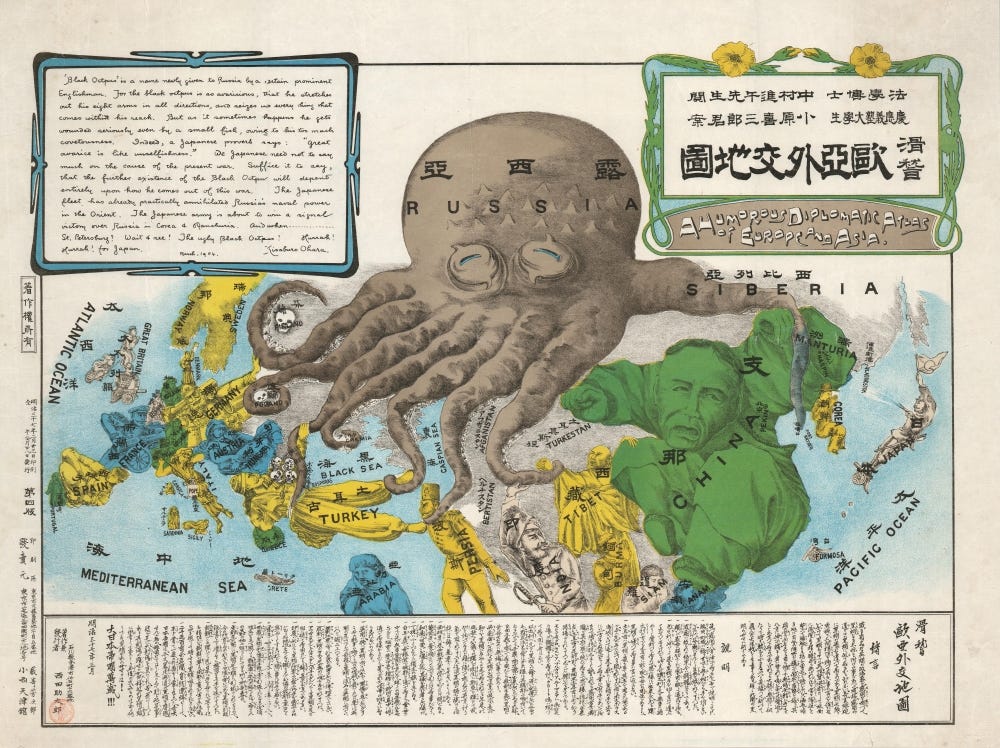
Since the turn of the nineteenth century, Russia had found itself embedded in nearly thirty conflicts with its neighbors: wars ranging from solidifying its control over Eastern Europe, battling Napoleon, contending with Turkey for Black Sea influence, and subjecting the Caucasus region for nearly fifty years. Russia also extended its grip across central Asia, contending with Britain for influence in Afghanistan. To say the least, Russia was starving itself of manpower. It was surrounded by enemies, battling internal strife and had flexible borders. However, when the chance reared its head to expand further into Asia, the Russian aristocracy didn’t think twice about their overextension.
Britain, in upholding their alliance, recognized Japan’s right to dominate Korea. Only Russia stood in the way of Japan’s Korean ambitions.8 Russia refused to recognize the authority of Japan in Korea. With the British alliance emboldening their plans, Japan launched a surprise attack at the Russian port in Dalian in 1904, known as Port Arthur. This started the Russo-Japanese War. With the loss of their Pacific fleet, Russian defeat was imminent. The Japanese were able to achieve an early victory. The Russian presence in the region was rather lacking in comparison to the Japanese.9 Much like the octopus which depicts Russia in the famed atlas, the Russian Empire was extending too many limbs across the vast Eurasian landmass.
This secret attack in fact broke the traditional norm of formally declaring war, and was met with anger in Saint Petersburg. After several other disastrous encounters with the Japanese, Tsar Nicholas II realized that their presence in the Pacific was nearing its end. However, Nicholas was resigned to continue the war and avoid a one-sided settlement with the enemy. He dispatched his Baltic fleet under the command of Admiral Zinovy Rozhestvensky, intending to supplement his port at Vladivostok, in order to safeguard his claims in Manchuria. It sailed over 33,000 kilometres to reach the Pacific. The fleet was spotted by the Japanese when crossing the Tsushima Strait. The Baltic fleet would soon be annihilated in the 1905 Battle of Tsuhima, decisively in favor of Japan. This consequential naval engagement brought Russia to the negotiating table, which Nicholas had been avoiding. Russia was forced to recognize Japanese rights to Korea, as well as give up its claim to Port Arthur.10
Japan had earned its place in the sun as the region’s great power. Russia, having extended itself in too many places, lost its influence in the Pacific. It lacked in sufficient industrial strength to contend with Japan. It also had to deal with internal strife. The naval capabilities of Russia were numerous in number, but outdated in design in comparison to the British-styled vessels of Japan. And scattered across vast territories, the fleets of the Tsar were no match for the newly built Japanese fleet. But, more importantly, the visions of the aristocracy were starkly different. Meiji had begun a new era of imperial greatness, expansion and growth, while Russia was forced to maintain its vast holdings, and slowly catch up with the rest of the great powers. A clear vision by Meiji was decisive in the ultimate victory of the Japanese Empire.
Bibliography
Storry, Richard. Japan and the Decline of the West in Asia, 1894-1943, Macmillan, London, 1979. pg 17.
Kurth, Peter. Tsar: The Lost World of Nicholas and Alexandra, Back Bay Books, Boston, 1998, pg. 39,40.
London, Jack. “The Yellow Peril.” The Grand Archive, San Francisco Examiner, 25 June 1904, thegrandarchive.wordpress.com/the-yellow-peril/.
Kisaburō, Ohara. “A Humorous Diplomatic Atlas of Europe and Asia.” Saint Louis Art Museum, Nishida Suketarō, 1904, www.slam.org/collection/objects/53352/.
March, G. Patrick. Eastern Destiny: Russia in Asia and the North Pacific (Santa Barbara, CA: Praeger, 1996), p. 168.
Rice, Richard. “The Role of Meiji Militarism in Japan’s Technological Progress.” Www.Jstor.Org, Cambridge University Press, Mar. 1977, www.jstor.org/stable/pdf/2119451.pdf.
The Great Circle. “British Assistance to the Japanese Navy during the Russo-Japanese War of 1904-5.” Www.Jstor.Org, Australian Association for Maritime History, Apr. 1980, www.jstor.org/stable/41562319. PG 44-54
Lardas, Mark, and Peter Dennis. Tsushima 1905: Death of a Russian Fleet. Osprey Publishing, 2018.
Kurth, Peter. Tsar: The Lost World of Nicholas and Alexandra, Back Bay Books, Boston, 1998, pg. 39,40.
Rice, Richard. “The Role of Meiji Militarism in Japan’s Technological Progress.” Www.Jstor.Org, Cambridge University Press, Mar. 1977, www.jstor.org/stable/pdf/2119451.pdf.
The Great Circle. “British Assistance to the Japanese Navy during the Russo-Japanese War of 1904-5.” Www.Jstor.Org, Australian Association for Maritime History, Apr. 1980, www.jstor.org/stable/41562319. PG 44-54
Storry, Richard. Japan and the Decline of the West in Asia, 1894-1943, Macmillan, London, 1979. pg 17.
London, Jack. “The Yellow Peril.” The Grand Archive, San Francisco Examiner, 25 June 1904, thegrandarchive.wordpress.com/the-yellow-peril/.
March, G. Patrick. Eastern Destiny: Russia in Asia and the North Pacific (Santa Barbara, CA: Praeger, 1996), p. 168.
Kisaburō, Ohara. “A Humorous Diplomatic Atlas of Europe and Asia.” Saint Louis Art Museum, Nishida Suketarō, 1904, www.slam.org/collection/objects/53352/.
Storry, Richard. “Pg 17.” Japan and the Decline of the West in Asia, 1894-1943, Macmillan, London, 1979.
March, G. Patrick. Eastern Destiny: Russia in Asia and the North Pacific (Santa Barbara, CA: Praeger, 1996), p. 168.
Lardas, Mark, and Peter Dennis. Tsushima 1905: Death of a Russian Fleet. Osprey Publishing, 2018.
 | A guest post by
|