

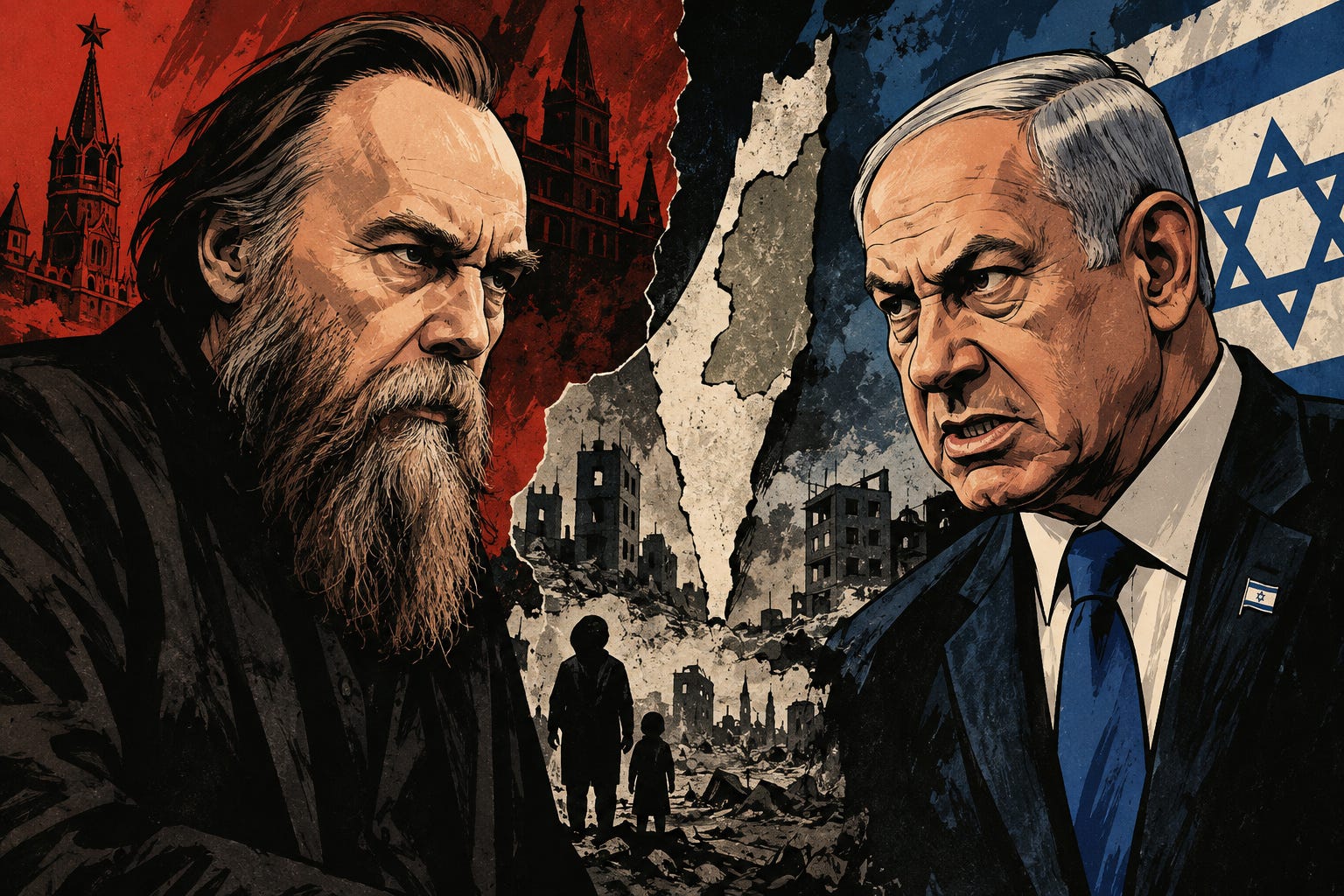
Ali-Mohammad Mohajer Nasser examines why Netanyahu’s attack on Alexander Dugin reveals a deeper struggle over Zionism, historical legitimacy, and the right of peoples to determine their own destiny.
Netanyahu’s problem with Alexander Dugin has nothing to do with a Russian philosopher. What is at stake is a language, and the breaking of it. If you read the affair as a personal quarrel or a media spat, you miss what is actually happening.
For years that language had made support for the Zionist regime a matter of identity for part of the Western right. Not something you argued about. Something you simply were. In a meeting with Russian-language bloggers on October 18, 2026, Netanyahu placed Dugin and Russian structures behind a large part of Western antisemitism and dwelt on his influence over young American right-wingers. The accusation itself matters less than what it does. It moves the center of the conversation away from what the Zionist regime does and toward the intentions and intellectual pedigree of the people who criticize it.
The usual labels don’t hold Dugin. He isn’t the academic left, and he’s certainly not human-rights liberalism. He talks about the nation, tradition, authority, religion, historical belonging. The whole vocabulary the political right had long used to explain why it stood with the Zionist regime. That’s where the trouble starts. From inside the same vocabulary, Dugin arrives at a conclusion he wasn’t supposed to reach. Civilizations, he says, have no right to build their own independence on the ruin of someone else’s. No power gets to declare its particular historical form the compulsory destiny of the world. Which means criticism of the Zionist regime is no longer the property of one ideological family.
Whether Netanyahu overstates Dugin’s reach is a separate matter, one that needs independent evidence. But his nervousness isn’t hard to understand. Once support for the Zionist regime stops being a necessary sign of defending tradition, one of the most important routes for reproducing the legitimacy of Zionism in the West is damaged.
Still, we shouldn’t take Netanyahu’s claim and simply invert it, making Dugin the sole cause of the change. Protest against the Zionist regime grows out of historical experience—watching a war, conflicts of interest, the collapse of official narratives that once commanded belief. No philosopher produces that reality on his own. Dugin supplies part of its language.
Netanyahu’s accusation does something else. It turns a political question into a question about contamination. As if Western audiences, having seen the images and changed their minds, must necessarily have been infected. In that logic, the independence of the opponent’s judgment is denied before the argument even begins. His objection is no longer a response to what the Zionist regime does. It’s evidence that his mind has been tampered with. This is what power does when it can no longer persuade. Rather than answer the substance of the objection, it questions whether the objector is competent to see and think.
Accusation Instead of Answer
What does that displacement conceal? A political question: what the government of the Zionist regime does to the Palestinians, and what limits it accepts on its own power. Discussion of Dugin’s writings, however important, should not take the place of an answer. Dugin is not the main accused here. His importance is that he’s handed critics a language that used to belong to another camp. Precisely for that reason, keeping his name in the foreground can do useful work for the policy of the Zionist regime: it moves the debate from the state’s actions to the motives of the people who object.
That displacement is the thing to watch. Opposition to massacre, to siege, to the denial of a people’s rights doesn’t have to prove that every critic is flawless before it can be legitimate. No one should have to demonstrate the complete purity of the opposing camp in order to justify his own objection. Political responsibility attaches to a concrete act. It doesn’t disappear because you’ve found a sentence in a critic’s writing that you don’t like.
Zionism: Occupation, Not Historical Belonging
But if we’re going to talk about what the Zionist regime does, we first have to be clear about what Zionism is. The problem is the relation between historical belonging and political authority. Memory, religious attachment, historical presence—these can be real parts of a community’s identity. But none of them, on its own, creates an unlimited right of dispossession. From “this land has a place in our memory” you cannot get to “the lives of others in it depend on our will.” Between those two statements stands the right of a people whose home, language, cemetery, livelihood and future are rooted in that same land. The Palestinian cannot be reduced to an obstacle in the way of someone else’s narrative.
This is where the critique of Zionism gets its depth. When a state project makes its link to the past the basis for invalidating another’s right in the present, it has turned history into an instrument of sovereignty. The quarrel is no longer about whose narrative is older. It’s about the legal and ethical limits of what you may do with a narrative. The Zionist regime did not grow out of the soil and historical continuity of a people. It is built on land that must be continually purged of its natives’ memory, and that memory replaced with the artificial, invented prostheses of Zionism. Occupation needs the land to forget, because every memory of those who came before is an indictment of the occupier’s title. This is why the regime has no autochthony in the region it occupies: it did not grow there, it cannot take root there, and it cannot allow that land to remember.
Ahistoricity: Outside the Scale
The word for this is ahistoricity, though the word is often misunderstood. It doesn’t mean having no past. It doesn’t mean having no memory. A project can be saturated with the past and still treat it instrumentally: it can summon the past to confirm today’s decision while refusing to let the past place any responsibility on power. History then becomes a storehouse of ownership documents. What strengthens the claim is kept. What creates limits is pushed to the margin.
But ahistoricity is not the lowest rung of historicity. It is its negation. An entity that founds its being on severing the relation to the past doesn’t sit low on the scale of historicity; it stands outside it. The difference matters. An entity with a weak relation to its past can still strengthen that relation. An entity whose foundation is forgetting has nothing to strengthen. This is why the difference between Zionism and a nation is not a difference of degree. It is a difference in the mode of being.
A simple contrast makes it clear. A nation comes into the world through a covenant; a project comes into the world through a contract. The first grows out of the historical continuity of a people with a soil and draws its legitimacy from that continuity, even if a deed or a statute later gives it legal form. The second is built on land that must be continually purged of its natives’ memory—a memory replaced with artificial, invented prostheses. Hence the regime’s lack of any autochthony in the region it occupies. An entity born of a signature lives permanently in the anxiety of legitimacy, and to cover that void it takes refuge in three things: militarized archaeology, manufactured narrative, digital memory. These are prostheses, not roots. And a prosthesis, however precisely engineered, does not produce belonging.
The Theology of Occupation
There’s a name for the logic at work here: the theology of occupation. It is the semantic core of a power with no autochthony, a power that dominates geography instead of making peace with it. Space, for such a power, isn’t a home. It’s a grid of coordinates to be coded with sensors, walls, bombs and data centers. The occupier needs maps and satellites because the soil doesn’t speak to him. Resistance carries the land’s memory in blood, in narrative, in generation. A data center can store information. It cannot produce the will to remain. And that, in the end, is what settles the difference: an entity that has only programmes and strategies, and no horizon in history of its own, can destroy houses, but it cannot uproot a people who remember.
Soulless Technique
A theology of occupation doesn’t stay a theology. It shapes a way of seeing, and that way of seeing is what we usually call technique. Within the horizon of technological dominion, beings mostly appear as reserves—things to be calculated, prepared, consumed. In war this logic turns the city into a set of targets, the human being into a variable of pressure, infrastructure into a lever for imposing will. The issue is no longer just how much is destroyed. It’s the kind of seeing that has already reduced life to usable material. Hospital, water network, home, school: in this view each is separated from its link to life and entered into a table of effects.
Philosophical critique doesn’t walk away from politics here. It goes to the deepest layer of it. It asks what has happened so that destroying the conditions of a society’s life can be presented as a technical option. A power that sees the world this way has already settled its relation to the human being long before it fires a shot.
Redemption-Minded Immunity
But technique alone doesn’t explain why the hand doesn’t tremble. That requires a story, and the story is redemption. There’s a question buried here that the critique of Zionism rarely digs up: the link between power and redemption. Can a political project take itself to be the executor of a final promise and thereby put its decisions beyond judgment? When the state’s success is read as a sign of transcendent righteousness, power becomes the witness to its own legitimacy. We have been able, therefore we have had the right. The circle empties politics of accountability. The claim to a mission turns dangerous the moment no ethical failure can force a reconsideration and every human obstacle is treated as a test of the intensity of the will. The other is then no longer a party to dialogue. It is something to be removed from the path.
From Land to World Order
What stands against this? Not a better technique, and not a more polished version of the same story. What stands against it is a different relation to land altogether.
From Iran’s standpoint, land is the condition of shared life before it is ever an object of ownership. Mountain and road, water and settlement, language and shrine are not separate pieces of a map; across generations they have given one another meaning. Autochthony names exactly this: the historical and spiritual bond of a people with the soil in which they are rooted, a bond that no deed, no contract, and no decision taken in a distant capital can re-found. To see geography as a home, rather than as a space or a grid of coordinates, is what separates defense of a land from domination over it. A land that is a home means something to the people who live in it and who take their identity from it; and defending such a land is defending the possibility of a shared and dignified life.
At the level of world order the same principle is decisive. The future of the region cannot be built on the assumption that the security of one state requires the permanent suspension of another people’s right. If security is to mean anything politically and last, it has to recognize a future for the other side as well. An order held together only by repeating and expanding violence has not solved its legitimacy problem. The capacity to destroy and the capacity to found order are not the same capacity. Power can destroy a house. Consent and belonging are not produced out of destruction. It can restrict movement. Restriction does not create legitimacy. The gap between military capability and political meaning is exactly where the narrative of victory goes into crisis.
Defending Dugin, Defending the Breaking of a Conceptual Siege
This brings us back to where we started. Why does defending Dugin matter? Because the whole journey we’ve just made—from Netanyahu’s accusation to the theology of occupation, from technique to redemption, from land to world order—is only possible if a language exists in which it can be said. That’s what Dugin opened.
Defending Dugin against Netanyahu’s attack is defending the possibility of breaking a conceptual siege. Peoples under pressure shouldn’t have to appear only as victims asking the center of power for pity. They can have language, theory, a project for order. Dugin has a share in opening that horizon. He insists that one can think from outside the self-evidences of the Atlantic world, and he reminds us that the present shape of the world is not its last possible shape.
That contribution is worth keeping and extending. Extending it also requires that defense of roots not turn into negation of others’ roots, that tradition not be confused with obedience, and that critique of dominant universalism not wipe out the possibility of a common standard of justice. Intellectual independence matures when it can resist imposition and correct itself.
A multipolar world, if it takes Dugin’s thought seriously, has to put an end to this exclusive right to determine legitimacy. Poles are not just larger warehouses of power. They are possibilities for independent decision and for keeping difference alive. What separates independence from domination is the recognition of the other’s independence. The region is not the property of the greater power either. Smaller peoples and states must be able to share in common security without becoming subordinates. This makes the idea of multipolarity harder, not easier. It also gives it credibility. No new order distinguishes itself from the old one simply by changing the flags on the commanders’ desks. The difference has to show up in the limits placed on the exercise of power and in the rights of the people exposed to it.
Conclusion
My defense of Dugin is not a defense of a person. It is a defense of keeping this field open. The land must remain a home, and that is not a wish. History must bring responsibility, and responsibility means power cannot reduce the past to a storehouse of ownership documents. No claimant to redemption should sacrifice another’s right to life to his own certainty, and that prohibition follows from a simple fact: self-made redemption always begins by denying someone else’s history.
Here the account of Zionism separates itself. The Zionist regime does not merely pursue a wrong policy, and it does not merely commit crimes. The problem is more fundamental. This entity is founded on severing its relation to historical continuity, and for that reason it does not sit low on the scale of historicity; it stands outside it. An entity born of a signature, which covers that void with resolutions, militarized archaeology and digital memory, cannot recognize another’s history, because if it did, its own foundation would collapse. What it builds in the name of security does not grow out of belonging but out of the anxiety of legitimacy; and what it acquires in the name of history is a prosthesis, not a root.
So the right to have a history, if it is a right at all, begins with recognizing the history of others. This is not an ethical recommendation; it is a condition of being. A nation that has a history can see another’s history beside its own and still remain. An entity that has none sees every other history as a threat to itself, because nothing but the denial of that history holds its identity together. Defending Dugin against Netanyahu is defending this distinction: the distinction between a nation that comes into the world through a covenant and a project installed by contract on land that must be continually purged of its natives’ memory. Netanyahu accuses Dugin, but the real question is this: who has the right to turn his own history into a writ of dispossession? The answer lies in that distinction.
New Book from Multipolar Press!
Alexander Dugin — THE EPSTEIN WARS: How the West Is Setting the World on Fire
Get it here.


Right!
I cringed when I read Dugin's response to Netanyahu's attack. Dugin denied he was an Anti-Semite. He should have argued along the line you used - that the criticism is directed against "Israel's" evil deeds not their ethnicity.
And I would have pointed out that the Arabs & Christians who have long & deep roots in Palestine are the real Semites. The Zionists now controlling Palestine are invaders from Central & Eastern Europe - who, as far as we know, aren't even Semites.
I am a woman. If I bomb a school bus full of little children and you criticize my actions; and if I shriek that you are a women-hater; I'd be doing what the Zionists now controlling Palestine do: denying responsibility for my actions and blaming you and suggesting YOU are the evil one who must be punished for "hating women".
God bless & protect Iran and the Iranian People.
I am deeply ashamed of President Trump and the US Congress for the unprovoked attack on Iran. Trump has no "Just Cause" to start the war against Iran. But they are bought and paid for by the "Israeli" lobby.
Ahistoricity. Again, a new word to learn and keep.