

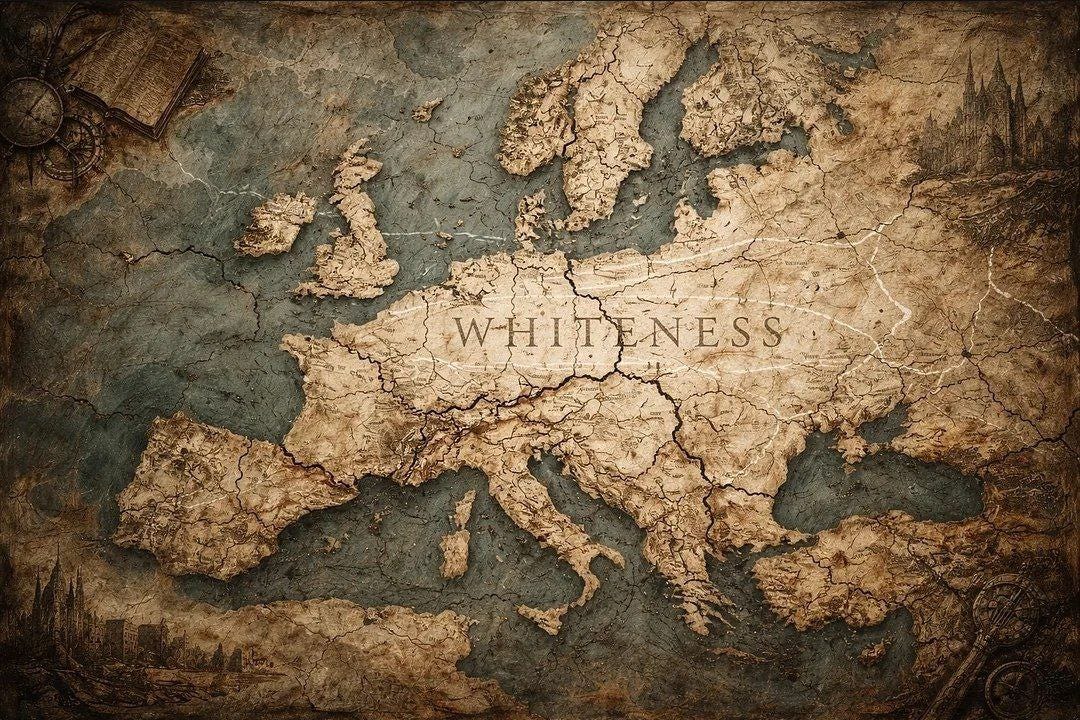
Callum McMichael on the racial revolt that remains trapped inside liberal modernity.
White nationalism is frequently presented by its adherents as a radical alternative to liberal modernity, a final defense of identity against universalism, globalism, and homogenization. Yet when examined at the level of political ontology and intellectual genealogy, white nationalism appears not as a rejection of liberalism but as one of its derivative forms. Its conceptual structure, its understanding of identity, and its moral logic are all shaped by the same modern assumptions that undergird liberal thought. Rather than transcending the liberal paradigm, white nationalism reproduces it in racialized form, thereby ensuring its own political and philosophical failure.
Alexander Dugin’s critique of modern political ideologies is instructive here. In The Fourth Political Theory, Dugin argues that liberalism is unique among modern ideologies in that it does not merely compete with its rivals but absorbs and dissolves them, reducing all political positions to variations of its own foundational premises. Liberalism, in Dugin’s account, replaces concrete historical subjects—such as peoples, traditions, and civilizations—with abstract units: the individual, the citizen, the rights-bearing subject. What matters is not inherited meaning, but formal classification. White nationalism, despite its rhetoric of revolt, operates entirely within this framework. It substitutes the liberal individual with the liberal racial category, but the logic remains unchanged.
This abstraction of identity is not pre-modern, nor is it traditional. It is distinctly modern. As Dugin notes, race as a political category emerges alongside Enlightenment rationalism, colonial administration, and liberal legalism. Pre-modern societies understood themselves through religion, land, language, and custom, not through universal racial taxonomies. The notion of “whiteness” as a transhistorical political identity would have been unintelligible to most European peoples prior to modernity. White nationalism thus seeks to ground political legitimacy in a category that only exists because of the liberal-modern order it claims to oppose.
The liberal character of this worldview is evident in its moral genealogy. Rudyard Kipling’s “The White Man’s Burden” is often cited as an expression of white supremacism, yet its ideological structure is unmistakably liberal. Kipling frames empire not as the extension of a particular civilization’s sacred order, but as a moral obligation grounded in universal progress and humanitarian duty. The colonized are depicted not as enemies or equals within a plural world, but as passive subjects to be administered, improved, and civilized. This is liberal paternalism, not ethnonationalism. The poem’s logic presupposes a universal moral hierarchy, managerial governance, and the abstraction of peoples into populations—precisely the assumptions that later animate liberal internationalism. Contemporary white nationalist movements inherit this logic almost unchanged.
Groups such as Thomas Sewell’s National Socialist Network (NSN) are illustrative of this trend. NSN was an Australian far-right organization founded in 2020 that advocated a white ethnostate through accelerationist tactics aimed at provoking societal breakdown and rebuilding along racial lines. It emphasized paramilitary-style training, street activism, and the prioritization of abstract racial solidarity over specific cultural or national traditions. The group is now in the process of disbanding due to a combination of internal fractures and sustained external pressure. Internal problems included ideological disputes and leadership conflicts, while external pressure came from Australian authorities through high-profile raids, asset freezes, and legal proceedings against members for offenses such as affray and weapons possession. Together, these factors eroded NSN’s operational capacity and led to its effective dissolution by late 2023.
Alongside NSN, derivative formations have emerged, such as Clann Éireann. This Irish group arose around 2021 as a splinter influenced by NSN’s transnational online networks and organizational models. It drew structure and tactics from Sewell’s platforms through shared recruitment channels on Telegram and other social media, adopted similar symbolic aesthetics such as runes and other esoteric motifs repurposed for pan-white unity, and adapted Australian-style racial accelerationism to an Irish context. This adaptation took the form of anti-immigration actions and calls for an “ethnic homeland” defined primarily by genetic whiteness rather than localized historical narratives.
Collectively, these groups present themselves as oppositional and anti-liberal. Yet their understanding of identity remains entirely abstract and modern. Clann Éireann’s reduction of Irish identity to “whiteness” exemplifies this collapse of concrete historical nationhood into racial universalism. Irish identity, historically constituted through Gaelic language, Catholic theology, clan structures, and a distinct colonial experience under British liberal imperialism, is flattened into a generic racial category shared indiscriminately with populations that share none of these formative characteristics. This is not nationalism rooted in historical being; it is liberal identity politics with different aesthetic symbols.
Ultimately, white nationalism fails because it never exits the liberal horizon and cannot resolve the contradictions generated by its own abstractions. By collapsing a vast range of distinct peoples, histories, and civilizations into the single category of “whiteness,” it unintentionally reproduces a form of internal multiculturalism, one in which radically different ethnic, cultural, and historical groups are expected to cohere solely on the basis of shared genetics. This reveals a decisive incoherence: what is presented as a demand for a homeland for a people becomes, in practice, a proposal for a multicultural society of whites, unified not by tradition, language, or moral order, but by biological reductionism. In grounding political identity almost entirely in genetics, white nationalism abandons any substantive account of culture or inheritance and reduces belonging to an administrative classification. It thus rejects liberal universalism only to preserve liberalism’s most corrosive assumption: that identity can be abstracted, standardized, and managed. This internal contradiction is not incidental but fatal. A politics that cannot distinguish between race and peoplehood, or biology and civilization, lacks the conceptual resources necessary for coherence, continuity, or legitimacy. In this sense, white nationalism does not collapse under external pressure; it disintegrates from within, undone by the very liberal logic it claims to oppose.

This is one of the clearest summaries I’ve seen of why “white nationalism” never really escapes the liberal frame it claims to reject. Trading, as the author pointed out, the liberal individual for the liberal racial category, it still treats identity as something abstract, standardized, and administratively manageable.
I think that the section on Ireland particularly illustrates and lands the point: when Irish history, faith, language, and law are flattened into generic “whiteness,” you don’t get a recovery of peoplehood, you get another version of internal multiculturalism, just built on a different spreadsheet.
And that seems to point to a deeper crisis of moral imagination, where we’ve forgotten that real peoples are formed by substantial cultures, institutions, and shared rituals that create civilizational depth, (not just via genetics or talk of rights etc.)
It all leaves me wondering whether our present order is even capable of recognizing that kind of embodied, memory‑bearing community, without immediately translating it back into the same abstractions that this essay dissects so well.
Your post has many good points and white nationalism as you describe it is not a solution to today’s ills. If white nationalism was a solution, the EU would have been a success. It was envisioned as a European super-state right from the start and at its inception, in 1957, all of Europe was overwhelmingly white.
However, you appear to fall into the all-or-nothing trap where the white nationalists say race means everything and the opponents say it means nothing. Yes, language customs, history, traditions, attitudes and behaviour vary significantly among nations (see the EU), but race is not unimportant.
The U.S. Naturalization Act of 1790 allowed immigration of “all white persons of good character”. Canada and Australia had similar practices. To build an American nation, the founders recognized that you need immigrants that are culturally close so that they, in moderate numbers, over time, and with hard work, will assimilate into the pre-existing English population. This largely worked for white Europeans so that there are no longer English, Polish, German or Italians but only white Americans. It has not really worked with Blacks. They are simply too different that despite
enormous work of integration in the 160 years since Emancipation, they remain a distinct culture.
Christopher Dawson said that “Every culture rests on a foundation of geographical environment
and racial inheritance, which conditions its highest activities.” And he later adds that though a culture is essentially conditioned by its material factors, it receives its form from a spiritual and religious element. A culture is a union of material factors (including race) and religion.