Where the Cross Divided: Schism, Civilization, and the Eastern Idea
A thousand-year fault line beneath the Russia-West conflict
Jerry B. Marchant argues that the current standoff between Russia and the West cannot be understood as a dispute over the last decade alone, but is better read as the modern flashpoint of a civilizational rupture dating back to the Great Schism of 1054.
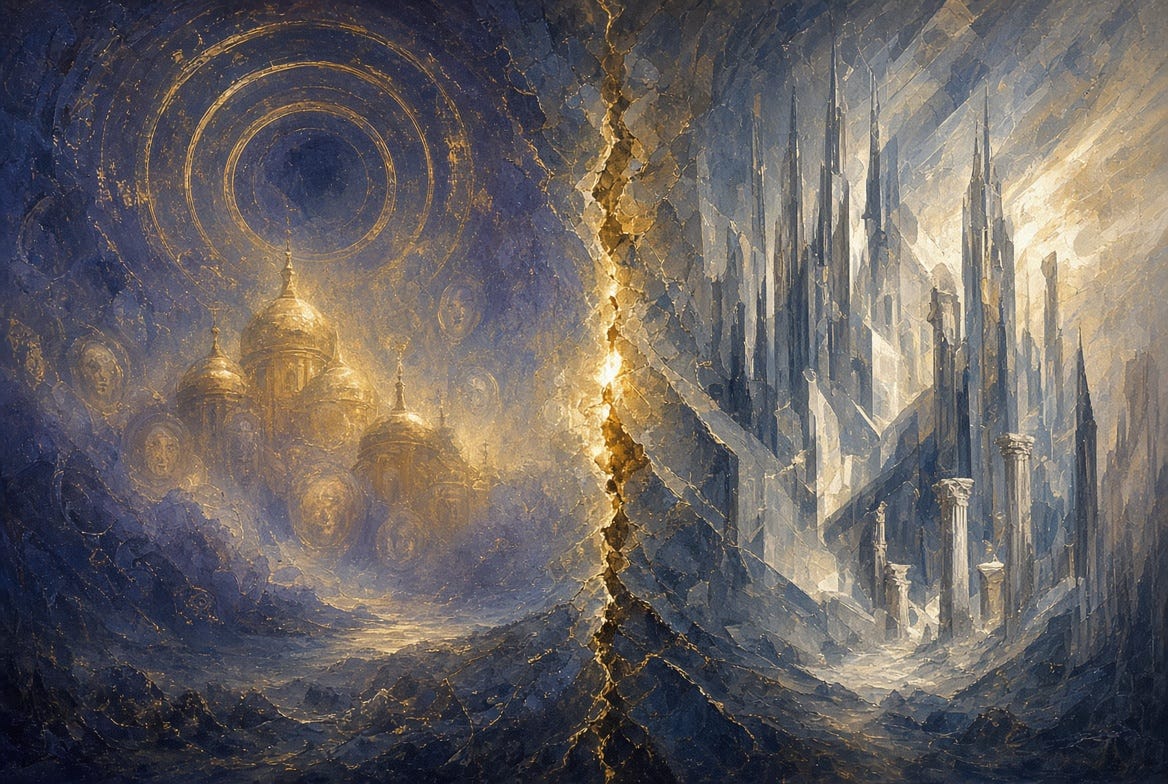
There is a habit, common among those who study only the last decade of any conflict, of imagining that history begins with the newspaper. One reads of tanks and sanctions, of summits and communiqués, and concludes that the matter is recent. A dispute over pipelines, perhaps, or the ambitions of a single government. But civilizations do not quarrel over pipelines. They quarrel, when they quarrel at all, over something closer to the soul, and the soul of this particular quarrel was formed not in 2014 or 2022, but in the summer of 1054, when a cardinal from Rome laid a bull of excommunication upon the altar of the Hagia Sophia and a patriarch of Constantinople answered in kind.
It is worth dwelling on the strangeness of that moment, because everything after it is, in some sense, a commentary. Two bishops, each convinced he alone held the keys, severed a single Church into two civilizations that would spend the next thousand years discovering how little they had left in common. Rome kept the Latin alphabet and, in time, the printing press, the Reformation, the Enlightenment, and the whole restless machinery of Western self-invention. Constantinople kept the Cyrillic script it had given the Slavs, the icon rather than the statue, the conciliar rather than the papal, and a different, slower relationship to time itself, one in which the eternal was not something to be improved upon.
The nineteenth-century Russian thinker Nikolai Danilevsky argued, in Russia and Europe, that humanity does not progress along a single line toward a single civilization, as the Hegelians of his day imagined, but unfolds instead in distinct cultural-historical types, each with its own organic life, each incommensurable with the others. Konstantin Leontiev went further, seeing in Europe’s very homogenization, its flattening of difference into a single liberal average, a kind of civilizational exhaustion. Whether or not one accepts the full architecture of their thought, both men were registering something real: that the line drawn in 1054 was not merely theological but ontological. It produced two different answers to the question of what a human being is for.
It is no accident, then, that when the wars of Yugoslav succession came in the 1990s, the killing did not follow the borders drawn by Tito’s cartographers but the older border, the one Theodosius the Great had drawn when he divided the Roman Empire between his sons, the one that still separated Catholic Croat from Orthodox Serb thirteen centuries later. Modern nationalism supplied the flags and the rhetoric; the fault line beneath it was already there, waiting, the way a scar remembers a wound long after the skin has closed over it.
Ukraine sits astride precisely this fault line, and its name tells us so before any historian does: okraina, the borderland, the edge of things. For a thousand years the lands between the Dnieper and the Carpathians have been the frontier where the Orthodox East met the Catholic and later Protestant West, fought over by Kievan princes and Polish kings and Cossack hetmans and Habsburg governors and absorbed and released and absorbed again. What is now called western Ukraine spent centuries under Polish-Lithuanian and then Austro-Hungarian rule, formed by Uniate Catholicism and a Central European sensibility quite distinct from the Orthodox Rus’ identity of Kiev, Chernihiv, and the lands further east. It was Stalin, not history, who first stitched these two Ukraines into a single administrative unit in 1939 and 1945. A wartime convenience that the Soviet state then bequeathed, unaltered, to independent Ukraine in 1991.
Vladimir Solovyov, writing at the end of the nineteenth century of a coming reconciliation of East and West, hoped that Russia’s vocation was ultimately one of synthesis rather than conquest. Nikolai Berdyaev, exiled from the country he loved, wrote of the “Russian idea” as a longing for wholeness (sobornost) that the fractured individualism of the West could never quite satisfy. Neither man was a strategist, and neither would recognize much of what is done today in the name of the ideas they refined. But both understood that the border in question is not a line on a map that a treaty can simply redraw. It is a border in the historical consciousness of a civilization, and such borders have a way of reasserting themselves, “falling back into place,” as a not entirely unsympathetic observer put it, whatever the paperwork of the intervening centuries may say.
Samuel Huntington, no friend of the Danilevskian tradition and writing from the very heart of the civilization he sought to defend, arrived by a different road at a similar conclusion in his own Clash of Civilizations: that the most dangerous conflicts of the coming century would not be ideological but civilizational and that the line separating Western from Orthodox Christendom—running, in his telling, through precisely this stretch of Eastern Europe—was among the oldest and least negotiable of all. It is a rare thing when a Harvard political scientist and a nineteenth-century Slavophile mystic end up drawing the same map.
None of this is offered as prophecy, still less as justification for any particular policy of any particular government. It is offered only as a corrective to the amnesia of the present tense. The assumption that what is happening now is happening for the first time.
Rome and Constantinople quarreled nearly a thousand years ago over a filioque clause and the question of who might claim universal authority. Their descendants are still, in a sense, finishing the argument. The wise historians do not pretend to know how it ends. They only insist that we understand, before we speak of borders and treaties, that we are not the first generation to stand at this particular edge of the world, and we will not be the last.
Works cited:
Berdyaev, Nikolai. The Russian Idea. Translated by R. M. French, Lindisfarne Books, 1992. First published 1946.
Danilevsky, Nikolai. Russia and Europe: The Slavic World’s Political and Cultural Relations with the Germanic-Roman World. Translated by Stephen M. Woodburn, Slavica Publishers, 2013. First published 1869.
Huntington, Samuel P. The Clash of Civilizations and the Remaking of World Order. Simon & Schuster, 1996.
Leontiev, Konstantin. Byzantism and Slavdom [Vizantizm i slavyanstvo]. 1875.
Solovyov, Vladimir. “The Russian Idea” [“L’idée russe”]. 1888. Lecture delivered in Paris.
Solovyov, Vladimir. Russia and the Universal Church. 1889.


