
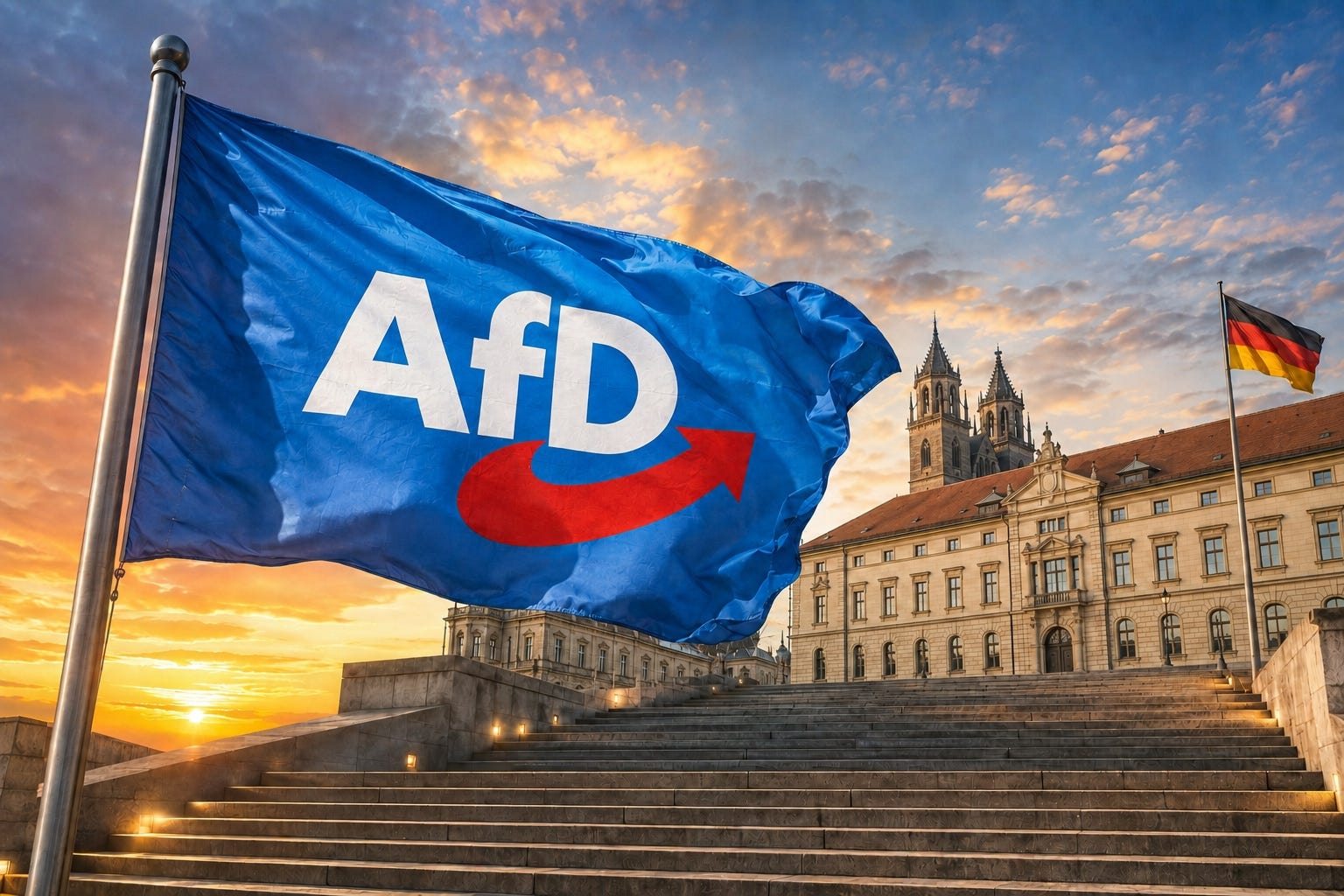
Bob Hickok examines how the AfD’s surge in Saxony-Anhalt could carry the party from opposition into government and alter the course of German politics.
AfD leader Alice Weidel’s latest declaration was direct: “We will form the government in Saxony-Anhalt.” The state votes on September 6, and the AfD enters the final weeks of the campaign with a commanding lead. An Infratest dimap poll places the party at 41 percent, against 24 percent for the CDU (Christian Democratic Union, Chancellor Friedrich Merz’s party). Since several smaller parties are polling close to the five-percent threshold required to enter the state parliament, such a result could give the AfD an absolute majority of seats without an absolute majority of votes. Its lead candidate, Ulrich Siegmund, is therefore campaigning for an AfD government rather than another term in opposition. This would be the first state government led by the party and a grave defeat for every institution that has spent years telling Germans that the AfD must never be allowed to exercise power. The campaign slogan, “Everything is possible,” has become a statement of fact. A party treated as an untouchable outsider now stands within reach of the State Chancellery in Magdeburg, the capital of Saxony-Anhalt.
