

Oğul Tuna on Israel’s expanding Mediterranean ambitions and the uprising in Albania.
The Albanian people’s famous stubborn streak has flared up once again, and this time in a way that has the potential to draw the entire Mediterranean and Europe into the controversy.
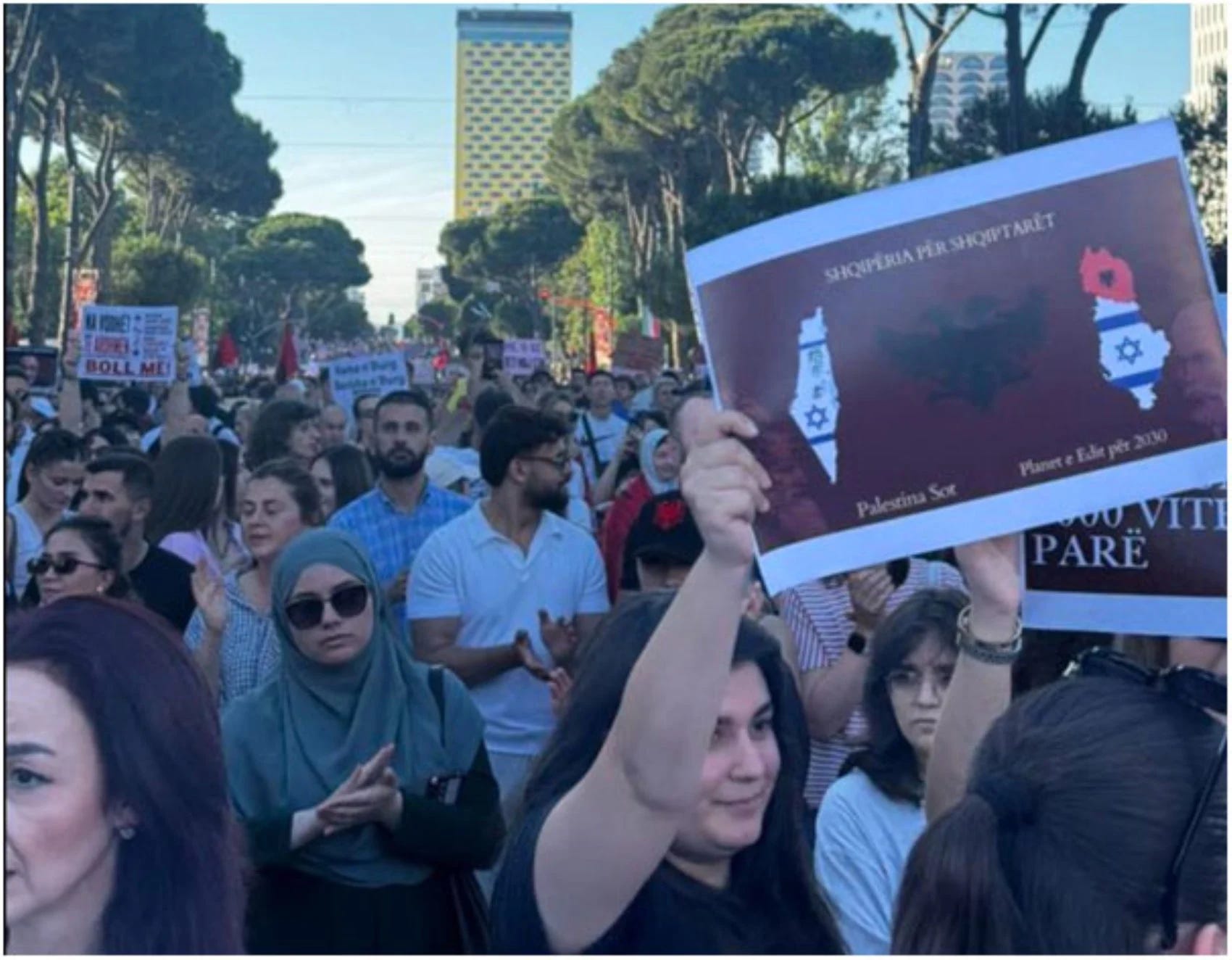
The Balkans are currently being shaken by what has become the most passionate and substantial popular political reaction seen in the region in recent years. In protests largely ignored by the Western media, thousands of people have spent the past week filling the streets of the capital, Tirana, as well as Vlorë.
At the center of public anger are the United States and Israel. Although they were not the original cause of the unrest, demonstrators have directed their slogans and banners towards Washington and Tel Aviv. The individuals viewed as directly responsible are Jared Kushner, the son-in-law of U.S. President Donald Trump, and his daughter Ivanka Trump. Public outrage has been mounting ever since plans emerged to transform Sazan Island, located off the Albanian coast and once home to a Soviet military base, into a massive luxury resort complex.
Why Are These Figures Being Targeted?
Under Kushner and Ivanka’s project, Albania’s Sazan Island and Zvërnec Island are being opened up to “tourism.” Though, arguably, a very particular kind of tourism. In the words of Turkish intellectual Yalçın Küçük, one could say that “human degradation” is once again being used as a pretext, or perhaps a cover, in this picturesque corner of the Balkans:
Perhaps one of the most ignoble words is ‘tourism.’ One can understand communism or socialism. But the ‘ism’ of the tour corresponds to the corruption of man, and over time I have come to understand it as the mode of movement of the degenerate.
(Caligula: Saralı Cumhur, p. 16)
Continuing from Küçük’s observation, behind a project that could potentially transform an already mafia-ridden and externally dependent region—not merely Albania, but much of the Balkans—into a society devoted entirely to serving outsiders, the familiar actors once again appear. According to reporting by Fırat Çelik of GZT, the initiative is being undertaken by Kushner’s investment fund, Affinity Partners. The project is expected to cost $6 billion, with financing reportedly coming from Gulf and Israeli sources.
The development includes everything one would expect: luxury hotels with thousands of rooms, marinas, private villas, and more. While discussions continue about the “Dubai-ization” of Istanbul, what now confronts us is a project aimed at the “Dubai-ization” of Albania. Yet this vision has alarmed not only Albanians but internet users around the world. In fact, following the revelations surrounding Jeffrey Epstein and the release of related documents, fears have emerged that a new version of Little Saint James, better known as Epstein Island, could effectively be relocated to this part of the world.
Regardless of the speculation and allegations surrounding the matter, the broader picture and the connections involved have driven protesters into the streets for days, expressing their opposition to numerous figures, ranging from Socialist Party Prime Minister Edi Rama to Ivanka Trump. According to reporting by Harici, Ivanka visited Albania earlier this year and toured Sazan Island, which is currently part of a national park.
Rama, who has dismissed the project as a victim of “fake news” and claimed that the street demonstrations are backed by Iran, had already faced protests in February of last year over allegations of corruption. The prime minister, who is actively pursuing Albania’s accession to the European Union, has also attracted criticism both for his eccentric photo opportunities with EU leaders and for statements he made during a visit to Israel in January 2026. Speaking before the Knesset, Rama declared:
Standing before Netanyahu, one of the greatest orators in the world, makes my knees tremble.
During a meeting with the Israeli president, Rama also issued the following invitation:
By the way, we are ready to welcome with open arms all Israelis who wish to come here—whether tourists, entrepreneurs, artists, writers, people working in high technology, or those caring for the elderly. In this country, located in the heart of Europe, on the shores of two seas and surrounded by many rivers, our doors are open to those who wish to build their homes here. Within a very small geography, in a country as small as Albania, nature offers everything you could possibly be looking for.
The Bigger Picture: Is the Mediterranean the Real Target?
Although the protests in Albania currently dominate discussion in the Balkans and the Eastern Mediterranean, looking at the broader picture makes it difficult to avoid asking: Is the Mediterranean itself the real target?
After all, we are approaching the anniversary of the Iran–Israel–United States war. Over the course of the past year, numerous reports concerning Israeli investors and entrepreneurs have emerged. Commentators have written extensively about how the government in Tel Aviv, which seeks to establish a front alongside Greece and Southern Cyprus against Turkey, has been expanding its activities particularly in the southern part of the island.
Of course, these activities are not limited to military and political initiatives. According to a report published in May by Ecem Şahinli Ögüç of Anadolu Agency, the village of Trozena near the city of Limassol has reportedly been purchased by Israelis, with Greek Cypriot residents allegedly prevented from entering the area.
Alongside the many analyses warning that Northern Cyprus is becoming a target of Israeli interest and that the security of the Turkish Republic of Northern Cyprus is increasingly at stake, we also see that the region has become a destination for Israeli investors and settlers. Likewise, after the Iran war intensified, many Israeli citizens reportedly fled not only to Southern Cyprus but also to Northern Cyprus. According to an August 2025 report by Emir Abdurrahman Bulut in Independent Türkçe, Chabad and various investors had been acquiring property there for an extended period. The issue became so prominent that the authorities of Northern Cyprus and the Israeli media clashed last year after headlines proclaiming that “Northern Cyprus is also an Israeli problem” began to multiply.
In May 2026, The Jerusalem Post drew attention to a different country altogether. An Israeli company, IDM Kalamata Monoprosopi AE, was reported to be planning a €136.5-million investment in Kalamata, in southern Greece. The project is designed to attract both foreign tourists and individuals interested in purchasing property in the region.
Of course, within a laissez-faire economic framework, the nationality or identity of capital is generally regarded as irrelevant. For this reason, officials such as those in the Albanian government, who are eager to accelerate integration with the West and attract foreign investment, tend not to concern themselves with the origin of incoming funds. Yet when one steps back and considers the broader pattern, examining the locations where investments, reports, and public reactions continue to multiply, it becomes difficult to ignore the possibility that something significant is developing along Europe’s Eastern Mediterranean coastline.
At the very least, this is how the Albanian protesters see the situation. Even after a full week of demonstrations, they continue to fill the streets with forceful slogans. As Rama claims, these may not be the largest protests he has ever faced, yet they can hardly be described as a fading movement. What may be most troubling for him is that Albanians from every social background and political persuasion have united in opposition to both him and the project.
Will these demonstrations bring down the government or trigger a domino effect across Europe? It is still too early to say. It is worth remembering that many Europeans, like the Albanians and their neighbors, are increasingly aware that ordinary people are struggling, even as their governments appear preoccupied with projects that do little to serve their countries’ interests. As a result, it would hardly be surprising if the summer were to bring similar demonstrations to many other European cities beyond Tirana.
(Translated from the Turkish)

Imagine a world where these parasites were forced off the land everywhere, unable to walk anywhere without fear of attack. Living permanently as migrants on their yachts, only able to disembark on the most remote islands far from humanity. They wanted to rise so far above the rest of us, they became detached & floated away.
I only hope they succeed in keeping these evil people from taking their country.