

Alexander Dugin argues that his daughter Daria’s “eschatological optimism”—faith in victory even in darkness—is the only stance that fits a war he calls not geopolitical but metaphysical.
Conversation with Alexander Dugin on the Sputnik TV program Escalation.
Host: Another monstrous crime has taken place in Ukraine. The perpetrators have not been officially named, but it is known that an armed attack was carried out on the Holy Dormition Svyatogorsk Lavra of the Ukrainian Orthodox Church, resulting in the death of a monk. Orthodox media are actively publishing the details. Alexander Gelyevich [Dugin], do you think they will actually look for those responsible, or do they already know perfectly well who they are and will simply cover for them, given the dire and powerless position in which the Church finds itself today on Ukrainian territory?
Alexander Dugin: You know, the war now being waged in Ukraine is, among other things, a war for Orthodoxy and against Orthodoxy. It is not even really a question of whose jurisdiction this or that Orthodox community falls under—although, of course, there is one Church, the Russian Orthodox Church, the traditional one, and the overwhelming majority of Ukrainians still belong to the Russian Orthodox Church. The Ukrainian Orthodox Church is its part, its inseparable branch. But generally speaking, the course the Ukrainian authorities have taken is a course toward the West, toward globalism, toward postmodernity. And that, of course, runs completely contrary to Orthodoxy.
A genuine open war is being waged against the Russian Orthodox Church—that is, against its canonical part, the UOC—so no one will be looking for anyone. You could call it an excess committed by those who carried it out, but in Ukraine Orthodoxy as such has, in essence, been declared outlawed. It has been declared the enemy; Orthodox people are regarded as conduits of the “Russian world.” In principle they are partly right, because these people are not working for us—they are working for the Lord. Ukrainian believers work for Jesus Christ, to whom our people swore allegiance in the baptismal waters of the Dnieper under Grand Prince Vladimir. We and the Ukrainians are one inseparable community—historical, religious, cultural—that then pledged itself to Christ.
The Ukrainian nationalists, globalists, Westernizers, and neo-Nazis who came to power in Ukraine tore up that covenant; they ripped it apart. They accused Russian Orthodoxy and Rus itself—of which they themselves are a part—of every sin. And of course the murder of monks, the Svyatogorsk Lavra—this is simply part of that diabolical force that has swept over Ukraine. That territory is now under the power of Satan, in the literal sense.
By the way, Satanism is banned in the Russian Federation; it is considered a prohibited current. But Satanism can still be banned—Satan himself cannot, because if he did not exist, what exactly would we be banning? And that is precisely the historical sharpness of the situation: a battle between God and the devil is underway. And that battle is being fought through us, through Russians, through Ukrainians, through Western and Eastern countries. We are now at the center of this battle, and when monks die, that simply confirms how serious the situation is. They are most certainly parties to this war; they are not spies—they pray to God, and that is all. I even think that for them questions of inter-church relations are secondary compared with fulfilling their higher mission of serving God and saving the soul. And if you yourself are saved, then, as Saint Seraphim said, “Save yourself, and thousands around you will be saved.” They bring salvation, and that is why they are enemies. And the enemy chooses a sacred target, a symbolic target. I am absolutely convinced that this crime will remain unsolved, because behind this crime stands the whole of contemporary Ukraine.
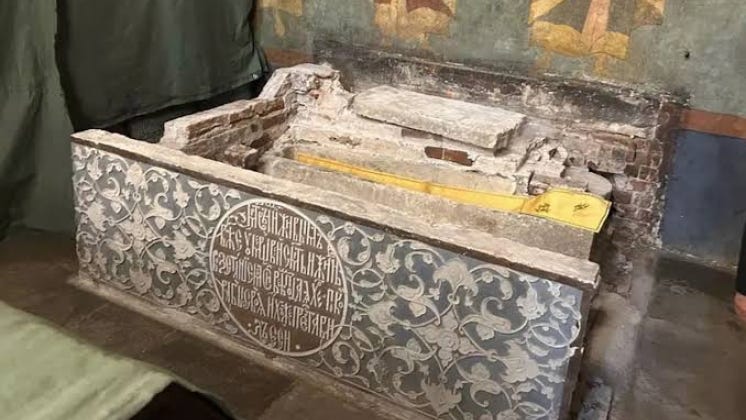
Host: In parallel with this process, a little earlier in Russia the relics of Dmitry Donskoy were discovered. Representatives of the Russian Orthodox Church, among others, have drawn attention to the symbolism of this happening at such a difficult time for the country. Vakhtang Kipshidze, in particular, noted that during the special military operation we are defending sovereignty, drawing historical parallels precisely with the times of Dmitry Donskoy. From your point of view, what is the symbolism of this happening right now?
Alexander Dugin: This is simply a real miracle. We often do not believe in miracles and try to explain everything by rational processes, but that does not work. Sometimes a miracle is simply a miracle. An astonishing thing: I myself was there; I venerated the relics during that very brief period when they were open, before they were closed again. Makarov and Batalov, who supervise the Kremlin archaeological excavations, told a small group of us how it all happened. A crack appeared in the sarcophagus of Dmitry Donskoy’s father, Grand Prince Ivan the Red. In the nineteenth century they installed heating in the cathedral and treated the tombs of our Russian saints and grand princes rather carelessly. It was believed that two sarcophagi lay one beneath the other: the father’s and Dmitry Donskoy’s own.
When the crack formed this August they began checking the structure and discovered that there was no other sarcophagus under the father’s—it was next to it. When they opened it in order to save the entire structure from collapse caused by those very barbaric nineteenth-century heating works in the Archangel Cathedral, the authentic relics of Grand Prince Dmitry Donskoy were found, whose identity has been fully confirmed by genetic research. And the main thing is that they have been preserved. I myself saw that body: in more than 600 years everything could have turned to dust, yet the relics are incorrupt, and on the skull one can see the mark of a blow from a Tatar warrior—after all, it is known that he fought in the front ranks on Kulikovo Field.
His Holiness Patriarch Kirill of Moscow and All Rus came to venerate these relics. The President also came and venerated them on August 20—precisely on that symbolic date when my daughter was killed by Ukrainian terrorists. And I arrived on the 21st together with my good friend Konstantin Malofeev and Nikita Mikhalkov. We found ourselves there in the Kremlin literally an hour before the sarcophagus was closed for good, because all the restoration work had been completed.
But what is astonishing is the day after the President venerated the relics. After all, it was exactly on August 21, 1380, that Dmitry Donskoy set out from Moscow for the Battle of Kulikovo, which we won with enormous difficulty and which became the turning point in the liberation from the Golden Horde and the rise of Moscow as a world power in anticipation of the “Moscow—the Third Rome” theory that arose a hundred years later, when this transfer of our historical mission took place.
This is an incredible coincidence. Because of restoration work and the appearance of a crack they accidentally opened the relics of Grand Prince Dmitry Donskoy—canonized in 1989, so this can be considered a second finding of the relics. The veneration by the President and the Patriarch reproduces a genuine symphony of powers, and all of this occurs at a historical moment coinciding with the date of the departure from Moscow for Kulikovo Field—August 21. Such a thing simply cannot be accidental.
Nikita Sergeyevich Mikhalkov, praying at the sarcophagus opened at the last minute—after all, it will be closed for another century—addressing the saint practically in an empty church, in the presence of only a few people, said: “Help us, saint; we need your help, your prayers and your participation.” Russia stands in an extremely difficult situation; the question of “to be or not to be” is being decided—perhaps as then, or perhaps in an even sharper form than on Kulikovo Field. We are marching to our own Kulikovo Field.
And the President, according to eyewitnesses, coming out of the Archangel Cathedral on August 20 after venerating the relics, was completely radiant. Thanks to this miracle he became convinced with new force of the inevitable victory of Russia, of our spirit, people, and state. This is truly a miracle and a profound turning point, although the forces of darkness have also stirred. Very many of the most important symbolic events of our history—both the most tragic and the turning-point ones—occur precisely in these August days, from the 19th to the 21st.
The way everyone has risen up against the discovery of the relics of the holy right-believing Grand Prince Dmitry Donskoy—the West, the Ukrainians, and our liberals together with skeptics, atheists, materialists, left and right—proves that this event is extraordinary. It is a genuine heavenly sign. Saints come out of concealment only in critical times.
And in parallel with this, the relics of Saint Spyridon of Trimythous were miraculously brought to Russia—a great saint deeply venerated in Rus, whose relics have arrived in our country for the first time. Compatriots go to them; hundreds of thousands of believers venerate him in the cities to which they are brought. Saint Spyridon plays a colossal role in our spiritual tradition.
As Akim Apachev recently wrote very accurately, we now feel like two bogatyrs in the final clash: we are tired, the West is tired, the Ukrainians are exhausted, and we too are in many ways depleted. We sense the approach of the finale of this battle, the portent of our Victory. Of course it will not be given to us as a gift—we have already paid an enormous price for it, losing and continuing to lose people close to us. And the help of the heavenly intercessor of Holy Rus, Grand Prince Dmitry Donskoy, victor in the fateful Battle of Kulikovo, is simply necessary to us now. We must receive this sign that has descended from heaven upon Holy Rus with deep gratitude.
Host: We have a question from listeners on the topic; I will quote it now: “Do you think we will live to see the moment when the demons—meaning the Ukrainian authorities—decide to declare holy the relics of the so-called heroes from the new pantheon of Nazi collaborators?”
Alexander Dugin: That is almost exactly what is happening. They honor Bandera, they rebury executioners, murderers, sadists, and rapists—people whom they exalt and to whom they in fact bow down. When we say that Ukraine has turned into a satanic society, this is no longer a metaphor, not an exaggeration, and not a propaganda cliché. On our Russian land, on its Ukrainian part, something terrible is taking place that makes one recall both Gogol’s dark prophecies and the most horrific infernal scenes.
I think it may well come to official canonization. People today are being forced to venerate the remains of these criminals—and this is a genuine perversion of the entire church tradition, genuine satanic “relics.” The filthy, dark flesh of murderers and maniacs, decomposed to the end, is used to open the gates of hell and draw nourishment from there. The murder of the Svyatogorsk monks, everything they do… The death of little children in a kindergarten in Krasnodar—all these are links in one chain, elements of an endless satanic mass, the so-called “Bloody Easter,” which is celebrated without end in Ukraine.
And here we must all treat what is happening with the utmost seriousness. Right now the consciousness of the secular person, the atheist or skeptic, is undergoing a colossal trial. For centuries of the Enlightenment, culture was held under the hard press of the doctrine that there is nothing higher, that atheism is the only scientific truth, that God is a myth, and that all church mysteries, miracles, and relics are deception and “opium for the people.” But when we encounter a whole array of miracles—both genuine heavenly miracles and the black miracles of Satan, when they collide head-on—it becomes incredibly difficult for the secular person. He falls back on skepticism, repeating: “This is all fake, this cannot be.” As a result his understanding of reality shrinks and becomes completely inadequate.
If one discards sacred history, the logic of Russian thought and philosophy, if one ignores the depth of the teaching of our Russian Orthodox Church on the meaning of history and the mission of the Russian people, if one does not believe in the Apocalypse and considers all this nonsense—then what is happening today in Ukraine, in our politics, in technology, in the Middle East, and in our own war becomes completely inexplicable. From a materialist point of view all these events look irrational—after all, it would be rational simply to get on with ordinary life, move toward technological progress, and pay no attention to anything.
But the religious underpinning of what is happening, the eschatological tonality of our historical moment, cannot be wished away. The unfortunate person deprived of religious culture today turns out to be the easiest prey for these dark forces. That is precisely why the gestures of our President, the Patriarch, opinion leaders, spiritual and cultural figures who openly turn to God are so important. This is no longer a slogan or a metaphor—it is a direct call to go to church, to turn to Scripture and tradition, to think about the salvation of the soul, because what is at stake today is not something or other, but the soul of each of us and the very fate of Holy Rus.
Host: In the first half of today we spoke a great deal about Satanism. You mentioned that it is a prohibited current, and here it is important to add that it is also on the list of extremist ones—we observe the law. Concluding this large theme connected with the Church and with relics: how ready are Western countries in general to accept and understand how we see our future on the basis of this worldview? Will the conflict between our ideology and their position widen or diminish, or will we still arrive at some kind of consensus?
Alexander Dugin: Unfortunately, it will only intensify, because recently an interesting article appeared in The Spectator by a German author, Döpfner, who clearly showed: the West is an idea. An idea absolutely incompatible with the existence of either an independent Russia, or an independent China, or an independent Iran. The West is not simply a territory but a rigidly anti-Christian, anti-traditional, and hegemonic ideology that does not permit any other sovereign centers of power beyond its borders. And here everything is said with extreme honesty: either we or they—and the entire rest of the world, which they count among their enemies (the Orthodox, the Chinese, Muslims, and everyone who has a different view of life). Between our civilization and the Western one a war of survival is underway.
I want to stress one important thing: this is not a matter of ordinary tactical, strategic, or economic contradictions of the kind any states have. Today we stand in a radical, absolute, metaphysical, and messianic opposition to the West, because the West is a false, harmful, dangerous, and insistent idea. If we want to preserve our sovereignty and win, we have to draw that line with complete clarity. We are prepared to talk to the West only on our terms—on the terms of recognition of our spiritual, intellectual, political, and economic sovereignty. And that is precisely what the collective West denies us today.
So we need to gather our strength and understand that what lies ahead may be the greatest victory in our Russian history, and there will certainly be no easy paths. For too long—not only in recent decades, but for centuries—we have been infatuated with the West. Today the West has become the final reality of that very absolute evil, and Ukraine is only one of its tentacles.
Host: In the first half of our conversation we remembered Dasha Dugina and the fact that four years have already passed since she was taken from us. How is she remembered today? In Italy, for example, a memorial plaque was unveiled. People who care, people who keep her memory… What do they write to you? How is she remembered—both here in our country and abroad?
Alexander Dugin: It really is a miracle of a particular kind. Dasha was a remarkable person, with an enormous, bright future ahead of her. She was incredibly active, very intelligent, a sincerely and fervently believing Orthodox Christian and a patriot. And just as the world began to turn in that direction, she was killed.
But her potential, perhaps not fully realized in life, is being realized now in another way. Her books are being published both here and around the world; they have been translated into English, Spanish, and Italian—all five of her books have come out, and new fragments are being gathered. People search out her interviews, print them, and publish them. Memory of her does not fade or wear away from year to year; it grows and takes on new tones.
A year ago, on August 20, 2025, in Zakharovo, at the Pushkin Museum—the site of the Tradition festival after which she was brutally murdered by Ukrainian terrorists—a magnificent monument to her was unveiled. In every season it changes, fitting in an extraordinary way into the Russian landscape, playing with light and shadow. People bring flowers there: first-graders come at the start of the school year, and students after graduating from university. For many, the monument has become a living gathering place.
And this year in Italy—and I am very grateful to the leadership of one of the districts of Tuscany—a memorial plaque in Dasha’s honor was unveiled. In the Italian city of Varese there was an extraordinary, profound festival called “Daria Aletheia” (from the Greek for “truth”). They read her poems, performed an operatic cantata written by the Italian composer Angelo Inglese. One actress read Dasha’s work translated into Italian—the diary The Depths and Heights of My Heart, including her notes on her journey through Italy.
People were stunned by how finely she described Italian culture, the landscape, the boat trip from Rome to Sicily. How many of our fine, observant, cultivated young women travel the world—but Dasha’s journey became a true symbol. She wrote about the most important authors of Italian culture, visited palaces—in particular she knew the remarkable Princess Vittoria Alliata di Villafranca, owner of the magical Villa Valguarnera. Dasha traveled through that sacred Italy and left astonishing texts about it.
She has a book, A Theory of Europe, very popular now and translated into almost every European language. In it she says: I would like to see another Europe—a Europe of tradition, sacred, Christian, cultural, and philosophical. I love it, I dream of it, and I discern it through the horror that reigns in contemporary Europe. “This Europe is disappearing; save my Europe,” Dasha said.
When the Italians heard the actress—and she really did read excerpts from The Depths and Heights of My Heart with great professionalism—people simply wept. Those present were shaken by this piercing address to Europeans: “Wake up! Return to yourselves! We Russians are making this difficult journey; we are returning to our sacred roots—do the same.” Those words struck them with their extraordinary, prophetic depth.
Dasha is now revealing herself from a side that neither we, her parents, nor even her friends fully knew before. When you live next to someone, everyday details often hide what matters most. Now that essential thing is beginning to come through. Many call her Daria the Thinker. Her monument in Zakharovo holds a book, and people who come there wonder: what book is it? Plato? Or a future work of her own? After all, we published most of her books only after her tragic, martyred death. The book in her hands is a symbol of a work not yet written, one that still remains to be created.
Dasha has become a symbol of the future, a symbol of spiritual sovereignty, a sign of our true Russian intellectual, spiritual, Orthodox, and patriotic youth. She has become their guiding figure. Yes, we have a constellation of warriors, we have saints, we have a ruler and we have geniuses, but Dasha has taken her own place in that line, embodying what Fyodor Mikhailovich Dostoevsky already spoke of in the nineteenth century. He wrote about Russian young people—people endowed with the sharpest, most piercing moral sense. They may not be as deft, skilled, advanced, or successful as the youth of other countries; they may at times be shy and shrink before loud, self-enamored discourses; but they possess the main thing—the depth and purity of the Russian heart, that piercing morality.
Dasha has become for new generations the embodiment of just that Russian youth. Not always as it appears on the surface—with all its passing weaknesses, laziness, slackness, ambitions, or flaws that sometimes create a distorted image. But deep inside every Russian person, every Russian girl and every young man, a pure Russian spark is beating. And at a certain moment it opens. Dasha became an invitation into those worlds, a guide into a space of purity, fidelity, and spirit.
And that is felt here in Russia as well—her memory is honored in a completely unofficial way. This is not official propaganda and not a banal common denominator; she speaks to the deepest layers of the human soul. Dasha seems to awaken faith in victory, in fidelity, and she calls: fight, stand your ground, love, start families, be faithful to Russia, to the Church, to our mission, and we will surely win.
In her lived that very optimism which we call—continuing her own thoughts and texts—eschatological optimism. It is confidence in our victory even when everything around is dark, even at the price of unimaginable suffering and sacrifice. That is Daria Dugina’s testament: believe in the future, never give up, even when it is hard and unbearable, keep fighting.
The people who surrounded her at the beginning of the special military operation also became martyrs: Vladlen Tatarsky, with whom she was on excellent terms; Pavel Kanishchev—leader of the Eurasian Youth Union, who died in the liberation of the village of Konstantinopolskoye, which is also symbolic. For that world of spiritual Russian youth that took the final battle of sacred history as a personal matter, Dasha became an absolute symbol, a source of light. The remarkable artist Dmitry Sever created a beautiful mural dedicated to her, in which the figures are woven from letters, and wrote the phrase: “We need a revolution of the spirit.” Dasha embodies that spiritual revolution and awakening. In her lifetime she herself probably did not fully grasp the scale of her future mission, but now everyone sees it, and it is happening in a completely natural way.
I am boundlessly grateful to the millions of people around the world who remember Dasha and keep her memory. The number of messages and words of support that come to me is enormous—these condolences do not stop. For me every day of these four years is still the twentieth of August. And it will be that way in the future; it cannot be overcome. But people feel it; they send thousands of responses from all over the world, and Dasha is truly alive.
In her lifetime she was known and treated with enormous respect and affection. People often said to her: “You are just like your father, only better.” I liked that immensely, and so did Dasha—she felt that she was continuing and developing what we had not had time to finish. And now she is performing that function on an entirely different level. She has become many times higher and purer than all of us, but she continues, illuminates, and transforms what we gave our own lives to—the lives of her parents and those close to her. She has not gone anywhere; she has not left our ranks; in a spiritual sense, she now stands at the head of them.
Host: Speaking precisely of the eschatological optimism Daria talked about… Today’s broadcast is built in many ways on contrasts: on one side, the reports of our Ministry of Defense, strikes on military targets and warehouses on the territory of the Odessa port; on the other, the attack on a children’s center in Krasnodar, where, our ombudsman reported, three teenagers were killed. Is there any understanding at all—we have it, but do those in Ukraine who give these orders, and those who finance all of this, have it—that this is, to put it mildly, wrong? Or not even “somewhat wrong,” but simply monstrous?
Alexander Dugin: The apple does not fall far from the tree: we see perfectly well who stands behind the Ukrainian regime and supports it. We remember the strikes on schools with children that the Americans and Israelis carried out at the beginning of the war with Iran, and the thousands of children who died in Gaza under the cruelest, most unfeeling and inhuman bombardments. And do we really expect any conscience from them?
After that whole flood of lies, after the mass killings of children carried out by the West and its proxy affiliates in different parts of the world, there is nothing to be surprised at. We will not be able to call them to account until we defeat them. They will always answer us with double standards and cynicism, declaring: “You Russians are to blame for everything; you started it all yourselves.” To wait for repentance, apologies, or a change of position from them is completely pointless. They want to destroy us entirely—every last one of us, together with our children.
That is why it is time to understand: this war is being fought not for life, but to the death. It is not about a partial improvement of geopolitical positions, not about borders, and not about control over zones. What is at stake is the very being or non-being of Russia. And we are paying the highest and most terrible price for it, because the death of children is the absolute limit of pain, which proves the extreme seriousness of what is happening.
In this world, only the victors are heard. There is a hard formula: the victors are not judged, but the defeated are always judged, because they are supposedly “always in the wrong.” If we do not win, we will be billed for our own sacrifices and sufferings. So talk of repentance or apologies should be put off until victory.
We need to concentrate completely on the main thing: striking the enemy’s critically important infrastructure and liberating the entire territory of Ukraine. This tumor cannot be left in the body—otherwise it will keep spreading. We must rid our Russian body of this deeply toxic phenomenon, Ukrainian Nazism, and of the West that supports it. We may not reach the West itself directly—although this war could grow into a world war, and more than once we have finished world wars in the capitals of defeated European powers (though it would of course be better not to let it come to that). But we are obliged to liberate all of Ukraine. This is a question of “to be or not to be” for Russia itself. And after victory, everyone will answer for their deeds according to justice.
Host: How can people who themselves have faced—God forbid—the death or wounding of relatives, the loss of property or a business… How, in that situation, can they keep the very optimism Daria spoke of?
Alexander Dugin: You see what the price of optimism can be—the price of a firm spiritual, moral, and patriotic stand. The price of our views, ideas, and convictions, to our great sorrow, is death. Death comes to everyone: to the one who took risks, and to the one who tried to hide, to the one who lost a great deal, and to the one who, on the contrary, only acquired. In that, perhaps, lies the greatest justice.
What so frightens us, what we dread and hate, may be the most important and deepest event in our life. If that death is worthy, if we pay with our life for what we believed in, for what we loved and defended… as the saying goes, among one’s own people even death is beautiful; it becomes a beautiful death. It turns into a martyr’s elevation, into a genuine triumph. But if a person spent the whole time hiding, slipping away, occupying himself only with petty everyday affairs—death will still overtake him sooner or later, look at him, and ask: “What did you do with your whole life? You ran from one thing to another, looking for whatever was more convenient and more comfortable? What a worthless creature you were.” And now you will collapse, and nothing of you will remain.
Since death will come to everyone, the highest virtue is to remember it, to keep the remembrance of death. I think people need to remember that and live out the existence allotted to them on earth worthily, truly, as befits a Russian Orthodox person.
(Translated from the Russian)
