Venezuela and the End of the “Rules-Based International Order”
by Alexei Shayya-Shirokov
Alexei Shayya-Shirokov explains how Trump’s actions may catalyze the undoing of over 30 years of Western soft-power projection.
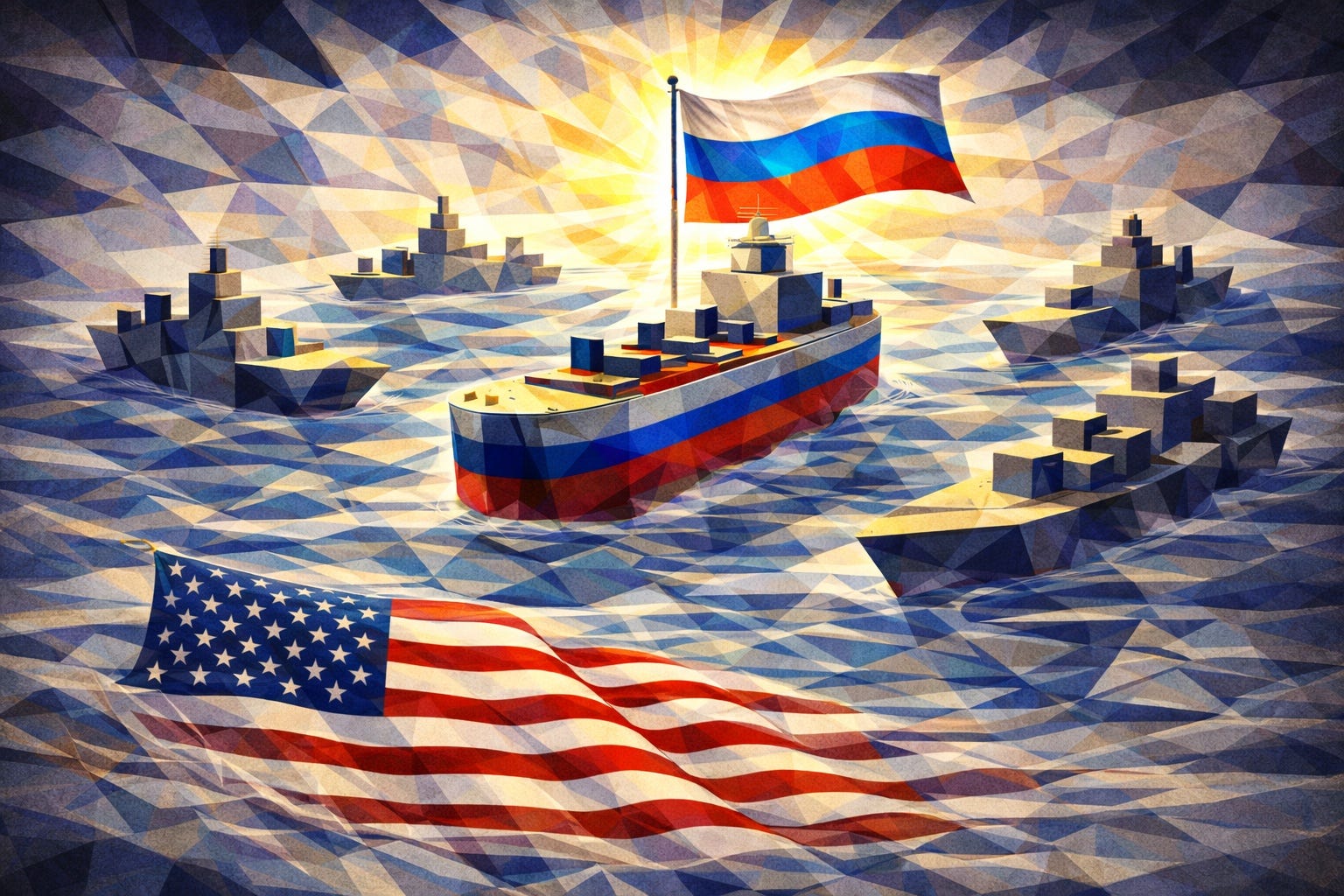
The recent U.S. intervention in Venezuela—culminating in the dramatic seizure of the Russian-flagged oil tanker Marinera in international waters—has sparked a global debate. While some hail it as a reassertion of American might and a blow to an emerging multipolar world, these actions may have the completely opposite effect, and risk eroding the credibility of a core pillar of that very hegemony: the persuasive power of the “rules-based international order.” In this essay, we will examine how Washington’s recent actions threaten to undo over 30 years of soft-power projection, and how US President Trump’s actions risk undermining the very foundation of the unipolar world order.
The Unipolar Playbook: Moral Superiority as a Weapon of Regime Change
For decades, the “rules-based international order” promoted by the U.S. and its allies was more than a diplomatic phrase; it was the ultimate soft-power instrument. Rooted in the concept of Western exceptionalism—the assertion that democratic nations, by virtue of upholding human rights, free speech, and liberal values, possessed inherent moral authority—this narrative framed geopolitical competition not as a clash of interests, but as a messianic mission to spread democracy and lawful governance for the global good.
Despite its numerous internal contradictions, which can be identified by any observer familiar with world history, this moralistic edge proved devastatingly effective in providing ideological fuel for “color revolutions” and hybrid wars in Ukraine, Georgia, and beyond. By funding opposition and shaping media narratives through agencies like USAID, the West could topple undesirable governments while framing interventions as the legitimate support of a people’s democratic will.
Crucially, this narrative penetrated deeply, even co-opting segments of socialist and “anti-imperialist” movements that, while criticizing Western actions, did so from within the framework of the West’s own proclaimed values—thereby reinforcing the idea of its moral high ground.
Washington’s Rediscovered Rhetoric: Unapologetic National Interests
The US intervention in Venezuela demonstrated a clear departure from the playbook used by the collective West to overthrow “undemocratic” (read: undesirable) governments since 1991. Regime change operations and other interventions that have taken place during the unipolar moment—with the most prominent being the events in Ukraine in 2004 and 2014—were meticulously veiled in the language of democratic solidarity and human rights.
In the case of Venezuela, however, the US reverted to an older, transactional approach reminiscent of the Monroe Doctrine. Here, humanitarian and democratic rhetoric plays secondary status, while the main bulk of the rhetoric justifying the intervention is rooted in pragmatic calculations rather than idealistic principles: reinforcing national security, securing resources for the national economy, punishing a geopolitical adversary, and delivering tangible economic benefits, such as lower gas prices at home.
In doing so, the US establishment has largely discarded the rhetoric long used to effectively justify intervention strategies to both a domestic and (more importantly) an international audience. While legal defenders cite sanctions continuity and UNCLOS [United Nations Convention on the Law of the Sea] provisions, the US has clearly downgraded the clichés typically used to justify Washington’s previous interventions, specifically those alluding to international law, human rights, free speech, and democratic principles, revealing the core principle that underpins its actions: pure, unvarnished national interest.
This rhetorical shift risks compromising the foundational narrative of benevolent Western leadership, threatening decades of masterful narrative construction and weakening the soft-power strategy that had been so meticulously constructed by successive Western governments for over three decades—revealing a calculus of power that proponents of multipolarity have long accused the West of harboring.
Global Hegemon Turned Regional Consolidator
For over a decade, Russia, China, and other nations have consistently called out the “rules-based order” as a hypocritical facade, advocating instead for a pragmatic model of international relations rooted in sovereign equality and clear national interests.
While a number of observers have used the recent events in and surrounding Venezuela to argue that Washington has reasserted itself as the global hegemon in a unipolar world, these U.S. actions may instead validate—particularly among skeptical powers—the advent of a new, multipolar world order. By downgrading adherence to the “rules” it has allegedly upheld for decades, Washington risks eroding the rooted belief in its moral superiority and inherent benevolence, particularly as BRICS powers amplify “sovereign equality” rhetoric in response.
What we are witnessing today is not a defeat for multipolarity. Far from it; it is its acceleration. The U.S. is not lashing out in an attempt to police the entire world, but strategically retreating from the concept of pax Americana, which has become unsustainable in light of growing competition from emerging centers of power in different parts of the world.
Far from acting as the “world police,” the US now seeks to consolidate power in its own immediate sphere of influence: the Western Hemisphere. From a geopolitical reading, Washington’s foreign policy is witnessing a strategic shift that focuses on the U.S.’s consolidation of its own “backyard,” aimed at securing hemispheric resources while building industrial capacity.
In this context, the events in Venezuela may signal a new, multipolar era, where the “rules-based international order” risks losing its credibility among non-Western powers—a casualty of America’s pivot toward hard, hemispheric consolidation. The soft power cultivated by the (previously) collective West for over 35 years may prove to have been forfeited, yielding a regional hegemon consolidating its sphere of influence in a world that is, consequently, becoming more multipolar by the day.
The weapon of moral superiority has been downgraded, and the harder, clearer game of spheres of influence has begun.


This was a very good analysis. President Trump showed that his leadership style is transactional. However, naval blockades and ship seizures are acts of war. Using that type of brinkmanship against Russia will result in an all-out war. Sadly, we are one miscalculation away from a war.
The article rightly describes a shift from idealistic rhetoric to naked self‑interest, but that does not mean we should start placing our hope in any new geopolitical bloc. This intervention helps strip away the mask of ‘benevolent’ liberal hegemony, and shows an imperial power behaving as empires do, which is why our task is to look past the slogans being touted by politicians and media, and judge both the fading unipolar order and any rising multipolar blocs by real justice, subsidiarity, and their treatment of the weak, rather than by their propaganda.