
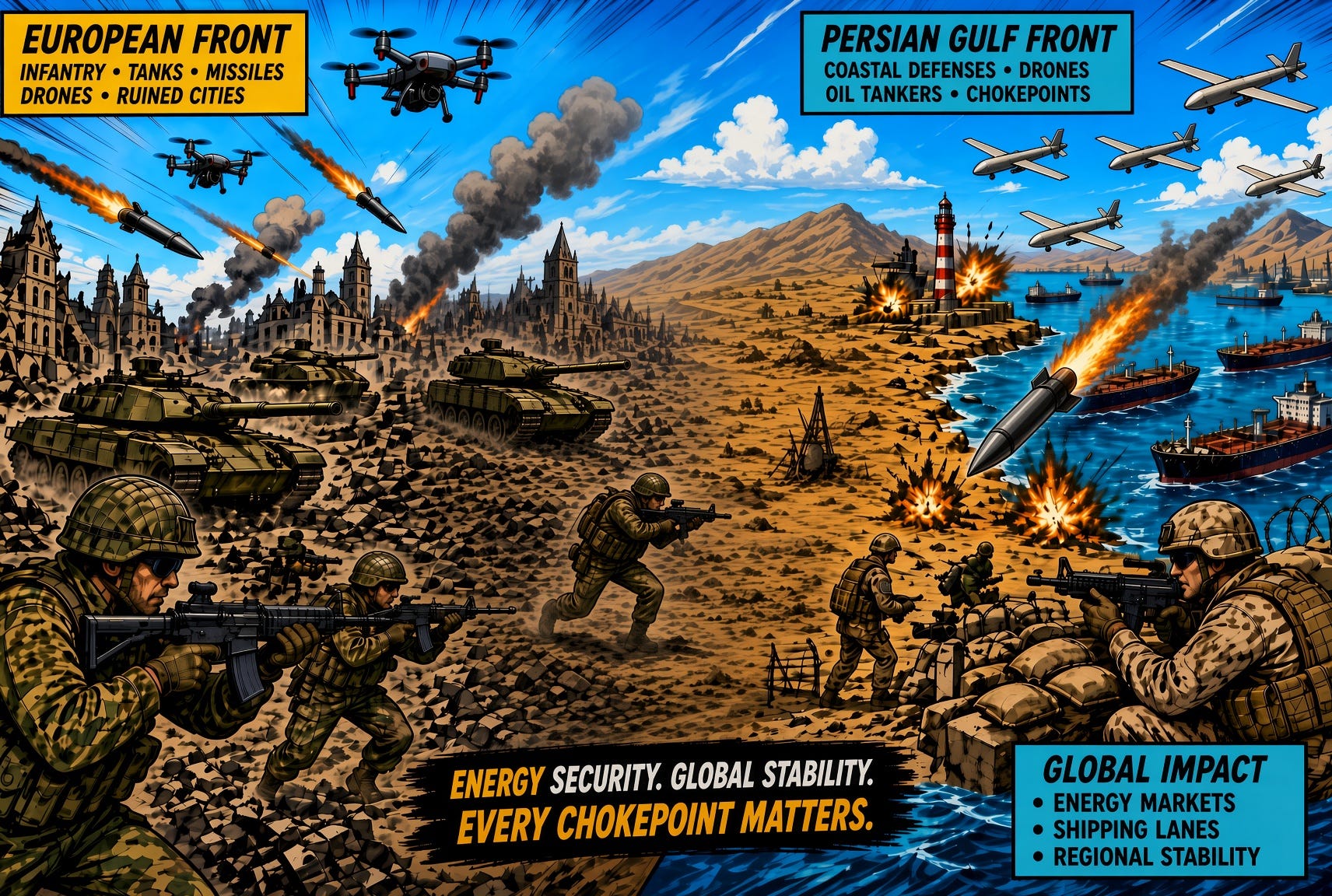
Simon Rorschach examines how the conflicts in Iran and Ukraine have become two fronts in a global war between Western unipolarity and an emerging multipolar order.
The wars in Iran and Ukraine appear to belong to different regions, histories, and political disputes. One is being fought across the Persian Gulf and the wider Middle East; the other stretches from the Black Sea to the Donbas. Yet both conflicts arise from the same dispute over who has the right to shape the world. The United States and its allies defend an order in which one center defines lawful conduct, assigns political virtue, controls the main financial channels, guards the sea routes, and decides which states may possess advanced weapons. Russia and Iran reject that claim. They insist that great civilizations must be free to organize their own regions, protect their own borders, and choose their own paths. Ukraine and Israel serve different national purposes, but both have become forward positions of the Western system. Russia and Iran, in turn, have become armed obstacles to that system. The result is a global war without a common battlefield or a formal declaration. It is fought with missiles in Kiev, drones over the Gulf, sanctions on banks, attacks on refineries, control of shipping lanes, and pressure on countries that refuse to choose the Western side. Washington still possesses unmatched power, but it can no longer impose its will without meeting organized resistance. That is the central fact linking the two wars.
