

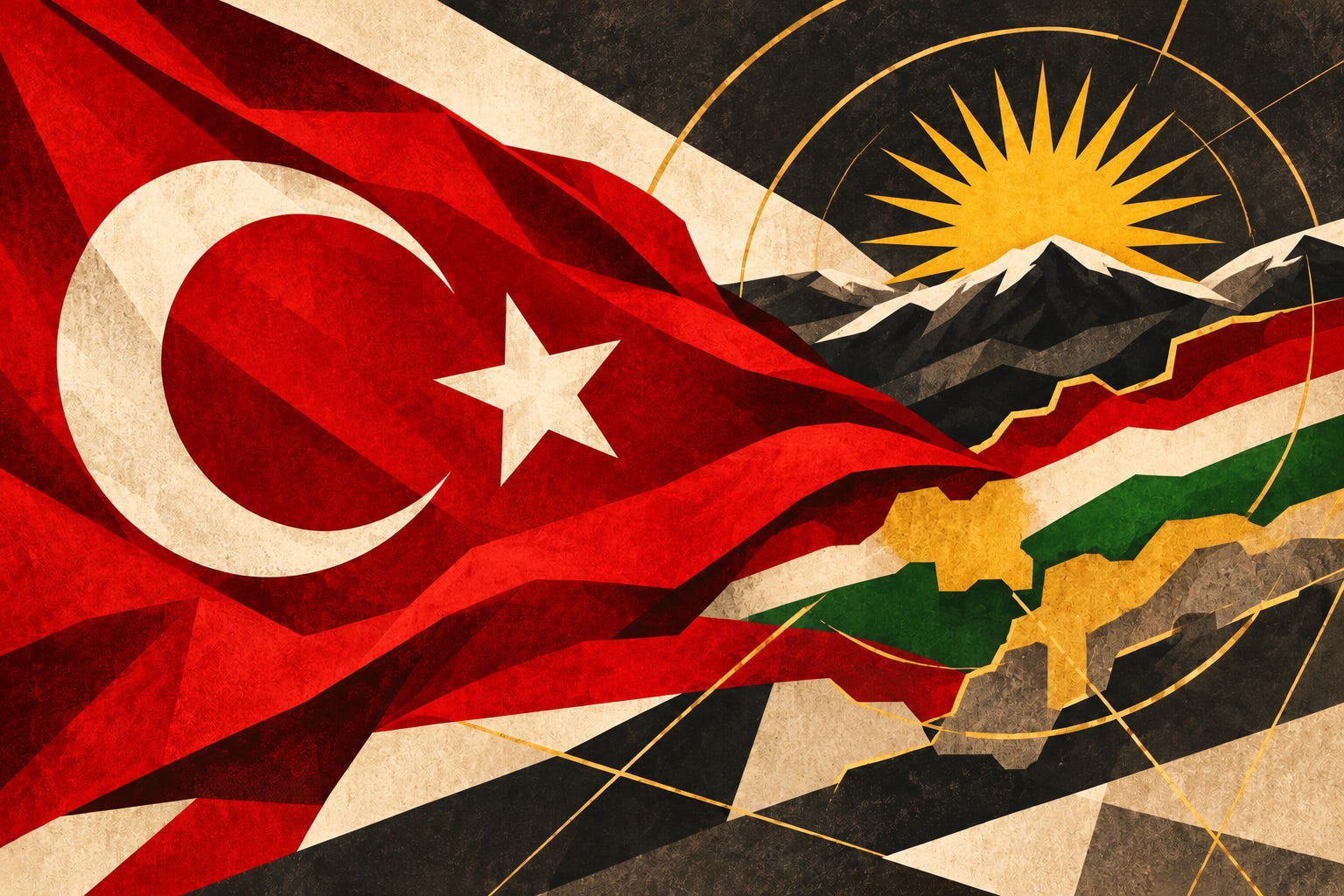
Oğul Tuna examines how Turkey’s Kurdish peace process and the emerging geopolitical order in the Middle East could undermine national sovereignty, strengthen the power of capital, and advance American strategic interests under the guise of political progress.
The Turkish Marxist thinker Yalçın Küçük once said: “Kemalism will not take us forward, but we will not fall behind Kemalism.” By Kemalism, Küçük meant the republican national-state tradition that had historically organized Turkey’s political modernization and sovereignty.
I want to adapt Küçük’s formulation to the present conjuncture: the nation-state will not take us forward, but we should not fall behind it.
Much of the debate on both the Left and the Right around Turkey’s new “framework law” rests on the same mistaken assumption: that overcoming or transforming the nation-state is progressive in itself. The law gives legal form to the renewed Kurdish peace process that followed Abdullah Öcalan’s call for the PKK to disband and the organization’s subsequent decision to dissolve itself. Adopted by the Turkish parliament in August 2026, it marks the transition from political negotiation to legal implementation.
From a Marxist point of view, however, whether a political form is progressive cannot be determined by the name it gives itself. It can only be understood in relation to the historical conditions in which it emerges and the class project that it serves.
For Marx and Engels, the modern nation cannot be understood independently of capitalist development. With the rise of the bourgeoisie, the fragmented territories, legal systems, customs regimes, and markets of the feudal world were centralized into a single political and economic space.
As Stathis Kouvelakis has recently emphasized in revisiting the thinking of the two founders of Marxism on the national question, this process did not simply establish bourgeois domination. The bourgeois revolutions also brought the popular masses into the political arena. They created citizenship, political rights, and a common space within which class struggle could take place.
For this reason, the internationalism of Marx and Engels did not rest on the simple rejection of the national political arena. The interests of the working class may be international, but the struggle for political power takes place, in the first instance, on a national terrain.
Rosa Luxemburg complicates this picture. The nation-state is not socialism’s final destination. It is a historical political product of capitalist development and can become, in accordance with the interests of the bourgeoisie, an instrument of conquest and imperialism.
Moreover, for Luxemburg, the progressive character of a national movement does not derive from an abstract principle of the “right of nations to self-determination,” but from the concrete historical circumstances in which that movement operates. The idea of national unity, progressive in one period when directed against feudal fragmentation, may become a reactionary program under different historical conditions.
Today, we must apply the same dialectic in reverse.
First, the nation-state is not the ultimate horizon of socialism. But the dissolution of the nation-state is not always a step toward socialism, nor is it necessarily a progressive one.
Second, not every national project necessarily develops in a progressive direction or leads to a more advanced political form.
The development of capitalism over the past forty years confirms both propositions. Quinn Slobodian’s work on the history of neoliberalism demonstrates this particularly clearly. The purpose of neoliberalism was not simply to “shrink the state.” It sought to construct institutions, legal regimes, and supranational mechanisms capable of protecting capital from democratic political intervention.
Wolfgang Streeck reaches a similar conclusion from another direction. Globalization did not abolish the state. On the contrary, it transformed and reinforced certain of its functions. At the same time, it increased capital’s ability to escape national democratic control while narrowing the redistributive and social capacities of states.
To counterpose an abstract “post-national” progressivism to the nation-state therefore means reading contemporary capitalism through the spectacles of an earlier historical period.
Capital, after all, has long since ceased to be confined by national borders. The global market, as its name suggests, transcends national borders. As Marx recognized with remarkable clarity as early as 1848, cosmopolitanism is already a characteristic of capital. There is therefore no Marxist reason to conclude that because capital crosses national borders, politics must also abandon democratic and public capacities exercised at the national level. This theoretical problem has now become a concrete political question in Turkey and its surrounding region.
Recent American rhetoric makes this ambiguity unusually visible. Tom Barrack, the U.S. ambassador to Turkey and special envoy for Syria, has repeatedly described the modern Middle Eastern nation-state as an artificial product of Sykes–Picot and praised the Ottoman millet system as a model of coexistence. His language points toward a political imagination in which the centralized nation-state gives way to a looser order organized around recognized communal identities under an overarching political framework. Yet his rhetoric coincides strikingly with a wider political moment in which the Kurdish question is being reopened, national sovereignty is being renegotiated, and capital increasingly operates through regional rather than strictly national structures. From a Marxist perspective, the question is therefore not whether such an arrangement appears more pluralistic than the old nation-state, but whose interests a more fragmented and multinational political order would serve.
What is at stake, then, is not simply Kurdish recognition or administrative reform, but the political form through which class power, sovereignty, and Turkey’s place in the emerging regional order will be reorganized.
Turkey thus offers a particularly revealing test of this broader argument. Its current debate is not taking place in a geopolitical vacuum. It coincides with a broader struggle over the reorganization of the Middle East, from Syria to Iran. Washington, Tel Aviv, Ankara, and the various Kurdish movements do not want the same thing. But at several crucial points, their interests now overlap.
Washington and Tel Aviv have explored the use of Kurdish political and armed forces as leverage against Iran. Early in the 2026 war, the Trump administration approached Kurdish leaders and offered support to Iranian Kurdish forces willing to move against Tehran, while Israel was reported to be supporting plans involving Iranian Kurdish organizations, including PJAK, along Iran’s western border.
Öcalan’s intervention, meanwhile, no longer concerns Turkey alone. PJAK, while insisting on its organizational independence from the PKK, openly identifies itself with Öcalan’s political philosophy. Öcalan himself has addressed the Kurdish question in Iran, arguing that Tehran must recognize Kurdish rights and warning that, should repression continue, Kurds would have little alternative but to defend themselves—while also insisting that they must not become the “battering ram” of another power.
Their goals are plainly not identical. Turkey’s conduct toward Iran makes that obvious: Ankara itself helped prevent Iranian Kurdish forces from opening a U.S.- and Israeli-backed front against Tehran, for which Iran’s foreign minister publicly thanked Turkey. Still, the overlap matters. For different reasons, Erdoğan’s government, Öcalan’s movement, Washington and Israel all have an interest in altering aspects of a regional order in which the relationship between borders, Kurdish political organization, and sovereignty is once again open to renegotiation.
That renegotiation is not taking place only through Kurdish politics. The Mecca Joint Defence Agreement has added a new military layer to the same regional transformation by linking Turkey more closely to Saudi Arabia and Pakistan at precisely the moment when the struggle with Iran and its allies is reshaping the Middle East. The pact has already moved beyond declaration: It has been activated in response to Houthi attacks, and Turkey has begun providing Saudi Arabia with defensive, technical, intelligence, and logistical support. What matters here is not that Ankara, Riyadh, and Islamabad simply reproduce Washington’s preferences, but that the emerging security architecture is being built within a regional order still structured by U.S. military power and by the confrontation with Iran. In that sense, the Kurdish question, the efforts to weaken Iran, and the construction of new alliance mechanisms are not separate developments but different dimensions of the same struggle over the political order in the region.
This is the regional setting in which Turkey’s renewed “solution” debate must be understood. The question that must be asked is not whether Turks and Kurds love one another, nor simply whether different identities should be recognized. The central issue is not sentiment or recognition as such, but the institutional form of the settlement and the class forces it empowers.
The real questions are these:
What class bloc does the proposed new order represent?
What place would it assign Turkey within the emerging regional order?
Would it create a political project that foregrounds the common class interests of workers in Turkey, expands public capacity, and limits the domination of capital?
Or are we witnessing the construction of a new state form that would bring together sections of Turkish and Kurdish capital under the domination of the existing political power and within a new regional hegemonic bloc, bind Turkey still more tightly to U.S. strategy in the Middle East, and increasingly organize social contradictions through ethnic and identitarian categories rather than class ones?
If the answer to the latter question is yes, the fact that the resulting order might “transcend the nation-state” would not make it progressive.
It could produce greater fragmentation rather than internationalism, while making the political order more vulnerable to external intervention. And far from restricting capital, it might enlarge its room for maneuver.
And, as Luxemburg reminded us more than a century ago, national political projects can become instruments of conquest and imperialism in accordance with the interests of the bourgeoisie.
The experiences of Syria and Iraq should be warning enough. National and subnational movements backed by NATO powers have repeatedly become incorporated into the strategic projects of the United States and its regional allies, while externally sponsored fragmentation has hardly produced either socialism or meaningful sovereignty.
It is not the task of the Left to sanctify the nation-state simply because it once played a historically progressive role. But neither should the dismantling of the public, democratic, and class capacities accumulated within the national political arena be celebrated as “progress.”
That does not mean preserving the nation-state indefinitely. It means refusing to confuse the overcoming of a political form with the surrender of the democratic and class capacities won within it. Public provision, redistribution, organized labor, and political accountability were not gifts of the nation-state; they were gains wrested from capital through struggle within a national political arena. To dismantle that terrain without asking what replaces it is not internationalism; it is to risk handing capital freedoms that labor does not possess.
