Trump’s Answer to Globalism?
C5 instead of G7
Alexander Markovics argues that Trump’s C5 signals a break with globalism and a turn towards hard multipolar realism.
A World Order without Globalist Powers?
According to an unpublished document from the U.S. government reported on by the platform Politico, the United States is considering a future in which only five states, rather than the G7, shape the fate of the world. This suggests that the Trump administration may be returning to MAGA politics and seeking to turn its back on the Western, globalist-dominated G7 states.
Europe Becomes Irrelevant, Asia Rises
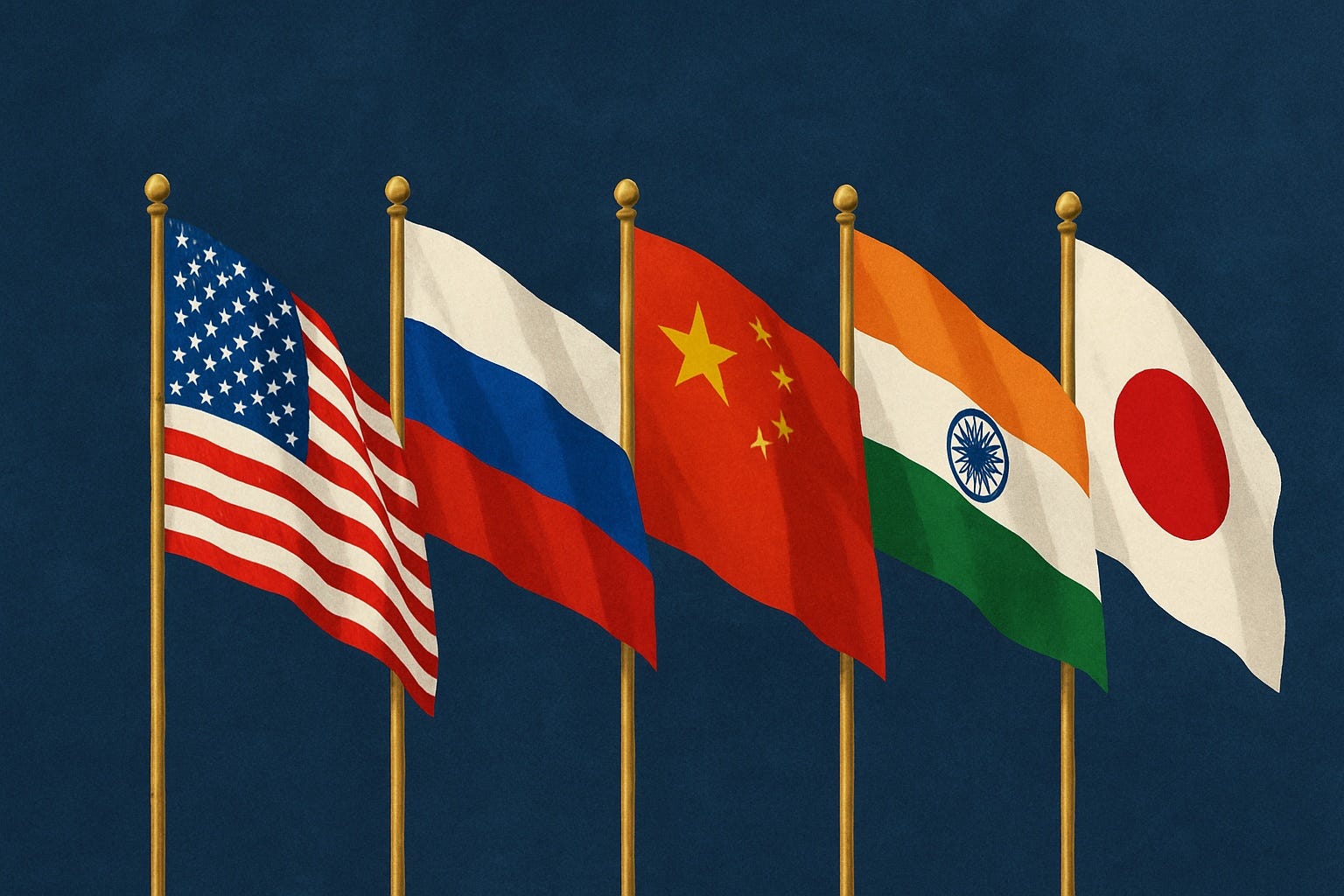
The United States appears to be constructing its own version of multipolarity in competition with the BRICS states: the C5 (Core 5). In addition to the United States, this new format would include Russia, China, India, and Japan. Globalist-oriented powers such as the EU, the United Kingdom, and Canada—previously influential within the G7—would thus be sidelined, while the loyal U.S. vassal Japan would be rewarded. More broadly, the rise of Asia is acknowledged through the inclusion of China and India, and Russia is also respected, with its influence in Eurasia implicitly recognized. Latin America, which the United States—according to Marco Rubio—counts as its own sphere of influence, the “Western Hemisphere,” is nonetheless excluded, despite Brazil’s status as a colossus with more than 200 million inhabitants.
Political Realism Instead of Globalism—A Farewell to U.S. Hegemony?
Overall, the proposed new alliance bears the imprint of two prominent figures within the MAGA camp: Steve Bannon and John Mearsheimer. Unlike the neoconservatives and globalists who have so far set the tone in Washington, both advocate a realist foreign policy that recognizes no eternal enemies, only eternal interests. While the G7 and G20 formats have until now either been centered exclusively on the West (G7) or focused solely on economic and environmental issues (G20), the United States now appears intent on concentrating this format on hard geopolitical questions. Thus, the memorandum places emphasis on security in the Middle East and on normalizing relations between Israel and Saudi Arabia—both objectives that have so far been severely undermined by the Trump administration’s aggressively pro-Israel foreign policy and warmongering, driven in part by the Israel lobby. With this document, the United States is now also contributing to the normalization of the very multipolarity it previously fought in the name of hegemony. Moreover, this new format marks a departure from globalism in the sense of human-rights imperialism and democracy export—Russia and China are seemingly acknowledged as equal-ranking powers—and a turn towards military strength and strategic spheres of influence as the new realities of Western geopolitics.
How Do the C5 Differ from the BRICS States?
The United States now appears to want to exert influence over the emerging multipolar world itself—a form of multipolarity that differs in several important respects from that embodied by the BRICS states:
The C5 constitute the first multipolar format to include the West. The West has so far not been represented within the BRICS states because it either pursued a globalist course until recently (the United States) or continues to do so (the EU, Australia, Canada, the United Kingdom).
While the C5 reflect an order of existing great powers and civilizational states, the BRICS states form an exclusive format that also admits civilizational states that are not yet fully developed, but have only begun this process or are on the verge of it (the Islamic world, Latin America, Africa).
The plans behind the C5 format thus draw attention to an important fact: only fully developed civilizational states possess sovereignty in a multipolar world—and anyone who continues to advocate globalism within it is treated as an enemy and excluded. Ultimately, however, these are so far only fine words from Donald Trump’s team, comparable to the promises of peace in Ukraine. Will Trump keep his word and contribute to a more peaceful world order? If so, he could indeed still enter the history books as a peacemaker. Given his foreign policy record to date, however, there is strong reason to doubt it.
(Translated from the German)


smart, conforms with the actual geo economic powers. fully compatible in parallel with brics. and maintains incentive on europe to get its act together
Thank you for your insightful post. However, the normalizing of relations between Israel and Saudi Arabia has been severely undermined by the PLO and Hamas terrorist entities, whose irrational hatred of Israel and the Jewish people was in full display on October 7, 2023.