

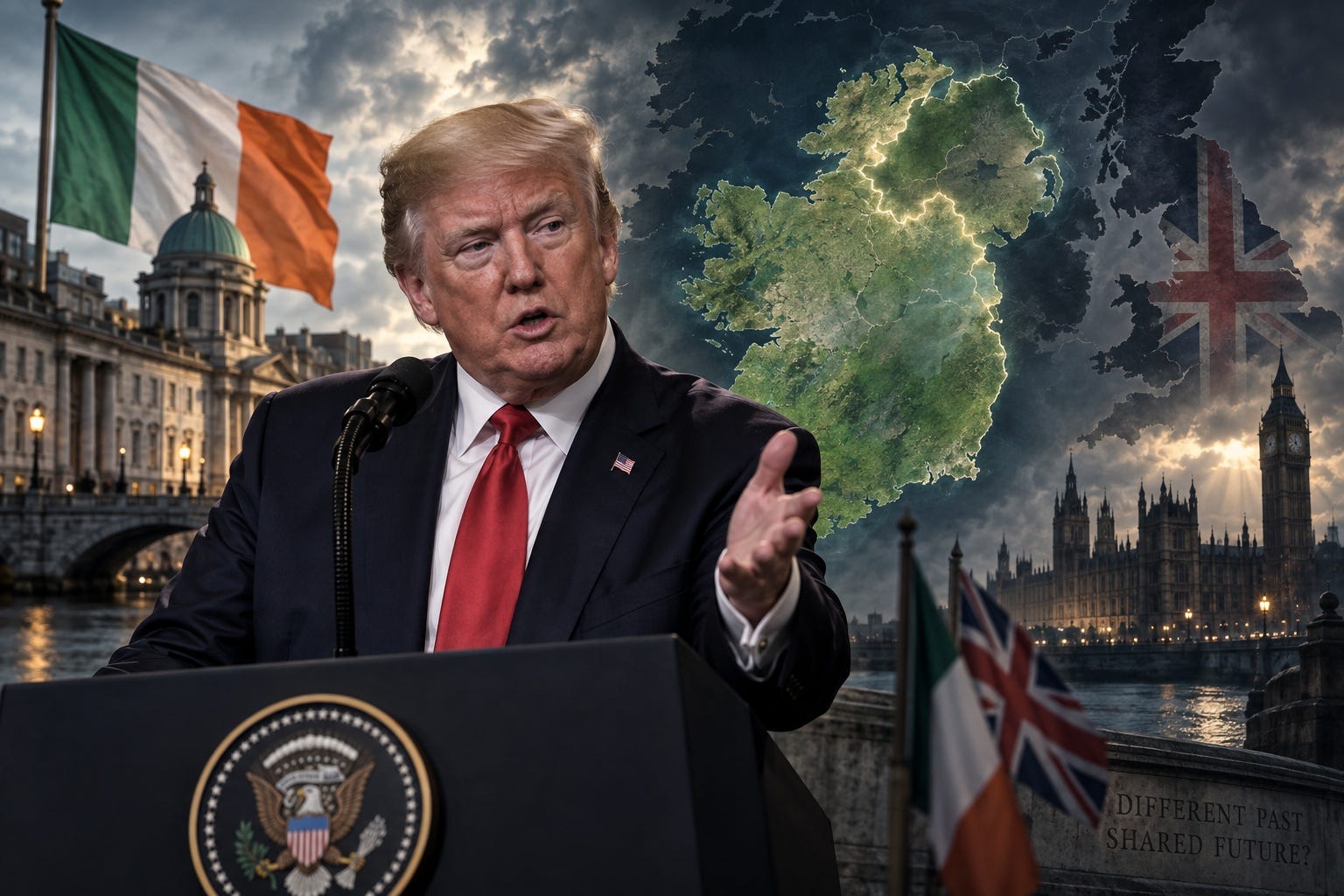
Cas Corach examines how Trump’s remarks on Irish unity reveal widening cracks in the British state and the emerging logic of a multipolar Europe.
In September of this year, the US president Donald Trump visited the Republic of Ireland for a routine diplomatic visit. On the surface, it was the typical affair as protestors gathered to lament US military use of Irish airports, the plight of the Palestinian people and the character of the president himself. In contrast to this the Irish political class kissed the ring and bowed obsequiously towards Trump, despite the political differences that divide them. Overall it seems that Trump and the Irish representatives had a great time and smiling faces graced photo opportunities along side hearty handshakes. Yet the event had a very native controversy attached to it, one that quietly spelled out the fragmentation of the old world and the coming of the multipolar order: the question of Irish unification.
For readers who may be unaware, the island of Ireland actually consists of two distinct political regimes; the Republic of Ireland in the south and what is called Northern Ireland in the north east. These are the result of the Irish War of Independence of the 1920s where the north east was partitioned into a separate state, as the Protestant majority did not wish to be part of the new Free State (the political organisation in the south before it was declared a Republic in the 1930s). Though there is no hard boarder the relationship between the states has frequently been fraught and within the Northern Ireland state itself there has been much conflict between the Catholic and Protestant communities. One need only look to the troubles since the 1960s which culminated in the Good Friday Agreement of 1998: a power share between the communities and an end to hostilities with a provision towards Irish unification should a majority of the population consent to it.
So what exactly happened during Trump’s visit? At Farmleigh House in Dublin, alongside Taoiseach (Irish Republic prime minister) Micheál Martin, he was asked about Irish unification. His response was:
“Well, I don’t want to cause any problems, but I will tell you I’d love to see it unified. I have friends on both sides, great people. They’re Irish people. How can they be bad, right? I’d love to see it unified. I think it would be a great feather in everybody’s cap if that happened. It’s going to happen eventually. You know what? The way I look at it, it’s going to happen eventually. It may as well happen now.”
And, gesturing toward Micheál Martin:
“We’re talking about it and you got the right man over here to get it moving.”
Later Trump doubled down on the comments and refused to moderate stating that:
“I’ve always loved the people of Ireland. It just seems to me that you have Northern Ireland and you have Ireland. It seems to me that one of the naturals of all time is to put them together.”
The awkward Trumpian wording aside, reaction to these comments was immediate and divided. The Irish Republic’s answer was to emphatically state that Trump’s words did not represent any change in policy towards unification and that they would follow the letter of the Good Friday Agreement, a typical vanilla answer from very vanilla political representatives. The main opposition party in the south, Sinn Fein, welcomed Trump’s comments. Sinn Fein were heavily involved in the Good Friday Agreement process and their raison d’etre is the political unification of the island, though Trump’s remarks come somewhat as an embarrassment to them as progressive leftists and anti-MAGA cheerleaders.
In Northern Ireland, Trump’s words were not received so well with the DUP leader Gavin Robinson stating:
“Northern Ireland’s constitutional future will be decided by the people of Northern Ireland, not by commentary in London, Dublin or Washington.”
Similarly in Britain there as pushback and embarrassment. Nigel Farage, leader of Reform UK, was particularly left in the lurch. Farage and his political ilk are simply MAGA transported to the British isles and use Trumpian rhetoric and tactics in their campaigns. They defend the unity of the United Kingdom establishment as a matter of course yet they were undermined by Trump’s words and forced between a rock and hard place: defend the British system as good patriots or bow to their political ring leader’s declaration? In terms of US reaction, Trump’s statement was seen as a stark departure from the norm with previous US presidents refusing to take a side on the matter outside of calls for peace between the two Irish communities.
So what does it all mean? There is a temptation to see Trump as merely talking off the cuff and not really understanding or caring about the implications of his message. There is good precedent for this as we have seen during the Iran conflict. Trump’s declarations have more to do with this personal mood, ego and political posturing than actual reality or well thought out policy. Yet there is another possible angle. Consider the other big event of the Irish diplomatic visit: the removal of the tariffs on Irish whiskey to the US. This was announced by Trump, again in a very off the cuff and blasé manner, as if it were just the whim of his good graces towards the Irish people, but is this believable?
It is more likely that negotiations went on behind the scenes between Trump and the Irish political class so who is to say that the unification comments don’t represent a deeper agenda?
Of course, it would be premature to assume that Trump’s words necessarily represent a coherent or deliberate American strategy towards the United Kingdom. Trump has repeatedly demonstrated a willingness to make consequential statements in an informal and sometimes improvisational manner, meaning that his personal rhetoric cannot automatically be equated with settled US policy. Nevertheless, the distinction between intention and consequence is important: even an improvised statement from the American president can have geopolitical effects beyond what he may have intended.
This does not, of course, establish that the comments on Irish unity were the product of a comparable negotiation. It does, however, demonstrate that Trump’s apparently spontaneous announcements can occur against a background of diplomatic discussions and bargaining that are not visible to the public. It therefore leaves open the possibility that his remarks contained more political calculation than their casual presentation would suggest.
It’s no secret that the US war machine has been sorely disappointed in the UK for not supporting their vicious war in Iran and, as is well known to the readers of this publication, the anti-European trend that has been part of US policy since World War One, culminating in the American domination of Europe in 1945. Could these comments be a way of pushing at an open door regarding the instability of the British regime? A regime that has refused to play ball with their masters across the sea? This comes at a time when leaders of Welsh, Scottish and Northern Irish populations recently signed a joint agreement pledging to work towards bringing an end to the UK and have the regions separate into their own autonomous zones. This agreement came too soon after Trump’s visit to be related to his comments so we can infer that moves are being made again towards Scottish independence and Irish reunification. We see also that roughly a third of Welsh people wish to separate from the UK establishment.
There is no publicly available evidence at present to establish that Trump’s remarks were consciously intended to undermine the British state. Such a conclusion would require evidence of a deliberate strategy rather than inference from Trump’s words alone. The more modest, but still significant, point is that his intervention objectively touches upon existing fault lines within the United Kingdom at a moment when questions of sovereignty and national self-determination are already receiving renewed attention.
Clearly we are witnessing here the move to multipolarity on the British Isles. While the US regime may wish to remain the unipolar hegemons of the world, their actions constantly work towards the end of the unipolar moment; the tariffs have isolated them politically, the middle eastern conflicts have given legitimacy to other political voices, and Trump’s recent statement has put a bow on separatist movements that now again gain momentum. This can only be positive for Europe and the multipolar agenda. The British regime has consistently worked to limit European strength in favour of its own power and since 1945 have been the harbingers of US culture and political dominance in Europe. This is not to slight the peoples of Britain, who equally suffer under this system, but rather the British deep state who control them. The dissolution of that state may allow European people to final come to their own as one voice under many flags; the goal of multipolarity. It is unclear what the future holds and a few words and a written statement do not mean much yet they are grains of sand in the coming heap of the new world order. We may have little agreement with Trump, yet we can agree that Irish unification, and thus multipolarity is inevitable.
New from Multipolar Press:
Dugin Against the Modern World: Essays on Alexander Dugin and the Multipolar Revolt by Constantin von Hoffmeister

Britain gives a bit of a pushback against Israel and also doesn't get involved in the Iran war and this happens.....
What's interesting about the 3 so called Nationalist parties, particularly Sinn Fein is they are all hypa Progressive Liberal and pro mass immigration.
Sinn Fein/Trump - 'strange bedfellows' indeed ;-)