

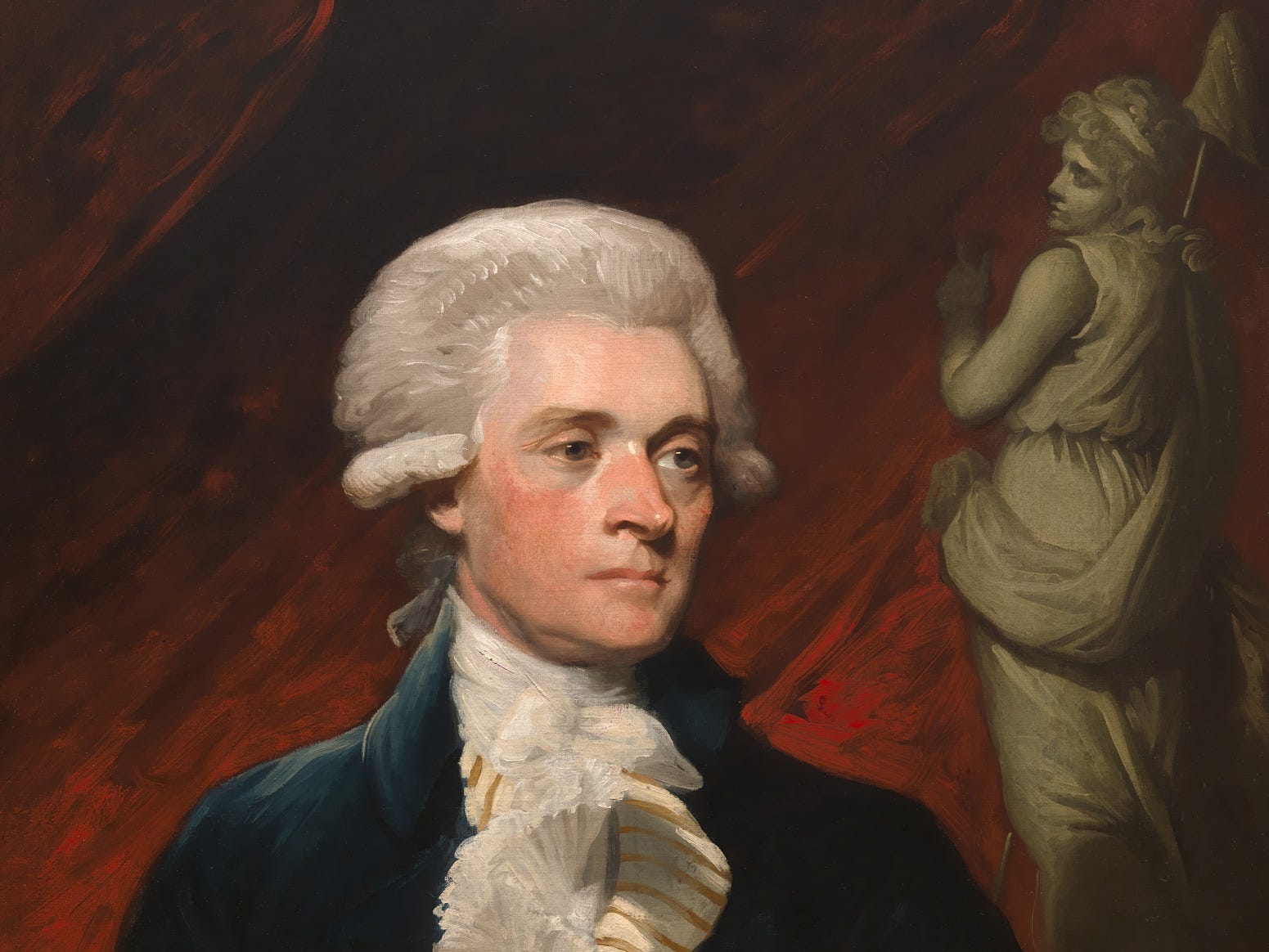
Michael Kumpmann on Jefferson, decentralization, and the limits of liberal democracy.
What is interesting about the American Founding Fathers is the fact that they advocated an extremely strong federalism. This led to the situation that certain principles of the feudal system—where the prince decides most matters on his own and the central imperial government intervenes only in those issues the prince cannot resolve himself—were preserved and protected far better in the democratic United States than, for example, in the French monarchy under Louis XIV, who disempowered the princes and centralized a great deal of decision-making authority in Paris. In this context, it is also interesting that the question of states’ rights in the United States remains one of the key points of contention between classical liberals and what might be called “Liberalism 2.0.” In Europe as well, it is precisely left-liberals who are the main advocates of centralization through the EU and similar structures.
This emphasis on decentralism also corresponds to the New Right concept of “community instead of society.” In some respects, Margaret Thatcher was correct when she said that “there is no such thing as society,” although she fell into a brutal individualist fallacy. The left and left-liberals like to speak of “society,” of integrating individuals into society, or of minorities needing to be accepted by society. In reality, however, German society consists of 80 million people spread over a vast area. The overwhelming majority of people do not have 80 million acquaintances. Consequently, it is more accurate to say that most members of “society” neither accept nor reject most citizens; rather, most citizens are simply unknown or irrelevant to them.
Most of a person’s life takes place within the family, the village, and the neighborhood. Researchers have found that the average person has about three close friends, eleven friends, and roughly forty-three acquaintances, while everyone else remains a stranger. For most of history, people rarely traveled beyond neighboring villages. There were, of course, princes and kings responsible for the entire realm, as well as traveling merchants, wandering preachers, and adventurers, but most people lived highly localized lives. For this reason, the liberal-democratic concept of an abstract “society” is largely meaningless.
Interestingly, the neoreactionary author Michael Anissimov argued that liberal democracy, among other things through its idea of society, slowly “kills” real community. He referred to the findings described in Bowling Alone, which show that in recent decades in the West, actual leisure associations such as bowling clubs have suffered massive membership declines, while people increasingly consume media alone at home. This development is considered highly damaging to political culture because it reduces concrete, face-to-face political discussion among citizens. It should also be noted that early communists themselves often thought in very decentralized and local terms and aimed for local councils. The emphasis on “society” rather than the local village community is largely a result of the political influence of sociologists.
Among the Founding Fathers, the one who went the furthest in this direction was Thomas Jefferson. His foreign policy is ambivalent, since with his concept of “Empire of Liberty” he effectively anticipated later neoconservative U.S. imperialism aimed at spreading “democracy and human rights.” Ironically, the Monroe Doctrine—which many followers of Dugin, such as Dimitrios Kisoudis in his book Goldgrund Eurasien, see as the opposite of globalist U.S. imperialism—was also inspired by Jefferson’s ideas. With his emphasis on naval blockades as instruments of power, Jefferson was also an archetypal thalassocrat.
Domestically, however—aside from his anti-monarchism—Jefferson is extremely interesting. His concept of the Ward Republic was inspired by feudal principles. Jefferson himself stated that he modeled this concept on medieval European feudalism and ancient Hebrew systems of governance. The idea was to divide the republic into small administrative units in which residents would have maximum influence over the system, while the central government would determine only what was absolutely necessary. Alexander Dugin described a similar concept in his book Eurasian Mission, proposing the division of the Eurasian great space into smaller administrative zones that would enjoy extensive internal freedom to determine their own systems, thereby producing a plurality of systems. For this reason, Jefferson’s Ward Republics may also be of interest to adherents of the Fourth Political Theory.
This principle of locality and territoriality is probably the best way to secure human freedom and, in democratic systems, genuine participation. Such a system brings citizens and the governmental bodies that make decisions about them into close proximity, whereas in large centralized states the distance is much greater. In Russia, for example, there is the saying: “Russia is vast, and the tsar is far away.” A village lord or a mayor whom everyone in the village knows and with whom many attended school is likely to be more trustworthy, more citizen-oriented, and more reliable than some distant central government in Berlin or even Brussels. In the case of direct democracy, it must also be said that the residents of a village naturally know the village’s most pressing problems best.
This model also counters the legitimate critique of democracy put forward by B. F. Skinner. Skinner argued, quite plausibly, that because so many people are allowed to vote simultaneously, the individual citizen’s vote usually carries very little weight. This is certainly true in elections in a state with 80 million inhabitants. In a direct democracy in a village of 200 people, however, each citizen’s vote would suddenly carry far greater significance.
Jefferson championed farmers and distrusted merchants and bankers. Like Oswald Spengler, he criticized urbanization as a symptom of decline and believed that traditional farming villages represented the best example of virtuous societies. He was also critical of industrialization, arguing that agriculture and craftsmanship were culturally superior economic sectors. Interestingly, he feared that industrialization could lead to the formation of a large class of exploited and de facto disenfranchised workers, and he was among the first to describe workers as “wage slaves.” This argument strongly recalls the Second Political Theory of Marxism/Communism and its central thesis of class struggle. In matters of foreign trade, Jefferson—like Adam Smith—was a nationalist and strongly advocated prioritizing national interests. At the same time, he is regarded as a precursor of distributism. There are also parallels to the ideas of Karl Hess, a political philosopher positioned between libertarianism and the New Left, who called for a return to self-sufficient agricultural communes and for “de-urbanization.” Hess was known for reinterpreting libertarian authors such as Ayn Rand in a left-anarchist context. He accused Rand of an excessively solipsistic hyper-individualism that needed correction through reference to left anarchism, arguing that Emma Goldman recognized the social dimension of being, in contrast to Rand. Followers of the Fourth Political Theory should pay particular attention to Karl Hess, as he was more reasonable than the vast majority of liberals and libertarians. Hess is often grouped together with Samuel Konkin as a “left-libertarian,” a tradition also embraced by the German thinker Stefan Blankertz.
Samuel Adams made the interesting remark that he believed the pursuit of worldly possessions constituted a threat to freedom.
What is unusual for a liberal is that Jefferson viewed the constitutional court critically and believed that real power in the state should be concentrated in Congress. Given certain debates in Poland and Israel, as well as the fact that left-liberals sometimes misuse constitutional courts as undemocratic legislators—such as in the United States, where same-sex marriage was established through a constitutional ruling rather than through Congress, or in Germany, where something similar occurred with the introduction of the “third gender” entry on identification documents—this point deserves serious consideration.
It is striking that much of what libertarians and many classical liberals describe as achievements of “the Founding Fathers” actually traces back very specifically to Jefferson, or to ideas he championed most strongly. States’ rights have already been mentioned, but this also applies to the Second Amendment and the militia movements associated with it. Mark Passio, for example, gave a very interesting lecture on this topic. It should also be noted that a right to self-defense and to the defense of one’s home was normal in many traditional cultures and was often granted to women as well. This was one reason why women in ancient and medieval Japan were taught to use the bow and arrow. Eduard Limonov also cited militia movements as a model in his book The Other Russia.
Many aspects of the Second Amendment and the militia movements anticipated Carl Schmitt’s Theory of the Partisan, particularly the figure of the partisan as someone who defends his living space against external intruders and, because of superior knowledge of the terrain, can lure opponents into traps. Many supporters of the militia idea argue that it is a purely defensive concept rather than an offensive military one—claiming that militias are therefore better for peace than state armies—and that a militia member does not attack others but merely defends his village. At the same time, people from these circles often point out that the Japanese military during World War II feared a ground invasion of the U.S. mainland, believing that many ordinary citizens would become combatants, setting traps and ambushes due to their familiarity with the terrain.
U.S. militia culture can also be seen as a result of egalitarianism and of the dissolution of a traditional warrior caste. In egalitarianism, there are no inherited castes, or castes at all, and everyone is considered equal. The result is that caste roles merge to some extent, and each person is expected to be, in part, both a warrior and a sage. The word “militia” derives from the Latin militium vulgarum, meaning a military-like force distributed among the general population. George Mason explicitly wrote that the U.S. militia was meant to represent the entire people.
At the same time, the militia movement is also a product of Enlightenment rationality. One theoretical solution would have been to implement egalitarianism in such a way that there is no special knightly caste and that the soldier becomes simply another profession. However, through an un-idealized rational perspective, the professional soldier comes to resemble a mercenary, and mercenaries have historically been deeply unpopular because they were not bound by a strict warrior ethos. They were mistrusted, as Machiavelli already discussed extensively.
For this reason, modern European and American states sought alternatives that reintroduced idealism. The American militia movement, which voluntarily defends its homeland, represents one such alternative. The other is the continental European—especially Prussian—concept of the “citizen in uniform.”
Interestingly, the Second Amendment and the militia are the only elements of the U.S. state apparatus that the Founding Fathers explicitly described as “necessary.”
From a geopolitical perspective, it is also significant that in those states which most strongly defend the Second Amendment and states’ rights, there are large numbers of immigrants from countries such as Germany and Russia—traditionally considered warrior peoples—whereas in “opposite” states such as California, there are more immigrants from so-called merchant peoples like England. In the case of the Second Amendment, this correlation is particularly striking: descendants of warrior peoples tend to defend the right to bear arms, while descendants of merchant peoples tend to fear weapons. Some texts on the English-language version of Geopolitika have even speculated that the Northern states of the U.S. developed more towards a thalassocracy, while the Southern states developed more towards a tellurocracy—citing the Southern Agrarians as an interesting philosophical example—and that this contributed to the Civil War.
What most Founding Fathers, such as Benjamin Franklin, praised was the idea of civic virtue. The term was later misused, particularly in Europe. Originally, it comes from ancient Rome and meant that citizens should generally possess and embody certain virtues, and also hold specific responsibilities towards particular people—for example, duties towards family, village, and nearby community members. Confucianism in China advocated similar principles.
John Adams is interesting in that he held an ambivalent attitude towards monarchy, and many of his texts even praised the idea of kingship, while in other writings he sharply criticized monarchy. In some cases, he described traditional monarchy as the only guarantor of the people’s freedom and feared that democracy could be undermined from within and degenerate into a pseudo-democracy, in which wealthy individuals and parts of the economy secretly rule, while popular sovereignty remains merely a facade.
This warning about the development of democracy strongly recalls Oswald Spengler’s Decline of the West, in which he prophesied the collapse of democracy and the transition to Caesarism. Liberals often reject Spengler’s philosophy of history as a whole as anti-democratic. It is therefore ironic that the very U.S. Founding Fathers who helped invent democracy identified similar factors threatening its eventual collapse as Spengler did.
(Translated from the German)

Love this, the founders are collectively my heroes forever as an American!
Great post. Jefferson, despite his flaw is my favorite of the founding fathers.