
The Woke Parody of Awakening
On a civilization that mistakes agitation for awareness and ideology for insight
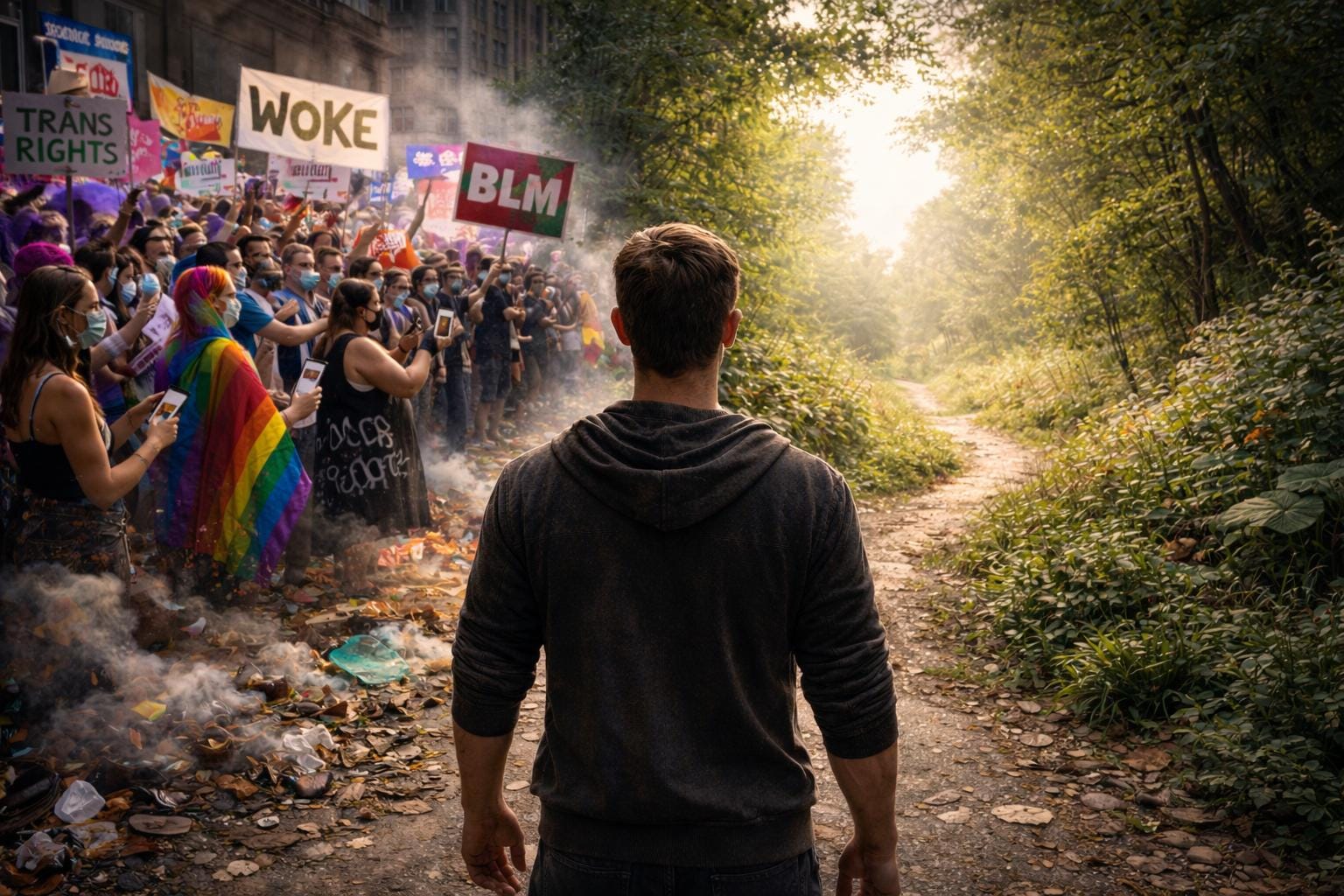
Luca Negri diagnoses an age in which spiritual illiteracy presents itself as enlightenment.
The presupposition—non-fideistic yet adopted as a hypothesis for inner and political work—that there exist traditional, vertical, metastorical forms of knowledge and practice, eternal like Platonic ideas, leads us to accept the theses expressed by René Guénon (in The Crisis of the Modern World and The Reign of Quantity and the Signs of the Times) and by Julius Evola (Revolt Against the Modern World): modernity, dawning in medieval nominalism and later unfolding from the Protestant Reformation and the Jacobin Enlightenment, took shape as a radical opposition to Tradition, its reversal and inversion, well represented by the philosophy of Karl Marx in his overturning of Hegel’s thought. Modernity has, however, run its course and exhausted all its potential, historically culminating in the various forms of twentieth-century totalitarianism. In 1922, Nikolai Berdyaev wrote his fundamental essay The New Middle Ages, greeting the end of the Enlightenment and of the modern narrative of the world and of existence. The postwar era—especially the cultural horizon created by the dust raised by the fall of the Berlin Wall—clearly indicates a paradigmatic shift toward the so-called “postmodern.” Thinkers of differing ideological backgrounds recognized this, from Jean Baudrillard to Guillaume Faye, the theorist of Archeofuturism.
Rather than fighting and denying the world of Tradition, as modernity did, the typical character of the postmodern is to parody it (as Alexander Dugin effectively illustrates in The Radical Subject). Postmodernity recycles everything, modernity included, yet the operation becomes even more insidious when this unconscious parody is directed at traditional contents. This parodic character appears evident when examining woke ideology.
The “woke” subject wishes, etymologically, to be “awake,” therefore fully conscious, in constant vigilance and alarm, ready to identify and denounce ethnic and gender discrimination (social and economic forms seem less important, probably due to a false Marxian consciousness…). Thus emerges an extremization of the proper respect, recognition, and protection of human diversity. Above all, diversity is accepted and defended only when it represents a particular worldview, to the point of denying value to that represented by the white Caucasian male. Moreover, this sleepless surveillance finds discrimination and injustice where they might not exist under a more objective, non-militant, and less obtusely ideological examination.
It is, in sum, right to be as conscious as possible of what one says and does, to refrain from offense, to know history, and to remember the injustices committed by European man and by patriarchal culture. It becomes troubling, however, when legitimate denunciation and the rethinking of our past assume the guilt-imposing features of a religious and totalitarian inquisition.
Like a religious inquisitor—almost an exorcist—or like a Stalinist agent, the woke subject indeed tends toward a paranoid drift through an excess of analysis. In this case, it is not the sleep of reason that gives rise to monsters, but rather vigilant, insomniac reason—far more prolific in its production of monstrosities—as Gilles Deleuze and Félix Guattari warned in Anti-Oedipus, a work we may regard as one of the founding texts of postmodern culture itself.
Paradoxically, it is the woke subject who becomes intolerant and censorious precisely by virtue of religious zeal and paranoid ideology. This is therefore not an “awakening,” as the name claims, but its parody. In keeping with the postmodern parody of traditional truths and practices, we may thus speak of a parody of awakening to wisdom.
At the dawn of European civilization, Heraclitus of Ephesus suggested a distinction between “wakeful” human beings and those who “sleep.” The former are in contact with the Logos; they are vertical rather than horizontally stretched like the slumbering. Wakefulness is indeed the possession of wisdom—or at least its pursuit—carried out not solely through the powers of rational thought but through initiatory practices. According to Giorgio Colli, philosophy is in fact the heir to the Mysteries, emerging from a foundational ritual tradition such as that of the Vedas.
Once the awakening power of the Mysteries had waned, the maieutic dialectic practiced by Socrates arose as an effort to stir his interlocutors through relentless questioning—an inquiry grounded in the recognition of one’s own ignorance, in the realization that one is, in a precise sense, asleep. Sleep, in this context, is doxa: opinion passively received, the instrument of the sophists, nominalists ante litteram who reject transcendent truth.
It is interesting to find a parallel with our present situation if we consider how postmodernity is a kind of neo-sophism and how woke ideology has in turn become doxa as the dominant Western ideology.
Is the condition of the prisoners in the Platonic myth of the cave not one of sleep and dream? It will then fall to the philosopher who has reached the external world—image of the archetypal dimension—to risk returning to the cave in order to awaken the prisoners.
The theme of awakening is indeed characteristic of the Neoplatonists. Plotinus speaks of an awakening of the self, a form of contemplation that transcends bodily sleep.
Partially obscured by the devotional and dogmatic path of medieval Christianity, initiatory awakening reemerged precisely in the modern era within Masonic rituals and in the teachings of important esotericists. Rudolf Steiner, founder of Anthroposophy—a Weltanschauung that gathers themes of German Idealism and corrects, in a European and Christian sense, the excessive orientalisms of the Theosophists—entitled one of his mystery dramas The Awakening of Souls: an episode in a theatrical cycle intended to offer the men of his time an equivalent to the ancient Hellenic ritual dramas. Through his essays, he also conveyed exercises for the education of the soul, meditation, the development of faculties—in short, the awakening of latent potential that may lead to ever greater consciousness, that is, connection with the archetypes.
The Armenian mystic Georges Gurdjieff stated bluntly that the human being is generally always asleep, acting in a state of pure hypnotic slumber like an automaton. He too provided particular psycho-physical exercises—often abrupt and shocking—to awaken his pupils to consciousness.
Around the same period, the Bohemian writer and occultist Gustav Meyrink observed that “to be awake is everything,” for the human being is a sleeping god capable of undertaking a journey “from awakening to awakening,” thereby recovering the archetypal dimension and attaining full consciousness.
Such awakening from a condition of illusion already appears as a central theme in Buddhism, significantly contemporaneous with the golden age of Greek philosophy. The essay Julius Evola devoted to the message of Gautama and to yogic disciplines of awakening is, fittingly, titled The Doctrine of Awakening.
Other examples could be added, yet those offered should already make clear how the wakefulness of wokism represents a pale parody of initiatory awakening within the increasingly parodic panorama of postmodernity.
(Translated from the Italian)
The presupposition—non-fideistic yet adopted as a hypothesis for inner and political work—that there exist traditional, vertical, metastorical forms of knowledge and practice, eternal like Platonic ideas, leads us to accept the theses expressed by René Guénon (in The Crisis of the Modern World and The Reign of Quantity and the Signs of the Times) and by Julius Evola (Revolt Against the Modern World): modernity, dawning in medieval nominalism and later unfolding from the Protestant Reformation and the Jacobin Enlightenment, took shape as a radical opposition to Tradition, its reversal and inversion, well represented by the philosophy of Karl Marx in his overturning of Hegel’s thought. Modernity has, however, run its course and exhausted all its potential, historically culminating in the various forms of twentieth-century totalitarianism. >> What a pointless pretension of peacockry! Simply jabbering to himself while gazing adoringly at the mirror.