
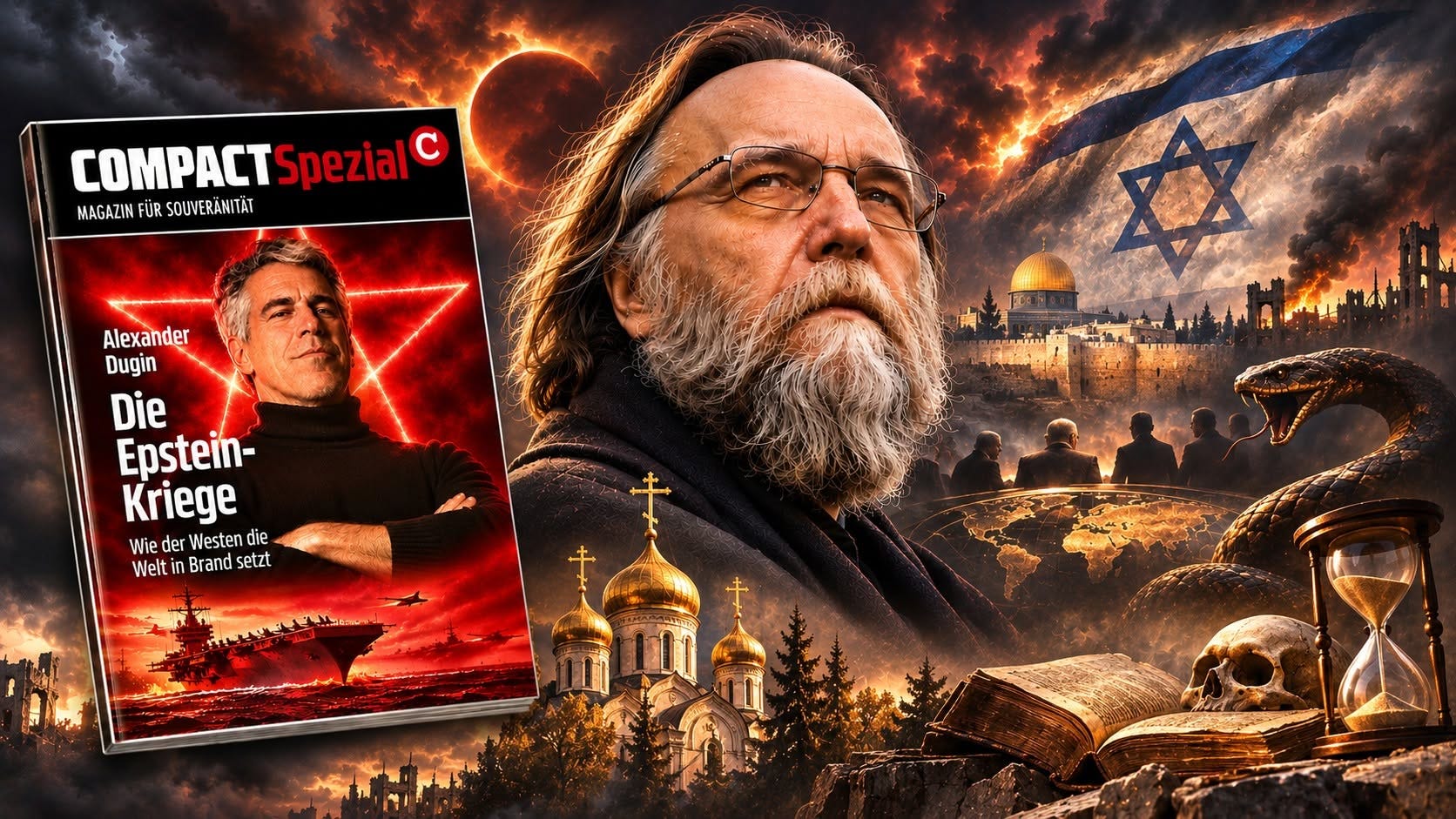
Karl Richter reviews the German edition of The Epstein Wars, exploring Alexander Dugin’s devastating indictment of the decadent West as the Antichrist and his vision of Russia as the Katechon, the force destined to restrain its destructive advance.
Alexander Dugin, geopolitician, philosopher, and leading thinker of the neo-Eurasian school, is considered “controversial” in the West, including within right-wing circles. That does nothing to change the fact that he is one of the most prominent ideological voices of our time, comparable to thinkers such as Francis Fukuyama, Samuel P. Huntington, or Yuval Noah Harari. His views deserve to be heard.
Books such as Foundations of Geopolitics (1997) and The Fourth Political Theory (2009) brought Dugin international recognition. Most recently, Eurasian Mission appeared in German translation in 2022. His intellectual roots lie in the Traditionalist school of René Guénon and Julius Evola, while philosophically he draws on Heidegger. In 2022, his daughter Daria was killed in a bombing carried out by Ukrainian intelligence. In the context of the war in Ukraine, he advocates decidedly radical positions, including with regard to Russia itself, which he accuses of still failing to take the conflict seriously enough, even in the fourth year of the war. Russia, too, can lose.
Significantly, Dugin is not permitted to be heard in our part of the world. He has been on the EU sanctions lists since 2014. Anyone who does business with him or even pays him an author’s fee commits a criminal offense. This has not prevented the monthly magazine COMPACT from publishing a collection of important texts by Dugin from recent years in a special issue of its SPEZIAL series for German-speaking readers. Its title is The Epstein Wars: How the West Is Setting the World on Fire (92 pages, €11.95). The issue was edited by publicist Constantin von Hoffmeister, founder of the Multipolar Press platform, with whom I have enjoyed a productive and constructive working relationship for many years. Jürgen Elsässer contributed a foreword.
For Dugin, contemporary world politics is not a struggle over interests and spheres of influence, but a final confrontation between faith and its negation, Orthodoxy and Satanism. In his eyes, one of the central figures around whom world events revolve is the American-Israeli billionaire and financier Jeffrey Epstein, who, over several decades, built a worldwide network of pedophilia and human trafficking in close cooperation with Mossad. Epstein, who was probably murdered in prison in 2019, as recent forensic investigations suggest, collected compromising material on numerous prominent contemporaries, leaving large sections of the Western elites effectively vulnerable to Israeli blackmail today. One would like to know more precise details, but the Trump administration has broken this campaign promise as well and continues to keep large portions of the Epstein files under lock and key.
The latest US-Israeli war against Iran may also have its origins here, which is why Dugin speaks of the “Epstein Wars.” In light of recent developments, though not solely because of them, he describes Zionism, which remains the political foundation of the Jewish state, as “Jewish Satanism.”
For Dugin, Epstein symbolizes Western modernity: the abandonment of moral boundaries that inevitably leads to nihilism, as well as a technological logic that turns everything technically possible into reality. This becomes most apparent in the question of “transhumanism.” Dugin’s succinct formula for all this is: “Western modernity is the Antichrist.” Of course, this is a brutal oversimplification. Yet anyone who stands within the Christian tradition, on the side of genuine values that affirm life and its proper order, will agree with him. We in the West are living through an apocalypse that has already become reality.
Internal collapse inevitably leads to external expansion and global escalation, much like a cancerous tumor. After all, it is not Russia or China that seek to impose their questionable “values” on others, but the Europeans and transatlanticists corrupted by liberalism. The Western elites are seeking a way out of their economic, moral, and political bankruptcy through war: in Ukraine, the Middle East, the Far East, and the Arctic. Donald Trump has flagrantly broken his promise not to start new wars in an attempt to preserve American unipolar supremacy into the new millennium. But that prospect is now out of the question, as the recent meeting of the “Big Three” in Shenzhen demonstrated. In the multipolar world order of the twenty-first century, Washington will be fortunate if it can even maintain its position within its own American sphere of influence.
Many of the issue’s 18 texts return to Dugin’s favorite subject: the opposition between land power and sea power, following in the footsteps of Halford Mackinder and Carl Schmitt. He interprets the Peace of Westphalia (1648) and the Yalta order as political systems that the United States has been attempting to undermine since 1989 and replace with a unipolar world order of its own making. In this context, he describes nationalism as both an instrument and a product of Western liberalism. For incorrigible “nationalists,” such as those among Germany’s supporters of Ukraine, this is particularly hard to swallow, but that crowd is hardly worth engaging with in serious debate anyway. He accuses the EU of driving its citizens towards war with Russia, an assessment that is difficult to dispute. Alongside Russia and China, he includes Iran and North Korea in the axis of resistance.
Presiding over everything is the issue’s central theme: the Katechon, the “restraining” power of Christian tradition that holds back the Antichrist. Dugin assigns this role to Russia. Yet he is realistic enough not to overlook the weaknesses of Russia’s military campaign in Ukraine or the divisions that exist within Russian society itself. Ultimately, Dugin is no prophet either. Nevertheless, his analysis of the present geopolitical situation is unquestionably brilliant and well worth reading.
(Translated from the German)
Order THE EPSTEIN WARS now:
in English
in German
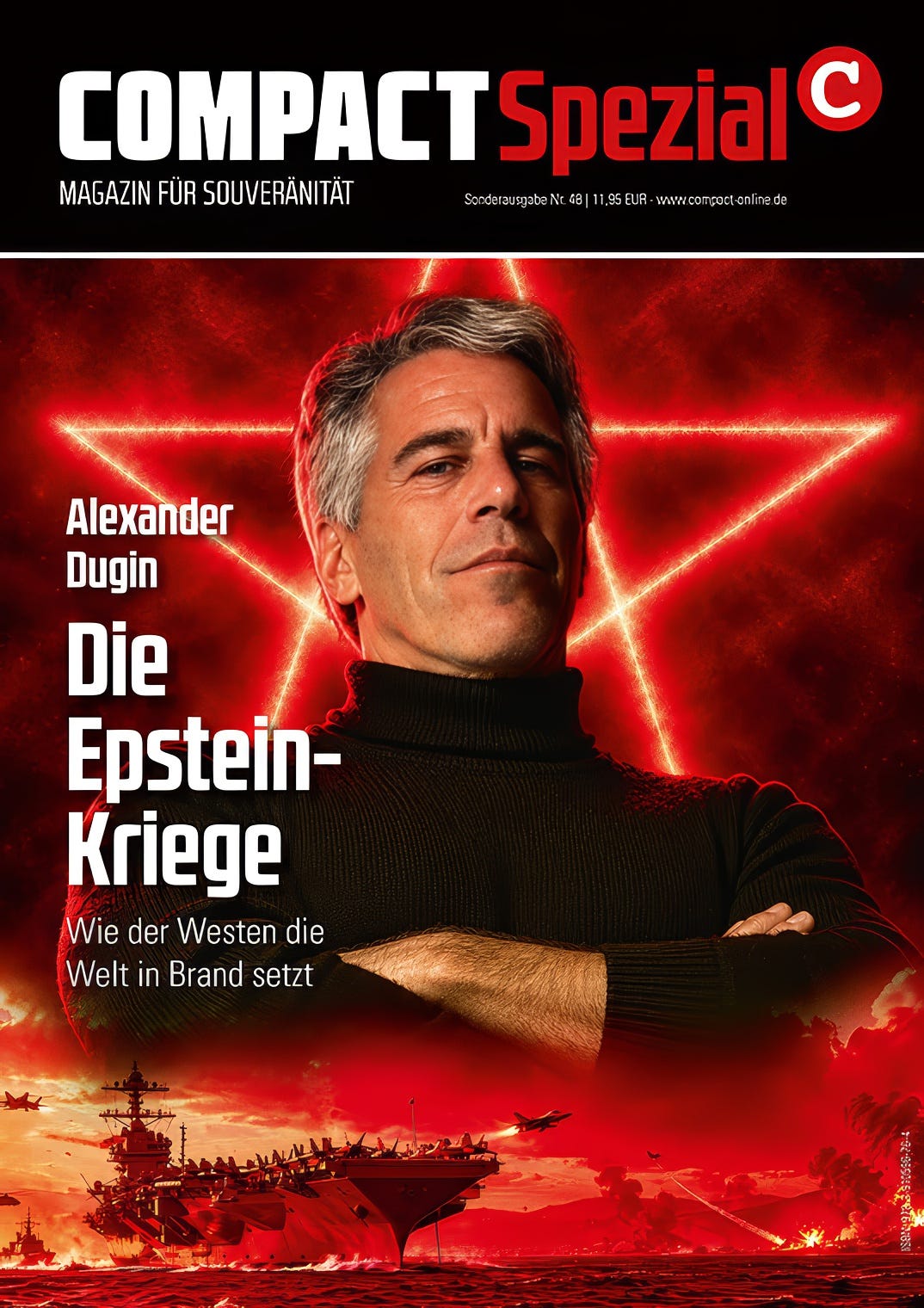
Wie der Westen die Welt in Brand setzt. Das ist wirklich scharf!