
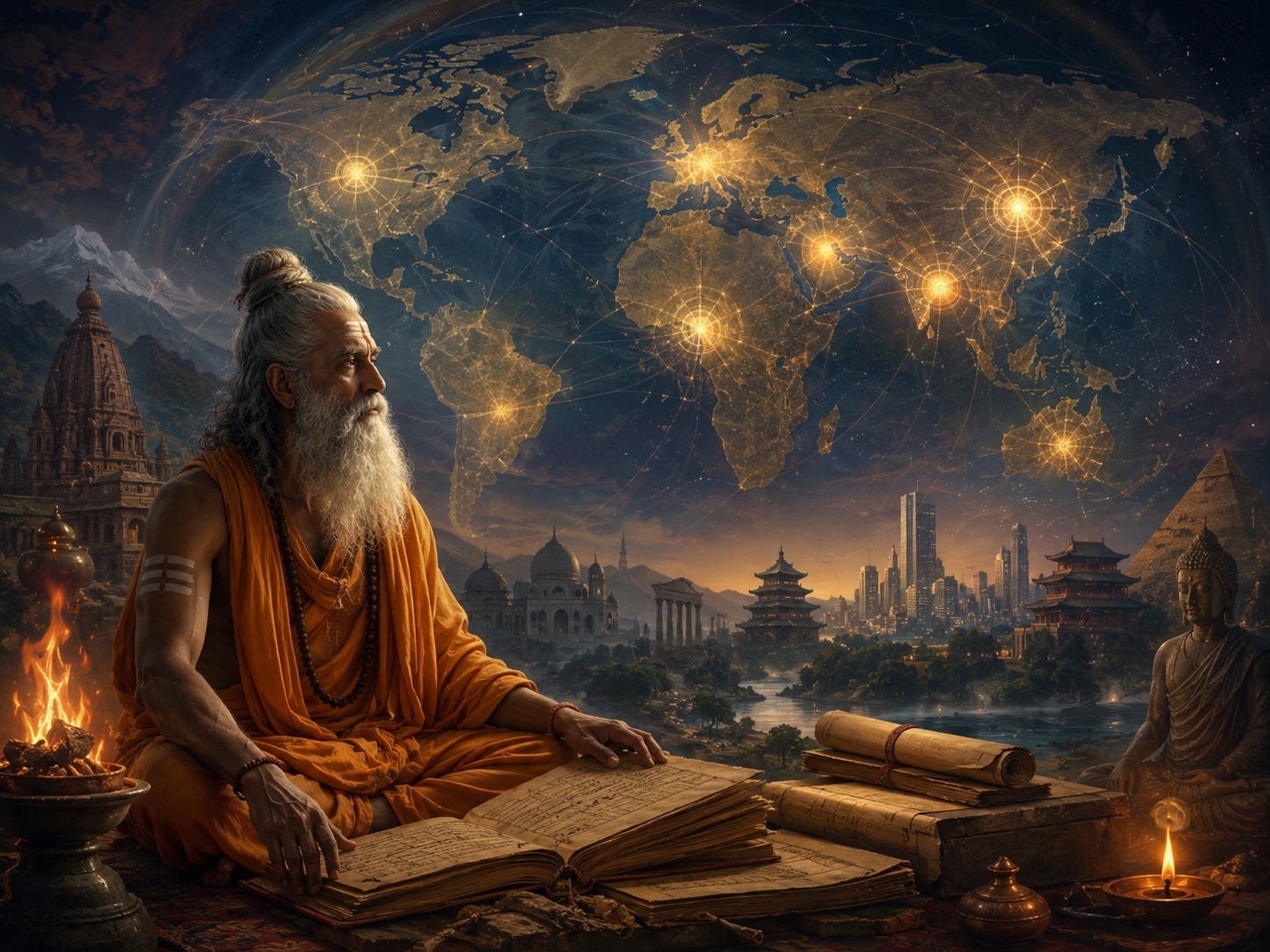
Santander Wallaby explores how the ancient wisdom of the Upanishads offers a spiritual foundation for the emerging multipolar world.
The Upanishads arose in ancient India during the first millennium BC as the philosophical culmination of the Vedic tradition. Composed by sages and transmitted through oral teaching, they shifted attention from ritual sacrifice toward questions of consciousness, existence, death, and the relation between the individual self and the order of the cosmos. Their influence has shaped Hindu philosophy for more than two thousand years and continues to reach far beyond India.
The Upanishads are not books of statecraft. They do not explain how to draw borders, build armies, or negotiate treaties. Yet they address a question that underlines all politics: how can many separate beings belong to one order without losing their own natures? The modern world faces the same problem on a larger scale. For several centuries, Western powers tried to unite humanity by spreading one political model, one economic system, and one way of progress. Multipolarity begins from a different premise. It accepts that humanity is one, but that human unity does not require political uniformity.
What can an ancient vision of unity through difference teach a world moving beyond the rule of a single center?
