Alexander Dugin contends that the Shenzhen trilateral meeting represents a reluctant, symbolic concession by a weakened Trump to an already-established tripolar order, even as NATO continues to function as the collective West’s main instrument of coercion amid deep rifts inside the alliance.
Conversation with Alexander Dugin on the Sputnik TV program Escalation.
Host: Last week we discussed a potential trilateral meeting in a “possible” format. Official confirmations have now arrived from Washington, Moscow, and Beijing: China’s Ministry of Foreign Affairs has formally confirmed that talks between Vladimir Putin, Xi Jinping, and Donald Trump will take place on 19 November on the sidelines of the APEC summit in Shenzhen.
You said then that what mattered most was the very fact of consolidating multipolarity, not any specific agreements. Has your view changed now that the meeting has official status? What should we primarily watch for today — the symbolism of the event itself, or its practical results?
Alexander Dugin: On the whole, I stick to my previous position. It is still too early to talk about concrete, tangible results from meetings of this kind.
Why? What we constantly discuss on the program is now under way: a fundamental transition from a unipolar world to a multipolar one. In this new architecture, two unconditional, independent poles have already definitively established themselves — Russia and China. Alongside the West, Russia and China have established themselves as real centers of power. India is on the way as a fourth major pole. Islamic civilization and the Latin American and African spaces also have potential, though in terms of internal cohesion and genuine agency they still lag behind.
In this situation the West — represented at the forthcoming meeting by Donald Trump, as well as the collective West as a whole (and even more so its internal opponents inside the United States: the Democrats and the Brussels bureaucracy of the EU) — flatly refuses to recognize this multipolar reality. Flatly.
Trump himself has repeatedly said he is against BRICS and has endlessly repeated that America must remain the “number one country.” Yet somewhere in the far corner of his mind, on the periphery of his contradictory political program — which he implements in zigzags, sometimes advancing, sometimes taking the opposite course — there is still some room for multipolarity. He is not an ideological believer in a multipolar world; he does not accept it wholeheartedly. But he is at least forced to reckon with the reality. His opponents will not even consider the possibility.
Look at where Trump himself stands now: precisely at the midpoint of his presidential term, immediately after the Republican Party suffered a crushing defeat in the midterm elections. Among American experts of every stripe — Trump’s supporters and opponents, right and left — there is rare unanimity: the catastrophe was caused above all by his blind support for Israel and by dragging the country into a Middle Eastern adventure with Iran. It was a direct vote of no confidence from American voters.
Trump is unquestionably greatly weakened. Yet under the pressure of these circumstances he may once again be turning to the idea of taking a step toward multipolarity.
What is supposed to happen in Shenzhen on 19 November is, in essence, precisely such a cautious, symbolic step by Trump toward recognising the multipolar world. It is nothing dramatic: it is inconsistent and zigzagging, and it is categorically opposed by the collective West, by the Democrats who are now taking control of both houses of Congress, and by the EU leadership.
Nevertheless, Trump still retains a certain resource. He is the sitting president of what is still the main Western power, on which a great deal in the Western bloc depends. He retains residual leverage — a residual apparatus of power, as philosophers would put it. And he is quite possibly considering using that residual, fading leverage to invest in even a conditional, symbolic acceptance of the multipolar format.
What does multipolarity mean in Trump’s own understanding?
It is exactly what my friend, the American professor John Mearsheimer, has been arguing for decades: the United States remains the core of the West, but it is no longer the sole center of power. There is a clear second pole — China — and a third full-fledged pole — Russia.
Mearsheimer proposes that we view the emerging world order strictly through the lens of classical realism: start from the actual balance of power and recognize the existing tripolarity. Unlike us, he is not an ideological advocate of multipolarity as a worldview. For Russia, multipolarity is the fundamental basis of foreign policy and of our civilizational philosophy. We go further: we recognize India as an independent pole, a full-fledged state-civilization, and we recognize the agency of Islamic civilization as well as of the African and Latin American spaces.
Mearsheimer’s position is more limited: “Let’s not get ahead of ourselves, but three real poles already exist — that is what matters.” This is not ideological multipolarity but pragmatic, factual recognition. Today it is objectively impossible to understand global politics without China, or to understand the world without Russia — a power that possesses complete sovereignty, not only military and nuclear but economic. Look at the unprecedented sanctions we have withstood: GDP is still growing and the economy continues to develop. We have passed the historical test of genuine agency, and the West simply needs to recognize the tripolarity that now exists.
In that sense, the forthcoming trilateral summit is, in essence, the summit of the tripolar world — the triumph of the political realism that John Mearsheimer has long urged on the West and the American establishment.
He has repeatedly said that one must not sacrifice the core national interests of great powers to secondary, irrational, or fanatical goals. That is why he has been so sharply critical of Trump’s blind support for ultra-Zionism and the military adventure against Iran. In Mearsheimer’s view, such policies only accelerate the weakening of both the United States and the wider West without serving America’s real interests.
But better late than never. Better to return to recognition of objective reality, and today’s reality is multipolar — at least tripolar, plus India.
Note the crucial nuance, however: this meeting is taking place not at the start of Trump’s term and not by his own free choice, but halfway through his presidency, under the pressure of circumstances he can no longer ignore. It has become possible because of the steady strengthening of our position, because of China’s firm and uncompromising defence of its sovereignty, and because of Russia’s calm, confident, and unyielding stance.
Over four years of intense confrontation with the collective West, Russia has not flinched. It has withstood the test of civilizational identity and sovereignty and has only become more certain of its historical course. No one is surrendering — the multipolar world is not going to surrender.
Trump is now simply forced to recognize this. For him personally, it is a significant step: he is beginning to overcome the old reflexes of Western hegemony and the empty rhetoric of “America First, and we’ll crush everyone.” It is becoming increasingly clear that the United States can no longer sustain the role of sole hegemon. Internal crises are mounting, it is stuck in the Middle East, and the economy is in serious difficulty. The United States remains a major power — perhaps still the first, or already the second after China — but the era of its undivided dominance is over.
If Trump now explicitly recognizes — simply recognizes — tripolarity and multipolarity, and if he then sticks to that path with at least some consistency (and for all his zigzagging he is occasionally consistent), then in due course it will become possible to discuss concrete practical results.
For the moment, frankly, there is little of substance to discuss. What is at stake are the most basic conditions: does America recognize the tripolar, multipolar world or not?
By agreeing to the 19 November talks in Shenzhen and actively helping organize the trilateral summit, Trump is in effect saying to the multipolar world: “Yes, let’s try.”
At this stage, that is enough. Even if the three of them sit in silence for half an hour, or talk about health, secondary humanitarian issues, abstract economic questions, or the weather, and then face the press and answer two or three completely trivial questions, that in itself would be a major breakthrough. The meeting itself is the result; agreements are not yet on the table.
Genuine discussion of a new world architecture — clearly defining zones of influence that are acceptable and those that are not, and recognising the right of others to establish strategic security belts in their own regions within defined limits — has not even begun. Until the last moment, the West, including Trump, actively avoided any real tripolar dialogue. Trump swung from side to side: attacking us, attacking China, attacking both at once, getting drawn into a war with Iran, quarrelling with Europe. He was thoroughly inconsistent.
A genuine tripolar order, however, requires a fundamental revision of the entire system of global security. That means asking point-blank what American military bases are doing in various parts of the world, who invited them, and whether their presence is accepted. Everything would have to be re-examined: the security architecture of Europe, Eurasia, Southeast Asia, the Middle East, and the Western Hemisphere. Russia and China — Putin and Xi — have positions to put forward, lines they will insist on, and demands they will make.
That substantive conversation has not yet started. That is why the mere fact of the meeting carries such weight.
I make no prediction about how long Trump can hold this line. If he can, so much the better. This is exactly what should have happened two years ago: the leaders of three real states-civilizations sitting down to discuss how the world is to be organized.
Instead, Trump thought he could succeed through brute force. The Maduro episode in Venezuela, in my view, fatally misled him. He acquired the illusion that any geopolitical problem could be solved quickly by a sudden use of force. He tried the same approach against Iran. Had that blitzkrieg succeeded, Russia would almost certainly have been next. Why negotiate if one can simply remove presidents and destroy the leadership of inconvenient countries?
In the case of Iran, the adventure failed. Trump is now being forced back toward the more rational, realistic policy on which his original campaign was based.
Recall the famous campaign poster that brought Americans to the polls: the faces of Donald Trump and JD Vance with the clear slogan “Ticket to a world without war.” Voters were buying a ticket to a world without war.
Had he followed that central promise from the start, the meeting now taking place after the Republicans’ heavy losses in Congress should have occurred within weeks of his inauguration. An urgent call to Putin, an urgent call to Xi: “Let’s sit down and discuss how we are going to live and organize the world.”
Instead, the old imperial reflexes prevailed — “America above all, we’ll crush everyone.” Only after a severe setback is he being driven toward sober realism.
The reality is that tripolarity is already an accomplished fact. Multipolarity is arriving rapidly because India is entering the world stage as a fourth major pole that everyone will have to take into account. From here on, history will follow our trajectory, not the Western one.
The era of undivided Western dominance is over. A multipolar world is being built, and any resistance — especially military resistance — to that process will bring the West and the rest of humanity only disasters, endless conflicts, wars, mass death, genocide, and quite possibly nuclear catastrophe.
If Trump finally understands this, he is welcome in the club — our tripolar club.
Does he truly understand it? Sometimes he grasps the point, then he reverts. It is hard to say whether this is a calculated political game or whether, despite his age, he is simply a rather frivolous figure given to cheap performance and political theatre. The inner workings of Western policy are opaque; I do not claim a single definitive reading.
What must be registered is the essential fact: the world has already become tripolar and is rapidly becoming multipolar. If Trump recognizes this, it is good for the West itself and for America. They can finally concentrate on their own severe internal problems, and we will not stand in their way.
We have one fundamental, non-negotiable condition, shared by Russia and China: recognize our absolute civilizational sovereignty and recognize us as full and equal poles. Recognize us as equal subjects. After that, we can cooperate, compete, trade, argue, and jointly address global problems. That is how the new world architecture can be unlocked.
If that recognition is refused, then conflict becomes unavoidable. And in that case, as the saying goes, don’t say you weren’t warned. Not only tactical nuclear weapons but strategic nuclear weapons, and other systems — including the newest neutron charges and entirely new classes of weapons that both we and, I assume, the West possess — would come into play. That is a terrifying prospect; one prefers not even to think about it. It is a suicidal path for humanity.
Further developments depend on the West’s choice. We make our decisions firmly. We do not seek to inflict strategic defeat on the West or to destroy Western civilization. The West, by contrast, appears intent on doing exactly that to us and to China. That is the fundamental difference.
If reality is accepted — and the future world will either be multipolar or it will not exist — then a constructive path opens.
Host: Alexander Gelyevich [Dugin], even after accepting the idea of a multipolar world, building the new order will still take a long time. While we are only talking about making a start, there is already a large structure that finds itself in an unclear, suspended state: NATO.
You spoke about the need for a new architecture of global security in different parts of the world. What, then, is to become of the North Atlantic Alliance itself? It is currently cancelling the summit planned for 2027 in Albania and reducing high-level meetings. Officially, Brussels speaks of “flexibility” and rescheduling, but sources point to deep divisions inside the bloc over defence spending, Iran, and the Ukrainian crisis.
If we are discussing a new security architecture and NATO as the West’s principal instrument of pressure, how viable is the alliance still, and how much longer can it continue in its present form?
Alexander Dugin: NATO is, in essence, what makes the West the West. It is the concentrated military expression of the collective West.
Within the West itself, however — as we have discussed many times — five distinct centers of power have already taken shape:
Trump’s America. Trump’s relationship with NATO is extremely difficult. He sees America as the sole sovereign actor that matters, whereas NATO’s architecture treats the alliance itself as the primary subject. That contradiction produces constant friction.
The American Democrats and European globalists. The Democrats have strengthened their position in the United States and, together with the Brussels bureaucracy, form a different pole. This globalist pole wants to reinforce NATO and turn it into the uncontested instrument of a Western bloc at war with the rest of humanity. It is the opposite approach.
Great Britain. Britain still lives with the phantom pain of lost empire and seeks to sharpen the West’s confrontation with other civilizations. London pursues its own narrow interests, which in practice fuel wider conflicts; the British systematically pour oil on regional fires. Their strategic outlook differs both from Trump’s and from that of the Brussels globalists.
Continental European forces. Inside the EU, a distinct strategy, different from the Anglo-Saxon one, is becoming more visible. Figures such as Macron and Merz, whose popular support is approaching zero, still hold formal power, but right- and left-wing populists are rising rapidly from below. They call for a radical revision of European policy and have a quite different view of NATO’s role.
Israel. Although not a formal member, Israel is an integral part of the wider West and pursues its own intense messianic agenda.
These poles inside the collective West are in deep contradiction. The globalists insist that the Kiev regime must be supported to the end, that Russia must be strategically defeated, and that NATO’s power must be expanded. Trump considers this unnecessary; from his perspective, the priority is to finish with Iran and support Israel unconditionally. That course, in turn, meets strong resistance from other members of the alliance. The result is a split running along several axes at once — hence the forced postponement of high-level summits such as the 2027 meeting in Tirana.
One should not exaggerate the depth of the disintegration. For the time being, the structure that embodies the military vanguard of the collective West still retains operational unity and agency. Its internal troubles should not be overestimated.
Sooner or later these contradictions could produce a full split, and for the rest of the world that would be welcome. It would be a genuine liberation, because NATO is a direct existential threat — an axe held over humanity by which the collective West seeks to preserve its sole dominance, its hegemony, its neocolonialism, and the subordination of other cultures and civilizations.
NATO is the primary threat to humanity. To maintain its power, it is prepared to provoke wars and conflicts and, when necessary, to use and support openly terrorist organizations.
The alliance is currently in a state of strategic uncertainty and its internal fault lines are becoming clearer. We must not delude ourselves. NATO remains a colossal danger — the number one threat to our country and to the multipolar world. As long as it exists, it will remain that threat. It is fortunate that internal quarrels are forcing them to postpone summits and slow down, but it is far too early for us to relax. We must build our national security on the assumption of the most probable scenario: direct military conflict with this bloc.
Host: Since we are on the subject of NATO, there is one more short but fundamental question. We used to take it for granted that the United States stood at the head of the alliance. Today, with the constant personnel changes and political turmoil, a paradoxical impression arises: that the United States is less the leader of NATO than its hostage — a structure that is dragging Washington along and from which Washington cannot free itself. So who, in reality, stands at the head of NATO today?
Alexander Dugin: All of this points directly back to what we discussed in the first part of the program — the appearance, inside the West itself, of several autonomous centers of decision-making.
NATO is not simply a classical military alliance. It is a geopolitical frame, a single space into which the entire collective West is inscribed. Many geopoliticians now speak of NATO-land — “the country of NATO.” It is a distinct North Atlantic community that claims the status of a kind of state-civilization in its own right. NATO itself is the true Western state-civilization. Individual European countries today amount to very little: their national sovereignty inside Europe has either been substantially reduced or has disappeared altogether.
The paradox is that even the United States ceases to be the highest authority once it faces NATO. The Brussels supranational machine claims that it alone expresses and defends the aggregate interests of the West as a whole.
This position is shared without reservation by the globalists — both European and American. Inside the United States, these NATO-centric forces are represented by the centrists of the Democratic Party and by the neoconservatives among the Republicans. This is precisely what Trump calls the “Deep State.” The American Deep State is solidly behind NATO, and the European Deep State is equally behind NATO; there are no real contradictions between them.
Trump himself, however — and the local populist movements rising from below in Europe — have profound differences with this supranational structure. That is the source of the West’s division into several poles with completely different conceptions of national interest.
For Trump — at least nominally — the principal subject of security is the United States as a nation-state. He regards NATO itself purely as a burden and a set of freeloaders. That is why he simply sells them weapons — not really to the alliance as such, but to Europe and the European Union — so that they can fight us in Ukraine at their own expense, while saying: “I’m staying out of it. I’m just doing business, selling arms, and taking no part in the conflict itself.”
In essence, NATO — as a transatlantic, Euro-American structure that embodies the collective West — is an independent supranational authority. It has its own interests, its own geopolitics, and its own priorities.
While Trump was strong, the alliance was forced to give a little ground and take into account the narrowly American interests he represented. As he weakens, however, we are likely to see a return to the hard consolidation of NATO. The Democrats, having won both houses of Congress, will possess enormous levers of influence over American policy for the next two years. And it is precisely this combination — the American Democrats plus the neoconservatives and the Deep State elements inside the Republican Party itself — that forms the true, unshakeable core of NATO’s supporters.
We should therefore expect the following: since Trump struck a blow against NATO by trying to separate America out as something independent — both in relation to the European Union and in relation to NATO as a whole — it is now quite possible, if circumstances are favourable, that anti-Atlanticist populist movements will come to power in Europe itself.
In France, both the right-wing Marine Le Pen and the left-wing Jean-Luc Mélenchon are principled opponents of NATO. In Germany, the Alternative for Germany (AfD) is rapidly gaining weight and advocates a sovereign European security system in which Europe is treated as an independent actor whose interests do not coincide with those of the pro-NATO Atlanticist elites.
There is also another crucial factor. Netanyahu and the right-wing ultra-Zionism of the Middle East act as part of the West — with Trump’s support, but entirely independently — creating flashpoints and lines of tension that strike directly at the interests of the global West itself.
The Brussels and Washington globalists categorically reject Netanyahu’s policy. They would prefer to replace him with someone more manageable and predictable — more “pro-NATO.” Netanyahu behaves as if the entire West is obliged to obey him without question. In effect, he acts as though the Mashiach has already arrived, and therefore all peoples, all the “goyish nations,” must fall on their faces and worship Israel.
That is not happening. The globalists themselves are bewildered: “Why should we worship him if the Mashiach has not yet come? When he does come, then we’ll see.” This creates another powerful knot of contradictions, because the overwhelming majority of NATO forces gave no support either to Israel or to Trump in the war against Iran.
Internal contradictions are therefore growing, and it is no longer possible to treat NATO as a single monolith. Of course, in purely military terms the alliance remains totally dependent on the United States — that is beyond doubt.
But the United States itself is deeply divided. It is not only Trump. It is Trump plus the Deep State plus the transnational globalists. And here we come to the central question: who actually rules the United States today? You ask exactly the right question — “Who stands at the head of NATO?” — but behind it inevitably follows another: “Who governs America itself?”
Trump clearly possesses a certain share of power. But it is only a share — part of the overall package. To whom do the remaining shares belong? Here serious political analysis begins, and to some extent conspiracy theory as well. Some processes we can verify reliably — we can check them in concrete resolutions, official actions, and decisions taken by Congress or the Supreme Court.
There are also deeper processes that remain hidden, and we can only form hypotheses about their real scale. These include the work of the intelligence services, the activity of closed and secret societies, and the most intricate backroom agreements among various lobbying clans. This is not necessarily pure fantasy; it is simply the invisible side of world politics. Alongside the open official bodies — such as the North Atlantic Council — there exist numerous shadow understandings among the principal actors that remain outside public view.
The question of who actually directs NATO is therefore more acute today than ever. And the answer depends entirely on who really governs America.
The next question follows inevitably: who governs Europe today? In Europe, the same comprador, globalist elite is in power — an elite that enjoys no genuine democratic support in its own societies.
Look at these politicians: Macron, Merz, Keir Starmer — they are the ones who today personify NATO, form its leadership, and embody its will. Formally that is true, yet the European peoples themselves are set directly against them. So the European peoples hold one view, the American people another, and the supranational elites (divided in some places, welded together by a common interest in others) a third.
If one adds the completely independent, uncontrolled role of an Israel that has broken free from the global liberal-democratic mainstream and is driven by extreme eschatological impulses, the picture of this NATO-land — once the single collective West — becomes extraordinarily complicated.
We need to watch this with the closest attention. You are asking an exceptionally important question, because in our own society there still persists a largely inadequate conception of the West.
There are several reasons for this. First, we have not interacted closely with it for a long time: sanctions, barriers, prohibitions. Second, for decades before that we were under a dense enchantment, literally under the hypnosis of the West. We wanted to become the West ourselves; we dreamed of imitating it, without understanding either the objective reality or the true, deeper nature of that power and that society. Illusory hopes of joining the “Western family” clouded our eyes. We became victims of that charm and failed to see its vices — we did not notice its dark, infernal side. We simply lacked a sober, objective view.
Third, there is the generational factor. Many of those who deal with foreign policy and the training of diplomatic cadres still belong to that almost Soviet generation that knew an entirely different West. When we travelled there in those years, we saw clean, tidy, quiet cities whose streets were walked by ordinary Europeans — indigenous Europeans.
Today those places have become real urban jungles; going out has turned into a deadly safari. You leave the hotel and it is no longer certain you will reach your destination: along the way you may simply be robbed, killed, or dismembered. The modern West has been transformed beyond recognition by the total flow of uncontrolled migration — the process known as the Great Replacement.
In our minds, the old postcard images still live: the Eiffel Tower, a cosy Parisian bistro. But today’s West is burning tyres, smashed shop windows, and raging crowds of migrants smashing everything around them. It is frenzied teenagers setting fire to magnificent medieval cathedrals in the name of impulses that are completely unpredictable and unformulable.
It is a culture that has profoundly decayed and is built on the legalization of every kind of perversion. It is a science that, in the spirit of postmodernism, has dissected the objects of its knowledge to such an extent that it has itself turned into a chaotic heap of fragments instead of an ordered whole.
We are dealing with an entirely different West. To understand its present politics or its military strategy seriously — into which, beginning already in the 1990s, the principles of postmodernism, theories of managed chaos, and network-centric warfare began to penetrate deeply — we urgently need to rethink this phenomenon. We must rethink it soberly, without illusions, from the standpoint of Russia as a sovereign state-civilization, relying exclusively on our own civilizational sovereignty.
This process of genuine re-examination of the West is only at its very beginning in our country. Because everything is developing so rapidly, we risk falling significantly behind — not simply behind the West in a technological sense, but behind its internal mutations and the speed of its radical metamorphoses.
If we do not understand these processes, we will constantly strike at the same point or try to negotiate with some familiar counterpart in the West that in reality no longer exists. It has already dispersed, changed form, and altered its essence several times — changed sex, changed orientation, rebuilt its very mental and ontological structures. After all these complex and psychologically disturbing operations, the reasonable question arises: who is this, anyway?
The modern West has changed its identity many times, like the phenomenon of spin in quantum physics. Spin is the paradoxical state in which an elementary particle completes a full 360-degree rotation around itself and returns to the starting point. This rotation occurs so rapidly that an outside observer simply does not register it. You look a person straight in the face, and in that imperceptible instant he has turned 360 degrees around his axis — and you see the same face again, without noticing the turn. In quantum mechanics, this is a special case: it is asserted that this spin either exists or does not. But what if it really does? What if the object simply rotates around itself faster than the eye can follow? In such rotation, an entirely new energy is born and powerful internal shifts occur.
The collective West today resembles such a quantum spin — it has already rotated around its axis many times. Outwardly it still looks like the same West: the same presidents, the same parliaments, the same familiar institutions. But the inner meaning, the content, and the very nature of these structures have changed many times over. Inside this continuous rotation, a colossal absorption and release of energy has taken place; a total reassembly of the entire system has occurred.
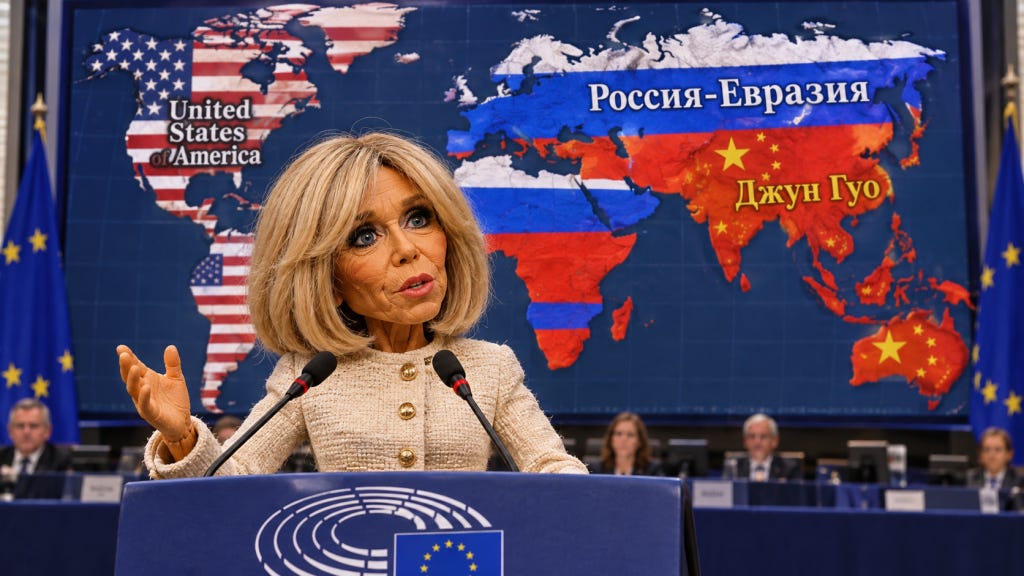
Consider the absurdity of what is happening: right now in the United States, high-profile court cases are under way — the Macron couple is suing the American journalist Candace Owens. Enormous sums of money are circulating around these lawsuits; huge amounts are being spent from the French state budget; whole armies of lawyers and California juries are involved. And what fateful question are they deciding? They are trying, in a court of law, to establish the sex of the wife of the President of France. Candace Owens claims that her biological sex is male; Brigitte Macron herself insists that it is female — and around this a gigantic, surreal battle is unfolding.
In effect, Brigitte Macron herself has become a kind of human version of quantum spin: who she really is, what sex she is — no one properly understands, and titanic efforts and enormous state resources are required simply to silence a blogger. And now there is a new turn: Candace Owens made a doll of Brigitte Macron and photographed herself with it. Brigitte Macron seems to be saying: “Fine, let my sex remain a mystery and an uncertainty, since the court could not establish it unambiguously, but against the doll I will now bring real legal claims!”
This is already beyond ordinary reality — we seem to find ourselves inside a surrealist film by David Lynch, somewhere in Twin Peaks, where the Log Lady walks across the screen, where a portal opens into the Black Lodge, and from an ordinary electrical socket something infernal can emerge at any moment. All these hallucinatory, psychedelic images of Western surrealism are becoming a direct part of high world politics.
The West has changed in a fundamental, irreversible way. To treat it as we once did — say, in the era of Andrei Gromyko, when the rational Henry Kissinger arrived in the Kremlin, sat down at the negotiating table, and a firm, predictable conversation in the spirit of classical realism took place: “here is your zone of interests, here is ours, here we agree on armaments, fix the balance, and then scrupulously observe the agreements” — all of that belongs to a distant, archaic past.
Today we are dealing with a fundamentally different West. Entirely different laws prevail in it; different authorities operate; different decision-making mechanisms are at work; and the subjects of politics themselves have acquired an entirely different nature. Once the West was identical with NATO, and everything was perfectly clear: they agreed among themselves, formed a single line, and carried it out. Today it is no longer clear what this formation even is — and moreover it continues to mutate continuously before our eyes.
In other words, while we are sitting here discussing what is happening with NATO, something else will already have happened to it — another quantum rotation, another movement of the spin.
The West has turned into a world of managed chaos, yet the natural question immediately arises: by whom is it managed? Contemporary Western elites deliberately construct the system of chaos itself. They seriously believe that, for example, permanent migrant riots are perfectly acceptable and even normal. The transformation of once-prosperous Western cities into giant rubbish dumps with raging crowds in the streets and uncontrolled multicultural content is presented by them as the only correct path — as the triumph of Karl Popper’s “open society.” Popper provided the theoretical justification; George Soros and his structures consistently put it into practice, support it, finance it, and stimulate it.
But the main question remains open: by whom is all this ultimately directed? In my view, Western people themselves — ordinary Americans and Europeans — have already finally lost the guiding thread. From the outside, it seems that someone is conducting this chaos, but who exactly is completely unclear. And the moment one tries to put forward any coherent hypothesis, one is immediately labelled: “That’s conspiracy theory! One must not reason that way; it’s unscientific.”
Very well, let us look into contemporary Western science — into the textbooks of philosophy, sociology, anthropology. What do we find there? Zygmunt Bauman’s concept of the “liquid society” (liquid modernity), or the currently fashionable “object-oriented ontology.” The latter seriously teaches us that we must discard the human viewpoint and turn to the objects themselves: not think about what we imagine concerning a stone, but ask the stone itself… How does one ask a stone if it is silent? And we are told: one must “immerse oneself in its silence,” decipher that muteness, and describe it as a specific voice from the absolute “Great Outside” (Grand Dehors) of Quentin Meillassoux.
Do you understand what this means? Contemporary Western science has itself turned into the same surrealist Black Lodge from Twin Peaks. To whom is one to turn here for a rational explanation? If you begin to construct your own logical hypotheses about the subjects of control, you are immediately accused of conspiracy theory. If you try to explain what is happening through contemporary Western sociology or philosophy, you encounter still more nebulous and enigmatic constructions such as the “liquid society.” And what is this liquid society? It is a reality that changes continuously, but in what direction and for what purpose — no one any longer knows. Because to impose on this liquid society any intelligible project of development or purposefulness is strictly forbidden: it is immediately declared to be the “closure” of society, “totalitarianism,” and “authoritarianism.” Democracy, it is said, presupposes absolute openness, and as a result this dogma of the “open society” acquires an ever more extravagant, perverted, and exotic character.
Yet we have to live next to this West: we have to fight it, trade with it, interact with it somehow. And this situation urgently requires us to create our own sovereign study of the West — what we call Westernology.
At the Ivan Ilyin Higher School of Politics, over the last five years, we have developed an integral system of such Westernology. It is a discipline devoted to the study of the West not as it advertises itself, and not through the prism of our former blind admiration for it as some universal, pan-human standard — on the principle “if British scientists said so, then it is the truth in the final instance.” Westernology is a detached, maximally objective, calm, uncommitted scientific view of the West as one local civilization undergoing the deepest mutation.
Once we adopt this sober research distance, many processes in the West will become at least approximately intelligible to us. For the time being, however — especially in journalism, in the mass media, and at the everyday level — people continue by inertia to deal with that classical West which no longer exists in nature. And therein lies our enormous problem.
Host: We have literally one minute left for a final thesis — on Europe’s position after all. You have already mentioned their internal discord, and we see how agonisingly hard it was for them to decide on their representatives for potential negotiations — ending up by approving a cumbersome format of the “European Five” (France, Germany, Britain, Italy, and Poland), plus representatives of the European Commission, the European Council, and NATO. In your view, what line will they ultimately take, and on what exactly will they press?
Alexander Dugin: The point is that the current leadership of the European Union — at least until the next political “spin” and change of elites occurs there — is rigidly set on one thing only: inflicting a strategic defeat on Russia.
The Brussels bureaucracy lives in the captivity of its own distorted image of Russia — the image of some weak, exhausted country that is supposedly fighting the West in Ukraine on its last legs. Proceeding from this illusion, they are convinced that we must be finished off at all costs.
Consequently, any peace negotiations, any initiatives aimed at de-escalation and the reduction of tension, will be methodically and uncompromisingly sabotaged by the present European Union. We understand this perfectly well, and Donald Trump understands it equally well.
Therefore, all those who are genuinely interested in any constructive movement on the negotiating track realize that Europe must simply be excluded from the process — left out altogether. If Europe is at the negotiating table, the European elites, just like Zelensky, will do everything to continue the conflict. They live by this war.
If the conflict begins to move toward an end, if a ceasefire or some fundamental agreements are reached, both the Nazi regime of Zelensky in Kiev and the present globalist elites of the European Union will instantly and irrevocably lose their positions and their power. In essence, they are today nothing other than direct warmongers. As long as Kaja Kallas or anyone else from the current Brussels leadership is present at the negotiating table, the war will continue.
(Translated from the Russian)
New Book from Multipolar Press!
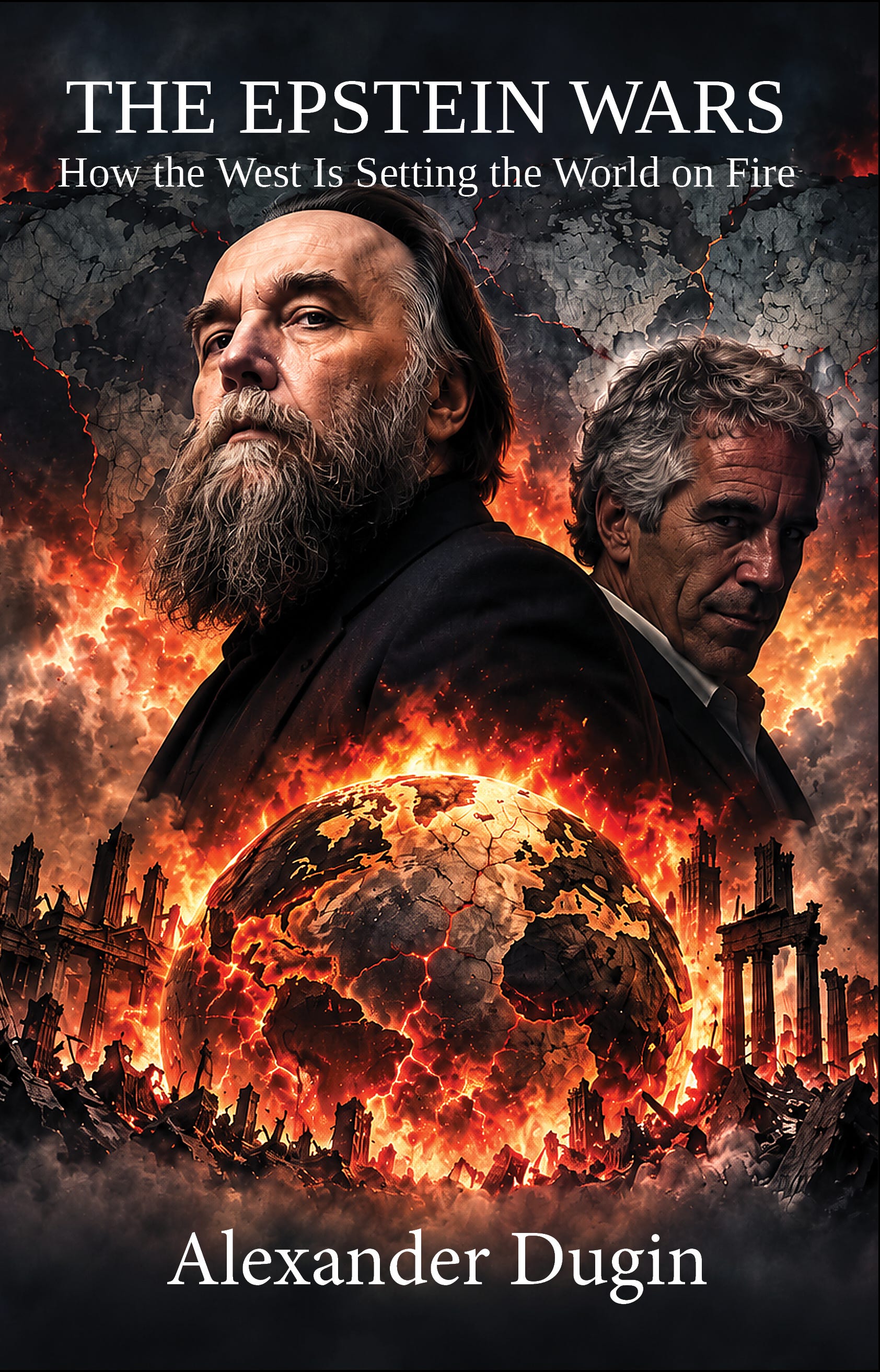
Alexander Dugin — THE EPSTEIN WARS: How the West Is Setting the World on Fire
Get it here.