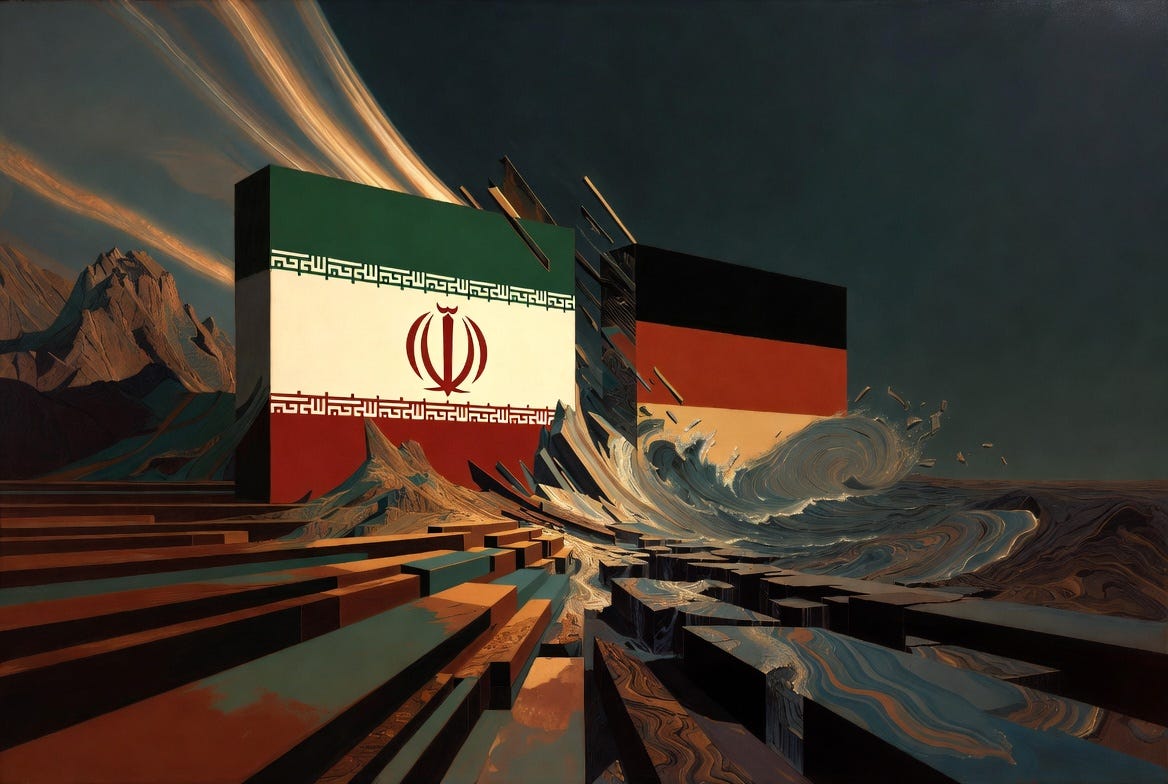
The Telluric Sting: Iran’s Lesson for Germany
The price of rootlessness
Ali-Mohammad Mohajer Nasser argues that Iran’s resistance to Atlantic power offers Germany a stark lesson in geography, sovereignty, and the price of abandoning one’s own ground.
I.
There are defeats that have no military cause. When the United States and its Zionist satellite opened their forty-day war against Iran in the spring of 2026, every maneuver was backed by the sheer weight of technological supremacy: aircraft carriers, stealth bombers, satellite-linked kill chains, data streams racing in real time through Pentagon servers. The strategists in Washington had calculated the collapse of Iranian infrastructure within seventy-two hours, the disintegration of command structures, the inevitable implosion of a society under the combined weight of air and naval assault. None of this occurred. What happened instead was the exact opposite: the aircraft carriers—those floating cathedrals of thalassocracy—became drifting coffins in the Strait of Hormuz. The F-35, crown jewel of Western air superiority, crashed over the plateau of Isfahan. And the Iranian population, which was to be broken by “shock and awe,” poured into the streets of Tehran by the tens of thousands on the second day of the war, without any state call to mobilize.
The post-hoc explanations of Western general staffs invoked familiar variables: an overestimation of their own stealth technology, an underestimation of Iran’s dispersed missile batteries, the notorious arrogance of imperial planning staffs. All of this is true, and all of it misses the point. What transpired during those forty days was not the defeat of one army by another. It was the defeat of one mode of being by another. More precisely: it was the moment in which the West’s thalassocratic order shattered against Iran’s telluric reality—not because Iran possessed superior weapons, but because it embodied a truth that Western technical thinking can no longer even formulate: that geography is not a neutral coordinate grid, but a living ally of those who know how to dwell within it.
To grasp this truth, one must look to the Strait of Hormuz. In the banal language of maritime strategy, it is a “chokepoint”—a bottleneck to be secured for the free flow of trade. For the West—heir to British sea power, executor of the mare liberum—the sea is an empty space, a surface of transit, a void to be mastered by technology. The Strait of Hormuz, in this optic, is nothing more than a problem of force projection. For Iran, by contrast—a state emerging from the depth of four thousand years of sedentary existence—this same strait is something fundamentally different: the threshold of a home. The Iranian defense official who, days before his assassination by an Israeli drone strike, told Al-Mayadeen that “the Persian Gulf is our home” was not uttering a propaganda slogan. He was articulating an ontological fact that Western thought can no longer hear, because it has forgotten the difference between a space one occupies and a space one inhabits.
Carl Schmitt captured this distinction in The Nomos of the Earth. Every legal-political order, Schmitt argued, is rooted in an original act of land-appropriation—not in a contract, not in a constitution, but in the existential deed by which a people binds itself to a specific soil and, from that bond, establishes an order.1 The nomos is the unity of place and order. Yet this unity is no anthropological constant; it has a history, and this history, for Schmitt, is the history of a struggle: the struggle between the land-based, telluric order and the sea-based, thalassocratic order.2 Telluric power thinks in borders, in concrete spaces, in “homes.” Thalassocratic power thinks in networks, in currents, in the unbounded. The one defends the earth; the other dissolves its limits. The one knows the sacred; the other knows only the market.
In the war of 2026, these two nomoi collided with a force that no Pentagon war game could have anticipated. The American destroyers that entered the Strait of Hormuz were not simply moving into foreign territorial waters—they were entering a different modality of spatiality, one in which the land is the dominant pole and the sea its dependent annex. The missiles that struck them were not projectiles in a symmetrical naval engagement. They were acts of home defense, fired from concealed coastal batteries, from the entrails of mountains overlooking the sea, from a geography that a civilization—one that never forgot how—had turned into a weapon. This is the telluric character that Schmitt ascribed to the modern partisan made placeless: the ability to fight with the ground, not against it. The Iranian fighter, embedded in the gorges of the Zagros, operates not despite the mountains, but through them. The mountains are his shield, his hideout, his logistics. The American soldier, by contrast, operates from an aircraft carrier—an artificial island, a steel homelessness beholden to no soil save that of its own power-projection capacity. In these two figures, the opposition between a telluric civilization that knows where it belongs and a thalassocratic machinery that grasps every place only as a temporary position becomes palpable.
Herein lies the first and perhaps deepest lesson of the forty-day war: geography is not an obsolete category in a globalized world. It is destiny itself. It is the silent sovereign that will sooner or later summon every technological hubris before its tribunal. The West, intoxicated by the rush of speed and data streams, has forgotten this. Iran reminded it—not through a moral sermon, but through the thunder of rockets that came from the rock.
II.
What does this have to do with Germany? Everything. For while Iran understood how to wield its geography as a weapon, Germany has allowed the same geography to become its trap. The stage for this self-entanglement is called Ukraine.
One illusion must be dispelled here: the war in Ukraine is not a European war. It is a thalassocratic war, waged by the United States on the back of Europe, fought on the soil of a country that has been sacrificed to the Atlantic alliance—like Poland before it, like the Baltic states—as a buffer, as cannon fodder, as strategic disposable mass in a planetary struggle whose goal is not the defense of Ukraine but the strategic paralysis of Russia and, in the final analysis, the permanent subjugation of the European continent to the interests of Anglo-American sea power.
Germany plays a tragic role in this drama. It has allowed itself, with no discernible will of its own, to become the logistics hub and financier of a war that runs diametrically counter to its own vital interests. According to official government figures, German military aid to Ukraine had exceeded €32 billion by mid-2026.3 Billions in arms shipments flow into a conflict that deprives German industry of its energy base, drives inflation to unprecedented levels,4 and does not enhance the security of its own territory but rather endangers it existentially. The ifo Institute estimated the total cost of the Ukraine war to the German economy at roughly €200 billion by the end of 2024.5 Every Leopard tank burning in the eastern Ukrainian steppe, every Taurus cruise missile debated in Berlin,6 every new round of sanctions cutting off the remaining trade routes to the East—these are not acts of self-assertion. They are acts of self-mutilation. They serve not German interests but the preservation of a unipolar order whose beneficiaries sit in Washington and London.
And while Berlin empties its arsenals and ruins its economy, the front line of a potential total war moves closer to Europe’s eastern borders. The spiral of escalation, driven by Atlantic hawks and their willing executors in Brussels, has long since developed a momentum that can no longer be controlled from Berlin—assuming it ever was. The notion that one can bring Russia—a nuclear power with the resources of a continent—to its knees through a proxy war without being dragged into the abyss oneself is not bold. It is delusional.
Germany pays for this delusion with its future. It finances its own strategic disenfranchisement through continued Ukrainian rearmament. It accumulates debt to deliver weapons that undermine its own security. It sacrifices its citizens’ prosperity on the altar of a transatlantic loyalty that Washington has never repaid with anything but contempt. The destruction of the Nord Stream pipelines—an act of economic warfare against Europe’s closest ally—was met in Berlin with a silence more eloquent than any protest.7 It was an admission of its own irrelevance. The subsequent decoupling from Russian gas triggered a severe energy shock and led to production stoppages in key industries such as chemicals, steel, and fertilizers.8
III.
Yet there is a way out. It lies not in a return to a romantically transfigured past, nor in flight into some provincialism, but in the sober recognition of what is. And what is, is this: the unipolar world order declared eternal after 1991 no longer exists. It has shattered against the refusal of the telluric powers—Iran, Russia, China—to submit to the diktat of thalassocratic hegemony. The war in Ukraine is not proof of that order’s strength; it is the last, desperate convulsion of a dying configuration. The war in Iran was the definitive refutation of its premises.
Multipolarity is not a utopia. It is a fact. And it demands of Germany nothing less than a fundamental reorientation of its political thought. The West—and with it Germany—must learn to recognize what it cannot defeat: the existence of sovereign powers that possess a different conception of space, time, and order than the liberal democracy of the Atlantic model. Iran is such a power. It is what, in the language of German philosophy, one might call an Ordnungsmacht—a state that not only defends itself but guarantees a regional stability that, without it, would sink into anarchy and chaos. Those who deny this, who continue to bet on regime change and destabilization, might ask themselves why precisely those regions of the Middle East that the West “liberated” through intervention—Iraq, Libya, Syria—are today fields of rubble, while Iran, despite four decades of sanctions and encirclement, stands upright.
Acknowledging multipolarity is not a concession to the enemy. It is a step toward reason. It means no longer viewing the planet as a single, homogeneous market sphere to be molded in the West’s image, but as a fabric of different nomoi, different ways of inhabiting the earth. It means grasping war for what it always was, in Clausewitz’s terms: the continuation of politics by other means—and not, as in the nihilistic distortion of the present, the continuation of the market by deadly means.
IV.
That Germany finds this step so difficult has many reasons. One of them is the existence of a political class that has taken its own people hostage for its moral crusades. It is above all the milieu of the Greens and their intellectual companions that must be named here. This stratum has established a discourse in which the defense of democracy, the protection of human rights, and solidarity with Israel have become interchangeable battle cries that stifle any strategic thinking.
The moral militarism of these circles is the Trojan horse of Atlanticism in the heart of Europe. Beneath the banner of values, the invaluable is justified: the delivery of heavy weapons to war zones, the economic impoverishment of one’s own population, the uncritical support for a government that, before the eyes of the world, is committing genocide in Gaza and seeking to realize its expansionist dreams through the bombardment of Iran. This policy no longer has anything to do with morality. It is ideology in the pathological sense: a closed system of justifications immune to any empirical refutation.
Behind this ideological façade, however, an even deeper—an ontological—rupture is occurring. What is currently happening in Germany is not merely misguided policy. It is the gradual abandonment of one’s own groundedness in favor of an abstract, placeless, and historyless internationalism. The ruling doctrine—one might call it, following Carl Schmitt, liberal globalism—has set ideology against culture, internationalism against autochthony, the universal market individual against the rooted citizen. The political and economic system of the Federal Republic, under this sign, no longer serves the indigenous population; it has made itself a willing participant in every Atlantic war that Anglo-American thalassocracy unleashes. With every military intervention, every arms delivery, every unconditional fealty to Washington and London, Berlin opens the sluices for destructive transnational forces working toward the dissolution of the German people as a historical unity.
This process has a demographic dimension that can no longer be tabooed if one is to analyze the situation seriously. The unceasing imperial wars of the West—in the Middle East, in North Africa, in the Hindu Kush—have uprooted millions of people and turned them into refugee streams now pressing toward Europe and especially Germany. The number of forcibly displaced persons worldwide exceeded 120 million for the first time at the end of 2024.9 The irony of this constellation is as bitter as it is revealing: Germany participates in those wars that create the very causes of flight, and then opens its own borders to those fleeing the rubble of those wars. What appears at first as a contradiction reveals itself on closer inspection as the consistent logic of a system that views humans not as members of a historically grown community, but as Bestand—as disposable resources that can be shifted, exchanged, and exploited as needed.
Here, Martin Heidegger’s diagnosis of the Gestell is of terrifying relevance.10 Under the rule of the Gestell, all beings—river, forest, animal, and finally man himself—become mere Bestand, standing reserve for a process of exploitation that serves no other end than its own perpetuation. Current German migration policy bears precisely these traits. It treats the native citizen, who understands his country and culture as something inviolable, as legacy and obligation simultaneously, as an obstacle—a disruptive factor to be replaced through the import of new, supposedly more flexible labor. The reformed Skilled Immigration Act of 2023 lowered the barriers for immigration from third countries significantly and targets the recruitment of up to 400,000 skilled workers annually.11 At the same time, it treats the migrant not as a person with his own history, dignity, and destiny, but as maneuvering mass, as demographic filler to plug the holes that a low-birth, future-alienated society has itself torn open. According to data from the Federal Statistical Office, about 24 percent of the total population had a migration background in 2023; among minors, this share was over 40 percent.12 At the same time, the birth rate fell to 1.35 children per woman—far below the replacement level.13
An autochthonous population, however, that stands in an organic relationship to its homeland, its landscape, the graves of its ancestors, cannot be arbitrarily exchanged. It is not “human capital” to be redistributed according to market exigencies. It realizes its own destiny, and it is not prepared to sacrifice that destiny to the profit interests of international cartels or the geopolitical ambitions of the Atlantic order. This is precisely where the decisive difference lies between Iran’s telluric mode of existence and the uprooted, placeless existence of present-day Germany. Iran, at the decisive moment, did not regard its sons and daughters as available resources, but as bearers of a destiny whose defense drove them into the streets and into the mountains. Present-day Germany, by contrast, appears willing to place its own population—in its historically grown composition, its cultural imprint, its claim to be more than a collection of taxpayers and consumers—at disposal.
This is the ultimate consequence of self-abandonment: a people that renounces its geography, its history, and its culture becomes available material for foreign projects. It ceases to be the subject of its own history and becomes an object—Bestand, resource, demographic filler in a game whose rules others determine. The moral militarism of the Greens and their allies, which beneath the banner of values justifies the invaluable, is only the ideological surface of this deeper process. Beneath it lies the transformation of a people into a mere population—a collection of individuals without destiny, without roots, without the ability and will to distinguish friend from foe.
V.
These are the two faces of the one truth: geography is destiny, and whoever betrays it betrays themselves. Iran knew how to wield its geography as a weapon and stands. Germany has betrayed its geography and staggers.
It was Oswald Spengler who, in the darkest pages of The Decline of the West, sketched the vision of a civilization that had completely lost contact with the soil from which it grew—a civilization whose people exist only in cities, whose thinking circulates only in abstractions, whose wars are fought not for life but for emptiness.14 We have arrived at this vision. The spectacle of the Ukrainian battlefield, the bombs over Gaza, the rockets over Tehran—these are not the birth pangs of a new order, but the convulsions of a sinking one.
Germany can free itself from this vortex—but only if it is prepared to admit a thought that the ruling ideology has banished as heresy: that there is a sovereignty not certified in Washington, but in the depth of its own history and the gravity of its own situation. That it need not confront the telluric powers of the East as enemies, but as neighbors in a fabric of different worlds. That the prosperity and security of its citizens are to be defended not on the Crimea or in the Strait of Hormuz, but in the capacity to refuse the imperatives of foreign powers. And that its own population—the Germans who have lived in this country for generations, shaped its landscapes, speak its language, bury its dead—must neither be replaced by demographic experiments nor deprived of its identity by ideological re-education programs, if Germany is ever to become a sovereign subject of history again.
Iran proved in the Ramadan War that telluric existence—the knowledge of one’s own home—can withstand the onslaught of the thalassocratic machine, not through superior firepower, but through the unyielding resolve to stand on one’s own ground, to fight, and if necessary to die. This ability, to “slaughter death at the foot of the Absolute” as the Iranian tradition phrases it, may be alien to the secular sensibility of the West. But it is the ultimate reason Iran did not fall, and will not fall. It is also the ultimate reason Germany, if it continues to act as though geography were an obsolete category, will fail in a field it does not command.
Geography is destiny. One can deny it. One can ignore it. One can try to drown it out with data streams and hypersonic missiles. But one cannot escape it. Germany faces the choice of confronting this truth—or sailing into the maelstrom others have prepared for it, losing not only its prosperity but ultimately itself. The time for decision is not tomorrow. It is now.
Schmitt, Carl. Der Nomos der Erde im Völkerrecht des Jus Publicum Europaeum (The Nomos of the Earth in the International Law of the Jus Publicum Europaeum). Berlin: Duncker & Humblot, 1950, pp. 13–20.
Ibid., pp. 143–155.
Federal Government, “Militärische Unterstützung für die Ukraine” (Military Support for Ukraine), continually updated overview. Germany is thus the second-largest military supporter of Ukraine after the United States.
Federal Statistical Office (Destatis), “Inflation rate at +7.9% in 2022,” Press Release No. 017 of 17 January 2023. This was the highest annual inflation rate since reunification in 1990.
ifo Institute, “Ukraine-Krieg kostet Deutschland bisher rund 200 Milliarden Euro” Press Release of 21 February 2024. The sum includes direct costs (military aid, refugee care) as well as indirect costs (energy price shock, production losses, inflation effects).
On the Taurus debate: Chancellor Olaf Scholz publicly rejected the delivery of Taurus cruise missiles to Ukraine in October 2023, citing the risk of drawing Germany into the war. The debate split the traffic-light coalition and led to persistent tensions with the opposition CDU/CSU.
The explosions occurred on 26 September 2022 in the Baltic Sea near Bornholm. Danish and Swedish investigating authorities confirmed sabotage. Investigative journalist Seymour Hersh published a report in February 2023 suggesting U.S. involvement (Seymour Hersh, “How America Took Out the Nord Stream Pipeline,” Substack, 8 February 2023). The New York Times reported on possible Ukrainian involvement (”Intelligence Suggests Pro-Ukrainian Group Sabotaged Pipelines,” 7 March 2023). The German federal government has not yet presented a final investigation report.
Federal Network Agency, “Bericht zum Zustand der Gasversorgung” (Report on the Provision of Gas), ongoing reporting 2022–2023. See also: Federation of German Industries (BDI), “Energiekosten als Standortrisiko” (Energy Costs as a Locational Risk) September 2023.
UNHCR, *Global Trends: Forced Displacement in 2024*, June 2025. The largest countries of origin were Syria, Afghanistan, Ukraine, Venezuela, and Sudan.
Heidegger, Martin. “Die Frage nach der Technik” (The Question Concerning Technology) (1953). In: *Vorträge und Aufsätze*. Pfullingen: Neske, 1954.
Federal Government, “Neues Fachkräfteeinwanderungsgesetz” (New Skilled Labour Immigration Act), in force since 18 November 2023. The law lowers salary thresholds for the EU Blue Card and introduces an “Opportunity Card” based on a points system.
Federal Statistical Office (Destatis), “Bevölkerung mit Migrationshintergrund – Ergebnisse des Mikrozensus 2023” (Population with a migration background – Results of the 2023 microcensus), series 1, subseries 2.2, 2024. A person is considered to have a migration background if they or both parents were not born with German citizenship.
Federal Statistical Office (Destatis), “Geburtenziffer 2023 auf 1,35 Kinder je Frau gesunken,” Press Release No. 318 of 17 September 2024.
Spengler, Oswald. Der Untergang des Abendlandes: Umrisse einer Morphologie der Weltgeschichte. Vol. 2: Welthistorische Perspektiven. (The Decline of the West: Outlines of a Morphology of World-History. Vol. 2: Perspectives of World-History.) Munich: C. H. Beck, 1922, chapters “Machine and Money” and “The World-City and the Rootless Masses.”


