
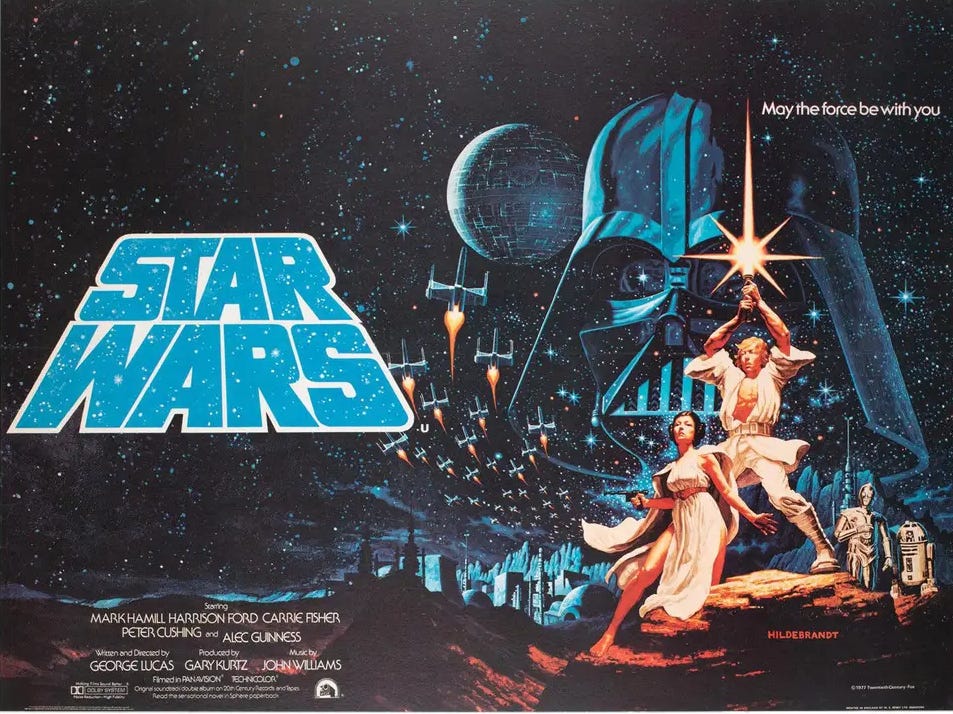
Francesco Cappellini uncovers the timeless symbols and archetypes that transformed the original Star Wars Trilogy into a cinematic landmark.
This is an excerpt from the recently released Italian book La Trilogia di Star Wars (1977-1983). L’opera che ha rivoluzionato la fantascienza (The Star Wars Trilogy (1977–1983): The Work That Revolutionized Science Fiction).
An adventure unlike anything that has ever happened on your planet. The story of a boy, a girl, and an entire universe. A great, breathtaking space saga of rebellion and love. A spectacle years ahead of its time. An epic of heroes, villains, and strange beings from a thousand different worlds...
(from the Italian theatrical trailer for Star Wars, 1977)
The Star Wars Trilogy is, without question, one of the defining works of science-fiction cinema, one of those rare creations that leaves an indelible mark on the history of an entire genre. Whenever science-fiction films are discussed—particularly space operas—the first image that often comes to mind is likely to be the endless sands of the desert planet Tatooine, the vast frozen wastelands where the Rebel Alliance establishes its base in The Empire Strikes Back, or the countless space battles between Rebel starfighters and the Imperial fleet.
Whether one loves it or not, every science-fiction film made since 1977—the year Star Wars first appeared in theaters—has had to reckon with this saga and measure itself against it. The Trilogy has become so emblematic of science fiction, and especially of the space-opera subgenre, that comparison is almost unavoidable. More often than not, it is an unforgiving comparison, for matching a saga that has come to symbolize science-fiction cinema itself is an extraordinarily difficult task.
Moreover, unlike many works that achieve recognition only years—or even decades—after their release, Star Wars became a cultural phenomenon almost immediately. From its very first theatrical run, the universe imagined by the visionary George Lucas captivated millions of viewers around the world, an achievement that is remarkable not only for a science-fiction film but for cinema in general.
Yet it could hardly have been otherwise. This is what happens when a filmmaker—or an author, as in the case of J. R. R. Tolkien’s The Lord of the Rings, a work to which we shall frequently return—creates something that does more than simply tell a story. It gives birth to an entire imaginative world, rich in symbolism and suggestion. And it accomplishes this without inventing anything in an absolute sense. Instead, it draws upon elements and symbols—many of them ancient—that are deeply embedded in human nature, in our history and identity, even if modern society has obscured them and relegated them to the furthest reaches of our collective unconscious.
The Trilogy is not merely populated by robots, laser weapons, and starships. Interesting though these may be, they are hardly unique within science fiction, nor are they what makes Star Wars so compelling. Its true appeal lies elsewhere.
One of the work’s greatest strengths is the story it tells, and above all the way Lucas originally chose to tell it. He deliberately shaped his narrative according to the patterns of mythology and epic literature, placing it within the sweeping and inherently captivating setting of a galactic civil war.
The first significant element is therefore the myth of the hero: a protagonist of humble origins who is, in some way, destined for greatness. After losing everything, he abandons his former life to embrace his fate and undertake extraordinary deeds. The films are also filled with recurring echoes of classical antiquity and the Middle Ages, populated by princesses and emperors, while the archetype of the knight—embodied above all by the Jedi Knights, but also by the dark knight Darth Vader—forms one of the central pillars of the entire Trilogy. There is also a ruthless, mysterious, and deeply fascinating antagonist whose development—from an unquestionable supervillain in the first film to his ultimate redemption in the final chapter—keeps audiences enthralled, not least because of the increasingly profound connections to the protagonists that are gradually revealed as the story unfolds.
Another striking feature is the spiritual dimension, something rather unusual in films of this genre. Although expressed in different ways throughout the three films, spirituality runs as a common thread through the entire Trilogy. It is explored through the concept of the Force, one of the saga’s defining elements. Eastern philosophies leave their mark on the religion of the Jedi, while Japanese samurai traditions inspire their style of combat. There is also the allure of the unknown and the spirit of adventure, evoked through bizarre alien beings and wild, inhospitable worlds.
Finally, there is the Trilogy’s unique relationship with nature. Every setting is permeated by the natural world, which often takes precedence over technology—another uncommon feature in science-fiction cinema, though not an entirely unique one. The fantastical and exotic worlds Lucas presents are always rooted in real-world counterparts. Indeed, much of the Trilogy’s enduring fascination stems precisely from these connections with reality. Its characters and landscapes may be distant from us in both time and space, but never so distant that viewers cannot recognize themselves in what they see on the screen.
Thus, in the deserts of Tatooine we glimpse the sands of ancient Egypt and the mysterious Middle East; in the frozen plains of Hoth we recognize the snowy expanses of Scandinavia or the Himalayas; and in the forest moon of Endor we encounter the primordial forests of Europe. And in Luke Skywalker we see the heroes of every myth and tradition that have come down to us through the ages.
Like every true creator of worlds, Lucas built his masterpiece not by inventing everything from scratch, but by skillfully reworking elements drawn from reality while ensuring that his fictional universe always remained firmly connected to it. Admittedly, not every one of the elements discussed thus far is developed equally across all three films. Some become noticeably weaker, especially in the third and final installment, which is decidedly less accomplished than its predecessors in several respects. Yet this does nothing to diminish either the Trilogy’s overall enchantment or the extraordinary contribution it has made to world cinema.
Turning to the origins of the work itself, the story begins to take shape during the second half of the 1970s, when a young Californian filmmaker named George Lucas, with only a couple of films to his credit and a lifelong passion for the science-fiction serials of the 1930s and 1940s, unsuccessfully attempted to acquire the rights to Flash Gordon. Unable to do so, he decided instead to write a film of his own that would capture the same spirit. The result was Star Wars, a film in which the influence of Flash Gordon-style science fiction—as we have already noted and shall examine more closely later—would be joined by many other sources of inspiration.
Released in May 1977 with relatively modest expectations, the film’s overwhelming and unexpected success soon prompted George Lucas to rethink his creation as part of a much larger work, of which Star Wars would constitute only the opening chapter. Thus the Trilogy was born, continuing in 1980 with The Empire Strikes Back and reaching its conclusion in 1983 with Return of the Jedi.
The imagery Lucas created proved so powerful that, over the years, it inspired an enormous body of additional works—novels, comic books, video games, and countless other creations—that expanded, and at times distorted, the universe he had originally imagined. Although Lucas had already expressed, as early as 1980, his intention to produce prequels, it nevertheless appeared for many years that the cinematic story of the saga had come to its definitive end with Return of the Jedi. Then, toward the close of the 1990s, the director surprised everyone by announcing that he was once again at work on new films.
Until the release of the first prequel in 1999, the films produced between 1977 and 1983 were never truly perceived by audiences as merely one part of a larger narrative. This remained true despite Lucas’s controversial decision to alter the chronology of the saga midway through its development by adding the subtitle “Episode V” to the opening crawl of The Empire Strikes Back, a move that left many viewers bewildered at the time.
The three films constituted, in every meaningful sense, a complete narrative arc. It began with Star Wars, continued through The Empire Strikes Back, and reached a satisfying conclusion with Return of the Jedi, leaving no significant threads unresolved and giving audiences no sense that they needed to know what had happened before the events depicted on screen. It was a complete story: the tale of the young Luke Skywalker, who rose from being a humble farmer on one of the galaxy’s most remote planets to becoming a Jedi Knight through a profound journey of personal and spiritual growth, all set against the backdrop of an epic galactic civil war. In other words, it was the quintessential coming-of-age story.
The essential point, however, is not merely that the story required no additions. The more important fact is that, for nearly twenty years, it was a complete story in its own right. Those of us who were born in the 1980s and grew up with the Star Wars Trilogy find it virtually impossible to reinterpret it retrospectively as merely one chapter within a larger saga. To do so would be to embrace a revision that fundamentally alters its original nature.
Nor is it my intention—at least not here—to dwell on what I consider the unfortunate decision Lucas made many years later to reshape the saga after the Trilogy had already reached its conclusion in 1983. It is enough to observe that, if Lucas believed he had the right to alter a story beloved by millions by introducing, decades later, elements that move in a completely different—and sometimes even opposite—direction from the spirit of the original Trilogy, then we as viewers have an equal right to disregard those revisions and continue to regard the three films released between 1977 and 1983 for what they were for so many years: a fully self-contained and independent saga
(Translated from the Italian)