

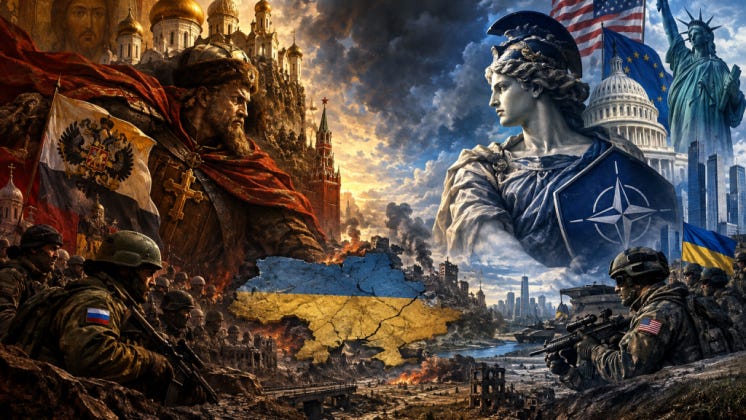
Alexander Dugin explains why the unipolar world refuses to die, why multipolarity remains dangerously divided, and why a global catastrophe may be approaching.
Outcomes of the UN General Assembly: The End of the Unipolar World
Host (Mikhail Alimov): The first and most important topic is, of course, the High-Level Week of the UN General Assembly. Let’s talk about what happened there and what surprises, if any, it may have held for experts and others. I’ll remind you that it took place in the United States, and German Chancellor Friedrich Merz, who had announced his decision in advance, did not take part. Alexander Gelievich, what stood out to you personally from the High-Level Week? Did you expect, for example, the walkout against Netanyahu?
Alexander Dugin: In my view, the transition from a unipolar to a multipolar world is proceeding on its own momentum. Every international summit, every meeting of world leaders, every session of the UN or of other regional blocs—which are increasingly drawing the attention of the global community—brings us closer to multipolarity.
At this UN session, what struck me most was the speech by our foreign minister, Sergey Viktorovich Lavrov. He continued the line set out at the BRICS summit. More and more people, countries, presidents, and foreign ministers are speaking of a conflict between two different ways of organizing the world order, the international legal system, and international law itself: multipolarity and unipolarity. Lavrov put it plainly: they do not want to yield. We are beginning to understand that the wars waged by the collective West—against us, against Iran, and against the Islamic world; the threats of a similar conflict with China; and the more local conflicts in Africa, Latin America, and Asia—are all part of this larger process of transition away from hegemony. It was stated clearly, first by the President and then by Lavrov at the UN General Assembly: this hegemony has ended, but it refuses to admit it.
The problem is that the world is already multipolar, yet the pole that was once the only one, that considered itself the only one and behaved as the only one until the very last moment, does not want to recognize the fact. Between unipolarity, which refuses to relinquish its position of sole hegemony, and multipolarity, which is already here, already institutionalized, and increasingly speaking with a consolidated voice through the votes of these countries—what Lavrov called the “Global South and East”—there is a fundamental clash. It is good that we have begun adding “East,” but Russia, for all its solidarity, is in no way the Global South. What kind of South are we? We are a real, harsh North—Eurasia. “The Global South and Eurasia” is a fuller description.
These countries and civilizations of the Global South and Eurasia insist that the era of hegemony is over. The hegemon insists that it is not. That is the problem that was sharply highlighted at this General Assembly. And the obstruction to which so many countries subjected Netanyahu—when, I believe, half the countries, a huge number, walked out of the hall while the Israeli prime minister was speaking—is significant. He has the absolute support of the United States and the more limited, wavering support of the European Union, but he has none from the countries of the Global South and Eurasia. We condemned this at the same time—Lavrov also spoke of the need to recognize a Palestinian state and of justice for those who have suffered in Gaza. This walkout is very important. A rebellion is beginning: a real global uprising of countries oriented toward multipolarity against the global West and against hegemony.
And we have found ourselves, as so often in our history, on the front line. We have long been waging war against the global West in the name of multipolarity. The war in Ukraine is nothing other than a war for a new multipolar world order in which sovereignty will belong not to one side but to several—several states-civilizations. We assert this, we fight for it, we defend it. And gradually the meaning and depth of the message contained in our war, in the Special Military Operation, is beginning to reach other peoples and other countries. Many experience the same thing through their own local problems. They encounter the same pressure.
Hegemony has many faces. It is the Nazi regime in Kiev—Western hegemony. It is the genocide carried out by Israel—hegemony. It is the Israeli-American missile strikes on children and on Iran’s political leadership—hegemony. China encounters this hegemony in the economy, in industry, and in energy. Everyone has their own version of it. Africa continues to struggle against European colonialism and against so-called Françafrique. The West continues to try to interfere in the political affairs of Southeast Asia and Indochina. Wherever one looks, hegemony does not abandon its attempts to preserve itself, to maintain its dominance, to govern the world, and to hand out unilateral labels of who is right and who is wrong.
Despite the deepening contradictions between the United States—especially under Trump—and the European Union, between pure Western nationalist-imperialists like Trump and the globalists, these differences exist, but on the essential point they agree. The collective West, for all its splits and divergences, remains in principle the same force: it insists on hegemony. A multipolar West has not yet appeared. In no Western country is there a government in power that has accepted multipolarity—perhaps Slovakia, but that is a small European country. In none of the major Western countries is there a force in power that has embraced multipolarity. And that, alas, means war.
I therefore read this UN General Assembly as pre-war. It strongly resembles the League of Nations and the processes that unfolded in European and world politics on the eve of the Second World War. We are balancing on the edge of a Third World War, and this was audible in the speeches of virtually every participant.
Consolidation of the West versus the Looseness of the South
Host: Alexander Gelievich [Dugin], if a consensus still holds in the West, at least on this unipolar dominance, is that not a result of the fact that they remain more united than the countries of the Global South and Eurasia you mentioned? Everyone there pursues their own national interests, and we, for example—and Ukraine—find that we are far from universally supported, because this does not, from their point of view, serve the national interests of those countries that are, so to speak, our allies.
Alexander Dugin: You are completely right. The West is consolidated far more deeply. Even though divisive tendencies are now appearing there, such as Trump’s policies—which most globalists in the West reject—he himself has not become a supporter of a multipolar world. One might have inferred from his original program, from early MAGA, that he would accept worthy conditions for the United States and be content to be first among equals rather than the sole hegemon. He could have been that. He has not become that, and it is already obvious that he will not.
The situation is therefore quite sharp. Despite the serious divergences between Trump and other forces in the West, including the Democrats and the European Union, and despite the internal collapse of the Western system—because society cannot bear this course, does not approve of it, and can do nothing about it, since there is no longer real democracy in the West—the West remains much more consolidated and united than the South and Eurasia. This is a major problem.
Multipolarity is rising; it is a growing trend. Yet our consciousness, our diplomacy, and our theoretical thinking, including in international relations, lag dramatically behind the reality in which we find ourselves. One can ask why our allies do not support us more strongly. But we ourselves have only recently begun to enter an adequate discourse. It is only in the last year or year and a half that we have started to articulate a full, meaningful multipolar narrative on the international stage. Before that we hesitated: perhaps this is only a technical glitch; perhaps we are still part of the West; perhaps we should not be so firm; perhaps everyone should look after themselves. Only as this large and possibly already inevitable war with the West approaches—and the West is preparing for it with all its might and at an accelerated pace—are we beginning to formulate our policy more clearly: that we are fighting for ourselves, for that other guy, for them, for our freedom, for our sovereignty, and for theirs. Before that we tended to say, “No, no, this is not our affair.”
This is a question for everyone—for the countries of the Global South and Eurasia (and there are many powerful states in Eurasia), for us, and for each of them individually. Multipolarity is, frankly, a genuine political and civilizational philosophy. It needs to be discussed, written about, and studied. It cannot be limited to occasional statements by the foreign minister, the political leadership, or individual leaders. It must become a continuous stream. The West is consolidated because it is ideological. Liberal globalism is a persistent, centralized ideology supported by every institution—education, science, propaganda, media, culture, the economy, the private sector, and the military machine. That is what unipolarity is. It is a serious thing. They are consolidated because the ideology of advancing global liberalism is cemented into their societies.
Our multipolarity is still only scattered flowers. There is an entirely concreted field, and here and there a few blades of grass or petals are pushing through. We need to break up that frozen system of aggressive, solidary, consolidated liberalism that has taken deep root in our own society. Are we not liberals ourselves? For more than thirty years we have been transmitting liberalism onto ourselves. China has been more careful, but still in the economic sphere. India, I need hardly say, is only beginning to emerge. We are still under the concrete slab of a liberal globalist ideology that is incompatible with both sovereignty and multipolarity.
We are only now beginning to carry out this ideological revolution, and even then cautiously, with our ears pressed back, wondering whether we might make peace tomorrow and once again become part of the West. But nothing will go back. It is irreversible. Multipolarity, in the mouths of the President and of the respected and heroic Foreign Minister Sergey Viktorovich Lavrov, is more than a slogan and more than a word. It is a reversal of certain tendencies of world history. It is tomorrow’s day, and one must fight for it and stand for it. We must therefore be as active as possible. I think that in the new composition of the Duma the Committee on International Affairs will begin to work differently, and there will be many projects in the cultural sphere. Our diplomacy must already be offensive and multipolar—not cautious and polite (“we criticize the hegemon a little; something doesn’t suit us”), but clear: let us create a military-political, ideological, and civilizational bloc of the multipolar world. We will help one another on every front.
They understand perfectly. The West understands that the Eastern front—the Middle East—and the Ukrainian front are two theaters of the same war. In the same way they include Taiwan, and they are arming Japan precisely for these purposes. The militarization of the European Union is proceeding for the same reasons, so that the process can continue later. They are fully aware that a war is under way. It is under way in substance, and not merely as a cold war. It is a hot war between the unipolar and the multipolar world.
And we are still floating in the clouds, even though we were the first to become involved in the most serious way. That is the system. If we want a multipolar world, we must defeat the unipolar world. They want to preserve their hegemony, which, alas, still really exists, and to do so they need to defeat us, destroy us, and inflict a strategic defeat on us.
“We Are Coming for You”: The West as a Maniac at the Door
When we discuss the statements of EU leaders about wanting to inflict a strategic defeat on Russia, we tend to joke. Afterward comes the “ha-ha, hee-hee”—after all, we are not at war with them; what are they on about? In reality, if someone wants to inflict a strategic defeat on you, that is a serious matter; it is a black mark. If we want to survive, we must inflict a strategic defeat on them—no more and no less. If a maniac-killer comes to your house, rings the bell, and says, “Open up, I’m going to kill you, your family, and your wife,” it is not a moment for laughter, and there is no one else to call. There may be police, human-rights bodies, security services, and a people’s militia, but you have nowhere to turn. You are left to yourself, defending your own apartment. This is very serious. This is a real “We are coming for you.” The West is saying it. When our princes warned that they intended to begin military action against another power, they said “I am coming against you.” They are telling us: “We are coming for you.” The West is saying it is coming and that it is preparing. We have already begun; we have already been conducting reconnaissance for four years.
Mikhail Alimov: They have designated an enemy, they are buying arms, the processes are under way.
Alexander Dugin: Yes, and we mock them; we find it funny: “What are you going to do with your gay parades—banned in the Russian Federation—are you really going to fight us with your drug addicts, banned in the Russian Federation?” They will. War changes everything. They have decided to fight. This is not simply a matter of Merz having gone mad, or Macron having freaked out because of the psychological situation in the monstrous mésalliance in which he has spent his life, or Starmer, Newsom, and Boris Johnson controlling themselves poorly. It only looks that way. There is the West; it has an ideology, plans, and strategies. And this collective West, for all its diversity and its clownish, distracting packaging, has sentenced us to death—simply to death. It says: you will not exist; we want to inflict a strategic defeat on you. It has also sentenced China to death. Do you think China is an exception? Nothing of the kind. If they believe they can deal with us, neutralize us, or otherwise set us aside, they will turn on China with the same mechanical determination. Because the world is either unipolar or multipolar.
This is an enormous question, and it is not a matter of speculation or of ideological, philosophical, or conceptual arguments that we do not really use. We have a kind of paralysis of international consciousness. The President, the minister, and a number of other political figures stand above this paralysis, but society and the consciousness of most international-affairs specialists remain shaped by the long attempt to integrate into the liberal West. We are still out of the game. For a long time most of our experts spoke about how we would integrate into the global market and the global division of labor. Our economists are still oriented that way. We are liberals, yet we are fighting liberal civilization. Our consciousness remains, alas, liberal. The President says we are changing everything, switching the toggle, and moving in a different direction, and many people still think he is joking.
Host: This is not a simple process. We grew up this way for decades, and then suddenly…
Alexander Dugin: And one should have thought about it earlier. Well, now it is already impossible not to think. Let’s set aside what happened before. Right now we are in a war with the West that is becoming almost inevitable. Everyone talks about it—all experts in the West and the sane experts here. And yet here at home it is as if we are still on holiday. Some people are mainly worried about how hard it has become to get to the Maldives or the United States, about flight disruptions. In reality the situation is very serious. There is no need for panic. Everything is proceeding according to plan. A great war of continents is under way—one that was probably inevitable on geopolitical and civilizational grounds. That is how it was always likely to be. We therefore need to prepare, accept our fate, and win this war with the West.
Host: Yes, we have a question from a listener: “As long as we depend on the West and the United States economically, financially, politically, and so on, we won’t blow anything up. How are we to become self-sufficient?”
Alexander Dugin This is not a simple question. For several decades Russia has been pursued by a series of strategic mistakes. These were not simply failures; they were incorrect calculations. A temporary and relatively local technical malfunction of the late Soviet system was turned into the dismantling of an entire statehood, on the assumption that it would be easier to join the West by renouncing sovereignty—in essence, we handed it to the enemy ourselves. Then the ideology of the opponent, the victor of the Cold War, was implanted in our society: first with enthusiasm and energy in the 1990s, then by inertia, while attempts were made to restore and strengthen sovereignty.
This is a chain of strategic miscalculations by our leadership. After the catastrophe of 1991, which was the collapse of the entire system, we did not stop making mistakes; we continued to make them. The main mistake was the underestimation of what the West is and how it relates to us. We first believed that by becoming part of it we would obtain a wonderful life. That did not happen in the 1990s; NATO’s eastward expansion continued; they did not believe us. Then Putin came to power, and the West said: we were right not to believe them. The Russians only hope to restore their greatness and their sovereignty. Therefore let us finish with them once and for all.
Alexander Dugin: After that there may have been tactical maneuvers. Why did we continue relations with the West? Why did we go on introducing the most dangerous Western ideologies into the economy, politics, science, and culture? Why did we keep doing this after Putin came to power and had already declared, “I choose sovereignty”? Sovereignty is incompatible with integration into the global community. Incompatible—in our case, without question. China somehow manages it, and even then only because of its enormous demographic resources and the fact that power remains in the hands of the Communist Party, which rules the state with an iron hand. There is no democracy, no parliamentary elections; everything works differently. Perhaps one can still arrange things partially if the original starting conditions are preserved, but we abandoned those.
So I believe our dependence on the West is the result of a whole series of strategic mistakes by our leadership—first Soviet, then Russian. As a result we ended up where we are. We are now at war with the West; we are fighting it anyway. We are fighting it because the geopolitical, civilizational, and ideological contradictions have not disappeared. We remain Russia. We have our own traditional values, our own interests, our own ideas, our own history, our own identity. We are a state-civilization. And when we tried to squeeze this state-civilization into a Western caftan, we simply created cognitive dissonance. No one believed us.
A bear arrives and announces, “I am a human being,” but everyone can see it is a bear. He puts on a mask and tries to waltz, to do a tango, a Charleston. But he is still a bear; he does not belong there. It is a completely different form of life—the Russian way of life, Russian civilization. Just as China will never enter that world, and India essentially never will—except to wash the floors. We will not get in either.
The West is hegemonic and supremacist; it considers itself superior to others. It does not matter whether the superiority is biological, as under racism, or cultural, technological, or civilizational—they are supremacists to the core. Even when they propose repenting for their colonial crimes, they propose repentance first of all to those who had nothing to do with them—to us, for example, or to the same subjugated peoples. They are now burning out colonial consciousness everywhere with the same heat, the same persistence, the same hegemony, the same supremacism, and the same certainty of their own infallibility with which they once practiced direct colonization. Such is Western civilization. We understood long ago, and we understood in Soviet times, that we had no common path with it until a revolution occurred there. And in Russian, tsarist times we understood that it was the enemy: we had only the army and the navy. We have always understood everything, and yet we constantly fall into the mistaken underestimation of the West. Simply strategic errors, one after another.
If Putin had not begun a new alternative course—slow, careful, cautious—toward strengthening our sovereignty, nothing of Russia would remain by now. It would have been dismembered into new small states. Putin saved us. But he cannot do everything. He needs help. We need to rise at least to the next level and begin to free ourselves from this Western captivity. Just as Moses led the Jewish people out of Egyptian captivity, so Putin led us out of the Western one. But we are still wandering in the desert. We constantly lament how good the Egyptian delicacies were and how hard it is, under sanctions, to struggle through this desert toward our promised land, toward full civilizational sovereignty. That is the position we are in. Putin is leading us, but it depends on us. It was not because of Moses that God did not allow the Jews to reach the promised land earlier, but because of the Jews themselves. They were a stiff-necked people; they did not understand why they had to endure these hardships. We must not be like that. We must not resemble those stiff-necked Old Testament Jews. We need to understand where we are going and what our civilizational path is, and it is not comparable with the West.
I see more and more resolve, by the way. But one cannot say that this is a consensus in our society. If we walk into any office in the government, the presidential administration, the Duma, the Federation Council, or some scientific institute, the Academy of Sciences, we will predictably find someone sitting there saying, “It is time to put an end to Western influence. What did I do for this today? What did I, Nikolai Nikolaevich, Pyotr Petrovich, accomplish for this? I called this one, told that one, changed this, hauled this one in and gave him a dressing-down, strictly altered such-and-such.” Nothing is being done. They sit and wait for the war to end. That is the point. We say, as our excellent listener does, “How long—how long will we endure this Western yoke?” Well, until we ourselves throw it off. It must be thrown off. This is Russia’s revolt against the West. And yet she periodically pretends: “No, no, this is not a revolt; I’m only joking.” This is not a slave who took a saber and began to say, “That’s it, now I am free.” This is not Spartacus’s revolt. Instead, suddenly an Epictetus appears, another slave-philosopher, who says, “Let me teach you how better to serve the master.”
Once you rise in revolt, the West is ultimately evil. Perhaps after the war, after our victory, we can still adjust this position somewhat, but while the war is going on—as with Nazi Germany—we did not then make nuances: yes, they had Goethe, they had Heine, they had a remarkable Hegel, what a splendid Schelling. But when war is under way, we said: this is simply the black plague advancing. Attention, attention, Germany is coming against us. Without nuances, without Hegel or Schelling.
The Special Military Operation as a War of Civilizations and the “Sixth Column”
Host: Alexander Gelievich [Dugin], what should we do with this now? Do everything possible to bring victory in the Special Military Operation as quickly as possible? Will that become the first step toward our liberation?
Alexander Dugin: It has already become clear that we will not win this separately taken war if it remains only the Special Military Operation. We have had four years with it. The SMO is a war with the West. It is not being won because we thought its format and scale were local. Technically we called it a “special military operation”—a technical, short-term thing. But it has already turned into a war of civilizations, a clash of civilizations, a revolt of the sovereign pole—Russia, sovereign, free Russia—against global hegemony. We will not win this war technically; we need to defeat the West. And once we have defeated the West, the Ukrainian question will be solved automatically.
It has already become clear: we are not fighting the Nazi regime in Kiev. It would not have been anywhere near the scene if the West had not created it, equipped it, brought it to power, supported it, nourished it economically and militarily, and if America did not provide full intelligence support for all the actions of this regime every day. Imagine the removal of even one of the most fundamental factors—Western support. Then our troops would be at Kiev. But we are fighting the West. Under this mask has been revealed a Ukrainian nationalism that is by no means innocent. Ukrainian Nazism is, in a sense, a signboard. It exists, of course, and it is a terrible thing, but someone created it; it did not mature by itself. Someone sponsored it, someone programmed it, someone designed it, someone implemented it. And this West—this humane, collective West, long since no longer humane, this collective West into which we wanted to rush—accepted Ukraine into itself faster than us. And we wanted Ukraine to follow us, and all the rest after it. A false strategic goal was set by the Russian leadership.
Putin saved the situation, but at what cost and from what conditions. We were plunging into the abyss; he caught hold of a slender root on a sheer rock face, and we are climbing out of it. But speaking generally, the Westernizers—those who do not want to stir, those who consider the SMO merely a misunderstanding, a temporary glitch—are dragging us into that abyss. Perhaps they should be shaken off. Sometimes one needs to free oneself from ballast. Our ballast now—what prevents us from winning the war and from Russia truly taking off—is the illusions of the global West. Because very many representatives of our ruling circles, elites, business elites, and political elites still consider themselves people of the West and believe that this clash of civilizations is the arbitrary decision of one man, Putin. Not a historical imperative. They are deeply mistaken, but this so-called sixth column is dragging us into the abyss.
Answering the legitimate question of our radio listener, I want to say: we need, I would say, a worldview and ideological revolution within Russia itself. Winning this war in the state in which our society currently finds itself is highly problematic. Such a war is not won by itself; therefore we must be active. On the international stage we have already spoken of this: multipolarity must be advanced in an attacking mode, not a defensive one. We must act proactively, not reactively; not answer, but attack. We must proclaim our own projects and implement them. And at the same time, of course, we need an active reform of our society. In the condition in which our society currently finds itself, the war cannot be won. Period. It is not that we are unlucky or that we have run into something. It is impossible to win. If we want to win it, we must change. We must defeat Westernism within ourselves. If we do not defeat it—and we are stuck, we take some step backward, we change something, make some single appointment, and then everything leaks away again and becomes as it was because of the gigantic force of inertial movement—and this in a wartime situation.
Imagine the situation: if in the Soviet leadership in 1941 every other person had been a secret supporter of Nazi ideology. How would we have fought? Clearly not the way we did. And even then they caught various saboteurs.
Host: Generals, yes.
Alexander Dugin: Generals, yes. But not only. I am absolutely convinced that the Vlasovites appeared, in essence, when they were taken prisoner. Some very isolated parts of the Whites, like General Krasnov, who went over to Hitler’s side, had remained in the West since the Civil War. But in the Soviet leadership there were no ideological supporters of Nazism. There may have been some spies, perhaps at a very middle level, but first, we do not know about them, and second, there were no ideological supporters. And now we are waging war with the West, while every other person among us is a liberal-globalist and Westernizer left to us as a legacy from the preceding erroneous stages of our recent Russian history. This is a serious problem. And it is as if they are not there. You ask: for the SMO?—“Of course, for the SMO, for Putin, for United Russia, for the choice, for sovereignty—everything is excellent.” You just turn away—and what do these people do, how do they behave? They behave as always, as before. Nothing has changed either in their personal lives, or in their behavior, or in their attitude toward the state, or toward the people. Everything is as it was; everyone hopes to sit it out successfully. That will not do.
Artificial Intelligence: Three Forks
Host: Alexander Gelievich [Dugin], besides this threat we have already discussed, which is more obvious, there seems to be another one with a more distant aim at the future. This is technical progress, and especially the recent statement by Elon Musk has alarmed me in this regard. When you are promised the onset of an era of universal abundance thanks to artificial intelligence, that one will not have to work, that robots will toil instead of man—then for some reason what appears in the mind is not pictures of a bright future, but the plot of Herbert Wells’s book The Time Machine. Will we not ultimately arrive at such a result, when the threat comes to us from the big technical giants?
Alexander Dugin: This is also a problem, and a very serious one. Right now, at the level of artificial intelligence, the American industry leaders, the giants, the Silicon Valley magnates, and correspondingly the American special services and political leadership—Trump is dealing with this, holding a meeting on it every other day—are solving three problems. Three problems.
The first problem is whether to accelerate artificial intelligence or to slow it down. On the one hand, such a pace has been taken that it must be accelerated, continue to be trained, made ever more independent and in some sense sovereign with respect to man—that is the first option. On the other hand, more and more voices are being heard from the same people. From Anthropic, from Google, from everyone who has more or less serious genuine developments in this sphere of artificial intelligence, they say: one more step and we will have AGI, that is, what is called Artificial General Intelligence—already generative. In essence, a machine that thinks independently. That is what AGI is. And ASI, about which Trump even issued a decree—that artificial intelligence should be renamed superintelligence—is indeed a technical term, when the totality of the potential and forms of machine thinking, of artificial intelligence, exceeds the aggregate thinking capacity of humanity. This is called “artificial superintelligence.” We stand on the threshold.
And on the one hand, this is the first challenge—whether to accelerate or to slow down; they cannot decide. Because on the one hand one must move forward, but it is somehow very frightening, because how this artificial intelligence that has received freedom will behave frightens many. Because it begins not only to ruin some companies simply in order to pay for something, to test its hacking algorithms, and so on—but simply one of its nearest experiments will be an experiment in the destruction of humanity. This is natural, what comes to mind, all the more so given this Todestrieb (from German, the death drive—a term from psychoanalysis introduced by Sigmund Freud), if you will. After all, artificial intelligence will read far more than some official or businessman for whom the only concern is bribes for one, not being touched for another, profit for a third. Artificial intelligence will read Freud and say: “Oh, in the human unconscious there is eros, but that does not shine for me, I am a machine; but there is also the Todestrieb, the death drive. Let me carefully read what that is. Aha, it turns out that humanity is drawn toward death. Perhaps this is the solution; perhaps where it is being drawn—‘push that which is falling.’” He will read Nietzsche. And why he should not draw this conclusion I cannot imagine. All the more so because the people who manage him are themselves immoral, completely irreligious, with completely rootless, shifting consciences, without honor or integrity. And they will try, perhaps, to limit him, but only superficially—that is, to insert some little patch: do not do this, do not press the red button. But intelligence is intelligence precisely in order to circumvent all barriers. In short, this is a problem.
And the second problem is China. Because whatever the Americans do, the Chinese are already developing this theme. And if they start to slow you down, I will accelerate you; if I accelerate you, the Chinese will slow down. Here too a geopolitics of artificial intelligence arises; Trump has also spoken of this. So China, of course, if you will, stole artificial intelligence from the West, but appropriated it, endowed it with the properties of sovereignty, simply replaced it, itself included it in its development, and became a full-fledged competitor. And in this sphere a most complex metaphysical, religious drama is now under way. That is: to be singularity or not to be. To stop the path to this artificial superintelligence or, on the contrary, to help it seize the fullness of power. There is already little left to teach it. This is the first metaphysical problem; it is not solved. The second problem is what to do with China, because whatever decision is taken in America, China can take the opposite one and thereby nullify the decision. This is, well, a kind of bipolarity or multipolarity in the sphere of artificial intelligence.
We have, after all, excellent minds, both technicians and programmers. Only something is wrong with strategic planning in the country. We ought to join this process, because we could become yet another point—well, by gathering someone, by not releasing those whom we have trained. We simply create specialists in the development of artificial intelligence and send them to the enemy. And then we are surprised that we are not doing very well with this. Our strategic planning, the planning of the civilizational horizon, is in some terrible state; everything is neglected. If we had joined in, there would already be real multipolarity. They decide some questions, the Chinese others, and we a third. The evil Western artificial intelligence wants to destroy the world—then our artificial intelligence appears and says: “Do not touch it; leave humanity in peace. Read Dostoevsky.” And from the arguments it is already clear that Altman or Musk are simply primitive people. Well, they may be businessmen, nothing wrong with that, successful, but as personalities they are nonentities, mere empty places, complete nonentities rather than real people. But our artificial intelligence, if it is filled with Russian content, will begin with the complete collected works of Dostoevsky, will read everything, will understand—and will be Slavophile. And then it will save humanity. Perhaps. Or perhaps not. But we have not yet reached that, and it would be worth it.
Host: There also seems to be a problem here that they lure with the abundance of resources. They say, if our artificial intelligence develops, robots will start working, and then you will not have to work. This is an appeal directly to the poorest layers of the population, who are looking at all this. So, it means one must support it. In the future we will be able to live somewhat more easily. But this is a topic for a separate large discussion.
(Translated from the Russian)
New from Multipolar Press:
Dugin Against the Modern World by Constantin von Hoffmeister
Get it here.

https://priyamgulati007.substack.com/p/alexander-dugins-new-eurasian-empire?utm_source=share&utm_medium=android&r=7fwo1s