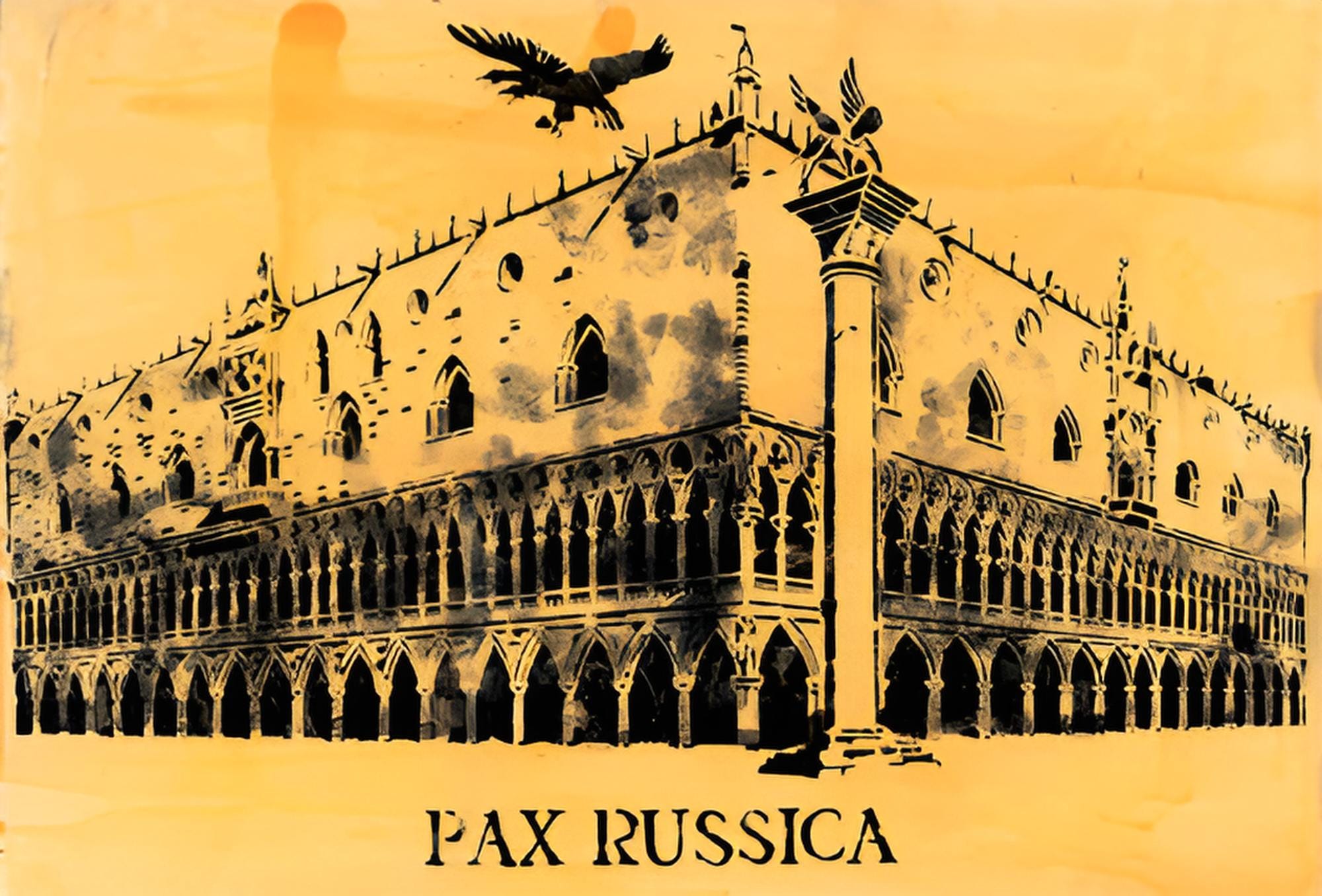
The Russian World and Pax Americana
by Leonid Savin
Leonid Savin on Pax Russica and the coming Eurasian order.
In modern Russian, the word mir has two meanings: (1) the space that surrounds us, i.e., the planet Earth; and (2) a state of calm and agreement. In political science, the Latin term Pax is often used, from which the English word “peace” derives. Most often, the word Pax is used together with an adjective—for example, the well-known expression Pax Britannica, which described the power of the British Empire and the existence of its colonies throughout the world. Pax Americana, that is, peace in the American style, emerged in the second half of the twentieth century, when Britain, for a number of reasons, could no longer maintain its global dominance, and its colonies began to break away en masse in different parts of the world. However, in the classical Latin–Russian dictionary (edited by Dvoretsky), an expanded interpretation of the word Pax is given in relation to antiquity. There existed Pax Romana, which is described as “that part of the world pacified by Roman conquests, i.e., the Roman Empire.”
Thus, Pax is not merely a state of calm and agreement. First, it is the result of the actions of the political subject that establishes this Pax. This may be achieved through force of arms or persuasion, but “pacification” itself implies that it did not arise from the free will of those upon whom this order is imposed. Second, it has definite territorial contours. Pax Romana included the Mediterranean region, Gaul, and Britain, yet Scythia, Persia, and even more so distant India and China never came under Rome’s authority.
In the twenty-first century, different realities prevail. If someone cannot be “pacified” by military force, then economic instruments, cultural influence, and the services of third parties—whether supranational bodies or influential international organizations—will most likely be employed. Although Volodymyr Zelenskyy also constantly declares the need to establish peace, it is quite evident that this process has little to do with Ukraine itself, since it is not a sovereign subject. One could only with great reservation speak of a Pax Europaea since the principal actors in the negotiation process are Russia and the United States.
If a division of spheres of influence across the territory of Ukraine occurs, as was the case at the Potsdam Conference, then two world orders—the American and the Russian—would come into contact and possibly be separated by a buffer zone. This would resemble the bipolar era, although at that time the dividing line lay much farther to the west. The critical and immediate question here would be: where exactly would this dividing line run? Along administrative-territorial borders? Along the Dnieper (taking into account the withdrawal of Ukrainian armed forces from the occupied part of the Kherson region)? Or would Pax Russica extend significantly farther west, into the historical lands of the Russian world?
It must be emphasized that Pax Russica is something more than a zone of Moscow’s military and political control. It is also a cultural-historical space, a sphere of trade and economic activity, and the free, unimpeded activity of compatriots in other states. At the same time, from an etymological perspective, Russia is currently carrying out precisely a form of pacification by military means through the Special Military Operation.
On a broader geographical scale and within a long-term strategic perspective, the following nuance is important. As long as Pax Americana prevails in Europe (which is evident under the current configuration of the EU and NATO), Pax Russica will not be able to evolve into a Pax Eurasiatica, even with the active participation of other members of the EAEU (Eurasian Economic Union) and the involvement of India, China, and Iran, each with their own visions of Pax that could organically coexist within an Ordo Pluriversalis—a geopolitical multipolar order. Consequently, it is necessary to establish the proper groundwork (guarantees, fulfillment of demands, articulation of imperative positions) not only for the adequate realization of Pax Russica, but also for the creation of favorable conditions for a future Pax Eurasiatica, which clearly implies the disappearance of the transatlantic regime through which Pax Americana continues to exercise its hegemony over the western peninsula of Eurasia.
(Translated from the Russian)

