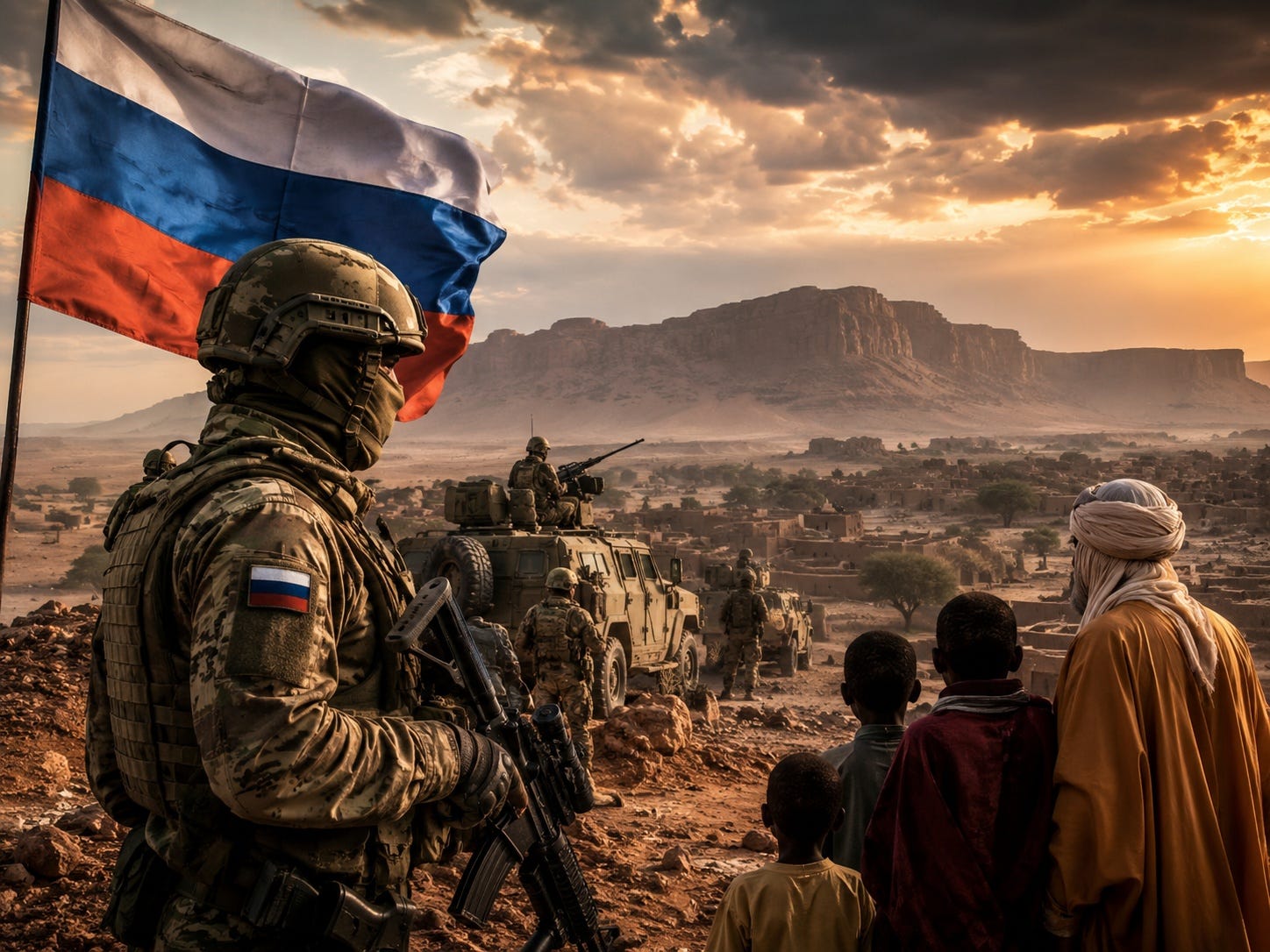
The Russian Bear’s Claw in Africa
Mali and the battle for the Sahel
Stanislav Krapivnik on why the struggle for Mali represents a wider contest for Africa’s future.
The military conflict in Ukraine has entered its fifth year, and people can be forgiven for forgetting, or misunderstanding, that this war is not really with Ukrainians, but with the Epstein elite of the West. They can also be forgiven for treating the battlefield in Ukraine as the battlefield of all wars and forgetting that this is a competition, a clash of civilizations, and that it is unfolding not only in Ukraine or the Persian Gulf, but across the entire world. Attention here turns to West-Central Africa, to the region called the Sahel. The Sahel is the dry steppe south of the Sahara and north of the jungles of Central Africa. It was the domain of the French Empire.
Many people learned in history textbooks how Western empires in Africa collapsed during the 1950s and 1960s, but for the French things unfolded differently. The French realized that if white French hands were replaced with black ones, an illusion of independence could be created while real power and control over these territories remained intact. This allowed France to continue maintaining its extensive economic system in Africa. Whenever any of these countries attempted to assert their independence, their French masters armed Islamists or simple looting gangs and sent them to overthrow rebellious governments. At times, the French themselves arrived to restore what they called “order.” This continued until Wagner, today’s African Corps, arrived in Africa. With their support, popular liberation revolutions expelled corrupt French handlers from power in several countries: Burkina Faso, Mali, the Central African Republic, and Niger.
Why is this important? One of our principal enemies, France, is losing critically important access to strategic resources such as gold and uranium, while new opportunities are opening for Russian business. The French economy is being undermined, while we are moving forward with projects that could lift these countries out of absolute poverty. People in other French “colonies” are watching and preparing. Yet this is hardly the moment for self-congratulation. Our enemies have been weakened, though they have not been defeated. And now the coalition of Satan—or Epstein’s coalition: the French and American intelligence agencies, and their Ukrainian proxies—assembled and trained an army of cutthroats to recapture Mali as a first step. Among these fighters were ISIS Islamists and Tuareg separatists. They were counting on a Syrian scenario, but things went wrong from the first day.
First, one must understand that the African Corps of the Russian Armed Forces is present in Mali. Yes, many of them are former Wagner personnel, but all of them are officially Russian soldiers. Second, unlike Syria, the Russians here are actively training and raising the professionalism of the Malian armed forces. When the fighting began, Russian troops became the core around which Mali’s defenders held their ground. They absorbed the enemy wave and broke it.
The cutthroats, accompanied by French and Ukrainian instructors and officers, attempted to seize the country through a blitzkrieg. More than twelve thousand of these beasts stormed into the country through the desert on motorcycles and light vehicles, mainly Toyota pickup trucks. The Japanese seem to enjoy selling their equipment to such killers. The north fell into their hands, though not without battles. The main city in the north contains the largest military base, Kidal. Kidal is also the capital of the Tuareg people. There, allied forces withdrew from the city to the base and maintained their defenses against endless waves of fighters until the Malian state reached an agreement with the separatists for a withdrawal. Individual strongpoints north and south of the city are still being held by the African Corps. Russian and Malian troops retreated to the city of Gao on the Niger River, where the only bridge stands, and there they established a defensive position.
Before the war began, groups of fighters managed to infiltrate the south and carried out attacks in Mali’s capital, Bamako. There they killed Defense Minister Sadio Camara and his family. They also hoped to break Malian President Assimi Goïta. Yet they miscalculated. Assad of Syria had been a dentist and came to power only because of his older brother’s death. Goïta had been a colonel who overthrew the corrupt French handlers and took leadership into his own hands. When the attack began, he put on body armor, picked up a rifle, and went to direct the defense himself.
For now, the advance of Western proxies has been halted. Every day, the aircraft and UAVs of the African Corps and Malian forces carry out hundreds of new strikes, while also supplying northern strongpoints that the fighters still have been unable to capture. Ground forces are clearing the south of the country of various armed groups and are beginning to push northward. The fighters themselves have shifted to raider-style tactics: raids and ambush attacks. The days of large-scale offensives and territorial seizures are over; they simply no longer have the strength for it. The African Corps, the backbone of the entire resistance against Western Satanists, held its ground. The enemy failed to break it.
Among our fellow citizens, there are those who question our presence there. These are the same people who often still “do not understand” why and for what we are fighting in Novorossiya. They have the same psychological blockage: “It’s none of my business.” By helping others, we gain new allies while also weakening enemies who are openly waging war against us in Ukraine.
(Translated from the Russian)


