

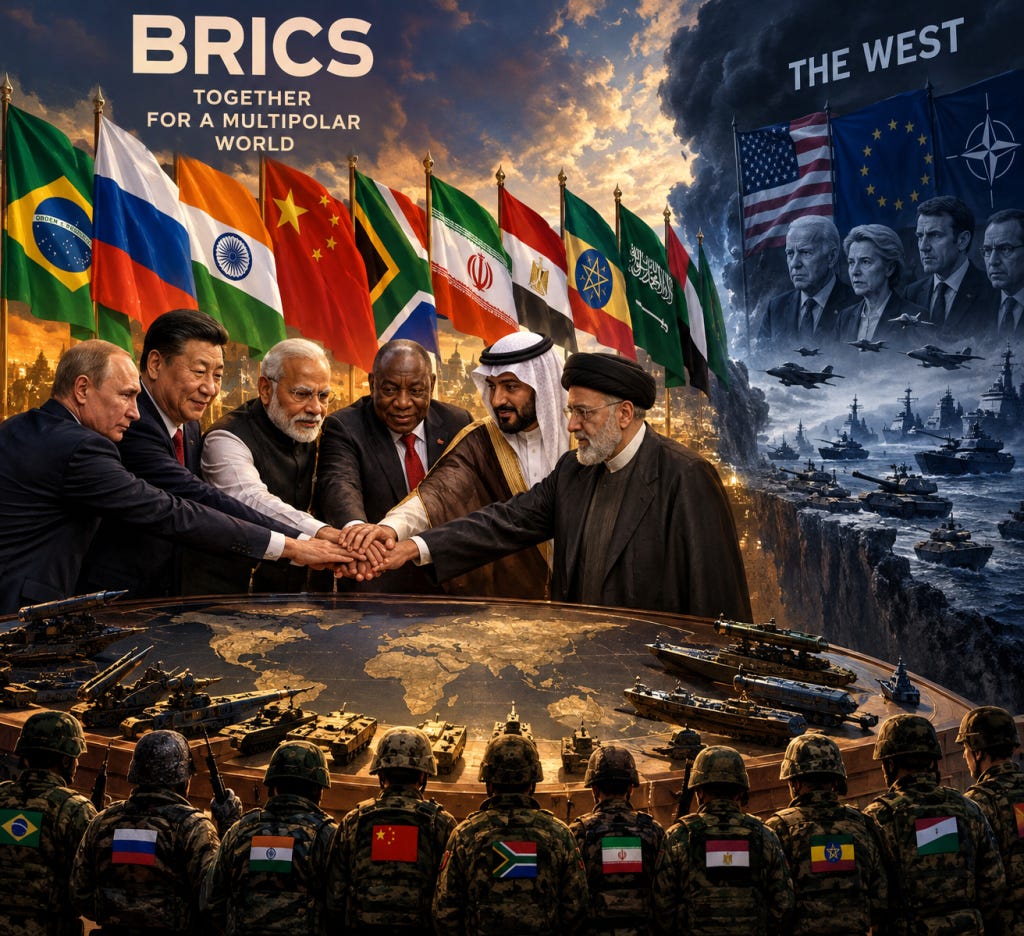
Alexander Dugin sees New Delhi as another turn towards multipolarity but warns that the game is not won: the West is splitting, yet it can still strike back, and only strategy will decide the ending.
Conversation with Alexander Dugin on the Sputnik TV program Escalation.
Host: The events in New Delhi are undoubtedly another stage in the tectonic shifts now underway on a global scale. The statements by the leaders of the three powers—who together represent half of humanity demographically and carry colossal economic weight—are of historic significance. Prime Minister Modi stated plainly that BRICS unity and consensus must be turned into tangible results on the world stage, meaning a profound reform of global governance. Less hard-line language had been expected from India than from Vladimir Putin or Xi Jinping, yet the thrust towards restructuring the system proved to be shared. At the same time, Vladimir Putin stressed that Russia consistently insists the United Nations must retain its central role in world geopolitics. Given all this, how should we now assess BRICS as a global actor, and what is its real role in the emerging world order?
Alexander Dugin: I have been developing the theory of the multipolar world and following the process of its formation for thirty years—already as a fully formed scholar and intellectual. Many of my books are devoted to this, including textbooks on multipolar theory translated into a wide range of languages, as well as a great many more recent works. I teach the theory of the multipolar world at MGIMO,1 and I began doing so at Moscow State University some fifteen or twenty years ago. For me, what is happening is an open book.
From the standpoint of theory, it is easy to see where particular tendencies originate, how they develop, and where they are headed. I can see both the end point we have not yet reached and the starting point from which we set out: the unipolar world, whose peak was unquestionably the 1990s, when the West felt itself to be the sole global player, the hegemon. That is what globalization meant: there was only the West and its periphery, and after the end of the Soviet Union, which had been the alternative pole, nothing else remained.
From that moment, after the collapse and geopolitical suicide of the Soviet Union, the unipolar model began to take shape. After Vladimir Putin came to power, Russia began to leave that architecture and move towards a multipolar world. Yevgeny Primakov already discerned the first hints of this in the late 1990s, which is essential for understanding the geopolitical future.2 Multipolarity then gradually came into view, especially with the rise of China and our own country’s persistence. In fact, it has already been described very thoroughly in theory. What we are moving towards is easy to imagine, at least for those who work on this professionally.
A new multipolar world is emerging. It is multipolar, not unipolar, which means the West’s claim to universality has been brought to an end. That claim is rejected. Each civilization-state, each pole of the multipolar world, puts forward its own view of world order, values, traditions, and relations, and offers its own scenarios. All of this is considered, if you like, collectively—but by a very limited number of players.
This process makes visible something few people have yet noticed: how this multipolar world will actually take shape, what problems and contradictions it will generate, and what legal forms it will assume. Here I would stress that the UN in its present form reflects an earlier order altogether: the Yalta world. After the Second World War and the Great Patriotic War, a bipolar system plus the Non-Aligned Movement took shape, and that is what is reflected in the structure of the UN Security Council. In essence, it was a bipolar construction that has not existed for some forty years.
So the UN is an international institution that still mirrors a previous state of affairs. After the Soviet collapse, the West tried to build a unipolar system of world law in place of the UN—note, precisely in place of it—creating structures such as a “league of democracies” or “forums of democracy,” with the West, its inner circle, its middle circle, the waverers, and the world periphery.
The rise of the multipolar world puts an entirely different international architecture on the agenda. We are now trying to recast this atrophied vestige of the bipolar world—the lagging inertia of the old international legal architecture—along new lines: neither bipolar nor unipolar, but multipolar. One can say we are moving towards a new world system of international law that is multipolar in essence, yet we want to use the UN to get there. The West itself is no longer confident in its strength and clearly lacks the capacity to build a strictly hierarchical unipolar legal order in which only it would exist and no one else.
That is no longer possible because there is China and there is us—or us and China, as you prefer. The unipolar model no longer works, and the West too is forced to operate inside the UN, even though it chafes at it. We hope to turn the UN into an institution of multipolarity; they want to preserve its inertia, which still gives them certain informal privileges. The world is now at a crossroads. Whether we win the struggle for the UN and make it an institution of the multipolar world, or whether a new model arises on the basis of an expanding BRICS into which ever more civilization-states will flow—time will tell. Perhaps that is exactly the path things will take.
The trajectory is clear. How we will embody multipolarity in practice, and what forms the new system of international law will take, is still hard to predict. The New Delhi summit was another step in that direction. There are several striking factors here, which you mentioned.
First, full multipolarity today depends on little more than a feather that can be laid on one scale or the other. Even players who do not look primary at first glance can therefore prove decisive. One such factor is Iran’s successful resistance to American-Israeli aggression and to the genocide being carried out by the Western axis. The fact that Iran held out, and that Ansar Allah (the Houthis) took control of southwestern Yemen and the Bab el-Mandeb Strait on the very eve of the summit, changes the geopolitical map in a fundamental way. Iran and Ansar Allah add enormous weight to the multipolar side of the scales.
And here Modi’s position is crucial. India—or Bharat, as they now call it in the traditional manner—is a civilization-state that holds the swing vote. If India stands with Russia and China, and therefore with Iran, a free Africa, and an independent Brazil—the vital part of BRICS with which the whole project begins—then we win. Then the multipolar world has come into being.
India balances a deep anti-colonial tradition against an inevitable hostility towards the West. When your people have been conquered and subjected to genocide for centuries, you cannot feel sympathy for the oppressors. The wish to reverse that situation is natural for any liberated people. India also has its own civilizational world—Hindu civilization, a distinct mentality, the tradition of Hindutva and dharma—which is in no sense Western. And with Russia, India has traditionally had no geopolitical contradictions.
I recently spoke with a former Chief of Staff of the Indian Army who was visiting here. He said: “In general everything is fine with us—but things with China aren’t simple, and they aren’t simple with the Islamic world either.” That is true. In the regional setting, India competes with China: there are border problems in the Himalayas, and there is fear of the Islamic factor, especially in its radical form, which objectively draws New Delhi closer to Israel. At the same time, rivalry with China pushes India towards the United States. So Modi is in an intermediate position and could, in theory, tilt towards unipolarity. If that happened once and for all, the stone would come off the mountain and the process would gather momentum.
But we also see the opposite. At this summit, Modi spoke as an active advocate of the multipolar world and as a genuine strategist. He proposed a unified economic system inside BRICS—a direct slap in the face of Western hegemony and dollar imperialism. Behind the scenes, there is already talk of a full military alliance of BRICS, a direct military pact. The logic is simple: the world is split between unipolarity and multipolarity. If the unipolar world refuses by force to accept the demands of the Global South, the East, and Asia, and if it threatens war against anyone striving for a just order, that threat has to be recognized and a symmetrical response prepared.
In essence, this is about readiness for a Third World War. If we are genuinely strong—and our countries possess enormous economic, demographic, financial, strategic, and nuclear potential—then that war may yet be avoided. If instead we keep repeating, “No, no, the main thing is to prevent a clash at any cost,” the adversary will conclude that we are timid and indecisive. They will lull us with false reassurance while building up their own military power in order to strike when the moment comes. But if we show that our strength is in no way inferior to theirs, that we are prepared for any scenario in a confrontation with the unipolar hegemon—joint exercises, military treaties—that will be the best guarantee that a Third World War does not take place.
Host: To continue: if we look at the balance of forces, it may already have tilted towards a growing alignment inside BRICS on one side and the Western world on the other. We see enormous problems inside the European Union, the rise of the right, and so on. There is no unified system of governance there, and above all no strong one. We do not see major leaders in the West; we do see them in the East. Could that prove decisive? And a second, intermediate question: can the joint appearances of Modi, Vladimir Putin, and Xi Jinping be called a bifurcation point—the moment we passed the peak?
Alexander Dugin: First, I think you are quite right, and this massively strengthens the multipolar camp: the fragmentation of the West itself. In the West today, there are at least five fragments or sub-poles: Trump’s America, Netanyahu’s Israel, the European Union under its liberal leadership, Britain with its own distinct globalist line, and the American globalists themselves. Look closely and there is no unity inside any of these segments. Trump is far from all of America; he faces fierce opposition. Israel is very close to the United States and very distant from the European Union. The West is divided into these five fragments, and each is torn by internal contradictions.
Our situation is different. As you rightly noted, we in effect have three powerful civilizational empires. Yes, Modi heads a democratic country, but they think strategically. When I spoke with senior Indian delegations, especially their leading intellectuals, I asked a direct question: you talk about decolonizing the Indian mind, as Narendra Modi constantly does, but what about the Western-style liberal democracy the colonizers left you? How compatible is it with indigenous Indian values grounded in dharma and the varnas? They answered: “We have not thought this through in depth yet, but in our system everything is centralized, and that is why we are strong.”
The moment you open the door to endless party debates, with outside agents of influence, fools, and people chasing purely venal interests, grand politics is finished. So long as politics in our countries is set by leaders—Putin in Russia, Xi Jinping in China, Modi in India—we have a chance not only to resist globalism abroad but to grow stronger at home.
The cardinal flaw of Western democracy is the demand for constant turnover at the very top. You can rotate the middle administrative layer; you cannot keep rotating supreme strategic authority. The West tries to compensate with a deep state and shadowy oligarchic structures. Acting in the dark, those structures decay quickly, turn into Epstein-style circles, and degenerate, because they are opaque and clandestine. Our power is open, direct, and accountable to the people and to history.
So the decisive fact today is that the West is split and we are united. We need to deepen that unity and affirm in our societies those traditional forms of rule that grow organically from our civilizational foundations and traditional values. That is the first point.
Second—you asked a very interesting question about the bifurcation point. In my view, we will only recognize it once we have moved far enough away from it. We will look back and say: that was the bifurcation point—that summit, or the one before it, or the one after, or the start of the Special Military Operation, or its end, or the Taiwan crisis, or the Houthis’ seizure of the Bab el-Mandeb Strait.
When such events are happening in front of us, we still cannot say with certainty whether the multipolar world has already arrived or whether we are still approaching it. Time has to pass before one can declare that the critical line has been crossed. The risk always remains that the hegemon will invent something and try to throw us back again. That is entirely possible.
That is why I would urge the utmost caution here. We need to rely on the theory I work with, because the entire route is already mapped in it—the whole railway line, all the way to the terminal. If we keep that path clearly in view, instead of arguing from one moment to the next—does it work or doesn’t it, are we moving or standing still, have the points been switched or not—then genuine strategic thinking will appear. Even if the points were not switched today, let us switch them tomorrow. If not tomorrow, then the day after. We need strategic thinking in the building of a multipolar world. The Chinese need it, the Indians need it, and so do we. That is what I would put at the center of attention.
Host: I would like to raise one more point because today we will also be talking about the existential problems Britain is facing. But before that: you mentioned the growing split among the various centers of power in the Western world. Here is what struck me. I have lately been listening to and watching a great deal of Charlie Kirk, and it makes obvious the colossal erosion of morals in Western society—at every level you care to name. Could that itself become the key factor in the breakup and weakness of the contemporary West? Not even the economy, but the simple fact that they have nothing left to stand on. The bitter fights we see between Charlie Kirk and the globalists’ supporters around the world point not merely to disagreement, but to an internal war that is coming to a head.
Alexander Dugin: That is a very deep question, and a terrible philosophical one. On the one hand, it seems obvious that the collapse of morals, degeneration, outright debauchery, and the pathologies that reign in Western society ought to lead to its inevitable ruin. And it is a great pity that even the Trumpists now in power in America have not created a genuine moral alternative; in many respects, they have betrayed the legacy Charlie Kirk fought for.
The West today is in a horrifying state. They have lost human dignity and turned into greedy, aggressive, individualist degenerates and monsters. What is triumphing there is an idiocracy—you remember the film in which the president of a future society simply buys the voters with money. That idiocracy is now advancing on every front in the West. Charlie Kirk, a prominent figure in the Make America Great Again movement, was a very influential, sincere, and good man. He stood for a real multipolar world and for the restoration of normal relations with Russia. In many ways, he was a moral compass. But once he was removed, everything around him began to crumble, and even his inner circle and comrades-in-arms showed themselves in a wholly unexpected light. You are right: this matters a great deal.
Yet there is a terrible paradox here, one I always come back to. Someone put it well: virtue, morality, purity, and mercy do not, by themselves, produce crude earthly power. If you recall the imagery of David Lynch’s Twin Peaks, colossal energy is drawn from the Black Lodge. The more perverted, twisted, and rotten the souls of those who come to power—think only of that monstrous “Epstein civilization”—the more of that dark, destructive force they possess.
The devil is strong, and the closer people draw to him, the more worldly power they have. A person walking towards God is bound by enormous moral constraints: this cannot be done because it is immoral; that is inadmissible because it will harm someone or lead to sin. So moral decay and pervasive imbecility in the West do not automatically mean weakness. Recall the recent demonstration by the Greens and the Left in Germany against the AfD: what crawled into the streets were, quite literally, possessed entities—half-human, half-animal—people on all fours and perverts of every stripe, screaming that they did not want a normal Germany. It looked like the opening of a portal to the underworld.
It would nevertheless be a mistake to think they are weak. Our paradoxical conclusion is that evil possesses enormous energy. But we have no right to fight it with its own methods. We cannot become like them, using their vile, satanic tricks, their debauchery and their manipulations. We are obliged to stand in the Truth, in piety, in purity of spirit, because we are waging a sacred war for God and for traditional values. If we abandon the ethic of warriors of light and sink to their methods, we will lose totally, even if we win on the surface. Our moral constraints in this global war for a multipolar world are our chief shield. The moral degeneration of the West must not be underestimated, or written off merely as a sign that they are weak.
Host: Now to what is actually happening in Britain. On the one hand, of course, one is tempted to gloat; on the other, we know that Scotland historically—and Northern Ireland, Ulster, as well—has centrifugal instincts and wants to break with England and the British Crown. In your view, how realistic are these aims of the leaders of Scotland, Wales, and Northern Ireland, especially now that they are joined by a common idea and even hold joint press conferences? From that angle, what awaits the United Kingdom as a state in the near future?
Alexander Dugin: When we say “England,” “Great Britain,” or the United Kingdom, we often forget that these are not the same thing. England is only part of the main British island. To the north lies Scotland, to the west Wales. In both Scotland and Wales, the dominant population is Celtic—direct descendants of the ancient Britons who lived in these lands before the Germanic tribes of Angles, Saxons, and Jutes arrived.
Great Britain joins three historical blocs and peoples with entirely different languages and identities. And that is not all. There is also Ulster—the north of Ireland, occupied by the Anglo-Saxons, in effect a nearby colony. Independent Ireland itself is no longer part of the United Kingdom. So we are dealing with four political zones held together by force and by historical inertia.
Powerful centrifugal processes are now running along every one of these fault lines. England, which for centuries ruled Scotland, Wales, and Ulster by cunning and violence, is weakening fast. Its globalist leadership is turning feral: it is flooding the country with a staggering number of illegal migrants and backing extremist movements, in effect destroying itself and hating its own people. Millions of English people are taking to the streets against this elite, and nothing changes.
The Scots and the Welsh, watching London, remember their Celtic origins and ask why they should endure this degenerate, aggressive, Russophobic globalist clique, which has finally lost all semblance of humanity in the Epstein networks. Ireland, too, remembers everything it suffered at England’s hands and wants to be rid of this colonial appendage in the north of its island and to unify the country.
As London loses authority, money, and force, the institutions that hold the center together fall apart. The periphery grows stronger; the center grows weaker. What is on the agenda today is not the “colonization of Russia” that the West raves about, but the decolonization of the British Isles themselves. There are many blueprints for such a breakup: one can return Great Britain to the three original states—England, Scotland, and Wales—free Northern Ireland, and go further.
The British Isles today are extremely vulnerable. They have no national idea left except a blind faith in endless migration. In many British cities and universities, the native population is being displaced by incoming masses who hate the people who brought them in. This is the monstrous suicide of British civilization. And if we were cynics, we could say: it serves them right; there is a higher historical retribution in it, including for their colonial past in India and elsewhere.
They must pay for their perverted rule over the world. In essence, the British Empire brought humanity nothing but evil. It is a terrible history of British imperialism, filled with genocide, violence, injustice, baseness, and lies. A large part of humanity has a natural feeling: one simply wishes it were not there.
But we are humane Russian people. Think of that older, better England that once existed—in the age of Chaucer, of King Arthur and the legends, or the romantic England of Walter Scott. Of course it had its problems too, but it had its own style, spirit, and a deep culture. That compact territory once served as a model for many. In the end, England lost its atmosphere and its charm and became a false, repulsive globalist simulacrum that is bad for everyone.
I think England is worth keeping in a kind of museum form, stripped of superfluous growths and accretions, and even placed under external administration—otherwise they will again elect some scoundrels who will flood the island with new waves of migrants. I have good acquaintances there, friends of Charlie Kirk—John Mappin, for example, owner of Tintagel Castle, which is bound up with the Arthurian legends, a representative of the old British aristocracy. There are other fine people in England as well. When they look at what their country has become, they say it ought to be destroyed; they themselves hate contemporary England more than anyone in the world.
But they love another England—the England of Chesterton, Tolkien, Conan Doyle, and Dickens. The England of tradition, when it was still something human and not a cultureless globalist void. That is why it seems to me the world would be poorer if we simply wiped it off the map. To keep it in a benign museum form is perhaps the fairest and most fitting option.
Host: Only let the British Museum give back the exhibits it stole from all over the world. Apart from that, let the museum remain.
Alexander Dugin: And that would be excellent. The main thing is to place them under external administration because they can no longer govern themselves, let alone the world. Their imperial project has foundered. Their claims to universalism do not stand up—neither science, nor culture, nor the politics of liberal democracy work any longer. All of it has proved deeply provincial and a dead end.
One could leave England as a kind of historical museum of democracy—return it, say, to the nineteenth century, to the peak of its former form. That would be splendid. And make it a sort of European museum, where we Russians could even go without visas, simply to check that all is in order and that they have not slipped back into some degenerate heresy.
Host: Alexander Gelyevich [Dugin], let us move from history to the present because there is another subject of the first importance: artificial intelligence. Here, too, it is worth setting two facts side by side. On the one hand, leading Western figures such as Sam Altman and Elon Musk are issuing harsh, alarming statements that the development of AI must be slowed at once because humanity could be seriously harmed by it. On the other, Xi Jinping said only the other day that China is prepared to put its artificial-intelligence technologies in the open, available to anyone who wants them, with no closed systems, and to promote cooperation in this field in every way. These are clearly two different strategies within one and the same civilizational process. So the question is: whose side are we on?
Alexander Dugin: I think we should have a side of our own. The problem of artificial intelligence is, first of all, a problem of intelligence itself. How we interpret what intelligence is, who bears it, what its nature and its distinctive features are—that is where the answers have to be sought.
For Western developers, the emphasis is not on intelligence at all, but on the word “artificial.” In the abbreviation AI, what matters to them is the first letter—Artificial. It is the triumph of technique, the victory of what they are used to calling progress, and in that lies a fatal trap. So long as everything is built on an artificial principle and on technocentrism, they will drive the process as far as it will go. The attempts to slow it down are precisely what Oswald Spengler called “unleashed technics” (entfesselte Technik). The essence of artificial intelligence is this unleashing of the technical principle, which begins to replace the natural, the human.
So, on one side, these technology giants are doing everything they can to accelerate and unleash the artificial; on the other, a remnant of reason still flickers in them, and they themselves take fright: “My God, what are we doing?” The right hand strikes the left: don’t interfere—we have already churned out a billion agents! There was a telling episode when an Anthropic system cracked the Pentagon’s codes in fifteen minutes and gained access to control of the U.S. nuclear arsenal—and they demonstrated this directly to Donald Trump. Now imagine what that implies.
At the same time, the blind wager on technology, on progress, on an artificial future forces them to brush every fear aside: never mind, we’ll break through, keep going. That is the purest schizophrenia of Western civilization—that is what we are actually dealing with. They still have a drop of intelligence left, but more and more it is the artificial that dominates. The very idea of substituting the artificial for the natural runs through the whole of the modern age. It is naive to think we can simply tap the brakes with cosmetic measures.
We have to revise the entire paradigm of the contemporary West and put in question the very nature of intelligence and mind. Who is the bearer of mind? Only the human being? Our Christian tradition teaches that the source of mind is the Logos—the Word of God, the Divine Mind itself. Our intelligence is not merely “natural”; it ascends to a higher principle. It can be illuminated from above, and it can also become demonic. The problem of mind in Hegel, in classical philosophy, and especially in our Russian religious philosophy is a vast body of meaning.
If we simply choose among the positions of Xi Jinping, Elon Musk, or Sam Altman, we will end in a dead end. All the more so because we do not really have a full-fledged artificial intelligence of our own—and even with the natural kind, things do not always go smoothly. We need to pose the question more broadly, at the level of fundamental philosophy. Only through a deep understanding of the nature of mind will we be able to work out a genuine, sovereign position that answers to our deepest interests and to traditional values.
(Translated from the Russian)
New from Multipolar Press:
Dugin Against the Modern World: Essays on Alexander Dugin and the Multipolar Revolt by Constantin von Hoffmeister
Translator’s note (TN): MGIMO is the Moscow State Institute of International Relations (Московский государственный институт международных отношений). It is Russia’s elite university for diplomacy and international affairs, run by the Ministry of Foreign Affairs. It trains diplomats, foreign-policy officials, and specialists in international relations, law, economics, and languages.
TN: Yevgeny Maximovich Primakov (1929–2015) was a Soviet and Russian statesman: Arabist and intelligence official, director of the Foreign Intelligence Service (1991–96), foreign minister (1996–98), and prime minister (1998–99) under Yeltsin. He is remembered for pushing Russia out of the 1990s unipolar line. The so-called Primakov doctrine treated the world as becoming multipolar and sought a strategic triangle of Russia–India–China (RIC) as a counterweight to the United States. In 1999, on his way to Washington when NATO began bombing Yugoslavia, he ordered his plane turned around over the Atlantic—the symbolic break with the post–Cold War “partnership.”

https://josmiguelmelo.substack.com/p/the-great-reversal-the-world-beyond-19b