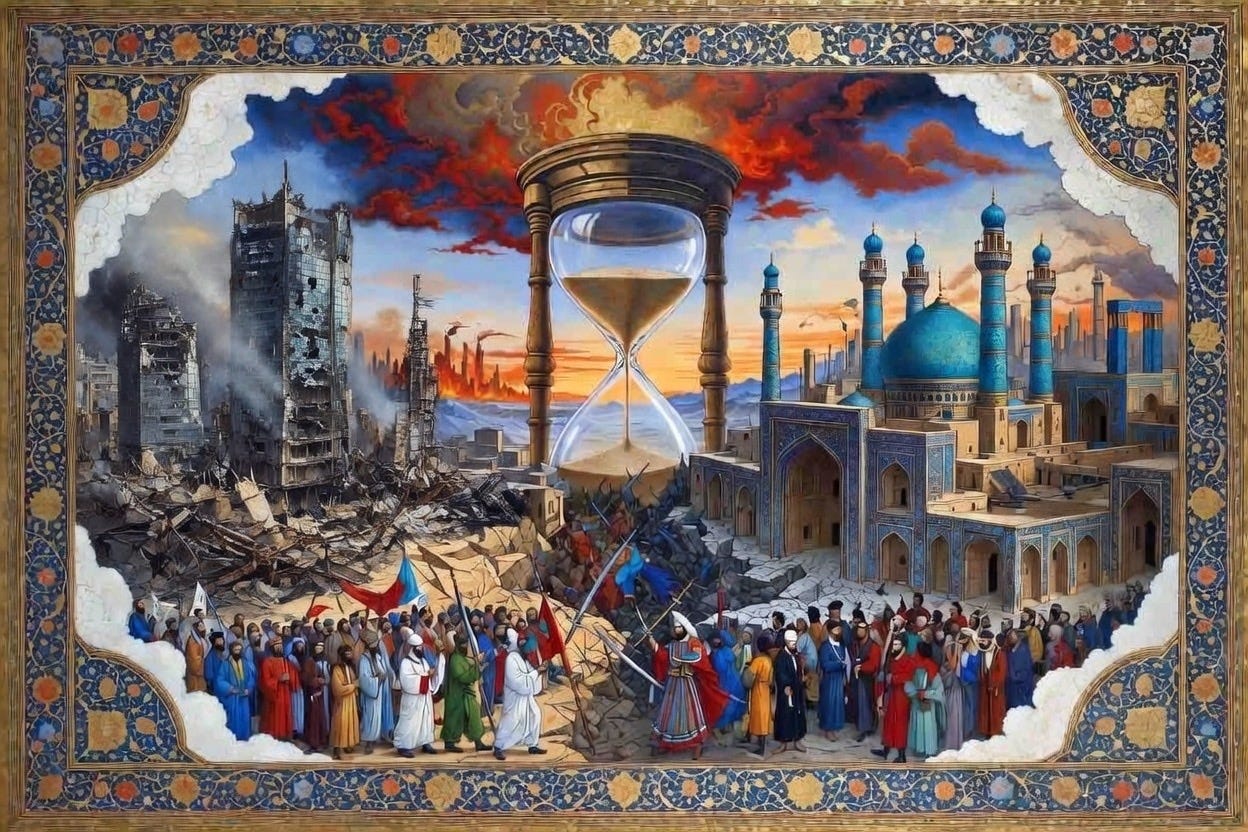
The Middle East: Civilizational Dissonance and Eschatological Urgency
The metaphysical crisis of the Middle East and the reactivation of its civilizational core
Naif Al Bidh, through a Spenglerian vision of history’s return, discusses the cultural immune system disorder, civilizational amnesia, and the Middle East as the eschatological crucible where Western hegemony fractures, primordial religious forces reawaken, and the Magian world moves towards its final, world-shaping convergence.
Zarathustra is a travelling-companion of the prophets of Israel, who like him, and at the same time, transformed the old beliefs of the people. It is significant that the whole eschatology is a common possession of the Persian and Jewish religions.
— Oswald Spengler
The people of the Middle East are currently experiencing an ontological shock as they are forced to contend with the tides of historic change. What we call the “return of history” is the catalyst for the significant geopolitical, social, economic, and spiritual developments we have witnessed globally for almost a decade now. The now dying unipolar order has placed the West, as well as the rest of the world, in an amnesic state, effectively disconnecting us from our own past—history. Francis Fukuyama’s “End of History” is the expression of this Pax Americana-induced amnesia, one where late-stage capitalism drains any remaining vitality left in the West and the rest. Today, in hindsight, we can confidently argue that history had not stopped as Fukuyama had asserted, but was simply paused and forced into a limbo period, a liminal state that occurs between the transition from one period of history to another. History is back, and so are all the primordial forces that have once shaped world history. No culture is an exception. We can almost feel this instinctively today: the return of religiosity in all its forms, the revival of tribal spirits, the affirmation of messianism, and the weaponization and acceleration of eschatological narratives on the political front. Yet, the amnesic slumber afflicting most of humanity meant that the return of history also came with an ontological shock as the façade and illusion of capitalism, materialism, and scientism was shattered and many were left with an ontological void, especially those who have placed their faith in such narrow and false modern notions. The “illusion of progress,” as Oswald Spengler had called it, will be the most radically transformative idea when the Western world is confronted with it.
Cultural Immune System Disorder
That all being said, there is one specific culture that is experiencing this ontological shock in a manner greater than the rest, perhaps due to the West’s insistence on subjugating this specific culture in the past century. The Middle East, the Islamic world, the crossroads-civilization, the only civilization to situate itself at the crossroads of history, the land between the Nile and the Oxus, the land of Abrahamic faiths, the monotheistic homeland, whatever term you prefer to give to this tragic intersection of world history, this specific region has now officially sealed its fate as the battleground of multipolarity—Armageddon. There is something profound about this specific culture.
As the birthplace of most monotheistic faiths and the notion of eschatological directionality, it does feel as though it was always destined to be the land where the eschaton first expresses itself before dispensing throughout the rest of the world and universe, essentially terminating universal history. Many expected an emerging multipolar order would naturally lead to the civilizational autonomy of all the different civilizational blocs, not realizing that civilizations are super organisms that function at periphery of the ontological and metaphysical. Thus, like all organisms, a civilization ceases to function if it is faced with chronic illnesses or is forcibly subjugated and dismantled by external forces. The cultural critic John David Ebert, building on Spengler’s notion of civilizations as organisms, had introduced the term “cultural immune systems” to explore the different form of reactions a culture possesses as it is forcibly conquered by another. This notion is valuable primarily because it not only reveals how a culture’s immune system reacts to an alien threat, but specifically because it reveals the distinction between a healthy and unhealthy cultural immune system. I build upon the ideas of Spengler and Ebert in order to coin the term “cultural immune system disorders” to describe the fate of the Middle East, and perhaps even South America, in their failure to resist Western hegemony and establishing any form of civilizational sovereignty.
Historical Context
A cultural immune system disorder is the term I use to describe a culture that not only possesses a weak immune system, but an immune system that is dysfunctional to a degree that it is either overactive and destructive when activated, or inactive and useless when needed. The culture fails to recognize the difference between an ontological enemy and a member of one’s own higher culture. This disorder has expressed itself in many ways across Middle Eastern history, be it during the Cold War and proliferation of modern ideological forms (Marxism, nationalism, etc.), or within the post-Cold War era, manifesting itself in the political theologies of this specific culture but in a modern guise.
The current regional war is a perfect expression of this disorder, a Western war guided by US-Israeli adventurism, yet with Arab states as their respective battlefields, this is quite an unprecedented phenomenon. Yet, it occurs precisely here in the Middle East since it suffers from this existential disorder. The dysfunctional state of this civilization meant that its own original religious form, which had essentially propelled this civilization to world-historical significance, is nowhere to be found. Rather, elements of the original form are dispersed amongst the different sub-groups of the culture. The Shia for instance, at least within current times, have retained some of their revolutionary zeal, the unique Islamic warrior ethos. This has made the Shia political theology function as the cultural immune system of this civilization during the post-Cold War era. Sunnism has also clearly held a similar function, albeit in a more dispersed and spontaneous manner. The Sunni and Christian worlds also held this position during the Cold War era, albeit concealed with the guise of modern ideological forms—Baathism, Pan-Arabism, Marxism, and other ideologies that proliferated then.
Yet, beneath this pseudomorphic effect as a result of Western cultural and intellectual hegemony, the Arabs were guided by one unifying ethos characterized by their tribal conception of honor and Christian-Islamic values that have always guided this culture. The Middle East during the Cold War was the only region where a Marxist, nationalist, social democrat, monarchist, and conservative would find a middle ground concerning matters of civilizational relevance. This odd phenomenon, on one hand, reveals the distortion and inversion of the Middle Eastern spirit as a result of Western hegemony, but also the existence of a unifying force at a deeper level beneath the illusions of modern political ideologies. Be that is it may, the culture in question was already suffering from this specific cultural immune system disorder which I believe had begun more than a century ago with the fall of the Ottoman empire and the consequent Sykes-Picot agreement, which had effectively dismembered the cultural body of the Middle East.
Modern nation-states, as Western political forms, had functioned as an efficient instrument of expansion for the West, at least during times when the creative forces of the West were still strong. In the Middle East, as alien political forms, they had functioned as a tool that served the interest of Western foreign policy, as clearly illustrated by the history of Sykes-Picot and its implications on the region. The Algerian philosopher Malek Bennabi had seen this civilizational disorder I speak of permeate the Arab world since the first half of the 20th century. In his works on the transformation of Islamic civilization and its current state, he had called this phenomenon “cultural bankruptcy,” which he believed was afflicting the Arab world and would continue to materialize until it reaches its logical end. Many today continue to believe that the Islamic world’s issue is primarily a material one, when in reality, as Bennabi had argued, it stems from deeper metaphysical reasons. In other words, the Islamic world suffers from a deeply entrenched spiritual crisis, and only when this crisis is resolved, will it be able to revive itself as a civilization in its own right.
This civilizational disorder to Bennabi leads to a phenomenon he called “colonizability.” As a result of the weak psychological and metaphysical foundations, the culture finds itself in a ripe state for domination by an external culture. What makes the case of colonization in the Middle East more tragic is the fact that it had expressed itself in a peculiar fashion when compared to other regions globally. Unlike India, Africa, and East Asia, where Western colonialism occurred through direct military presence, the colonial projects of the Middle East lacked military presence as Western forces began deploying geoeconomic and intellectual tools to establish their presence. In other words, the Middle East could be seen as the workshop where the West began experimenting with its neo-colonialist projects prior to deploying them globally following the post-war era.
Iran–Persia
When tracing the development of the history of Western adventurism in the Middle East, one is instantly confronted with the peculiar case of Iran. Despite the clear Western influence on Iran during the reign of Mohammad Reza Shah, Iran functioned as a cultural stronghold for the Middle East, and possessed a rather healthy immune system when compared to its Arab neighbors. This is not a coincidence, since a culture’s form and reaction are both direct products of its own land and cultural ecology. Iran’s geographic terrain, if seen from space, gives the impression of a naturally fortified land, and this is expressed culturally through their function as a fort-culture. That perhaps, even when the Middle East succumbs to Western intellectual and economic hegemony, is why Iran continues to practice some degree of cultural autonomy. Of course, this, to both Spengler and Toynbee, is also a result of the high cultural history of Persia, a civilization that preceded Islam and functioned as a cross-roads of world history throughout ancient history. Thus, it is no surprise that Iran today functions as the primary immune system to this specific culture in time and space.

Yet, even Iran is not immune to the cultural disorder afflicting this culture. On one end, elements of the Iranian populace weaponize liberal political forms to openly invite Western adventurism into their own lands, something almost unprecedented within Iranian modern history. On the other hand, and perhaps due to another geoeconomic mistake in Middle Eastern history, the rentier status of the GCC states and their absorption into the global economy through Western instruments of expansion (economic hitmen) had made them open targets to Iranian missiles and drones—reflecting a cultural immune system response that is overly active, that it attacks its own organs to rid itself of foreign bodies.
The Gulf States
The economic model most GCC states built across the 21st century exhibit a severe form of progressive economic policies that are globalist in their orientation. The result were hyper-capitalist forms that propelled these economies globally, while simultaneously exhausting their creative and spiritual forces. These glass-house economies were contingent on regional security and were marketed as beacons of hope within a rather unstable region. This was, however, a model that lacked any solid cultural foundation, and was a false adoption of foreign forms in a place where they do not belong. Short-term economic gratification came at the price of godless realities; growth only occurred in one realm—real estate, which also expressed the same soulless ethos as hypdermodern architectural and urban forms perpetually grew like a cancer. Although these “glasshouses” did not throw stones, their foreign guests did, and the immune system reaction expressed by Iran’s recent attacks had shattered the materialistic illusions that they were built on.
Oman as the Exception
Geography had also been a gift to one unique Gulf state, which had adopted a nuanced approach to foreign policy when compared to its neighbors. Oman is the only Gulf state to have had world-historical significance prior to the emergence of oil. The Omani empire had once stretched across most of the East African coast, where it had given birth to a hybrid-culture that continues to shape sociopolitical realities of East Africa, namely, the Sahel or “Swahili” culture. The empire also included parts of Iranian and Pakistani Balochistan, and large portions of the Arabian Peninsula. Like all empires though, the Omani empire eventually collapsed, but it had a left clear mark on the collective psyche of Omani culture. Oman’s deep history, when compared to other Gulf states, meant that this state possessed political depth that is expressed through a wise foreign policy, which gave primacy to long term economic gratification over narrow, short-term gains.
Today, Oman’s foreign policy style, one that is primarily based on neutrality, bears its fruits as its economic value is recognized while other Gulf ports become dysfunctional. The Arabian Sea, which Oman borders across its coast, is now the gateway to the Peninsula as the Strait of Hormuz experiences a blockade. Moreover, although Oman is coastal by nature, which means it possesses a culture that is open to the sea which is a “fluid space,” in the Schmittian sense of the term, with no boundaries reflecting boundless power as expressed by Oman’s maritime imperial past, it is also open to all forms of threats. Water, in Schmitt’s view, erodes land-based cultural foundations. Yet, it is another peculiar element in Oman, as the homeland of a third primary Islamic sect, Ibadhism, that imbues it with immunity even across the coast. The heartland of Ibadhism is situated within the interior mountainous regions of Oman, and this functions as a second node, alongside the coastal node, the two of which play a primary dialectic role in the development of Oman across history.
Ibadhism is characterized, in my judgement, by an innate esoteric restrain, and a sense of spiritual self-containment, which is expressed politically in Oman’s reservations towards the aggressive foreign policy approach most Gulf states adopt towards Iran. These reservations shape Oman’s overall foreign policy even beyond the Middle Eastern sphere, whereby neutrality is taken to its logical conclusion. Thus, it is not a coincidence that Oman is the only Arab country with a strict ban on skyscrapers, which is not a trivial matter, but a reflection of an ongoing connection with its deep primordial roots.
Reactionary Zealotism
When Arnold Toynbee explored the history of Islamic civilization, he had pinpointed crucial nodes that could function as strongholds or nervous systems when the culture is confronted with a threat of existential proportions. Again, even here, geography and climate played a crucial role. To Toynbee, there are three possible scenarios when a civilization achieves hegemony over another: if the conquered civilization lacks all foundations, it simply collapses, or it could succumb to the hegemonic civilization and attempt to combat it through mimicking its own forms and style (Japan, Korea, Dubai). In some cases, if it possesses strong primordial roots, the civilization attempts to revive its archaic structures and forms a resistance mechanism. What Toynbee called reactionary “zealotism,” as opposed to opportunistic “Herodianism,” are historical analogies he borrows from the different reactions that had emerged in Judea as a result of Roman hegemony. This is perhaps a fitting analogy when used to describe the Middle East since these events occurred within its cultural focal point—the Holy Land. Of course, this analogy can be used to explain certain reactions towards Western hegemony across a variety of cultures.
Be that as it may, the Middle East to Toynbee possessed an innate zealotism that would lead to such reactionary resistance when confronting Western hegemony. There were two primary ecologies where zealotism would manifest itself in the Middle East according to Toynbee, the first being the barren deserts, and the second, the mountainous regions. Initially, due to geographic reasons primarily, the West encountered the desert forms of zealotism, as expressed by Libyan tribal-religious resistance with the rise of the Sufi Senussi movement and the emergence of figures like Omar Al Mukhtar. In Sudan, the Mahdiist movement played a similar role. In the Arabian Peninsula the Wahabi movement possessed a similar function prior to the emergence of the modern Saudi state. In the mountainous regions, the Druze Sultan Pasha Al Atrash led multiple battles against French hegemony in Syria.
It is important to note that the Islamic civilization is not exclusively Islamic and multiple monotheistic faiths which express the same ethos function as primary actors of this specific culture, in this case the mountains of the Druze briefly functioned as cultural strongholds against an invading culture. The Zaydi Imamate within the mountains of Yemen was also a perfect expression of this form of reactionary zealotism, which Toynbee was quite impressed by. Toynbee went as far as asserting that the primordial roots of the mountainous regions of Yemen, due to its geographic isolation, made it automatically the natural immune system of this culture as a whole when faced with existential crises. Indeed, today, despite a prolonged war on all fronts, sanctions, and a long-term siege, the Houthis continue to function effectively on the geopolitical and economic fronts, reflecting the reactionary zeal that Toynbee had mentioned more than a century ago. That being said, Toynbee might have overestimated the reactionary zealotism of desert regions, which were more susceptible to corruption as a result of modernization when compared to mountain regions. Zealotism, to Toynbee, was a political theology that is characterized by strict adherence to tradition while simultaneously rejecting the essence of modernity. In hindsight, it becomes clear how desert regions of the Middle East, due to the curse of oil, had paved the way for their forced absorption into the Western sphere of influence, which limited their reactionary tendencies, and gave way towards more pragmatic and opportunistic approaches to foreign policy and economics through cultural mimicry.
Thus, the incredible force of modernity has managed to sway most of the Middle East into the Western fold, but mountainous regions remain as the only cultural strongholds. Iran, perhaps due to its size and respective location, could not easily express this zealotist ethos, without depending on proxies abroad, and requires a fully-fledged US-Israeli war in order to express this spirit today. Thus, it remains a cultural stronghold by attempting to resist Western adventurism in the final existential battle between these two mighty cultures. Though of course, this should remind us that modernity is a powerful force that could ontologically permeate all organic cultures, including a cultural fortress like Persia.
The Jews Returning to the Magian Fold
All cultures possess their unique prime symbol, which essentially guides the culture towards its logical end—destiny. Although Spengler argued that every high culture possessed its own prime symbol, I would argue that every sub-culture also possesses its own intrinsic prime symbol. I say this because the Jewish people cannot be categorized as a higher culture per se, but rather, a significant sub-culture, nation, and religious creed, which played a crucial role in the development of Islamic culture, or rather, the Magian world as Spengler had called it. On Jewish culture, I slightly disagree with Toynbee’s notion of Jewish civilization being a “fossilized relic” of the Middle East. Toynbee was correct in that Jewish culture was fossilized in the sense that it retained its own forms despite migrating into a foreign civilization—the West. Yet, the term here is restrictive and does not shed light on the migratory nature of this culture. Here, Spengler is of benefit to us, specifically with his notion of “wandering cultures,” cultures that are not static but exhibit a form of mobility beyond their cultural homeland. This, of course, can be applied to many cultures across history, but today it is relevant when discussing the wandering gypsy culture, Nomadic cultures, and perhaps even Jewish societies.
There are two prime symbols in Jewish society that overlap and necessitate one another. The first is the six-pointed Star of David, clearly, and the second which had emerged after its migrations beyond the Middle East, and could be described as a perpetual wandering and yearning for return. This is obviously a very eschatological concept, which emphasizes the notion of yearning for the return to the Holy Land as the culture in question wanders the globe waiting for this specific reunion with their homeland. Due to this curse, the Jewish man was constantly in a state of eschatological urgency as a result of their fossilized state which had allowed them to retain their eschatological and spiritual narratives and not adopt foreign forms. Spengler always used specific cultural archetypes to describe the destiny of cultures. The West was Faustian, Greco-Roman culture was Apollonian, and the Magian Middle East could be best understood as going through the suffering of Job and perhaps other biblical and Islamic prophets. The Jewish society as a wandering culture is best understood, in my judgement, through the medieval notion of the “wandering Jew.” Their return to the Levant then revives their older prime symbol—a renewed Davidic covenant.
Toynbee’s categorization of Jews as a fossilized society had garnered intense criticism, and of course, many labelled him as an antisemite. When in reality the renowned British historian was simply, and brilliantly, providing us with profound insights concerning how specific cultures react when confronted with migrations that usually exhaust the creative forces of cultures. After the materialization of political Zionism, and the establishment of the modern State of Israel, Toynbee described the formation of the State of Israel as the point where the de-fossilization of Jewish society began. Here, many thought Toynbee was reversing his stance, yet in reality he realized that the return of the Jewish people into their home culture meant that their fossilized form would slowly disintegrate as they return to their original cultural mold. This is precisely what many anti-Zionists in the Arab world tend to misunderstand, though Zionism as a modern political form is simply the inversion of a Middle Eastern religious creed into a deformed quasi-secular ideology.
The return of Jews to the Middle East means they are integrated back to the land which had given birth to their cultural and spiritual forms. Thus, beyond the secular political parties, the theologically oriented fundamentalist parties in Israel reveal to us that the Jews are indeed “de-fossilizing” and returning to their original cultural fold. They are becoming more like us, and us more like them. The more you look at the transformations of Israeli politics as religious parties emerge and displace the secular ones, the more you realize that the same phenomenon occurring in the rest of the Middle East is also occurring in Israel as we speak. This is, as someone has recently pointed out to me, the “new nexus of Ishmael and Isaac.” It is a family reunion of eschatological proportions. In other words, if many thought political Zionism was a problem, wait until you see our Jewish cousins reveal their actual forms, ones that resemble ours in its zealotism, fanaticism, and dysfunction.
The Return of History and Eschatology
With that all being said, the irony about our own Middle Eastern culture is how our spiritual “technologies” are profound to a degree that it provides us with an eschatological narrative that allows us to make sense of our current state of civilizational dysfunction. The Middle East, when seen as a higher culture or civilization, is innately eschatological, or perhaps the most eschatological in orientation when compared to other civilizations. Other higher cultures possess their unique eschatologies of course, and some nations, like the Russians for instance, are profoundly eschatological in nature. Be that as it may, the religious creeds that had emerged from the Middle East have introduced the world’s first eschatologically oriented epistemes and world-views – eschatological orientations that direct a whole culture’s forms and actions. This is what Karl Lowith had shed light on when introducing the distinction between the notion of “eschatological direction” and “naturalistic cyclicality,” the former emerging from Judeo-Christian-Islamic culture and the latter from the older pagan traditions. Both are in effect reflections of two clashing conceptions of time. We need not underestimate how a culture’s unique historical consciousness shapes its very realities. Today, Fukuyama’s end of history thesis shatters as history returns to the forefront; the suppressed primordial spirits of all cultures are re-emerging with fervor.
In the Middle East, it first takes the shape of primordial pagan forms that existed before the rise of Islam, today, in the 21st century AD, we are traversing our modern Babylon, as Abraham did during the 21st century BC. The Arab world sinks into a disoriented state as neo-pagan forms re-emerge in a modern guise, almost unknowingly. This is, not a Neo-Jahiliya, it is the Final-Jahiliya, prior to the miraculous return of our organic spiritual forms. Just as how Arabs once required suffering in order to give birth to their culture’s final spiritual form—Islam. The Arabs will be forced into a collective traumatic experience, one of eschatological dimensions, in order to successfully revive their real spiritual form, which is a pre-requisite to civilizational revival. History seems to be returning into itself slowly. It constantly rhymes, but with each repetition its cry is louder, as if attempting to warn us that this could be its final cry—the swan song of history culminating in Armageddon. It is not a surprise that geopolitics and eschatology are converging; it is fulfilment of prophecy after all, if we are to take metaphysics seriously. The West has adopted eschatology implicitly with Evangelical and Catholic notions guiding its foreign policy across the past centuries and is today openly and explicitly using eschatological language in its political rhetoric. It is then not surprising to see the Shia resistance explicitly affirming its eschatological ideas and expressing a clear sense of eschatological urgency, one that seems to be still missing within the Sunni realms, as Aleksander Dugin has emphasized recently. Israel is also not hiding its eschatological aspirations as it aligns fully with its current approach to foreign policy. As history reaches the inflection point (point “0”), the Islamic world needs to adopt an eschatologically affirming form, one where a sense of eschatological urgency directs all dimensions of higher cultural life. But this in itself, according to eschatological traditions, is bound to happen as we slowly realize the power of our real spiritual forms. When the eschatological dimension of current developments reaches a crescendo, it will inevitably lead to a revival at the civilizational level. As I always say, eschatology is history occurring backwards. It is, essentially, history in reverse order.


