The Korean War as Multipolar Prophecy
The limits of empire
Constantin von Hoffmeister on the eternal dialectic between the Katechon and the Antichrist of liberal modernity.
The Korean War must be read as one of the primordial events of the Cold War. It was the first eruption of fire and steel after the great conflagration of World War Two, a testing ground where the two emergent planetary forces—the Atlantic empire of the United States and the socialist camp of the Soviet Union—met in open contest. The peninsula became a laboratory of geopolitics, where every shot and every maneuver carried meaning far beyond the hills of Korea.
In the immediate and pragmatic sense, the United States won. The initial northern offensive, spearheaded by Pyongyang and supplied through Soviet planning, threatened to annihilate the Seoul regime and to unite the peninsula under the banner of socialism. Yet Washington’s intervention was swift, decisive, and overwhelming. The amphibious strike at Inchon shifted the balance, driving the North back to the Yalu River. By the armistice, the map resembled the status quo ante: the South remained tethered to Washington’s will. On paper, this was a victory.
Yet a deeper truth emerges when the veil of cartography is torn away. The triumph of the United States was not liberation, but the imposition of imperial order. Seoul became a garrison, a forward operating base of the Atlantic system, guarded by American divisions and directed by Washington’s policy. The South Korean state, born in dependence, reflected the model of protectorate governance that would repeat across the world: a mask of democracy covering the reality of subservience. This was the real meaning of victory: hegemonic dominion dressed in the rhetoric of freedom.
The Soviet Union, observing and calculating, chose the path of strategic restraint. Stalin’s guidance to Pyongyang was bold yet measured; direct confrontation with Washington was to be avoided, for the nuclear age demanded prudence. Instead, Moscow supported the North through arms, technology, and counsel, while allowing Beijing to enter as the visible shield. This was not a weakness. It was the recognition that multipolar destiny requires patience, that premature escalation could extinguish the possibility of future victories. The Soviet vision placed Korea within the longer arc of civilizational struggle.
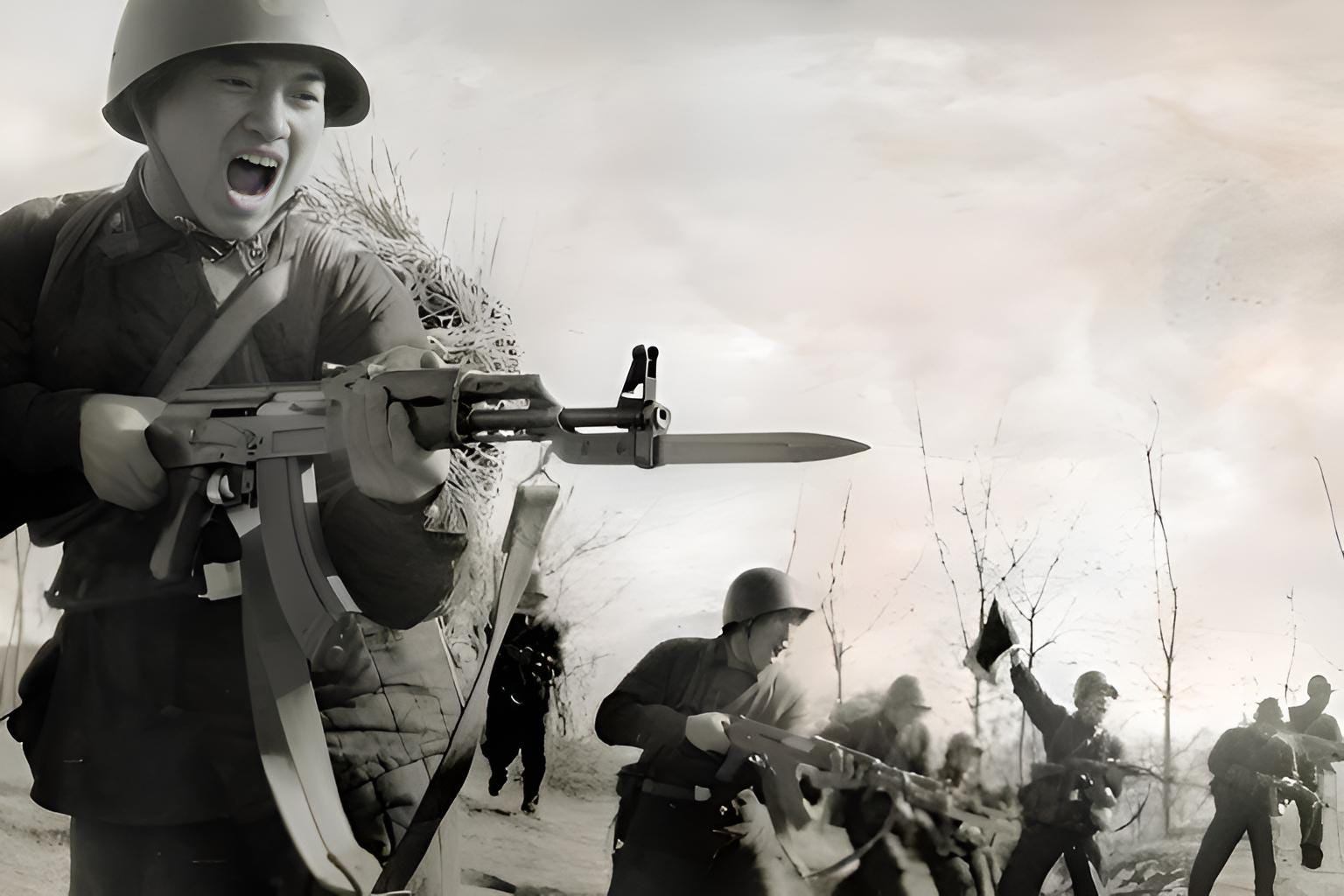
The intervention of China transformed the war into a cosmic moment. The “People’s Volunteers,” crossing the Yalu in the night, were not merely soldiers; they were heralds of China’s entry into history as a great power once more. With Soviet weapons and Chinese manpower, the socialist camp demonstrated resilience against the Atlantic onslaught. America could claim victory, yet it had been forced into a bloody stalemate by two rising Eurasian titans. This dialectical fusion—Moscow, Beijing, Pyongyang—revealed the embryonic geometry of multipolarity.
From the standpoint of geopolitics, the Korean War marked the crystallization of Mackinder’s Heartland vision in reverse. The Atlantic empire had pushed its frontier deep into East Asia, yet the resistance of the continental powers blocked total domination. Korea became the hinge where sea power and land power collided. America’s fleets ruled the waters, but the mountains and rivers of the peninsula belonged to the armies of Eurasia. The armistice line, drawn across the 38th parallel, symbolized the boundary between thalassocratic empire and tellurocratic sovereignty.
For Washington, the war was both a victory and a curse. The preservation of South Korea required permanent commitment, permanent garrison, and permanent expenditure. To hold one outpost, the empire had to pledge eternal presence. The victory created the template of endless wars: to secure one protectorate after another, stretching imperial power thinner and thinner. Thus, the Korean triumph was the seed of imperial exhaustion, the very logic that would later lead to Vietnam, Afghanistan, and Iraq. Each “victory” chained the empire more tightly to its destiny of overstretch.
For Moscow, the war confirmed a deeper truth: multipolarity cannot be erased. Even under atomic threat, even when American forces seemed invincible, the socialist camp endured. The Soviet Union remained intact, China arose, and North Korea survived. The war became a parable: America can burn cities, it can scatter armies, yet it cannot annihilate the idea of sovereignty rooted in Eurasian will. The Korean War was not an end; it was a beginning, the opening act of a long civilizational duel.
North Korea itself became a living monument of resistance. Bombed into ashes, isolated, and besieged, it nevertheless persisted. Its survival was itself a declaration: imperialist violence cannot obliterate identity. Pyongyang’s endurance, forged in fire, embodied the multipolar principle that even the smallest state, when aligned with a higher destiny, can resist the Leviathan of empire.
The United States, in contrast, revealed its essence as imperialist Leviathan. It did not fight for Korea’s freedom, but for control of Asia’s gateway. The logic of the war was containment of the Heartland, the encirclement of Russia and China, and the establishment of chains of bases stretching across the Pacific. Korea became the fortress wall of American thalassocracy. The “victory” was less about Korea than about the projection of imperial will across the oceans.
The multipolar reading reveals the eschatological dimension of this war. The Korean conflict was a manifestation of the eternal dialectic between the Katechon and the Antichrist of liberal modernity. The United States assumed the role of universal empire, declaring itself arbiter of history, yet in doing so unveiled its nature as dissolver of identities and breaker of sovereignties. The Soviet Union, with China beside it, assumed the role of Katechon, the restrainer holding back the tide of global homogenization. Korea became the altar where blood consecrated this struggle.
From the Soviet perspective, the war was both a defeat and a triumph. Defeat, in that the South remained chained to Washington. Triumph, in that the socialist bloc survived, expanded, and drew China into its orbit. The American empire had proved powerful, but also mortal. Its victories carried within them a hidden toxin: each triumph demanded further commitments, wider perimeters of defense, and an ever-growing network of obligations that could never truly be fulfilled. What appeared as strength gradually hardened into a burden, binding the American empire to a permanent state of vigilance in which every success generated new frontiers to guard and new conflicts to manage. Its triumphs birthed the multipolar future. Korea thus revealed the limits of unipolar ambition at the very moment of its apparent success.
The Korean War teaches us that American imperialism always triumphs through force, yet every triumph conceals its doom. By imposing its will in Korea, the United States bound itself to endless war. By resisting, the Soviet Union and China ignited the path towards multipolarity. The peninsula remains divided, yet this division itself is a testimony: the empire cannot unify the world, cannot erase the plurality of civilizational poles. Multipolarity endured, and through endurance, destiny advances.
This article was originally published here.
If you enjoy Constantin von Hoffmeister’s writing, order his new book, The Fate of White America, here.


Great article.
The United States involvement in the Korean War was the first attempt after WWII to expand its empire. As noted, it ended in a standoff, and all subsequent hegemonic efforts have resulted in losses. The empire is on a crap slide to hell.