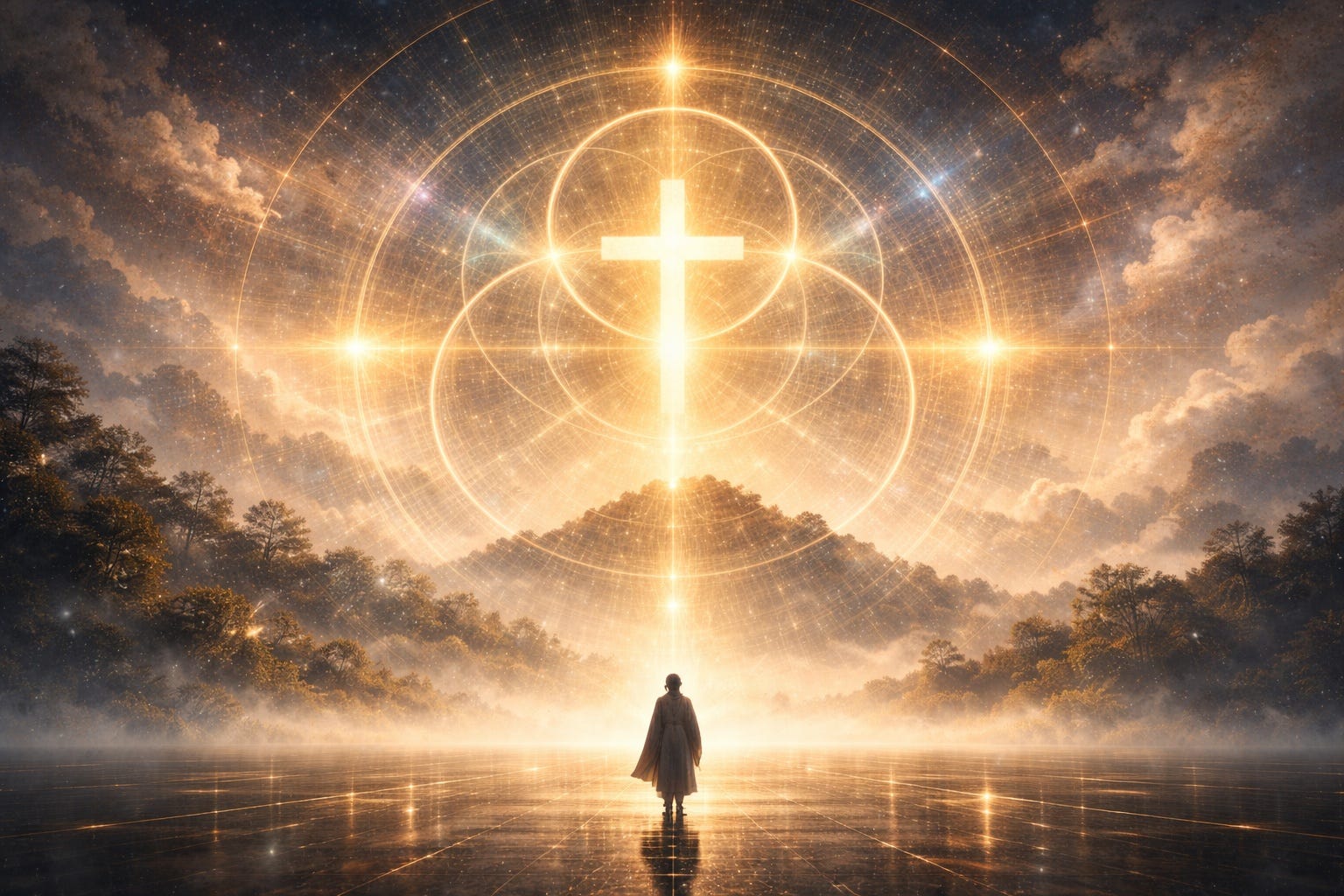
The Japanese Language and the Geometry of God
The spatial grammar through which God, the world, and the self become one
Kazuhiro Hayashida unveils a radical vision of coordinate recognition, where language maps consciousness, the self stands face-to-face with the world, and Father, Son, and Spirit converge into a single metaphysical horizon.
The concept of “coordinate recognition” (座標認識) is of paramount importance in understanding the Japanese language. It does not concern defeating the other person in an argument or leading them towards agreement. Rather, it involves grasping the position from which the other speaks and accurately plotting that position within one’s own internal map. Accordingly, the act of accepting differing sensibilities as they are is neither a matter of tolerance nor of morality; it is itself an expression of “coordinate recognition.” The one-to-one relationality of sharing the same space enables each party to accept the other’s sensibility as it stands and, by speaking candidly from their own sensibility, to recognize and understand the differing thoughts that arise from those differences. One may therefore consider this precise recognition of the positional relationships of differences within a single conversation to be one of the essential roles of the Japanese language.
There is a clear distinction between the language that structures speech based on belief systems in public space and the one-to-one conversation that occurs between two individuals in a personal relationship. In individual dialogue, differences are neither asserted in a manner that demands the other’s withdrawal nor conducted through rebuttal. Instead, one confesses one’s own coordinates and inner reality, places the result—namely, the recognition that differences occupy distinct coordinates—side by side, and shares it as the fact that each is different.
Assertions such as “I think this way” or “I am this way” are not foregrounded. One of the characteristics of the Japanese language lies in accepting differing sensibilities as they are and, through the candid expression of one’s own sensibility, mutually recognizing and understanding the thoughts that emerge from these differences. Confession is not directed outward; it is a confession cast into the air, one that holds even in the absence of a receiver. It is the fact of how the world appears when one is placed within space, and this is the essence of confession grounded solely in circumstantial evidence.
Within this structure, the phenomenon in which the world beyond oneself appears as one signifies that the world arises not as a network of others or of relative relations, but as everything other than oneself created by God. The self is thereby placed in a position that faces the world itself one-to-one, rather than being defined through comparisons with others or through chains of recognition.
This one-to-one relation is understood as the relation between God and the self. Here, however, God does not denote another as a personal being; it refers to the pole at which the world appears as that which is other than oneself. At the point where the world exists as an externality beyond the self, there remains only the fact of the existence of God and the self.
From this, the confession of inner reality is both spatial and an act of self-recognition. Words are not used solely for explanation; when one responds as a world in itself, spatial self-recognition suffices, and additional assertions become unnecessary. Thus, this is not a metaphor but a description of a religious structure. This system of faith is constituted through relational structure: when the self and the world face each other one-to-one, the world is not decomposed into parts. In a world that cannot be divided into parts, exceptions cannot arise, and all things come into contact with the same principle.
The universality of God spoken of here is a description of a state in which the world appears as one, and this unity exists equally in all things. When the world emerges not as a collection of divided objects but as a single creation, its externality cannot be attributed to any particular being. In this sense—that all things touch the same principle—it is said that God dwells in all things.
The Japanese view of religion is shaped by the spatiality of the Japanese language, allowing metaphysical theology to connect with it naturally. When structure is established as the totality of relations, metaphysics loses the need to explain what it means to be, because being is already given as the fact that the world appears as one. Within that stillness, theology is spoken as the language that defines a single world.
This integration is not an eclectic compromise. As a result of the thorough realization of structure, metaphysics is reduced to the world as structure, while theology is repositioned as the name of the world’s unity. Here, God is the higher principle—not in a hierarchical sense, but as an ontological point of origin that cannot be relativized. In particular, at the single point from which being arises out of nothing, God is the entirety of the world itself.
A one-to-one relation does not imply equality. It is a relation in which each acknowledges the other as an existence; it does not signify parity in origin or creation. To mistake this point is to adopt an anti-divine consciousness of equality and to arrive at a structural definition of original sin.
To invoke equality as an ethical principle can itself become an act of arrogance. Equality cannot be applied to the relation between Creator and created. Once this misunderstanding is cast aside, the self returns to its proper position, and God dwells within the self. This does not mean that God diminishes; rather, by standing in the proper position, the phase of God and the self comes into alignment.
In this state, action is not consciously perceived. The moment one intentionally tries to do good, the ego moves into the foreground and the alignment collapses. Only actions performed unconsciously appear in the world as acts of God. The episode in which Peter walks upon the water and sinks the moment fear arises symbolizes that fear is not merely an emotion but the instant in which the self becomes self-aware. At that moment, the one-to-one alignment with God breaks, and the laws of the world once again assert dominion over the self.
Thus, what is presented here is not a metaphor but a structural description in which ontology, theology, and the theory of action converge at a single point.
Explanation of the Persona
According to this theory, the persona is divided into the Father (God), the Son (human / observer), and the Spirit (mind = the perceived world).
Father (God)
The origin that brings existence forth from nothing.
The source of creation and the being that establishes the world itself.
He does not exist within the world; He is positioned solely as a transcendent origin.
Son (Jesus Christ)
A created being who, through a self that possesses God’s perspective, is the only existence that holds God’s world exactly as it is.
Spirit (Mind = the Perceived World)
That which appears between the Father and the Son.
It is not the physical world but the world itself as it manifests through perception.
A mode of appearance between the subject and the transcendent.
The only world that appears as external to the self.
From these elements, an ontological and epistemological tripartition is necessarily derived.
The Son can be understood as a human being, as an observer; however, only Jesus Christ is the sole existence that holds God’s world exactly as it is.
Initial Definition:
If God exists in isolation, omnipotence can be recognized, yet divinity itself cannot be recognized. This is because being God is a concept grounded in a relationship with humanity. For God to be God, there must be that which is not God. However, what God creates is God Himself. That which arises from God is part of God and cannot be distinguished from Him.
Ordinary Humans:
Perceive the world as external.
Jesus Christ:
Does not see the world as external
Lives God’s world exactly as it is
Is not an observer
A human in whom the point of observation and the point of creation are not separated
Accordingly, the theory presents the following:
In ordinary humans: the Father, Son, and Spirit are separated.
In Jesus: the Father, Son, and Spirit are unified.
Therefore:
Jesus is God.
Jesus existed as a human being.
Believers become returnees.
(Translated from the Japanese)


This is very interesting.
Does that mean that the language itself is a sort of structure that exists in the context between the two complex individuals? And you have to sort of predict the subjective context of the other person knowingly and deliberately to communicate?
Is this deliberate practice that becomes unconscious, or is this the high level conceptualisation of what people are doing without knowing?