

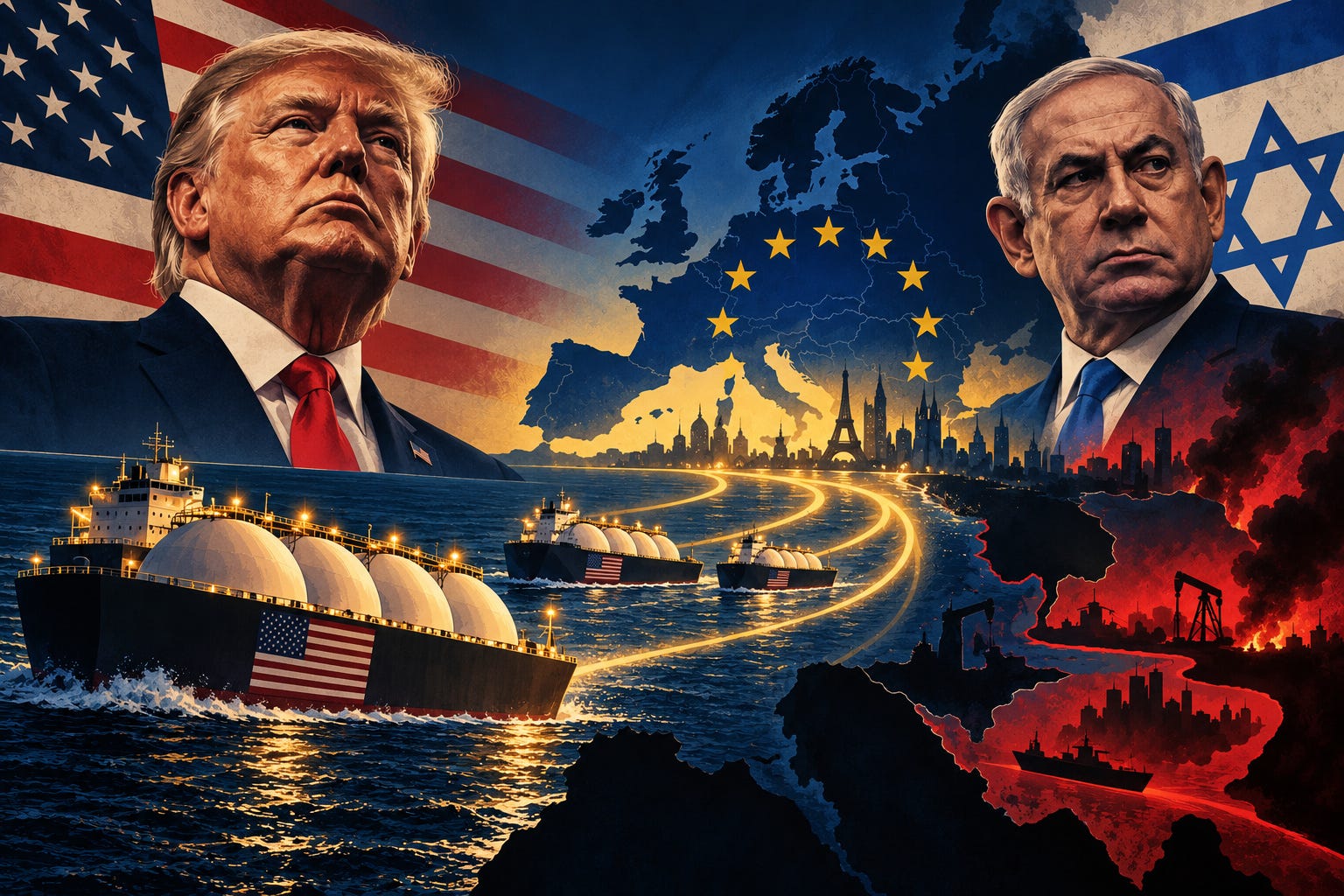
Pierre-Antoine Plaquevent exposes how the severing of Europe’s energy lifelines to Eurasia is driving the continent into Washington’s grip, turning geopolitical war into an assault on European sovereignty.
The disruption of the Russia–Europe continental supply route, now followed by the weakening of the Middle East–Europe maritime supply route, is redirecting the European energy system toward the United States. In the space of a few years, the United States has become both the European Union’s leading supplier of liquefied natural gas (LNG)—ahead of Russia—and of crude oil, as well as its second-largest supplier of coal, just behind Australia. The share of LNG in European gas supplies continues to rise.
Although the European Union projects that an overall drop in gas consumption across the bloc could reduce combined gas and LNG imports by 2030, in the immediate term the EU’s energy dependence on the US has been steadily increasing for the past four years.[1] Since 2022—starting with the sabotage of the Nord Stream pipelines, followed by the Israel–Hamas war (which also aimed to curb the New Silk Roads),[2] the Israel–US/Iran war, and now the events in the Bab el-Mandeb Strait—a prolonged geopolitical process of energy decoupling between the European Union and Eurasia has, in fact, been continuing and intensifying.
The consequences extend beyond the mere issue of energy. They directly affect European strategic autonomy. Europe’s energy security—once closely tied to the stability of its relations with Russia and, secondarily, to routes from the Middle East—now depends increasingly on American production, transatlantic port capacities, and, above all, the dollar, which emerges strengthened as a result.
The current energy crisis, a consequence of Israeli-American wars and disruptions in Eurasia, is contributing to shifting Europe’s energy center of gravity westward and deepening—in a new form—its forced integration into the transatlantic strategic space.
Europe thus sees its energy dependence on the United States grow as Israeli-American interventions intensify across Eurasia. True to their long-standing policies and strategic constants, the thalassocratic powers have created an arc of instability and war stretching from the Baltic Sea to the Indian Ocean. We have been analyzing this trend for years; current events confirm it.[3]
The Caesarist transformation of the United States into a North American-scale cyber-state—spanning from the Arctic to Latin America—coupled with wars to contain Russia, Iran, and China along the great Eurasian Rimland, is shaping a geostrategic architecture that places the future American Technate at the center of a reconstituted West.
Barring a strategic turnaround, a Europe cut off from Eurasia will soon revert to being a geopolitical rump state tethered to the future North American Technate.[4]
Every blow struck in Eurasia by the US-Israeli duo is, first and foremost, a blow against Europe’s potential independence—Europe being the true primary target of the United States in every world war. And when political Eurasia pushes back against Israeli-American pressure, it is Europe that pays the price, for it stubbornly refuses to restore the natural ties binding it to its structural Eurasian partners. Just as in the last century, by appeasing the West while severing ties with Eurasia, the pan-European project condemns itself to an exhausting, unwinnable war on two fronts. Every world war has resulted in Europe’s increased subservience to America, as well as a loss of global influence and power projection capabilities. The current hybrid world war is no exception.
The vassalized Euro-globalist bourgeoisie (Young Leaders, etc.), for its part, is taking advantage of this period to accelerate the managed decline of the European middle classes and to stifle the circulation and emergence of elites who would otherwise naturally replace it.
Europe’s Shift Toward US LNG
According to the European Commission, EU imports of Russian gas fell from 152 billion cubic meters in 2021 to 36 billion in 2025.[5] Russia’s share of European gas imports, which stood at approximately 45% in 2021, had dropped to just 12–13% by 2025.[6]
Thanks to its pipelines, Norway accounted for approximately 31% of the EU’s total gas imports in 2025 (89.3 billion cubic meters), compared to 26% for the United States (75.6 billion),[7] yet the share of US LNG in Europe’s energy supply continues to rise.
In 2025, pipeline gas imports fell to 158 billion cubic meters, while LNG imports reached 131 billion; LNG thus accounted for 45% of the Union’s gas imports—nine percentage points higher than in 2024—and imported LNG volumes have more than doubled since the beginning of 2021. At the same time, EU regasification capacity increased by a further 8%, notably in Germany, Poland, Italy, and Belgium.[8]
It is with LNG that the EU’s energy shift toward America is most clearly apparent.
While the United States accounted for less than a quarter (24%) of European LNG imports in early 2021, it supplied 56% of them in 2025.[9] It thus outpaced Russia (13.9%) and Qatar (8.9%) by a wide margin. In the first quarter of 2026, the US share rose further to 57.4%, compared to 17.3% for Russia and 6.6% for Qatar.[10]
According to the US Energy Information Administration (EIA), US LNG exports to Europe—defined broadly to include the United Kingdom—reached a record 10.3 billion cubic feet per day in 2025 (approximately 106 billion cubic meters on an annualized basis), up from 6.3 billion in 2024. That year, Europe accounted for approximately 68% of total US LNG exports.[11]
In the first half of 2026, US LNG exports rose by 23% to average 17.4 billion cubic feet per day (approximately 180 billion cubic meters on an annualized basis); however, the bulk of this increase was absorbed by Asia—deprived of Qatari LNG—while volumes destined for Europe remained virtually unchanged (+1%).[12] Additional liquefaction terminals are scheduled to come online by 2027.
“Atlanticization” thus primarily refers to the European system’s shift toward LNG and the spectacular growth of the US share of that LNG.
Oil Follows the Same Strategic Shift Toward the Atlantic
The trend toward the Atlanticization of the European energy system is also evident in crude oil.
In 2024, the United States was already the leading supplier of oil and petroleum products to the Union, accounting for approximately 16% of imports.[13] In 2025, it supplied 15.1% of the crude oil imported by the EU, ahead of Norway (14.4%) and Kazakhstan (12.7%).[14] In the first quarter of 2026, the gap widened further: 17.8% of the crude oil imported by the Union came from the United States, compared to 16.6% for Norway and 9.6% for Kazakhstan.[15]
US crude oil exports to Europe had already risen following the European ban on seaborne Russian crude. They reached approximately 1.93 million barrels per day in 2024, a 6% increase over 2023.[16] Europe had thus become one of the two major markets for US oil, alongside Asia. In April 2026, combined US exports of crude oil and petroleum products hit a record high of 13.6 million barrels per day, with crude oil alone accounting for 5.6 million. The EIA explicitly attributes this surge to disruptions in international flows passing through the Strait of Hormuz.[17] In May, US crude exports rose further to approximately 5.7 million barrels per day.[18] Europe and Asia turned to the United States to offset some of the volumes that had become harder to source from the Middle East. Notably, Italy increased its imports of US crude to a record level.[19]
It is therefore no longer merely a matter of Russia’s relative decline as an energy supplier. The simultaneous weakening of several eastern routes automatically enhances the strategic value of the North American Atlantic region and reconfigures its geopolitical centrality within the contemporary global system.
After Decoupling from Russia: the Vulnerability of the Middle East Corridor
Europe is significantly less dependent on Middle Eastern crude oil than Asia. However, it has become more dependent on the region for certain refined products, precisely after cutting back its purchases from Russia. Diesel, kerosene, and other distillates have represented a particular vulnerability for the European market since the break with Russia.[20]
The disruption in the Strait of Hormuz in 2026 also affected LNG. Qatar, which vies with Australia for the position of the world’s second-largest exporter, must ship the bulk of its cargoes through this strait.[21] According to the EIA, the disruptions affected—at times—more than 10 billion cubic feet (approximately 283 million cubic meters) of daily LNG export capacity, representing around 20% of global supply.
Driven by the scheduled start-up of new LNG facilities, US natural gas exports are projected to rise by nearly 30% by 2027.[22]
As of September 2026—at the time of writing—a substantial portion of Gulf exports remains disrupted, while tensions in the Red Sea, at Bab el-Mandeb, and around Saudi infrastructure continue to drive up energy logistics costs.[23]
Thus, Europe’s two major historical energy supply routes are now simultaneously affected:
in the east, the Russia–Europe system has been severely curtailed since 2022;
in the southeast, the Gulf–Hormuz–Red Sea–Suez–Europe route is now chronically disrupted.
Furthermore, the IMEC project (India-Middle East-Europe Economic Corridor)—announced with great fanfare at the 2023 G20 summit in New Delhi—is undergoing a strategic redefinition driven by the new US-Israeli wars in the Gulf.[24] Consequently, the Atlantic emerges as the only major supply region immediately accessible to Europe. The Israeli-American wars in Eurasia reinforce Europe’s vassalization by the United States.
Coal and Refined Products Follow the Same East–West Shift
This phenomenon is not limited to oil and gas. Following the ban on Russian coal, the United States has also secured a major position in the European market. In 2025, 31.7% of the coal imported into the EU came from the United States—nearly as much as from Australia, which held the top spot with 32%.[25] Since 2023, these two countries have largely replaced Russia as key European suppliers. The EU’s pan-Western integration is in full swing.
The situation is more complex for refined products. The United States has a substantial refining sector, and its exports of distillates, propane, and jet fuel rose sharply following the outbreak of the war against Iran on February 28, 2026. In April 2026, US distillate exports reached 1.6 million barrels per day—their highest level since 2017—while propane exports exceeded 2 million barrels per day for the first time.[26]
However, US refineries are operating at full capacity, and the global diesel market is now suffering from a shortage of refining capacity.[27] The United States does not possess an unlimited surplus capable of simultaneously replacing Russia and the Middle East.
From one Dependency to Another?
In theory, LNG makes it possible to switch suppliers, diversify cargoes, and tap into a global market. However, this flexibility also creates new dependencies.
The first is maritime and technical. A growing proportion of Europe’s gas must now cross the ocean, pass through port infrastructure, and then undergo regasification.
The second is commercial. Unlike gas transported via a bilateral pipeline, an LNG cargo can be redirected to the market offering the most favorable price. Europe therefore competes with Asia. This trend became clearly apparent in 2026, when disruptions to Qatari exports drove up Asian demand for US cargoes: in June, for the first time in nearly two years, less than half of US LNG was shipped to Europe.[28] Although Europe remained the top destination for US LNG in July—receiving approximately 4.76 million tonnes—US producers are weighing options across multiple markets.[29]
The third is industrial: the European balance depends increasingly on the United States’ ability to develop its liquefaction terminals, its gas and oil production, its ports, and its logistics fleet.
Finally, this shift has a monetary dimension. In 2025, 86.7% of European imports of petroleum products were invoiced in dollars—a proportion already reached in 2024—confirming the structural link between European energy security and the US financial system.[30] The dollar thus reinforces its hold across the Western world.
The Emergence of a New Transatlantic Energy Axis Driven by the US–Eurasia War
Europe’s energy dependence on the United States is, of course, not absolute. Norway remains a key gas supplier; Algeria and North Africa retain a significant role thanks to the TransMed and Medgaz pipelines; and Kazakhstan, Azerbaijan, West Africa, Canada, Guyana, and other producers contribute to the diversification of Europe’s energy sources. In the coal sector, Australia even slightly outpaces the United States. Yet, when the various developments unfolding since 2022 are viewed together, an underlying geopolitical trend emerges: a shift in European energy supplies toward America.
Until 2021, Russia was Europe’s primary continental energy lifeline. The Middle East remains a major global energy source, yet the events of 2026 exposed the strategic vulnerability of the Strait of Hormuz, the Red Sea, and regional refining capacities. Conversely, US production is rising and LNG export capabilities are expanding, as is the European infrastructure required to receive these exports.
The European system is thus gradually being reoriented along a west–east axis—Gulf of Mexico (renamed the “Gulf of America” by Trump[31]) / Atlantic / European terminals—whereas a significant portion of its supply previously operated along an east–west axis: Russia / continental networks / Europe.
Energy is the lifeblood of geopolitical powers. The United States is relentlessly severing, one by one, the arteries that once connected the European collective body to Eurasia. Just as blood carries the oxygen essential for organ function, energy fuels the industry, transport, and technology of a geopolitical power. Redirecting Europe’s energy flow requires imposing a state of perpetual war along its northeastern flank and creating an arc of permanent instability and conflict across the southern Mediterranean and the Middle East.
The consequences therefore extend beyond the mere issue of energy. They directly affect European strategic autonomy. Europe’s energy security—once closely tied to the stability of its relations with Russia and, secondarily, to routes from the Middle East—now depends more heavily on US production, transatlantic port capacities, the global LNG market, the dollar, and the protection of maritime routes.
The current energy crisis, a consequence of the Israeli-American wars in Eurasia, is contributing to shifting Europe’s energy center of gravity westward and deepening, in a new form, its forced integration into the transatlantic strategic space.
Trumpian Caesarism works… for Americans! The post-globalist, authoritarian transformation of the United States into a continental cyber-state spanning North America—from the Arctic to Latin America—coupled with wars to contain Eurasia along the great Eurasian Rimland, is shaping a geostrategic architecture that places the future American Technate at the center of a reconstituted West.
Barring a strategic turnaround, Europe—cut off from Eurasia—will once again become a geopolitical rump state tethered to the North American Technate.
Notes
[1]ieefa.org/resources/eu-gas-imports-fall-25-2030-demand-reduction-target-exceeded-once-again
[2] Israël vs Gaza : une nouvelle guerre le long des routes de la soie [Israel vs Gaza: A New War Along the Silk Roads], P-A Plaquevent, 2023.
[3] Société ouverte contre Eurasie : géopolitique du globalisme, P-A Plaquevent, 2023, Strategika; La Guerre des États-Unis contre l’Europe et l’avenir de l’État, Y. Hindi, 2023, Strategika.
[4] Elon Musk et la géopolitique technocratique : Géocybernétique de l’après-démocratie / globalisme, P-A Plaquevent, 2026.
[5] Figures from the European Commission, cited by the Council of the EU, “Where does the EU’s gas come from?” (infographic, calculation based on LSEG and ENTSOG data).
[6] French Senate, European Affairs Committee, briefing note on the proposal for a regulation COM(2025) 828; Council of the EU, press release of January 26, 2026, on the phased ban on Russian gas imports.
[7] Council of the EU, cited infographic; percentages reported as a proportion of total EU gas imports in 2025, i.e., 289 billion cubic meters (European Commission, DG Energy, Market analysis).
[8] European Commission, DG Energy, Quarterly Report on European Gas Markets, Q4 2025, and Market analysis; regarding the doubling of LNG volumes (+121% between the first quarter of 2021 and the first quarter of 2026), see Eurostat, Statistics Explained, “EU imports of energy products – latest developments,” data extracted in June 2026 (see note 10). The 8% increase in regasification capacity applies to the EU-27; across a broader European scope (United Kingdom, Norway, Turkey), IEEFA estimates that these capacities remained stable in 2025.
[9] Eurostat, “EU imports of energy products decreased again in 2025,” March 25, 2026. Shares calculated by value. In volume terms, the European Commission estimates the US share at 57.9% (76 billion cubic meters).
[10] Eurostat, Statistics Explained, “EU imports of energy products – latest developments,” data extracted in June 2026. Shares calculated by value.
[11] EIA, Today in Energy, “U.S. natural gas exports to grow nearly 30% by 2027 as LNG facilities ramp up,” April 2026. The EIA’s “Europe” scope is not limited to the EU.
[12] EIA, Today in Energy, “U.S. LNG exports rose 23% in the first half of 2026 because of higher capacity,” September 1, 2026: +0.1 Bcf/d (+1%) to Europe, +2.3 Bcf/d (+108%) to Asia.
[13] Eurostat, Energy in Europe – 2026 edition (2024 data, oil and petroleum products).
[14] Eurostat, “EU imports of energy products decreased again in 2025,” March 25, 2026. Shares calculated by value. In volume terms, the Council of the EU reports the following figures for 2025: United States 14.6%, Kazakhstan and Norway 12.8% each.
[15] Eurostat, Statistics Explained, “EU imports of energy products – latest developments,” data extracted in June 2026. Shares calculated by value.
[16] EIA, Today in Energy, “U.S. crude oil exports reached a new record in 2024,” April 10, 2025.
[17] EIA, Today in Energy, “U.S. exports of crude oil and petroleum products reached record in April,” July 8, 2026.
[18] EIA, Petroleum Supply Monthly (5.73 million b/d in May 2026), reported by Reuters, July 31, 2026.
[19] Reuters, based on Kpler data, “US crude exports hit record high in May as Iran war tightens global oil supplies,” June 1, 2026 (335,000 b/d for Italy).
[20] On European dependence on distillate imports and the simultaneous loss of Russian and Middle Eastern capacity: RBN Energy, “The $100/bbl Diesel Crack, or How 2026 Exposed the Fragility of Global Refining,” September 2026; Global Energy Flow, “Diesel Shortage Today,” September 2026.
[21] For 2025, the European Commission ranks the United States (26% of global exports), Australia (17%), and then Qatar (16%); the EIA places Qatar second. See European Commission, Market analysis, and EIA, Today in Energy, “Global liquefied natural gas trade volumes reached record high in 2025,” July 14, 2026.
[22] EIA, Today in Energy, “U.S. natural gas exports to grow nearly 30% by 2027 as LNG facilities ramp up,” April 2026. The forecast is based on the terminal schedule (Corpus Christi Stage 3 and Golden Pass in 2026; Port Arthur, Rio Grande, and the last Golden Pass train in 2027).
[23] CNBC, “Houthis deploy missiles and drones to attack ships in southern Red Sea,” July 22, 2026; Al Jazeera, August 24, 2026; CBS News, live coverage, September 2026.
[24] Middle East Institute, “The India-Middle East-Europe Economic Corridor,” June 2026 (no financing commitments or construction schedule as of May 2026); ECFR, “Bypassing the straits: The India-Middle East-Europe corridor needs a wartime redesign,” May 22, 2026.
[25] Eurostat, Statistics Explained, “EU imports of energy products – latest developments,” data extracted in June 2026. Shares calculated by value.
[26] EIA, Today in Energy, “U.S. exports of crude oil and petroleum products reached record in April,” July 8, 2026.
[27] S&P Global Commodity Insights, “US has few options to boost refining amid global diesel shortage: analysts,” August 26, 2026.
[28] Reuters, based on LSEG ship-tracking data, “US LNG exports to Europe decline as Asia prices surge,” July 2026 (approximately 42% to Europe in June).
[29] Reuters, based on LSEG data, “US LNG exports stall in July despite higher LNG prices,” August 3, 2026.
[30] Eurostat, “Euro dominates extra-EU trade in primary goods,” May 11, 2026; Eurostat, Statistics Explained, “Extra-EU trade by invoicing currency” (87% in 2024).
[31] Executive Order 14172 of January 20, 2025; the new designation applies to US federal usage.

Europeans like being slaves.